


Adding servers can make a system more complex without making it meaningfully more scalable. The right architecture scalability patterns depend on what’s actually constrained: request handling, data access, background work, or the ability to operate the system reliably. Before choosing a pattern, measure where requests spend time and which resource is under pressure. Otherwise, a performance problem can become an operational one.
A list of techniques is a useful starting point, but names alone don’t explain when a pattern helps or what it costs. A cache can ease pressure on a database, for example, while introducing freshness concerns. Microservices can separate workloads, while increasing deployment and coordination demands. Weigh those trade-offs against the specific bottleneck and the team’s capacity to operate the system.
This guide explains how common patterns work, the bottlenecks they address, and the limits they introduce. You’ll compare load balancing, caching, sharding, microservices, event-driven architecture, and auto-scaling, then connect each option to measurable workload constraints and operational capacity. The goal is a disciplined next step: identify the bottleneck, assess the trade-offs, and change the architecture only when the evidence supports it.
Key Takeaways
- Separate scalability from performance, availability, resilience, and elastic capacity to define what your system actually needs to improve.
- Group architecture scalability patterns by the constraints they address, then weigh each pattern’s benefits against its consistency and operational trade-offs.
- Map symptoms such as compute saturation, database contention, repeated reads, and bursty background work to potential architectural responses.
- Use a measurement-led process: set targets, observe workloads, locate bottlenecks, test a focused change, and review the results.
- Assess architecture alongside cloud configuration, security, deployment, and production readiness to prioritize improvements without unnecessary redesign.
What architecture scalability patterns solve, and what they do not
An architecture scalability pattern is a repeatable approach to handling growth or changing demand by addressing a class of system constraints. A pattern may distribute requests, reduce repeated work, or separate processing from user-facing activity. It gives you a way to reason about a problem, not a guarantee that the system will scale or perform better in every situation. The foundational concept of Scalability is the ability of a system to handle increased workload while maintaining its intended operation.
Scalability patterns help a system accommodate more work under defined conditions; their benefits depend on the workload, bottleneck, and implementation. They also introduce trade-offs. Spreading requests across more servers, for example, may add coordination, deployment, or data consistency demands. The useful question isn’t whether a pattern is popular, but which constraint it addresses and how you’ll tell whether it helped.
Scalability, performance, and availability are related, not interchangeable
Throughput is how much work a system completes in a given period. Latency is how long an individual operation takes. Availability describes whether the system is accessible when needed, while capacity is the workload it can handle while meeting its requirements. Resilience is its ability to withstand or recover from failures; elastic capacity is the ability to add or remove resources as demand changes.
These properties can move independently. A cache might reduce the latency of repeated reads without increasing availability. More servers might raise potential throughput, but won’t help if every request waits on one database. A resilient system may recover from a component failure yet still respond too slowly during ordinary peak demand.
Hypothetical example: imagine an online service where customer requests slow down whenever they query a shared database. Adding application servers may increase compute capacity, but it won’t necessarily improve response times if the database remains the limiting factor. That conclusion assumes database contention, rather than application processing, is the bottleneck. Measure query duration, connection use, and application resource consumption to test the assumption before changing the architecture.
How workload shape changes the architecture problem
A steady workload calls for different capacity decisions than a sudden traffic burst. Uneven traffic may overwhelm a small number of instances, while background processing can compete with interactive requests for compute or database resources. Read-heavy workloads may strain repeated data access; write-heavy workloads can expose limits in transaction handling or storage. Stateful workloads add another constraint because requests may depend on session or other data held by a particular instance.
Before selecting architecture scalability patterns, establish the workload and service-level requirements: request and data volume, peak shape, acceptable latency, availability expectations, and how quickly background work must finish. Look at the request mix and resource use during both ordinary and busy periods. These measures help distinguish observed bottlenecks from assumptions. A pattern is useful only when it fits the problem the system actually has.
Core architecture scalability patterns, from scaling up to distributing work
Different constraints call for different responses. If a process is short of compute, add capacity; if one instance can’t handle enough requests, spread requests across instances; if work is blocked by data access or long-running tasks, change how that work is handled. These architecture scalability patterns can be combined, but test their interactions. For example, adding application instances may increase demand on a shared database rather than improve the overall system’s capacity.
Scaling compute and separating application responsibilities
Vertical scaling adds resources such as CPU or memory to one component. It’s a direct option when that component is resource-constrained and a larger configuration is available. Its limits include the maximum capacity of the machine and the risk of concentrating a critical workload in one place.
Horizontal scaling adds instances and distributes requests among them, often using a load balancer. It suits workloads that can run across multiple instances. Stateless services make this easier: any instance can handle a request without depending on session data held by another. Teams still need to manage shared state, health checks, deployment, and capacity changes. Check that instances can be added without overwhelming shared dependencies such as a database.
Service decomposition takes a different step by separating an application into independently managed components. It can help when parts of a system have distinct scaling needs, but adds communication paths, monitoring, deployment coordination, and failure modes. A modular application can be a more practical fit when independent scaling isn’t required.
Managing data access, caching, and asynchronous work
Caching keeps frequently requested data closer to the application to reduce repeated work and ease pressure on a source such as a database. It fits read-heavy workloads with reusable data. The trade-off is freshness: decide how long entries remain valid, what event invalidates them, and how the application responds when cached data is missing or out of date.
Queues and asynchronous processing separate request handling from tasks that can finish later, such as generating a report or processing an uploaded file. A queue can absorb bursts and let workers process tasks at a controlled rate. It also introduces delay, retry behavior, duplicate-processing risks, and the need to monitor queue depth. Track both backlog and processing rate so you can see when incoming work exceeds worker capacity.
Read replicas can serve read queries from additional database copies, but replication delay may mean readers see stale data. Partitioning splits data across locations to distribute storage or query load; it can help when a single database is constrained, but adds routing, rebalancing, and cross-partition query complexity.
In short, vertical scaling increases the capacity of a component, horizontal scaling adds instances, and work distribution changes where or when tasks are processed. Before committing to a redesign, compare the likely benefit with the new requirements for state management, data consistency, and operations. The Code Factory’s architecture and scalability consulting helps teams assess these trade-offs against system constraints and production needs.
Compare scalability patterns by bottleneck, trade-off, and operational burden
Start with a symptom you can observe, then consider the architectural response. A pattern that eases one bottleneck can shift pressure elsewhere, so include consistency needs and the team’s ability to run the resulting system in the decision.
| Bottleneck | Candidate pattern or investigation | Potential benefit | Principal trade-off |
|---|---|---|---|
| Compute saturation | Profile execution; optimise code, then consider vertical or horizontal scaling | Reduces wasted work or increases processing capacity | More resources may not help inefficient code or a constrained dependency; extra instances require deployment and monitoring |
| Database contention | Review queries, indexes, access patterns, and data distribution; consider replicas or partitioning if evidence supports them | Targets database load or distributes data and reads | Replication can expose stale reads; partitioning adds routing and query complexity |
| Repeated reads | Cache frequently requested data | Reduces repeated database or service work | Freshness and invalidation require deliberate management |
| Bursty background work | Queue tasks and process them asynchronously; use capacity controls | Absorbs bursts and separates task execution from interactive requests | Tasks may complete later, and retries, duplicate work, and queue monitoring must be handled |
| Traffic spikes | Use load balancing and elastic capacity; assess caching and asynchronous processing | Shares incoming demand and can accommodate changing load | Scaling decisions, shared dependencies, and peak behavior need testing |
Which pattern fits a compute, database, or traffic bottleneck?
For CPU-bound work, identify which operations consume compute and whether execution can be optimised. Only then assess whether adding capacity addresses the measured limit. For database pressure, examine query patterns, indexing, connection use, and data distribution before introducing replicas or partitions. For traffic spikes, evaluate capacity controls alongside caching and whether non-interactive work can be queued. These steps help avoid scaling a component that isn’t the constraint.
What trade-offs emerge in distributed architectures?
Distribution adds network calls, coordination, and partial failure: one component may fail or slow down while others remain available. Replication and partitioning also require clear consistency expectations. Decide whether users need the latest write immediately or whether some delay is acceptable before choosing a data pattern.
Weigh potential benefits against deployment, observability, debugging, and on-call responsibilities. More components can make failures harder to trace; queues need visibility into backlogs, and replicas need monitoring for lag. Assess whether the team can operate the added complexity, not just build it. This table is a diagnostic aid, not a substitute for workload measurements. Use observed latency, resource use, errors, and queue depth to validate which constraint is limiting the system before selecting among architecture scalability patterns.
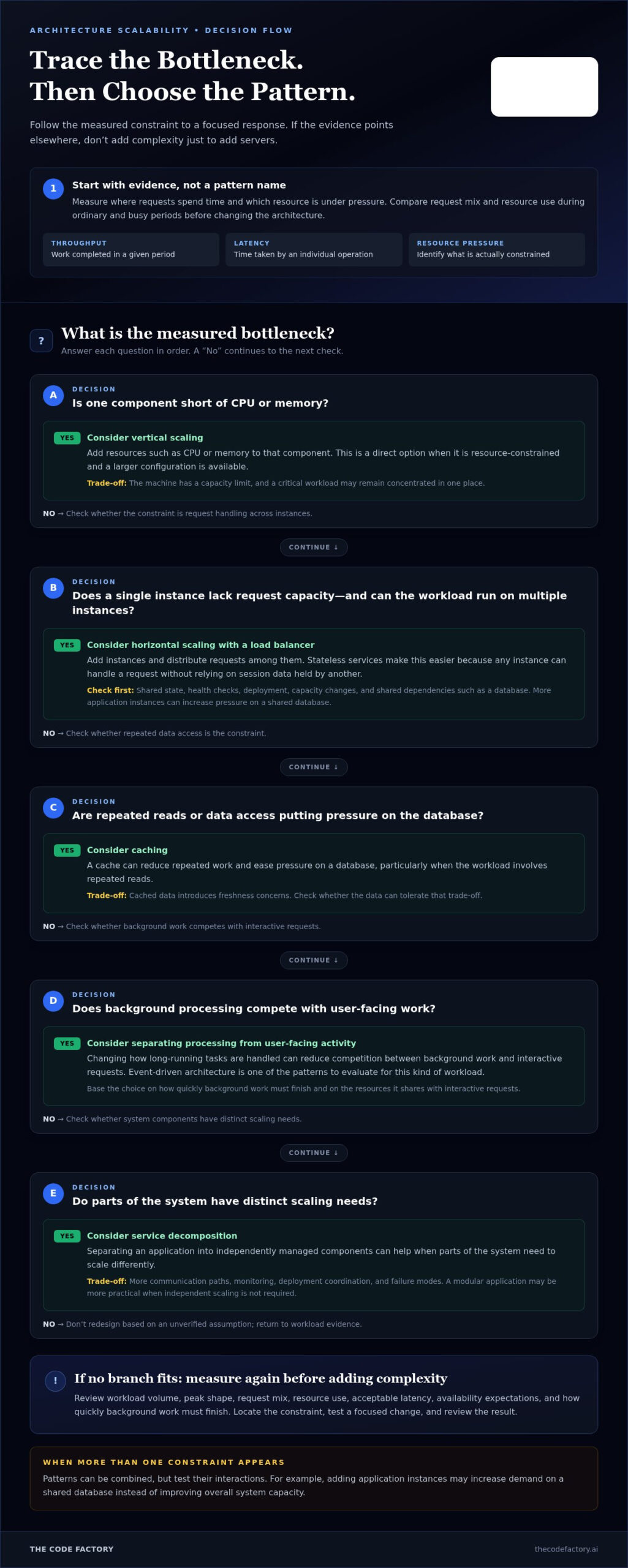
A measurement-led process for selecting and introducing scalability patterns
Architecture changes should follow evidence, not forecasts about where a system might fail. Use this sequence to connect a proposed pattern to a specific workload constraint and a result you can verify.
- Define targets. Set service-level expectations for latency, throughput, availability, and error rates based on what the service needs to deliver.
- Observe load. Capture normal and peak workload shape, including request mix, data volume, and background tasks.
- Locate the bottleneck. Use evidence to determine whether the limit is application compute, database access, network calls, or another dependency.
- Choose a focused change. Select the pattern that addresses the measured constraint, and document its expected trade-offs.
- Test the change. Validate behavior under representative demand and relevant failure conditions before relying on it in production.
- Review and adjust. Compare results with the baseline, then reassess operational effort and whether the original constraint remains.
A scalability change needs an observable success criterion so the team can tell whether it solved the intended problem or merely moved it.
Establish a baseline before changing architecture
Measure latency, throughput, error rate, and resource use at the boundary of the service you plan to change. Record workload shape as well: steady or bursty traffic, read/write mix, and background demand. Metrics show trends, traces connect delays across components, and logs provide event detail. For example, if response times rise while application CPU remains low, traces and database metrics can help determine whether requests are waiting on data access or another dependency. Set thresholds from service requirements, not universal rules.
Test the change and reassess its operational cost
Before implementation, write down the hypothesis, expected effect, and rollback approach. If a queue is intended to protect interactive requests from bursty background tasks, for example, track both request latency and queue depth. Test ordinary and peak demand, plus relevant failures such as an unavailable dependency. Then review whether deployment, monitoring, debugging, and team support remain manageable.
Keep the scope controlled. Change one major variable at a time where practical, compare results against the baseline, and check for side effects in dependent components. A change that improves one metric while degrading consistency or recovery behavior may not meet the service’s broader needs. A production readiness review can help assess those connected risks alongside performance.
For help evaluating constraints and prioritizing a measured architecture change, work with The Code Factory on scalability consulting.
Bring scalability patterns into an architecture built for production
A scalability pattern doesn’t operate in isolation. Adding application instances depends on cloud configuration, while a new data path can affect security controls, deployment processes, and production monitoring. A design that handles more demand in testing may still create operational risk if teams can’t deploy it safely, trace failures, or manage its dependencies.
Production readiness means assessing these connections before a pattern becomes a critical part of the system. Consider whether capacity changes are configured correctly, access controls cover new components, CI/CD supports reliable releases, and monitoring can show whether the intended improvement is happening. Architecture decisions should account for how the system is built, secured, deployed, and supported.
When an architecture review can clarify the next engineering step
Recurring bottlenecks, difficult releases, and growing operational complexity are signals to reassess the architecture. They don’t automatically justify a broad redesign. A focused review can connect workload evidence and production constraints to specific priorities, such as optimising a constrained code path, adjusting infrastructure, or addressing a dependency that limits capacity.
The distinction matters. Targeted remediation aims to resolve a known constraint; redesign changes broader system boundaries and brings wider migration and operational demands. Reviewing the evidence first helps teams choose a proportionate response rather than treating every scaling issue as a reason to replace the architecture.
Turn pattern selection into a maintainable production decision
Document the workload evidence, assumptions, chosen pattern, expected outcomes, and trade-offs. Record what the team will monitor and what would prompt a rollback or another review. This decision record makes it easier to evaluate results later and helps prevent a temporary workaround from becoming unexplained architecture.
Carry the decision through to implementation. Cloud configuration must support the intended capacity and behavior; security controls should account for changed data flows and components; CI/CD should make deployments repeatable and observable. A production readiness review can help expose gaps between the architecture on paper and the system teams can operate.
For a broader perspective on the engineering considerations behind software architecture consulting, explore the related guidance. If your system has complex scaling constraints, explore architecture and scalability consulting to assess priorities and plan a measured path forward.
Make Your Next Scalability Decision With Confidence
The right architecture scalability patterns address a measured constraint, not an assumed future problem. Match the approach to your workload, weigh benefits against consistency and operational demands, then validate the change against clear success criteria.
That discipline also extends beyond application design. Cloud configuration and production readiness affect whether a scaling approach can be deployed, secured, monitored, and maintained reliably. The Code Factory provides architecture and scalability consulting, alongside cloud infrastructure configuration and production readiness reviews, to help teams assess constraints and prioritize practical improvements.
If your system’s bottlenecks or trade-offs are difficult to untangle, explore architecture and scalability consulting. The Code Factory can help assess your constraints and prioritize a measured path forward. Start with the evidence, then make the next architecture decision with confidence.
Frequently Asked Questions
What are architecture scalability patterns?
Architecture scalability patterns are repeatable design approaches for handling growth in workload, data, or system demand. Examples include adding service instances, caching frequently accessed information, processing tasks asynchronously, and partitioning data. Each approach targets different constraints and brings trade-offs, such as added coordination or data freshness concerns. A pattern doesn’t guarantee better performance; connect it to an observed bottleneck, workload requirements, and the team’s ability to operate the resulting system.
What is the difference between horizontal and vertical scaling?
Vertical scaling adds resources, such as CPU or memory, to one system or component. Horizontal scaling adds instances or distributes work across multiple resources. Scaling up can be simpler to operate, but a single component has practical capacity limits. Scaling out can expand capacity, but requires attention to shared state, coordination, and failure handling. Choose based on the workload, platform constraints, and measured performance rather than assuming one approach is always superior.
When should a system use caching to scale?
Use caching when repeated reads or expensive computations create a measurable bottleneck and the results can be reused safely. For example, a service might cache frequently requested data rather than perform the same database lookup for every request. Define how cached information stays fresh, how updates invalidate it, and how the application behaves if the cache is unavailable. Then test under representative demand to confirm caching addresses the original constraint.
Are microservices necessary for scalability?
No. Systems can scale without microservices, and splitting an application into separate services doesn’t automatically improve performance. Decomposition may help when components have distinct scaling or deployment needs and clear boundaries. However, it adds network communication, coordination, monitoring, and failure-handling work. Before choosing this approach, assess the current bottleneck, workload, and team’s ability to operate distributed components. A well-structured application can remain a suitable choice when independent scaling isn’t needed.
How do queues improve scalability?
Queues help manage bursts by separating request handling from background tasks that can run later. For instance, an application can accept a request and place report generation in a queue for workers to process asynchronously. This may keep interactive work responsive, but introduces decisions about retries, ordering, duplicate processing, and delivery behavior. Define how failures are handled, then monitor queue depth and processing capacity under representative workloads to detect growing backlogs.
What is the difference between scalability and availability?
Scalability is a system’s ability to handle changes in workload or demand; availability is whether users can access it when needed. A system can have spare capacity yet still become unavailable during a failure. Conversely, redundant components may support availability without fixing a performance bottleneck. Some design decisions affect both, but they’re separate goals. Define and measure capacity, response behavior, and availability independently so improvements in one aren’t mistaken for progress in another.
How do you choose the right scalability pattern?
Start by defining workload and service requirements, then use metrics and traces to identify the component limiting the system. Compare candidate patterns by their expected effect, consistency requirements, failure modes, and operational burden. Test the change with representative demand and a clear success criterion, and review whether it creates new constraints. If the bottleneck isn’t measurable yet, improve observability first. The Code Factory provides architecture and scalability consulting to help assess constraints and prioritize changes.
