

What if an AWS Well-Architected Framework review surfaced dozens of risks but left your team unsure what to fix first? The review is valuable only when its findings reflect how a workload actually operates and translate into clear, owned engineering priorities.
That concern is reasonable. Teams must balance security, reliability, performance, and cost without turning an assessment into a checklist disconnected from delivery. A useful review examines workload decisions against the framework’s six pillars: Operational Excellence, Security, Reliability, Performance Efficiency, Cost Optimization, and Sustainability.
This 2026 guide explains what reviewers assess, how to apply framework questions to a real AWS workload, and how to move from observations to scoped improvements. You’ll learn how to weigh risks against business needs, prioritize work that strengthens production readiness and maintainability, and decide when independent engineering support can help. We’ll also cover how to turn architecture, infrastructure, security, and operational findings into practical remediation work rather than recommendations that sit untouched in a report.
Key Takeaways
- An AWS Well-Architected Framework review assesses a defined workload, so set its boundaries and goals before evaluating design decisions.
- Use the six pillars as connected perspectives on the workload, not as separate teams or a maturity ladder.
- Structure the assessment with the AWS Well-Architected Tool, then validate findings against workload evidence and operational context.
- Turn observations into engineering priorities by comparing impact, severity, effort, dependencies, and accountable ownership.
- Major redesigns, scaling pressure, recurring incidents, or unclear ownership can signal the value of independent review and remediation support.
What an AWS Well-Architected Framework review assesses
Framework: AWS’s architectural best-practice guidance. Review: a structured assessment of a defined AWS workload against that guidance, used to identify risks and improvement opportunities. Remediation: the engineering work that changes the workload in response to selected findings.
An AWS Well-Architected Framework review does not automatically evaluate every account, application, or team in an organization. Its focus is a workload: a set of components that work together to deliver a business outcome. The review helps teams examine design decisions, uncover potential risks, and plan improvements. It is not a certification, a guarantee of quality, or a substitute for implementing and validating changes.
How a workload review differs from an AWS account audit
An account-wide inventory identifies which resources exist. Operational monitoring shows how systems behave over time. A workload review asks whether the architecture and operating practices behind a particular outcome are appropriate for its requirements. These activities can inform one another, but they answer different questions.
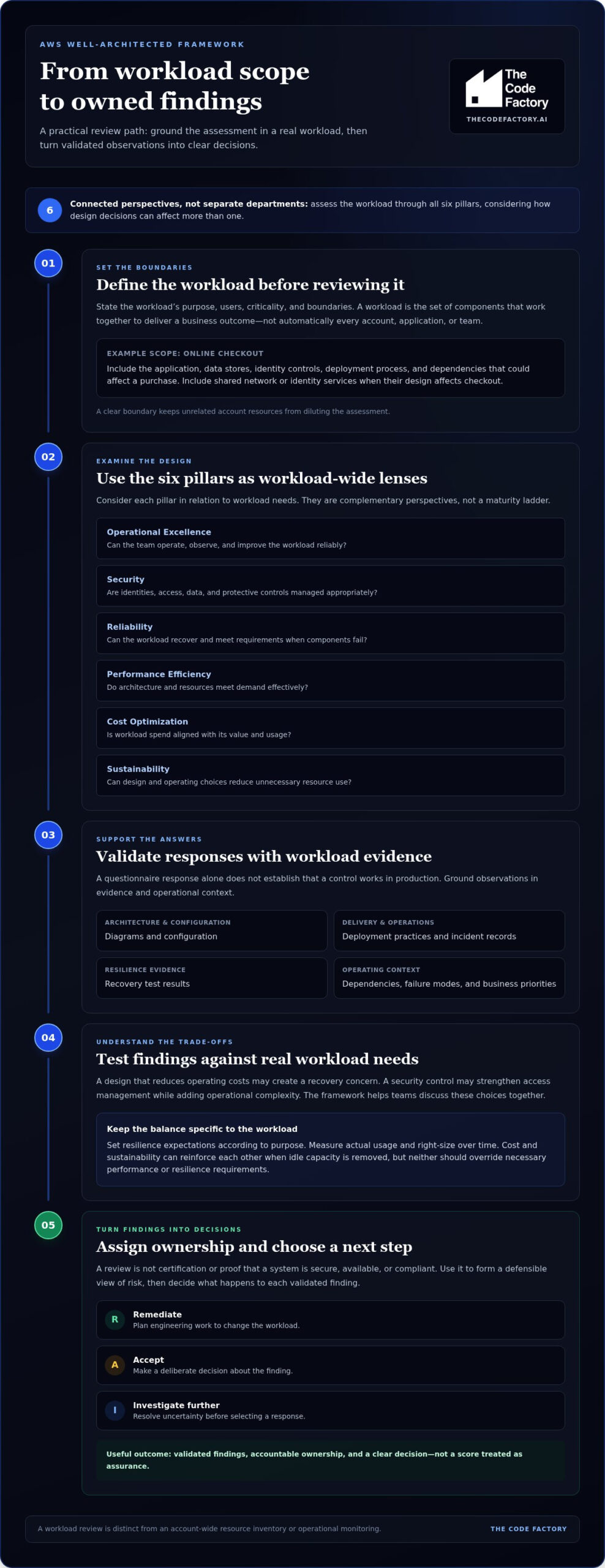
Before starting, define the workload’s purpose, users, criticality, and boundaries. For an online checkout service, the scope might include the application, its data stores, identity controls, deployment process, and dependencies that could affect a purchase. A shared network or central identity service may also be in scope if its design affects checkout. Clear boundaries prevent unrelated account resources from diluting the assessment.
What a review can and cannot tell a team
Review answers can expose risks, trade-offs, and areas to investigate. A design may reduce operating costs but create a recovery concern. A security control may strengthen access management while adding operational complexity. The framework gives teams a consistent way to discuss these decisions in relation to workload needs.
A review cannot prove that a system is secure, available, or compliant. A questionnaire response alone does not establish that a control works in production. Support answers with evidence such as architecture diagrams, configuration, deployment practices, incident records, or recovery test results. Engineering context matters too: assess recommendations against actual dependencies, failure modes, business priorities, and implementation constraints.
The result should be a defensible view of where risk exists and which decisions deserve attention, not a score treated as assurance. Findings become useful when teams validate them, assign ownership, and decide whether to remediate, accept, or investigate further. This keeps the assessment grounded in the workload rather than turning it into a paper exercise.
The six AWS Well-Architected pillars and the questions behind them
The six pillars, Operational Excellence, Security, Reliability, Performance Efficiency, Cost Optimization, and Sustainability, offer complementary perspectives for evaluating how a workload meets business and technical needs. They are not isolated departments or sequential maturity levels. A decision about one part of a system can affect several pillars, so an AWS Well-Architected Framework review should consider the trade-offs together. The official documentation from Amazon Web Services outlines this comprehensive six-pillar model.
- Operational Excellence: Can the team operate, observe, and improve the workload reliably?
- Security: Are identities, access, data, and protective controls managed appropriately?
- Reliability: Can the workload recover and continue to meet its requirements when components fail?
- Performance Efficiency: Do the architecture and resources meet demand effectively?
- Cost Optimization: Is the workload’s spend aligned with its value and usage?
- Sustainability: Can design and operating choices reduce unnecessary resource use?
How security, reliability, and operational excellence shape workload risk
These pillars connect security controls with the workload’s ability to withstand disruption and be operated consistently. Review identity and access boundaries, data protection, incident readiness, and the practices used to deploy and maintain changes. Set resilience expectations according to the workload’s purpose: a customer-facing transaction path may need different recovery capabilities from an internal reporting tool. Clear ownership, useful observability, and repeatable operations help teams detect issues and respond without relying on undocumented knowledge.
How performance, cost, and sustainability affect design choices
Performance requirements influence service selection, configuration, and capacity decisions. A system designed for rapid response during peak demand may use more resources than a workload with flexible processing windows. Measure actual usage and right-size over time rather than treating tuning as a one-time task. Cost and sustainability considerations can reinforce each other when teams remove idle capacity, but neither should override necessary performance or resilience requirements. The right balance depends on workload needs and constraints.
The pillars frame these choices, but they do not dictate one universal architecture. If an assessment reveals connected gaps in design, infrastructure, or production readiness, architecture and scalability consulting from The Code Factory can help translate them into scoped engineering improvements.
AWS Well-Architected Review: From Scope to Findings
A structured process keeps an AWS Well-Architected Framework review grounded in the workload’s actual design. The AWS Well-Architected Tool can help teams organize workload reviews and record responses. The tool is available at no additional charge, although AWS resources continue to incur their usual costs. A reference to the tool’s review capabilities is available from vertexaisearch.cloud.google.com.
Prepare a workload and evidence set before answering questions
Start by documenting the workload’s business purpose, boundaries, critical dependencies, and operational owners. Gather architecture diagrams, deployment practices, monitoring signals, and relevant incident or recovery-test context. Record constraints and design choices too. For example, a dependency on a shared data service or a deliberate limit on automated changes can affect how reviewers interpret a design decision.
Useful evidence shows how the workload is built and behaves, not just how the team expects it to behave. Include configuration or operational records that substantiate responses. If a document is outdated or an owner cannot verify a practice, record that uncertainty rather than treating an assumption as fact.
Use review questions to identify and validate risks
Work through the questions with engineering, operations, security, and product stakeholders. Each group sees different failure modes and constraints. The AWS Well-Architected Tool provides a structure for recording responses, but completing the questionnaire does not validate the architecture. Compare answers with implementation evidence and observed system behavior.
Move through the assessment in a deliberate sequence:
- 1. Select the workload: Set clear boundaries around the system being reviewed.
- 2. Define goals: Identify business outcomes, criticality, and review priorities.
- 3. Gather evidence: Assemble diagrams, operational records, and stakeholder context.
- 4. Assess: Work through relevant questions and document responses.
- 5. Validate: Check responses against configurations, operating practices, and system behavior.
- 6. Record actions: Capture findings, evidence, affected components, potential impact, and follow-up ownership.
Separate confirmed gaps from unknowns that need investigation. A finding should explain what evidence supports it, which components are affected, and why the issue matters to the workload. This makes prioritization more reliable and gives engineering teams a clear starting point for remediation. The Code Factory provides production readiness reviews and code remediation to help translate validated findings into practical architecture, infrastructure, or software improvements.
How to prioritize AWS Well-Architected findings without creating a paper exercise
An AWS Well-Architected Framework review creates value only when findings lead to decisions and follow-through. A long list of observations is not a plan. Teams need to decide which risks require immediate action, which improvements belong on the engineering roadmap, and which trade-offs they will consciously accept.
Rank findings by impact, exposure, and engineering dependency
Start with the workload’s business purpose and criticality, then consider the potential impact and exposure of each finding. A weakness affecting a customer-facing transaction path may deserve earlier attention than a similar issue in a low-impact internal tool. Sequence work around dependencies too: tightening access controls may need to precede a migration, while better monitoring may be necessary to validate a later reliability change.
There is no universal priority score that fits every workload. Record why a finding ranks where it does, including the evidence, business consequence, and relevant constraints. Use a comparison like this to support a reasoned decision:
| Factor | What to assess |
|---|---|
| Severity | How material is the identified weakness or failure mode? |
| Workload impact | Which users, business functions, or recovery needs could be affected? |
| Effort | What engineering changes, testing, or coordination are required? |
| Dependencies | Must another change or decision happen first? |
| Accountable owner | Who is responsible for making or tracking the next decision? |
Separate urgent risk reduction from longer-term architecture work. A team might first restrict an exposed access path, then schedule a broader identity redesign. Other findings may be monitored while evidence is gathered, deferred until a dependency is resolved, or recorded as accepted trade-offs with a rationale and review point.
Turn improvement actions into measurable engineering work
Translate each selected finding into a scoped action with an owner, target milestone, and evidence of completion. “Improve resilience” is too broad. “Test recovery for the workload’s critical data store and document the outcome” gives the team a verifiable result. Keep implementation tasks distinct from decisions to monitor, defer, or accept risk, and revisit those decisions when workload needs change.
Architecture findings that require broader design decisions can be addressed through software architecture consulting. The Code Factory provides architecture and scalability consulting, along with code remediation, to help teams turn review findings into owned engineering work.
When an independent AWS Well-Architected review needs engineering follow-through
An internal review can be effective when workload owners have the expertise, evidence, and capacity to assess findings and act on them. Independent engineering support can help when a major redesign is underway, scaling pressure is exposing architectural limits, incidents keep recurring, or no one clearly owns remediation. A fresh perspective can challenge assumptions while taking account of the workload’s purpose, dependencies, and delivery constraints.
The value is not simply a second set of answers. It is a clearer connection between risks and engineering decisions. Findings may call for architecture and scalability changes, cloud configuration adjustments, security hardening, or broader production-readiness work. The right response depends on what the evidence shows and what the workload must deliver.
What to expect from an engineering-led review
A useful engagement starts with collaborative discovery: clarify workload goals, understand the existing design, and gather evidence from the people who build and operate it. The assessment should produce workload-specific findings and recommendations, not generic prescriptions. Remediation can then be scoped around risk, technical dependencies, and delivery constraints, helping teams distinguish urgent corrective work from changes that need further design or planning.
If the review raises broader launch-readiness questions, a production readiness review can help assess concerns beyond architecture, including operational preparedness and maintainability.
Choose a next step based on the review’s purpose
Keep the assessment internal when owners can validate design decisions, access reliable evidence, and follow findings through to completion. Bring in independent engineering support when complex dependencies are hard to assess, teams disagree on risk, or implementation bottlenecks keep high-priority improvements from moving forward.
An AWS Well-Architected Framework review should lead to a decision the team can explain and an action someone can own. The Code Factory supports assessment and engineering follow-through across architecture, infrastructure, security, and production readiness. Discuss an AWS architecture review to identify a practical path from workload findings to engineering work.
Turn review findings into a stronger AWS workload
An AWS Well-Architected Framework review is most useful when it moves beyond questionnaire answers to evidence-backed findings and owned engineering work. The six pillars help teams examine connected trade-offs across operations, security, reliability, performance, cost, and sustainability, while a clearly defined workload scope keeps the assessment relevant to business needs.
Prioritize findings by their impact, exposure, dependencies, and delivery effort. Then assign owners, define milestones, and record how each improvement will be validated. Some actions will reduce immediate risk; others may require broader architecture changes or a deliberate, documented trade-off.
The Code Factory supports this work through production readiness reviews and code remediation, architecture and scalability consulting, cloud infrastructure configuration, and security hardening. If your team needs to assess a workload or turn complex findings into practical improvements, discuss an AWS architecture review with our engineering team.
With clear priorities and accountable follow-through, your review can become a practical step toward a more reliable, secure, and maintainable workload.
Frequently Asked Questions
What is an AWS Well-Architected Framework review?
An AWS Well-Architected Framework review is a structured assessment of a defined AWS workload against architectural best practices. It helps a team identify design risks, examine trade-offs, and plan improvements in the context of the workload’s purpose and requirements. The review does not automatically cover every account or system in an organization. Its findings are starting points for decisions and engineering work, not a certification or guarantee of workload quality.
What are the six pillars of the AWS Well-Architected Framework?
The six pillars are Operational Excellence, Security, Reliability, Performance Efficiency, Cost Optimization, and Sustainability. Together, they help teams consider how a workload is operated, protected, recovered, scaled, funded, and designed to use resources responsibly. The pillars are complementary perspectives, not separate organizational departments or steps in a maturity sequence. A decision such as increasing redundancy may affect reliability, cost, and operational complexity at the same time.
How do you conduct an AWS Well-Architected review?
Define the workload and its goals, identify owners and dependencies, then gather evidence such as architecture diagrams, deployment practices, and operational records. Work through relevant framework questions with engineering, operations, security, and product stakeholders. Validate answers against actual configuration and system behavior, distinguishing confirmed risks from unknowns. Record each finding with its evidence, potential impact, affected components, and next action. The AWS Well-Architected Tool can help structure and document the review.
Is an AWS Well-Architected review a certification or compliance audit?
No. An AWS Well-Architected review is an assessment against architectural best practices, not a certification or formal compliance audit. It can help surface design concerns and inform improvement planning, but it does not certify that a workload meets a standard or guarantee security, availability, or compliance. Treat findings as evidence to investigate and validate, and use the appropriate audit or assurance process when formal confirmation against specific requirements is needed.
What is the difference between the AWS Well-Architected Tool and an expert review?
The AWS Well-Architected Tool provides a structured way to record workload details, answer questions, and track findings. An expert review adds interpretation: an experienced engineer can challenge assumptions, examine evidence, account for dependencies, and relate recommendations to business constraints. The tool can support an assessment, but it does not replace engineering judgment or implementation. Teams may use it internally or alongside external support when findings are complex or remediation is difficult to prioritize.
How long does an AWS Well-Architected review take?
There is no fixed duration for an AWS Well-Architected review. Timing depends on workload scope, architectural complexity, stakeholder availability, and how readily teams can access reliable evidence. A clearly bounded workload with current diagrams and responsive owners is generally easier to assess than one with undocumented dependencies or unresolved questions. Allow time not only to answer review questions, but also to validate findings, agree on priorities, and record accountable next steps.
What should a team do after an AWS Well-Architected review?
Validate findings, then prioritize them according to workload impact, risk, dependencies, and engineering effort. Turn selected improvements into scoped actions with an accountable owner, target milestone, and evidence that will demonstrate completion. Some findings may call for immediate risk reduction; others may be scheduled for later, monitored, or recorded as accepted trade-offs with a rationale. Revisit priorities as workload requirements change, and use engineering support to address implementation bottlenecks that stall important work.
