

What if cloud changes intended to improve scalability make reliability, security, and costs harder to control? That tension often appears as systems grow. Each architecture decision can affect performance, operating complexity, and the team’s ability to respond when something goes wrong. Effective cloud architecture consulting services connect those decisions to production constraints, not just an idealized diagram.
The challenge isn’t simply choosing cloud services. It’s understanding the tradeoffs, identifying which risks matter most, and improving the environment without adding unnecessary complexity or disrupting delivery. Recommendations create value when teams can put them into practice and verify the results.
This guide explains how cloud architecture consulting can align systems with security, scalability, resilience, and operational needs. You’ll learn which decisions have the greatest impact, how to compare options, and how to move from assessment to controlled implementation. At The Code Factory, architecture and scalability consulting connects with cloud infrastructure configuration, security hardening, code remediation, and CI/CD improvements to turn design priorities into production-ready engineering.
Key Takeaways
- Trace how workload design, data flows, and service boundaries affect behavior under load and shape resilience.
- Assess security architecture through identity controls, network boundaries, encryption, and least privilege.
- Compare managed services and self-managed components across reliability, security, scalability, complexity, and operational ownership.
- Effective cloud architecture consulting services turn discovery and risk assessment into documented decisions, validation, and prioritized implementation.
- Connect architecture priorities to practical changes in cloud configuration, security hardening, and production readiness.
What Cloud Architecture Consulting Services Solve in Production
Cloud architecture consulting is expert guidance for designing, assessing, and improving cloud-based systems so they meet defined business and operational requirements. Unlike cloud account administration, which focuses on access and routine account settings, architecture consulting examines how workloads, data, infrastructure, and operating practices fit together. An overview of cloud computing architecture can help establish the core components, but production decisions must account for the specific system’s needs and constraints.
The goal isn’t to adopt a particular cloud pattern for its own sake. It’s to make deliberate choices about availability, delivery speed, security, and growth. A system can be running successfully today and still depend on a capacity bottleneck, fragile deployment steps, or knowledge held by one team member. As demand or business requirements change, these weaknesses can lead to interruptions, slower releases, or more difficult operations. Cloud architecture consulting services help uncover those risks and connect recommended changes to business priorities.
When does a cloud environment need an architecture review?
Look for recurring incidents, releases that are difficult to coordinate, services nearing capacity, or unclear ownership when something fails. These are signs that the system may be outgrowing its design or operating model. An acquisition, modernization effort, or significant workload increase can also change assumptions about data flows, integration, security, and responsibility.
Match the scope of the review to the evidence. A targeted review can investigate a constrained workload, a deployment bottleneck, or a specific reliability concern. A broader redesign may make sense when multiple parts of the system depend on the same fragile patterns or no longer support the organization’s direction. Start with the constraint, not a predetermined rebuild.
Which business outcomes should architecture work support?
Architecture decisions should translate business requirements into engineering priorities. Availability and recovery expectations shape how a system handles component failure and how quickly operations can resume, supporting customer access and business continuity. Clear ownership and documented dependencies help teams identify what to investigate when service is disrupted.
Maintainable services and dependable deployment practices also affect how safely an engineering team can deliver change. If releases require fragile manual steps, or a small change creates risk across unrelated components, the architecture may be limiting delivery capacity. The response could involve refining service boundaries, improving infrastructure configuration, or strengthening deployment pipelines. Success is not architectural complexity. It’s whether the system meets its requirements and remains operable as those requirements evolve.
The Cloud Architecture Decisions That Shape Security, Scale, and Resilience
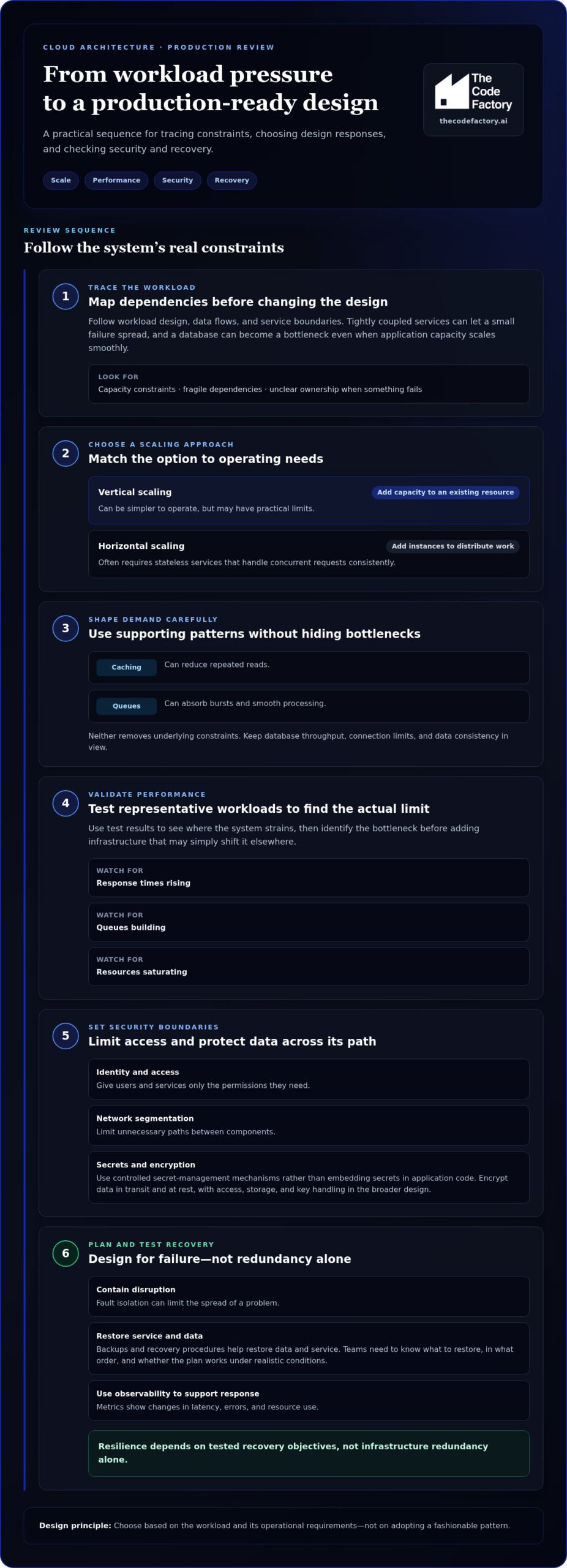
Architecture decisions determine how a system behaves when demand rises, a dependency slows, or a component fails. Workload design, data flows, and service boundaries all matter. Tightly coupled services can allow a small failure to spread, while a database can become a bottleneck even when application capacity scales smoothly. The right design depends on the workload and its operational requirements, not on adopting a fashionable pattern.
How should architecture account for growth and performance?
Vertical scaling adds capacity to an existing resource. It can be simpler to operate, but may have practical limits. Horizontal scaling adds instances to distribute work, but often requires services to be stateless and handle concurrent requests consistently. Caching can reduce repeated reads, while queues can absorb bursts and smooth processing. Neither removes underlying constraints: database throughput, connection limits, and data consistency still need attention.
Performance testing helps validate these assumptions before a capacity issue becomes urgent. Test representative workloads and examine where response times rise, queues build, or resources saturate. Use those findings to identify the actual bottleneck before adding infrastructure that may simply shift it elsewhere.
How do cloud security and reliability fit into the design?
Security starts with controlled access. Identity and access management should give users and services only the permissions they need. Network segmentation should limit unnecessary paths between components, and secrets should be managed through controlled mechanisms rather than embedded in application code. Encryption protects data in transit and at rest, but works best as part of a broader design that accounts for access, storage, and key handling.
Reliability requires planning for component failure and dependency disruption. Fault isolation limits the spread of a problem, while backups and recovery procedures help restore data and service. Redundancy can support continuity, but only when teams understand and test the recovery process.
Resilience depends on tested recovery objectives, not infrastructure redundancy alone. Teams need to know what they are trying to restore, in what order, and whether the plan works under realistic conditions. Observability supports that work: metrics show changes in latency, errors, and resource use; logs provide event detail; and traces help follow requests across service boundaries. Together, these signals help teams detect degradation and investigate incidents with less guesswork.
Turning these decisions into practical improvements may involve architecture and scalability consulting alongside cloud configuration and security hardening. Explore cloud architecture and scalability consulting to connect design priorities with production needs.
How to Compare Cloud Architecture Options Without Guesswork
Architecture choices are easier to assess when the team compares them against the same requirements. A managed database may reduce maintenance work, while a self-managed component may offer more control but require more operational expertise. Neither is automatically better. Cloud architecture consulting services should make these tradeoffs explicit, including who owns each responsibility after implementation.
| Decision area | Questions to compare |
|---|---|
| Reliability and recovery | What failures can the design tolerate, and how will the service and data be restored? |
| Security | How are identities, network access, encryption, and configuration controlled across components? |
| Scalability | Can the design handle expected workload patterns, or will a shared dependency become a bottleneck? |
| Complexity | How many components, integrations, and failure points must the team understand? |
| Operational ownership | Who patches, monitors, backs up, troubleshoots, and changes each component? |
Which architecture tradeoffs deserve explicit review?
Data flows expose important tradeoffs. Strong consistency may be necessary when a transaction must immediately reflect an update, while other workloads may tolerate delayed synchronization in exchange for improved responsiveness or availability. Document the requirement before selecting a pattern, then validate it with representative tests.
Independently deployable services can help teams release changes separately, but they also introduce more network calls, integration points, and distributed troubleshooting. A monolith may be simpler to operate for a cohesive workload; modular boundaries can improve maintainability without requiring a distributed system. Security controls and ownership also shift as components multiply, so record who manages access, secrets, updates, and incident response for each option.
How should teams assess cloud platforms and services?
Compare capabilities against workload needs, governance requirements, integration constraints, and the team’s ability to operate the result. AWS, Microsoft Azure, and Google Cloud are examples of platforms with different service portfolios; popularity or a long feature list alone doesn’t establish fit. Portability matters too, but designing for it can add abstraction and maintenance work. Decide whether that tradeoff addresses a real requirement.
Separate confirmed requirements from assumptions in an architecture decision record. For each assumption, note what evidence would confirm or challenge it, such as a load test, recovery exercise, security review, or integration prototype. This keeps choices open to revision as evidence changes, rather than allowing an undocumented guess to harden into infrastructure.
What a Cloud Architecture Consulting Engagement Should Deliver
An architecture review that ends with diagrams alone leaves the hardest work unresolved: deciding what to change, in what order, and how to prove the changes work. Effective cloud architecture consulting services connect assessment to engineering action, with operational constraints and business priorities guiding each recommendation.
A useful architecture deliverable is an actionable, prioritized engineering plan that links each change to a risk, an owner, and a way to validate the result. The plan should make its reasoning visible. It should document assumptions, system dependencies, risks, and the rationale behind key decisions so internal teams can implement and maintain the design.
How does assessment become a prioritized architecture plan?
Start with the operating reality, not a preferred target architecture. Review system boundaries, deployment workflows, infrastructure configuration, and available operational evidence, such as incident records and performance signals. Then follow a clear sequence:
- Discover constraints: clarify business requirements, technical limits, and team responsibilities.
- Assess the current state: identify dependencies, bottlenecks, and exposure to failure or security risk.
- Prioritize findings: weigh business impact, likelihood, engineering effort, and dependencies between changes.
- Design and validate: define the proposed approach and test critical assumptions before wider implementation.
- Implement and review: deliver changes in a controlled sequence and assess their effect in production.
This ranking separates immediate risk reduction from longer-term modernization. A configuration issue that creates material exposure may need prompt attention; replacing a core system may be a larger opportunity that depends on earlier work. Each recommendation should explain why it matters, what it relies on, and what evidence would show it has succeeded.
How can teams implement changes without unnecessary disruption?
Break the plan into changes that can be understood, assigned, and verified. For each one, identify an owner, dependencies, acceptance criteria, and rollback considerations. An infrastructure change might require a security control review; a deployment improvement may depend on a pipeline update or application remediation. Sequencing these steps reduces avoidable disruption and makes progress easier to track.
Validation should fit the system’s risk profile. Use appropriate tests before release, monitor relevant behavior during rollout, and define what would trigger a pause or rollback. For a high-impact change, a staged release can expose issues before the change reaches every workload. Less consequential adjustments may need a lighter process, but still require clear success criteria.
Architecture and implementation should remain connected throughout the engagement. The Code Factory brings architecture and scalability consulting together with cloud infrastructure configuration, security hardening, code remediation, and CI/CD deployment pipelines. Put cloud architecture priorities into practice with an approach grounded in production readiness.
How The Code Factory Connects Cloud Architecture to Production Readiness
Architecture decisions have limited value if they stop at recommendations. The Code Factory connects architecture and scalability consulting with enterprise engineering work, helping organizations relate design priorities to the infrastructure, security controls, and software delivery practices their teams operate. This implementation-focused approach keeps attention on production constraints: how workloads behave, how changes are deployed, and how systems can be maintained as requirements evolve.
For example, an assessment may identify infrastructure configuration that needs refinement or a security concern that calls for stronger controls. Those findings can guide cloud configuration and security hardening. Where code changes are needed, remediation and optimisation can address maintainability, while CI/CD pipeline deployment can support a more controlled path for delivering software. The work is tailored to each project’s priorities and operating needs, not to a fixed architecture pattern.
What makes an implementation-focused architecture approach practical?
A practical engagement connects each finding to an engineering action and the reason it matters. That could mean clarifying infrastructure settings, strengthening security controls, or identifying code and deployment changes that make the system easier to operate. Recommendations should account for team ownership, existing workflows, and production dependencies. The aim is to define relevant next steps, not impose unnecessary complexity.
What should decision-makers prepare before starting?
Useful context helps focus the discussion. Gather available architecture diagrams, deployment details, incident patterns, and known technical constraints. Also clarify which workloads are business-critical, what reliability expectations apply, which security obligations shape the design, and how the workloads may grow. Complete documentation isn’t a prerequisite; gaps can also surface useful questions for assessment.
With this context, architecture priorities can be considered alongside infrastructure configuration, security hardening, code remediation, and delivery improvements. The result is a grounded discussion about what needs attention, what depends on other work, and how proposed changes fit the organization’s operational capacity.
If your team is evaluating architecture changes or preparing for growth, discuss your cloud architecture needs with The Code Factory. A production-focused conversation can connect business requirements and engineering constraints to practical priorities.
Turn Cloud Architecture Priorities Into Production Progress
Strong cloud architecture is measured by how well systems meet real requirements, not by how complex the design looks. The right cloud architecture consulting services help clarify tradeoffs, prioritize risks, and shape improvements around security, scalability, resilience, and the team’s ability to operate what it builds.
Architecture guidance matters most when it connects to implementation. The Code Factory combines architecture and scalability consulting for enterprise-level performance with cloud infrastructure configuration and security hardening. Related engineering capabilities, including code remediation and CI/CD deployment pipelines, connect design priorities to maintainable systems and controlled software delivery.
If your cloud environment is becoming harder to scale, secure, or operate, take a focused next step: discuss your cloud architecture needs with The Code Factory. Clear priorities can help your team move forward with a practical path to production readiness.
Frequently Asked Questions
What do cloud architecture consulting services include?
Cloud architecture consulting services assess how an organization’s cloud systems are designed and operated, then identify practical improvements. The work may cover workload and service design, infrastructure configuration, scalability, security controls, resilience, and deployment practices. A useful engagement connects findings to business requirements and documents priorities, assumptions, dependencies, and validation steps. The Code Factory connects architecture priorities with security hardening, code remediation, and CI/CD deployment pipelines.
When should a company hire a cloud architecture consultant?
Consider an architecture review when recurring incidents, slow releases, capacity constraints, or unclear operational ownership suggest that the current design may no longer fit. Major workload growth, modernization, or an acquisition can also change system requirements and dependencies. A focused review can investigate a specific bottleneck or risk; broader redesign is more appropriate when structural issues affect multiple components. Begin with the business impact and evidence behind the concern.
How does cloud architecture consulting improve scalability?
It identifies where workload growth is likely to strain an application, such as a shared database, tightly coupled services, or deployment processes that make capacity changes difficult. Consultants can assess whether vertical scaling, horizontal scaling, caching, queues, or changes to service boundaries fit the workload and operating model. Performance testing helps validate assumptions before capacity decisions become urgent. The result is a reasoned plan, not a promise that every component will scale without limits.
What is the difference between cloud architecture consulting and cloud migration?
Cloud architecture consulting evaluates or shapes how cloud systems should be structured, secured, scaled, and operated. Cloud migration focuses on moving applications, data, or infrastructure from one environment to another. The work can overlap: architecture decisions may inform migration planning, while migration can reveal design changes needed in the destination environment. They are distinct objectives, so define whether the priority is improving the current architecture, relocating workloads, or coordinating both.
How long does a cloud architecture consulting engagement take?
The duration depends on the scope and complexity of the system, the availability of useful documentation and operational evidence, and whether the work includes implementation. A targeted review of one workload differs from an assessment across interconnected services followed by infrastructure or code changes. Before work begins, clarify the questions to answer, the systems in scope, and the expected deliverables. This helps establish a realistic plan without assuming a standard timeline.
Can cloud architecture consulting help improve cloud security?
Yes. An architecture review can examine identity and access, network boundaries, encryption, secrets handling, and how security responsibilities are applied across cloud resources and applications. Findings can inform prioritized changes rather than remain abstract recommendations. The Code Factory connects architecture and infrastructure work with security hardening, helping address design priorities through practical changes. Security improvements should reflect the organization’s systems, threat concerns, operational processes, and applicable obligations.
What should an architecture consulting deliverable include?
A useful deliverable should explain current-state findings, recommended decisions, and why each recommendation addresses a requirement or risk. It should document assumptions, dependencies, tradeoffs, and unresolved questions, then prioritize work by impact and implementation considerations. For each proposed change, include an owner or responsible team, validation criteria, and relevant rollout or rollback considerations. The goal is an actionable engineering plan that guides implementation and operational validation, not diagrams without next steps.
