


A faster pipeline can still produce a negative DevOps ROI. Calculating the ROI of devops means looking beyond deployment counts to the business value of faster delivery, more reliable services, and lower operational effort, then comparing those benefits with the full cost of achieving them.
That’s difficult when benefits are spread across engineering, operations, security, and product teams. A rise in deployment frequency doesn’t automatically mean more revenue, and fewer incidents don’t tell the whole story unless you measure their operational and business impact. Without a clear baseline and documented assumptions, even a promising ROI estimate can be hard to defend.
This framework shows how to build a transparent DevOps ROI case for 2026. You’ll learn how to set a before-and-after baseline, connect delivery and reliability measures to financial outcomes, and include tooling, infrastructure, implementation, and ongoing operating costs. It also explains how production readiness reviews and engineering optimization can help identify constraints worth addressing, so you can distinguish measurable improvements from activity that only looks like progress.
Key Takeaways
- Define the scope, timeframe, baseline, and assumptions before calculating the ROI of devops.
- Count the full investment, including implementation labor, migration, tooling, training, and ongoing maintenance.
- Classify returns as realized savings, avoided costs, capacity gains, or risk reduction to make the value easier to assess.
- Compare results before and after changes, while separating DevOps contributions from other organizational factors.
- Use measured delivery or reliability bottlenecks to select a bounded improvement, assign an owner, and set a review date.
What does DevOps ROI measure beyond faster deployments?
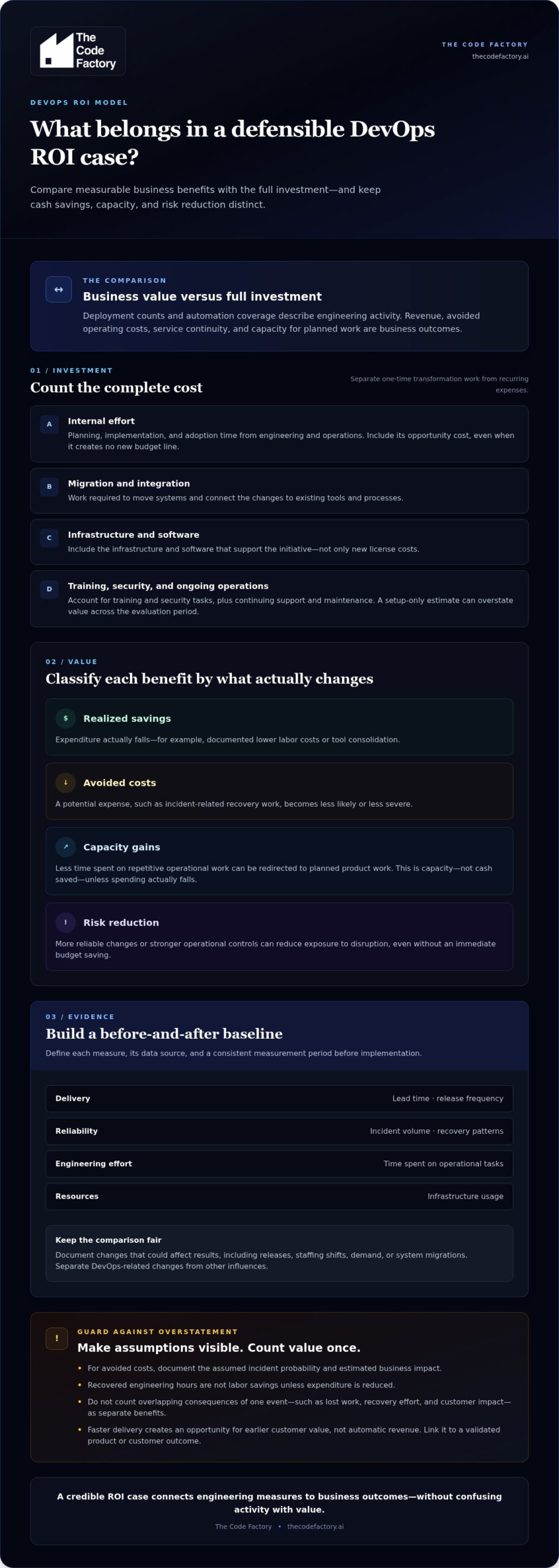
DevOps ROI compares measurable business benefits with the full investment required to achieve them. Deployment frequency, build duration, and automation coverage describe engineering activity. Revenue, avoided operating costs, service continuity, and capacity for planned work are business outcomes. Engineering measures can help explain those outcomes, but they don’t prove value by themselves.
A release that reaches production sooner may deliver customer value sooner, but only if it contains a validated improvement customers need. Faster deployment can also amplify defects if testing and release controls aren’t sound. A defensible assessment therefore considers delivery speed alongside reliability, customer impact, and the resources required to operate the resulting systems. For a foundation in DevOps principles and metrics, distinguish the practices that change engineering workflows from the outcomes leaders need to evaluate.
Which DevOps outcomes can create business value?
Shorter lead time can bring validated product changes to customers sooner, creating an opportunity for earlier feedback or revenue impact. That’s a potential benefit, not an automatic financial return. Connect the delivery change to a specific product or customer outcome before assigning it a monetary value.
Fewer failed changes and faster recovery can protect service continuity by limiting disruption. Automation may also free engineering time from repetitive deployment or incident work. Treat that as capacity gained, not cash saved, unless the organization actually reduces spending. The value may instead be that engineers can deliver planned product work.
Why does a DevOps ROI calculation need a baseline?
Without a record of existing conditions, a later improvement has no reliable point of comparison. Before implementation, capture delivery measures such as lead time and release frequency, incident volume and recovery patterns, engineering effort spent on operational tasks, and infrastructure usage. Define each measure and its data source so you can use them again when you assess the result.
Choose a consistent measurement period and document changes that could affect results, including releases, staffing shifts, demand, or system migrations. This context helps separate DevOps-related changes from other influences. If production constraints affect the measures, a production readiness review framework can help assess system readiness and clarify what belongs in the baseline. That discipline makes calculating the ROI of devops more credible than relying on a before-and-after deployment count alone.
Which costs and benefits belong in a DevOps ROI model?
A credible model accounts for the entire investment, not just new software licenses, and classifies benefits so operational improvements aren’t mistaken for cash savings. Separate one-time transformation work from recurring costs. Then distinguish realized savings from avoided costs, capacity gains, and risk reduction. This makes assumptions visible and helps prevent the same benefit from being counted twice.
How should teams account for DevOps investment?
Include the internal effort required to plan, implement, and adopt changes. Engineering and operations time has an opportunity cost, even when no new budget line appears. Add migration and integration work, infrastructure and software, training, security tasks, and ongoing support or maintenance.
Keep initial effort distinct from recurring expenses. For example, building a CI/CD pipeline may require concentrated implementation work, while maintaining it and paying for its supporting tools and infrastructure continue over time. A model that counts only setup can make an initiative appear more valuable than it is across the full evaluation period.
How can teams value delivery and reliability improvements?
Classify each benefit according to what actually changes:
- Realized savings: Expenditure falls, such as when a documented reduction in manual work leads to lower labor costs or tool consolidation.
- Avoided costs: A potential expense, such as incident-related recovery work, becomes less likely or less severe.
- Capacity gains: Engineers spend less time on repetitive operational tasks and can redirect that time to planned product work.
- Risk reduction: More reliable changes or stronger operational controls reduce exposure to disruption, even when no immediate saving appears in the budget.
Recovered engineering hours are capacity, not cash savings, unless they lead to an actual reduction in expenditure. If the team uses that time to deliver planned features, record it as a capacity or product-value outcome and state how you assess it. Don’t also count those same hours as labor savings.
An avoided-cost estimate should document both the assumed probability of an incident and its estimated business impact, because the resulting value depends on those assumptions. Use incident history and a clear impact method where available, and identify uncertainty rather than presenting a forecast as guaranteed savings. Apply the same discipline to downtime. Don’t count lost work, recovery effort, and customer impact as separate benefits if they represent overlapping consequences of one event.
To see which technical constraints drive these costs, an engineering assessment can help organize the evidence behind an improvement case. The Code Factory’s enterprise engineering work connects delivery and infrastructure changes to operational outcomes.
How do you calculate DevOps ROI step by step?
Start by fixing the boundaries of the calculation. Define which teams, systems, and DevOps changes are in scope, choose an evaluation period, and record the baseline before work begins. Then list attributable benefits and all investment costs within that same period. This prevents a short-term view of setup effort from being compared with benefits measured over a much longer horizon.
Use a consistent formula:
ROI (%) = (Net benefits ÷ Total investment) × 100
For this formula, calculate net benefits as the value of attributable benefits minus total investment. Use the same currency, timeframe, and accounting assumptions for every input. Calculating the ROI of devops is only as defensible as the evidence behind those figures.
What inputs should the calculation use?
Build the calculation in a sequence that can be reviewed and repeated:
- Set the baseline: Record delivery, reliability, engineering effort, and infrastructure consumption using defined measures and data sources.
- Set the scope and period: Specify the systems and changes included, and use a consistent evaluation window for costs and benefits.
- Estimate attributable benefits: Connect measured changes to financial value, and state the confidence level and assumptions behind each estimate.
- Include all investment: Count initial implementation costs and recurring expenses that fall within the chosen period.
Keep a record of assumptions that could change the result, such as adoption timing or whether released capacity produces measurable business value. Where delivery controls affect cost or risk, the CI/CD pipeline security protocol provides relevant context for evaluating pipeline safeguards.
How should teams interpret ROI and payback?
A positive ROI indicates that measured net benefits exceeded the investment within the selected scope and timeframe. A negative result means they didn’t. An uncertain result may signal weak attribution, developing adoption, or inputs that need better evidence. There’s no universal benchmark that makes a result worthwhile for every organization. Interpret it against the initiative’s objectives, constraints, and assumptions.
Use sensitivity scenarios when timing or benefit estimates are uncertain. Compare a conservative case with expected and stronger-adoption cases, changing assumptions transparently rather than presenting one forecast as certain. Assess payback separately: it estimates when cumulative benefits recover the initial investment, while ROI measures net return relative to investment over a defined period. An initiative can have a longer payback horizon yet still produce a positive ROI over its full evaluation window.
How can you prove DevOps ROI without overstating attribution?
A before-and-after comparison is useful only if you show what changed besides the DevOps work. Record the measurement window and note relevant releases, staffing changes, shifts in demand, and changes to architecture or product scope. These factors can influence delivery and reliability independently, so describe them rather than quietly crediting every improvement to one initiative.
Track leading indicators alongside lagging business outcomes. Pipeline duration may improve before customers experience faster delivery. Fewer failed changes may contribute to service continuity, but check that outcome against incident and customer-impact data. Engineering measures show whether workflows changed; business and service measures help establish whether those changes mattered.
Which metrics connect engineering performance to business outcomes?
Use consistent definitions for DORA measures such as deployment frequency, lead time for changes, and change failure rate. Track recovery time as an internal trend, defining exactly when the clock starts and stops. Pair these measures with relevant customer, service, and infrastructure indicators, such as delivery of validated product changes, disruption, or resource consumption. Don’t compare teams or periods until their measurement rules are aligned.
A compact measurement record keeps the comparison auditable. Set a baseline and target before implementation, assign an owner, and use the same period for each comparison. For example:
| Metric | Baseline | Target | Owner | Period | Caveat |
|---|---|---|---|---|---|
| Lead time for changes | Recorded starting value | Defined improvement | Named team or role | Consistent window | Release scope changed |
| Change failure rate | Recorded starting value | Defined reduction | Named team or role | Consistent window | Failure criteria documented |
| Service disruption | Recorded starting value | Defined reduction | Named team or role | Consistent window | Demand or architecture shifted |
How do you avoid misleading ROI claims?
Keep assumptions, data sources, exclusions, and uncertainty beside every reported result. Separate changes directly tied to the DevOps work from improvements that happened at the same time but may have other causes. A new release, changing workload, or expanded product scope can distort comparisons. Flag these factors and qualify conclusions where attribution is uncertain.
Architecture can also constrain delivery or reliability independently of pipeline changes. For a closer look at that relationship, see this software architecture consulting guidance. A disciplined evidence review makes calculating the ROI of devops more defensible without overstating causation. Assess your engineering constraints to identify which delivery and reliability measures deserve attention.
How can engineering leaders turn DevOps ROI findings into action?
An ROI model should guide the next engineering decision, not just justify the last one. Start with the bottleneck that has a demonstrated effect on delivery, reliability, or operating effort. A slow pipeline matters most when it delays valuable releases; recurring production failures matter when they disrupt service or consume capacity needed for planned work.
Rank candidate improvements against four factors: expected business impact, confidence in the evidence, implementation effort, and operational risk. Record dependencies too, including architectural constraints, security controls, and the team adoption needed to sustain the change. This makes trade-offs explicit instead of allowing an attractive estimate to outweigh delivery risk.
How should leaders turn the analysis into an investment decision?
Use a staged decision. Select a bounded improvement, name an accountable owner, define the outcome to measure, and set a review date before implementation begins. For example, a team might focus on one release bottleneck and assess whether the change improves a defined delivery measure without weakening reliability controls. Treat early estimates as hypotheses, not guaranteed returns.
At the review, compare actual operating results with the baseline and update the model. Include ongoing support and infrastructure impacts, check whether the expected benefit materialized, and revise assumptions when adoption, workload, or system conditions differ from the original case. If evidence remains incomplete, extend measurement or narrow the next investment rather than overstating certainty.
What is a practical next step for improving DevOps ROI?
Review existing delivery and reliability evidence first. Then select an intervention that addresses a measured constraint and tie it to an explicit outcome. A production readiness review can surface operational constraints; code remediation or cloud configuration can address identified engineering or infrastructure issues; CI/CD pipeline work can target delivery friction. Choose the intervention based on the evidence, not before it.
Keep the feedback loop active: measure the result, record unexpected costs, and decide whether to refine, expand, or stop the work. This is the practical value of calculating the ROI of devops: investment decisions become traceable to operating conditions and business priorities.
Explore The Code Factory’s engineering services to see how technical assessment and engineering work can address measured delivery and reliability constraints.
Turn DevOps measurement into focused engineering action
A defensible DevOps ROI case starts with a clear baseline, counts the full lifecycle investment, and connects engineering measures to business outcomes without overstating attribution. Faster delivery matters, but reliability, operating effort, and the value of capacity released for planned work belong in the assessment too.
Use the results to prioritize a measured constraint, define an owner and review date, then update the model as operating evidence emerges. That disciplined approach makes calculating the ROI of devops a continuing decision tool, not a one-time justification for investment.
Production readiness reviews and code remediation can help identify constraints, while architecture, cloud infrastructure, and CI/CD engineering can address delivery and operational needs. Explore The Code Factory’s engineering services to see how focused engineering work can support measurable improvement. Start with the evidence, choose the next step carefully, and build a stronger case with each review.
Frequently Asked Questions
How do you calculate the ROI of DevOps?
Calculate DevOps ROI by dividing net benefits by total investment, then multiplying by 100. Net benefits are the attributable financial value of improvements minus the investment over a defined period. Before entering figures, set the scope, timeframe, baseline, and assumptions. Include measurable savings and benefits such as reduced operating costs, while avoiding claims that treat faster delivery or released engineering capacity as cash returns without evidence.
What costs should be included when calculating DevOps ROI?
Include all costs needed to implement and sustain the changes: internal engineering and operations time, planning, migration, software and infrastructure, integrations, security work, training, and ongoing maintenance or support. Separate one-time implementation effort from recurring costs, but include both within the evaluation window. Counting licenses alone can understate the investment, especially when team adoption and pipeline upkeep require continuing effort.
Which metrics are used to measure DevOps ROI?
Use delivery and reliability indicators alongside business measures. Common DORA metrics include deployment frequency, lead time for changes, change failure rate, and recovery time. Pair them with relevant evidence such as customer impact, service disruption, infrastructure consumption, or engineering effort spent on operational work. These indicators help explain performance changes, but ROI requires connecting them to financial value or a clearly stated business outcome.
Can DevOps ROI include avoided downtime?
Yes. Avoided downtime can be included as a risk-reduction benefit if the estimate is transparent. Document the assumed likelihood of disruption and its business impact, using incident records and a consistent method where available. Distinguish estimated avoided costs from realized savings, since a prevented incident is a modeled benefit rather than a budget reduction. Avoid counting overlapping effects, such as recovery labor and lost work, twice.
How long does it take to see a return on DevOps investment?
There’s no fixed timeframe for seeing a return. It depends on implementation effort, adoption, the operational constraint being addressed, and how soon benefits can be measured. Define an evaluation period that captures both initial costs and recurring expenses, then track results at consistent intervals. Payback occurs when cumulative benefits recover the investment; ROI measures net benefits relative to investment across the chosen period.
What is the difference between DevOps ROI and DevOps productivity?
DevOps productivity describes how effectively engineering work gets done, while ROI evaluates whether the benefits justify the investment. Shorter lead time or fewer manual tasks may indicate improved productivity, but they don’t automatically translate into reduced expenditure or increased revenue. To support an ROI claim, show how the productivity gain affects a business outcome, such as lower operating costs or more capacity for planned product work.
How can you measure DevOps ROI when several changes happen at once?
Compare consistent pre- and post-change measures, and document other influences such as releases, staffing, demand, architecture, or product scope. Separate outcomes directly linked to DevOps work from improvements that occurred at the same time but may have other causes. Where practical, assess a bounded change with a clear owner and review period. State data sources, assumptions, exclusions, and uncertainty rather than assigning every improvement to one initiative.
