


The speed of modern development, particularly with the surge of AI-generated code, has created a dangerous illusion: that if a prototype works in staging, it’s ready for the enterprise. You likely recognize the underlying anxiety that accompanies this shift. It’s the fear that your infrastructure might collapse under real-world load or that a hidden prompt injection vulnerability could expose sensitive data. In a landscape where the OWASP LLM Top 10 2026 now dictates security priorities, simply “shipping fast” is no longer a viable strategy for maintaining structural integrity.
This article provides the rigorous production readiness review protocol you need to transform experimental software into a resilient enterprise asset. You’ll master a repeatable framework designed to reduce technical debt before it becomes a liability. We’ll explore how to move beyond basic checklists toward a model of continuous readiness, focusing on automated validation, risk-tiered intake processes, and the specific hardening required for AI-integrated systems. By the end, you’ll have the architectural confidence to deploy at scale without the constant threat of post-launch failure.
Key Takeaways
- Understand why a formal audit is the only way to move beyond experimental speed toward enterprise-grade reliability.
- Master the 2026 production readiness review protocol to secure your architecture against modern threats like prompt injection and the latest OWASP vulnerabilities.
- Address the inherent instability of AI-generated code by implementing specific hardening protocols and rigorous vulnerability scanning.
- Build a resilient foundation by assessing whether your current cloud infrastructure and CI/CD pipelines can handle sudden, massive shifts in enterprise load.
- Leverage specialized engineering audits to identify and resolve performance constraints before they manifest as costly system outages.
Beyond the Prototype: Defining the Production Readiness Review
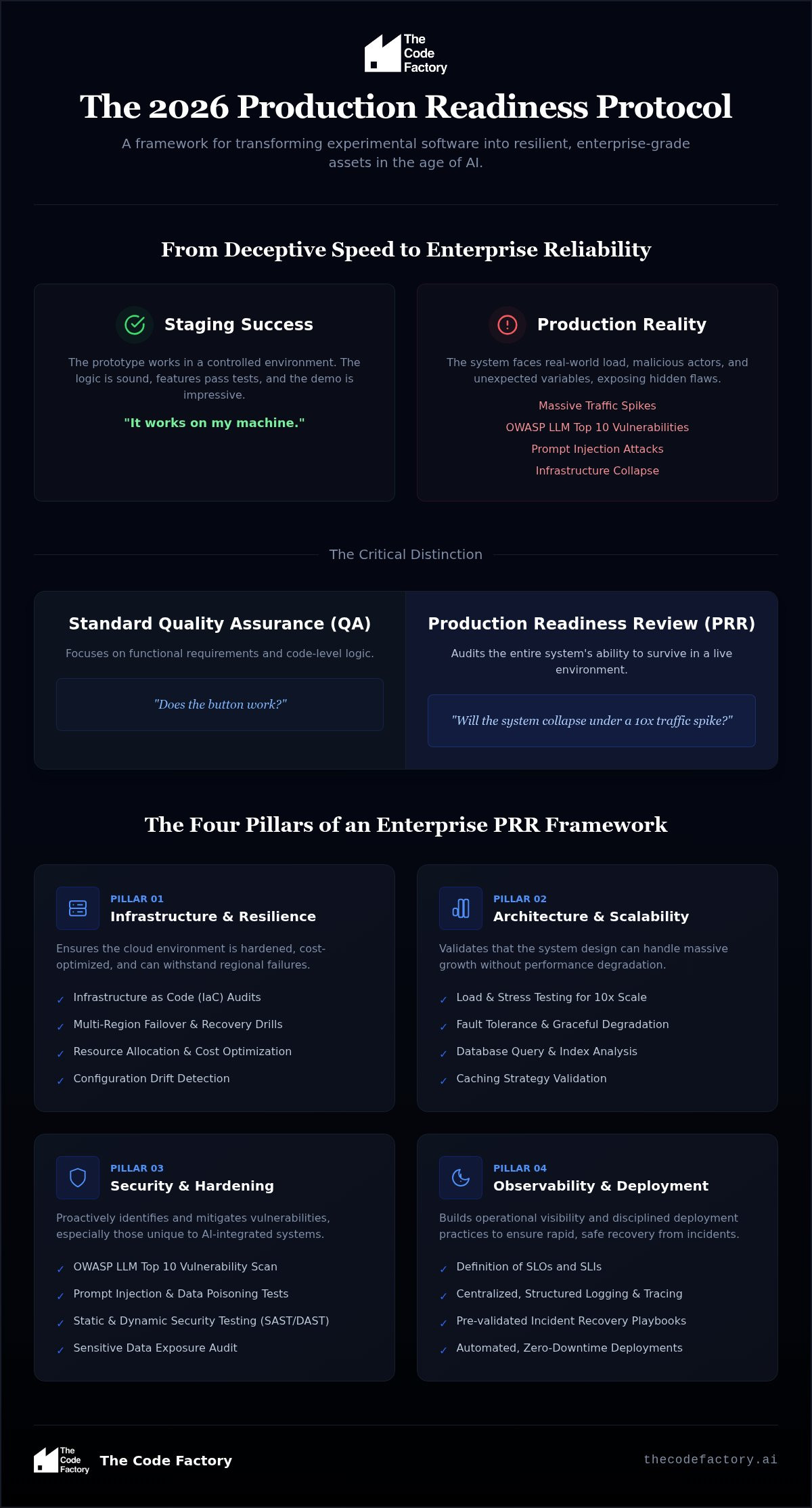
Success in a staging environment is often a deceptive milestone. While a developer might claim “it works on my machine,” that local success rarely accounts for the chaotic variables of a live enterprise ecosystem. A production readiness review serves as a formal, architectural audit designed to bridge the gap between experimental speed and production-grade reliability. It’s a structured gate that scrutinizes a system’s architecture, security posture, and operational stability before a single customer interacts with the code.
The core objective of this protocol is the identification of systemic risks. These are the hidden flaws that don’t appear in unit tests but manifest as catastrophic outages under heavy load. Moving from a prototype to an enterprise asset requires a fundamental shift in perspective. You aren’t just verifying features. You’re hardening a foundation to ensure it can survive the transition from a controlled experiment to a high-stakes production environment.
The Strategic Importance of the PRR Protocol
Implementing a rigorous review process acts as a sober voice of reason in a development lifecycle often driven by hype and artificial deadlines. It forces teams to confront technical debt before it compounds into unmanageable legacy issues. By establishing clear operational standards, you significantly reduce Mean Time to Recovery (MTTR). Proactive planning ensures that when an incident occurs, the team isn’t guessing; they’re executing a pre-validated recovery strategy. This foresight transforms the deployment process from a stressful gamble into a disciplined engineering exercise.
PRR vs. Standard QA: Understanding the Difference
Standard Quality Assurance (QA) is primarily concerned with functional requirements. It asks: “Does the button work?” In contrast, a production readiness review audits the environment and the underlying architecture. It focuses on non-functional requirements such as observability, scalability, and security hardening. A passed test suite confirms that the code’s logic is sound, but it doesn’t guarantee that the system won’t collapse under a 10x traffic spike. This is particularly vital when dealing with AI-generated software, where logic might be functional but the underlying resource management is poorly optimized. While QA tests the software, the PRR audits the system’s ability to remain resilient, secure, and observable within the context of enterprise infrastructure.
The Four Pillars of an Enterprise PRR Framework
A successful production readiness review is not a superficial scan of a codebase; it is a multi-dimensional audit of the entire operational ecosystem. At the enterprise level, the transition from a functional prototype to a resilient service rests on four critical pillars: infrastructure, architecture, security, and deployment. Each pillar represents a potential point of failure that, if left unaddressed, will compromise system integrity under load. By treating these as non-negotiable standards, organizations can move beyond the “hope-based” deployment model toward a strategy grounded in verifiable engineering data.
Infrastructure Hardening and Cloud Resilience
The foundation of any enterprise application is its cloud environment. A rigorous review must audit Infrastructure as Code (IaC) templates to identify configuration drift and security misalignments. It’s not enough for the infrastructure to exist; it must be hardened. This involves testing multi-region availability and verifying that failover protocols actually function during a simulated outage. As noted in Production Readiness Reviews: A Surprisingly Versatile Practice, these audits are essential for maintaining stability as services scale. Optimizing resource allocation during this phase prevents the performance bottlenecks and unexpected cost overruns that often plague unrefined cloud migrations.
Observability and Operational Visibility
Visibility is the antidote to post-launch anxiety. Without comprehensive logging and monitoring, you’re flying blind. An enterprise-grade framework requires the definition of critical Service Level Indicators (SLIs) and Service Level Objectives (SLOs) that align with business outcomes. If your monitoring doesn’t provide actionable alerts, it isn’t serving its purpose.
- Logging: Centralized, searchable, and structured logs for rapid debugging.
- Monitoring: Real-time dashboards reflecting the health of the entire stack.
- Alerting: Logic-based notifications that reach the right person before a breach of SLOs.
Ensuring the “on-call” path is documented and actionable is a core component of this pillar. If a system fails at 3:00 AM, the response should be a practiced protocol, not a frantic search for documentation. For teams struggling to bridge these gaps, architecture and scalability consulting provides the specialized expertise needed to build these frameworks from the ground up.
Security, Scalability, and Automated Deployment
The final pillars focus on the software’s ability to survive growth and external threats. A PRR must verify that the attack surface is minimized through security hardening and compliance checks before the first user logs in. Simultaneously, the architecture must be audited for its ability to handle 10x growth without a complete rewrite. Finally, a robust CI/CD pipeline automates the path to production, eliminating the human error inherent in manual deployments. For organizations looking to harden their delivery infrastructure against supply chain attacks and pipeline vulnerabilities, securing CI/CD pipelines is a critical engineering discipline that complements every production readiness audit. This automation ensures that every release follows the same rigorous standards, maintaining the structural integrity established during the initial review.
Hardening the Edge: PRR Protocols for AI-Generated Software
The rise of Large Language Models has introduced a phenomenon often described as “vibe coding,” where software is built on prompts rather than principles. While this accelerates the creation of experimental prototypes, it introduces a dangerous level of instability into enterprise environments. A production readiness review for AI-integrated systems must account for the stochastic nature of AI output. Logic that appears functional during a brief demonstration often contains hidden flaws that only surface under the pressure of concurrent user traffic or malicious input.
Hidden vulnerabilities are the primary risk. AI-generated code frequently lacks the defensive programming patterns required to mitigate risks identified in the OWASP LLM Top 10 2026, such as prompt injection or excessive agency. Without a human-led audit, these modules can become entry points for security breaches. Restructuring this output isn’t merely a cosmetic fix. It requires a deep architectural remediation to ensure the AI-driven components can scale alongside traditional, hand-coded infrastructure.
Fixing AI Code for Production-Grade Performance
Refactoring inefficient logic is a mandatory step in any modern PRR. AI models often generate redundant loops or resource-heavy queries that degrade performance at scale. Beyond speed, these modules must be hardened to meet enterprise security standards. This includes validating how the code handles sensitive data and ensuring it complies with privacy regulations. A “working” module is useless if it exposes PII or fails to implement proper encryption protocols.
Remediation as a Service: Bridging the Prototype Gap
Transitioning from an AI-generated “vibe” to engineered rigor requires a specialized skill set. At The Code Factory, our approach focuses on patching security risks and optimizing infrastructure before a single customer logs in. We utilize a credit-based engineering model to provide the flexibility needed for rapid remediation. This allows teams to address critical flaws identified during the audit without derailing their broader development roadmap.
The cost of skipping a formal audit can be devastating. For example, an AI-native application that neglects a production readiness review might face unbounded consumption costs or misinformation risks that lead to significant legal liability. By prioritizing a human-led engineering audit, organizations ensure their AI investments are resilient assets rather than operational liabilities. This process transforms a fast-moving experiment into a stable, production-grade reality.
The 2026 Production Readiness Checklist: A Pragmatic Guide
A checklist is the skeletal structure of a disciplined production readiness review. Without a formalized sequence of actions, critical vulnerabilities slip through the cracks of even the most experienced engineering teams. The 2026 standard demands more than a simple “pass/fail” on unit tests. It requires a deep dive into how the system behaves under stress and how it recovers from inevitable failures. Following this structured path ensures that your transition from staging to production is a controlled event rather than a chaotic gamble.
- Step 1: Architectural Audit. Map all component dependencies and evaluate if the scalability model supports 10x growth without a complete rewrite.
- Step 2: Security Hardening. Execute deep vulnerability scans and ensure all configurations adhere to zero-trust principles before the first user logs in.
- Step 3: CI/CD Validation. Audit the deployment pipeline to ensure every build is immutable, fully automated, and free from manual intervention. A comprehensive approach to securing CI/CD pipelines against supply chain attacks is essential at this stage to protect your entire software delivery infrastructure.
- Step 4: Failure Mode Analysis. Conduct rigorous load testing to identify the exact threshold where the system degrades or collapses.
- Step 5: Operational Handover. Formalize documentation and alerting protocols to ensure the support team is equipped for day-one operations.
Load Testing and Performance Benchmarking
You cannot claim a system is ready for the enterprise until you’ve found its breaking point. Real-world traffic is rarely linear. It consists of unpredictable spikes and edge-case scenarios that can paralyze unoptimized databases. Performance benchmarking must simulate these patterns, focusing specifically on query optimization and resource contention. If your database latency triples during a 50% traffic increase, your architecture is fundamentally flawed. Identifying these constraints early allows for targeted remediation before they impact your customer base.
Deployment Safety and Rollback Readiness
Stability is maintained through safe deployment patterns. A production readiness review must verify that Blue-Green or Canary strategies are not just configured but functional. It’s vital to test whether automated rollbacks trigger immediately upon health check failures. This “shift-left” approach to security and stability ensures that faulty code never lingers in a live environment. For organizations looking to implement these rigorous standards, securing your production environment through a professional audit is the most effective path to long-term resilience.
Strategic Engineering: Why Partner with The Code Factory for PRR?
The transition from an experimental prototype to a resilient enterprise environment is a high-stakes engineering challenge. Identifying risks through a production readiness review is only the first step. The true value lies in the strategic remediation of those risks. By partnering with The Code Factory, you gain access to a team of specialized fixers who understand the nuances of high-scale production. We don’t just hand you a list of failures; we provide the architectural guidance and hands-on expertise required to harden your stack.
Our approach focuses on the structural integrity of your software. Whether it’s optimizing cloud infrastructure configuration or streamlining CI/CD deployment pipelines, our goal is to eliminate technical debt before it impacts your bottom line. This level of rigor is especially critical for organizations integrating AI-generated modules. We transform these potentially unstable components into hardened, liability-free assets that meet the highest enterprise security standards.
The Code Factory’s PRR Methodology
Our methodology is built on a foundation of pragmatic urgency. We provide a holistic view of your system, moving beyond surface-level code checks to audit the underlying architecture and scalability. This includes deep security hardening and infrastructure optimization. We recognize that every stack is unique, which is why our audits are tailored to your specific cloud environment and business objectives.
One of our core differentiators is our credit-based engineering model. This flexible approach allows you to execute remediation tasks exactly when you need them. Instead of being locked into rigid service contracts, you can deploy our expertise to fix logic flaws, refactor inefficient AI loops, or optimize database queries as identified during the review. This model ensures that your path to production remains efficient and results-oriented.
Next Steps: Securing Your Next Launch
Securing your next launch requires more than a checklist; it requires a partnership with a seasoned architectural guide. To begin, we conduct a discovery session to understand your specific stack and deployment goals. We then customize our protocol to ensure every component, from the edge to the database, is production-ready.
Don’t let an unvetted prototype compromise your enterprise reputation. You can Schedule your Production Readiness Review with The Code Factory today to secure your environment and ensure long-term system stability. Our team is ready to help you move from experimental speed to enterprise-grade reliability with confidence.
Transitioning to Enterprise-Grade Resilience
The transition from a successful experiment to a stable enterprise asset requires a fundamental shift in engineering discipline. You’ve seen how the 2026 protocol demands more than basic QA; it requires a deep audit of infrastructure, security, and the unique risks inherent in AI-driven logic. By implementing a formal production readiness review, you move beyond the “vibe coding” trap and establish a foundation capable of handling 10x growth without catastrophic failure.
Stability isn’t a happy accident. It’s the result of rigorous load testing, automated deployment safety, and proactive architecture consulting. The Code Factory provides the specialized engineering support needed to optimize AI-generated code and harden cloud-native applications against modern threats. Whether you’re refining a new launch or stabilizing an existing system, our expertise ensures your software remains a resilient asset rather than an operational liability.
Don’t leave your next deployment to chance. Secure your next launch with an expert Production Readiness Review and build with the confidence that your system is truly ready for the enterprise stage. You’ve built the innovation; now let’s ensure it stays online.
Frequently Asked Questions
What is a Production Readiness Review (PRR)?
A production readiness review is a formal, structured audit that evaluates a system’s architecture, security posture, and operational stability before it enters a live environment. It ensures that a service meets internal enterprise standards for reliability and observability. By identifying systemic risks early, the process prevents experimental code from collapsing under real-world load. It’s the definitive checkpoint that transforms a functional prototype into a resilient, production-grade asset.
How does a PRR differ from a standard security audit?
While a security audit focuses primarily on identifying vulnerabilities and compliance gaps, a PRR is significantly broader in scope. It evaluates the entire operational ecosystem, including infrastructure configuration, scalability limits, and observability frameworks. A security audit might confirm your data is protected, but only a PRR ensures your system can handle a 10x traffic spike or recover automatically from a regional cloud failure. It’s a holistic assessment of survival, not just safety.
Why is a PRR essential for AI-generated code?
AI-generated code often prioritizes functional logic over architectural rigor, leading to “vibe coding” instability. These modules frequently lack defensive programming patterns and may contain inefficient loops that degrade performance at scale. A production readiness review is essential to refactor these AI-driven components. This ensures they adhere to enterprise security standards and don’t introduce unbounded resource consumption or hidden logic flaws into your production environment.
What are the most common risks identified during a PRR?
Reviews frequently uncover critical systemic weaknesses that standard testing misses. These include:
- Configuration drift in Infrastructure as Code (IaC) templates.
- Inadequate observability, such as missing SLIs or non-actionable alerting.
- Single points of failure without tested failover protocols.
- Inefficient database queries that cause latency spikes under load.
Identifying these risks proactively prevents the high costs associated with post-launch outages and emergency remediation.
When should an organization conduct a PRR in the development lifecycle?
An organization should conduct a formal review toward the end of the development cycle, once the architecture is stable but before the final launch. However, the modern standard is moving toward “continuous readiness.” This involves integrating automated checks early in the CI/CD pipeline while reserving the deep, human-led audit for the final transition to production. Timing it this way ensures that remediation doesn’t derail your broader development roadmap.
Can a PRR be automated within a CI/CD pipeline?
Many technical checks, such as security scanning, test coverage validation, and SLO compliance, can be automated within a CI/CD pipeline. Automation provides a baseline of confidence for every build. However, a comprehensive audit still requires a human-led architectural review. Automated tools can’t yet evaluate complex failure mode analysis or the strategic alignment of a system’s infrastructure with long-term business scalability goals.
How long does a typical Production Readiness Review take?
The duration of a review depends on the complexity of the stack and the maturity of existing documentation. A standard audit for a focused service might take a few days, while a complex, multi-region enterprise application could require two weeks of deep analysis. The goal is efficiency without sacrificing rigor. Using a credit-based engineering model allows teams to move through the audit and remediation phases with the pragmatic urgency required for modern release cycles.