



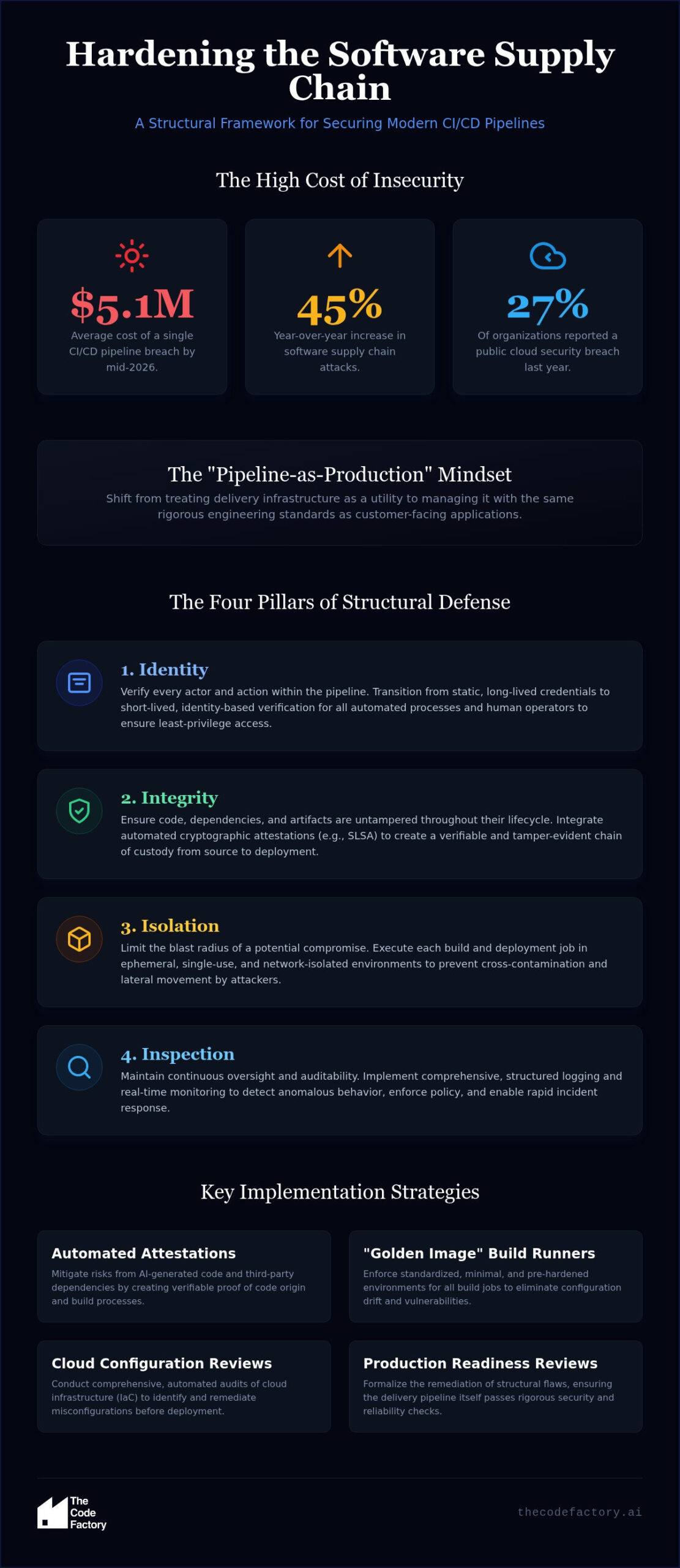
By mid-2026, the average cost of a single CI/CD pipeline breach has surged to $5.1 million, driven by a 45% year-over-year increase in supply chain attacks. This staggering figure confirms that your delivery infrastructure is no longer just a utility; it is the primary target for sophisticated adversaries. For many organizations, the process of securing CI/CD pipelines has become a reactive struggle against pipeline sprawl and the hidden vulnerabilities within AI-generated code. You likely recognize the anxiety of manual secrets management or the uncertainty of whether your automated builds are truly resilient against modern threats.
It’s understandable to feel that rigorous security might stifle the very speed that gives your enterprise a competitive edge. This guide promises a different path. You’ll learn how to shift from experimental speed to enterprise-grade reliability using a strategic framework for hardening your software delivery infrastructure. We will preview a roadmap for automated, secure deployments and provide the engineering protocols necessary to achieve SLSA Level 3 compliance. This transition ensures that your move toward AI-integrated production is defined by structural integrity rather than technical debt.
Key Takeaways
- Adopt a “Pipeline-as-Production” mindset to ensure your delivery infrastructure meets the same rigorous engineering standards as your customer-facing applications.
- Establish a structural defense for securing CI/CD pipelines based on the four critical pillars of identity, integrity, isolation, and inspection.
- Mitigate the inherent risks of AI-generated code and supply chain attacks by integrating automated attestations and specialized remediation protocols into your workflow.
- Harden your deployment environment by enforcing “Golden Images” for build runners and conducting comprehensive cloud infrastructure configuration reviews.
- Transition from experimental speed to enterprise-grade reliability by prioritizing the remediation of structural flaws through a formal Production Readiness Review.
The Evolution of CI/CD Security: Beyond Automated Speed
The traditional focus of software delivery has long been the optimization of velocity. In the race to market, engineering teams prioritized the removal of friction, often treating the delivery pipeline as a transparent utility rather than a critical production asset. This mindset has created a dangerous imbalance between automated speed and structural integrity. As supply chain attacks increased by 45% year-over-year by mid-2026, the industry is witnessing a harsh correction. Speed is a liability without structure. The modern threat landscape now targets the very tools used to build software, turning compromised pipelines into conduits for large-scale breaches. While the rapid adoption of AI-assisted development has accelerated the “vibe coding” phenomenon, it has simultaneously introduced a wave of unverified logic into critical delivery paths. This environment demands a sense of pragmatic urgency; a commitment to hardening systems before the next vulnerability is exploited.
Traditional perimeter security, which relies on static firewalls and long-lived credentials, is fundamentally insufficient for dynamic pipelines. Modern delivery systems operate in ephemeral cloud environments where build runners spin up and down in seconds. The shift toward DevSecOps principles represents an industry-wide acknowledgement that security cannot exist in a vacuum. It must be woven into the fabric of the architecture itself, moving beyond simple perimeter checks to a model of continuous, identity-based verification.
The High Cost of Technical Debt in Delivery Pipelines
Unoptimized pipelines are more than just a bottleneck; they are a significant financial and operational liability. When security is treated as an afterthought, the resulting technical debt manifests as “broken” CI/CD processes that fail under the pressure of enterprise scaling. These failures often stem from manual secrets management, inconsistent environment variables, and a lack of architectural oversight. In high-stakes production environments, a single misconfiguration can lead to a public cloud security breach, a risk that 27% of organizations reported in the last year. Hardening these delivery systems must become an architectural priority. Refinement and streamlining are necessary to transform a fragile deployment process into a resilient, enterprise-grade asset that supports long-term maintenance rather than temporary fixes.
Transitioning from Prototypes to Production-Ready Infrastructure
Moving from an experimental prototype to enterprise-grade infrastructure requires crossing a specific maturity threshold. This transition is marked by a shift from “good enough” configurations to rigorous, audited standards. Technical audits play a vital role here, acting as a diagnostic tool to identify hidden deployment risks and performance constraints before they manifest in production. For decision-makers, the goal is to replace uncertainty with confidence. This holistic evaluation frames the pipeline as a core component of production readiness reviews, ensuring that every deployment runner is as secure as the code it carries. By viewing the pipeline through the lens of structural integrity, organizations can finally secure CI/CD pipelines against the sophisticated threats of the current technological landscape.
The Pipeline-as-Production Framework: A Structural Approach
Securing CI/CD pipelines requires a fundamental shift in perspective. To achieve enterprise-grade reliability, engineering teams must stop treating the delivery chain as a background utility and start managing it with the same rigor as the production application it serves. When a pipeline is compromised, the integrity of every downstream environment is invalidated. A structural approach to security moves beyond the superficial application of tools, focusing instead on four foundational pillars: Identity, Integrity, Isolation, and Inspection. By integrating these requirements into the architecture phase through Infrastructure as Code (IaC), organizations can ensure that security is not an added layer but a core characteristic of the deployment system. This shift-left strategy prevents technical debt from accumulating in the form of undocumented configurations and fragile scripts.
The use of IaC is particularly critical for maintaining a hardened state. When pipeline definitions are versioned, peer-reviewed, and audited, the risk of “configuration drift” is minimized. This level of oversight is essential for any high-stakes production environment where structural flaws can lead to catastrophic supply chain vulnerabilities. For teams struggling to bridge the gap between rapid development and stable operations, engaging in architecture and scalability consulting can provide the necessary blueprint for a resilient delivery framework.
Identity and Access Management (IAM) for Pipelines
Identity is the first line of defense. Many organizations still rely on manual secrets management, a practice that contributed to the 23.8 million secrets leaked on public GitHub in 2024. Transitioning to an enterprise-grade protocol means implementing the principle of least privilege for all CI/CD service accounts. Instead of using long-lived credentials that provide permanent access, engineers should utilize short-lived, OIDC-based tokens that expire immediately after use. This approach aligns with the OWASP CI/CD Security Cheat Sheet, which emphasizes the necessity of multi-factor authentication and hardware keys to prevent unauthorized lateral movement within the delivery chain.
Isolation and Ephemeral Environments
Persistent build runners are a significant security liability. If a runner survives across multiple jobs, it can harbor malicious artifacts or cached credentials from previous builds, providing a foothold for persistent malware. The solution lies in ephemeral, containerized build environments that are spun up for a single task and destroyed immediately upon completion. This isolation ensures a “clean room” for every build, significantly reducing the attack surface. Coupled with strict network segmentation, these ephemeral runners prevent a compromised job from accessing sensitive internal resources, effectively containing potential threats within a restricted, short-lived boundary.
Mitigating Critical Vulnerabilities in the Software Supply Chain
The software supply chain has become the soft underbelly of the modern enterprise. While securing CI/CD pipelines often focuses on the infrastructure, the artifacts moving through those systems are frequently compromised before they ever reach a build runner. According to industry data, 86% of commercial codebases currently contain known-vulnerable dependencies. This reality turns the delivery pipeline into a high-speed distribution network for “poisoned” packages. To combat this, full transparency is required through a Software Bill of Materials (SBOM). Under the EU Cyber Resilience Act, which begins enforcement in 2026, automated attestations and SBOMs are no longer optional for SaaS providers; they’re a legal prerequisite for market entry.
Implementing AI code remediation services within your pipeline allows for the proactive identification of these vulnerabilities. This isn’t just about scanning. It’s about active refinement. By automating the detection and correction of malicious patterns in third-party libraries, organizations can maintain their velocity without sacrificing structural integrity. This transition from passive monitoring to active remediation is what separates a fragile prototype from a hardened production asset.
Secrets Management and Leak Prevention
The proliferation of AI-assisted development has inadvertently increased the risk of credential exposure. GitGuardian reported that 23.8 million secrets were leaked on public GitHub in 2024, many of which originated from hardcoded keys in AI-generated configurations. These tools often prioritize functional code over security best practices, leading to the accidental inclusion of API keys and long-lived tokens in repository files. Securing CI/CD pipelines requires a multi-stage approach to leak prevention. This includes automating secrets scanning at the pre-commit stage and utilizing centralized vaults for dynamic secret injection during build time, ensuring that sensitive data is never stored in plain text.
Hardening AI-Generated Code and Configurations
AI-produced pipeline scripts frequently exhibit security anti-patterns, such as overly permissive execution environments or unvalidated input handling. These “vibe coding” errors can lead to command injection vulnerabilities that compromise the entire build runner. Establishing a protocol for human-in-the-loop remediation is essential before any AI-generated component is promoted to a production-level pipeline. Professional code remediation is a mandatory step for ensuring enterprise stability in an AI-driven development lifecycle. This rigorous verification process ensures that the speed of AI doesn’t result in the fragility of your core infrastructure.
Implementation Strategies for Hardened Deployment Architecture
Transforming a delivery system into a hardened asset requires a methodical execution of specific engineering tasks. Securing CI/CD pipelines is not achieved through a single tool; it’s the result of a layered defense strategy that addresses both the infrastructure and the process. By following a structured protocol, organizations can eliminate the common vulnerabilities that lead to supply chain compromises. This transition from experimental speed to enterprise-grade reliability involves five critical steps:
- Step 1: Conduct a comprehensive cloud infrastructure configuration review. Misconfiguration remains the leading cloud threat, often surpassing zero-day exploits in impact. A deep audit of your cloud environment identifies overly permissive roles and exposed resources.
- Step 2: Define and enforce “Golden Images” for build and deployment runners. This ensures that every runner is pre-hardened, stripped of unnecessary services, and updated with the latest security patches before execution.
- Step 3: Implement automated compliance-as-code. By defining security policies as code, you prevent configuration drift and ensure that every deployment meets your architectural baseline.
- Step 4: Establish a secure promotion path. This includes the cryptographic signing of artifacts to ensure that only verified, untampered code moves from staging to production environments.
- Step 5: Continuous monitoring and high-fidelity logging. Detailed logs are essential for identifying anomalous patterns and providing the audit trail necessary for regulatory compliance.
For enterprises managing complex environments, a professional cloud infrastructure configuration audit is the most effective way to identify and remediate these structural risks.
Architecting for Scalability and Resilience
A secure pipeline is the foundation of high-stakes application scaling. When delivery systems are architected for resilience, they can handle increased load without introducing security regressions. This requires designing for failover and rapid recovery, ensuring that a compromise in one region does not paralyze the entire global deployment. Strategic architecture consulting provides the blueprint for these systems, moving beyond basic setup to create a delivery infrastructure that supports long-term stability and growth. Securing CI/CD pipelines at this level ensures that your infrastructure can withstand both operational stress and targeted attacks.
Security Hardening for Web Applications at Scale
Enterprise-grade pipelines must integrate Dynamic Application Security Testing (DAST) and Static Application Security Testing (SAST) without creating developer friction. The goal is to automate vulnerability remediation as part of the standard deployment flow, treating security findings as blocking bugs rather than ignored warnings. Additionally, the pipeline itself must be resilient against Denial of Service (DoS) attacks, ensuring that malicious traffic cannot disrupt the critical path to production. This level of hardening ensures that your web applications remain accessible and secure even under extreme operational pressure.
Navigating the Transition: From Experimental to Enterprise-Grade
Scaling a delivery system from a fast-moving prototype to a resilient enterprise asset is an exercise in disciplined engineering. Many organizations find themselves caught in the “vibe coding” trap, where the speed of creation outpaces the capacity for maintenance. Securing CI/CD pipelines in this environment requires the intervention of a specialized fixer; an expert who understands the nuances of high-stakes production and can identify the hidden risks within legacy technical debt. This transition isn’t about halting innovation. It’s about refining the infrastructure to ensure that every deployment is a calculated, secure action rather than a gamble on unverified configurations.
Success depends on the strategic prioritization of remediation efforts. Rather than attempting to fix every minor dependency at once, enterprises must focus on the structural flaws that present the greatest architectural risk. This includes hardening identity layers, isolating build environments, and establishing a human-in-the-loop protocol for AI-generated components. The Code Factory serves as the architectural guide for this transformation, providing the foresight and expertise needed to prevent systemic failures before they manifest. By balancing the drive for rapid innovation with the rigor of traditional engineering safety, you create a delivery system that is both fast and fundamentally sound.
The ROI of a Hardened CI/CD Pipeline
A hardened delivery infrastructure provides a measurable return on investment that extends beyond simple risk mitigation. By establishing reliable, automated safety nets, you significantly reduce the likelihood of high-stakes production failures that can paralyze an entire organization. This structural integrity also improves developer productivity. When engineers aren’t fighting fragile pipelines or managing manual secrets, they can focus on high-value features. Ultimately, this approach builds a culture of security through engineering excellence, where stability is viewed as a prerequisite for speed rather than an obstacle to it.
Next Steps: Securing Your Production Environment
The path to enterprise-grade stability begins with a diagnostic evaluation of your current delivery systems. Initiating a professional production readiness review allows you to identify the specific gaps in your architecture and establish a roadmap for remediation. This process often transitions into a comprehensive cloud infrastructure configuration and security hardening phase, where your deployment runners and network segments are optimized for resilience. Don’t let experimental hype define your delivery strategy. Move toward a future of enterprise-grade reliability and secure your production environment with the rigor it deserves.
Establishing a Resilient Delivery Protocol
The transition from experimental speed to enterprise-grade reliability requires more than just a change in tools; it demands a fundamental shift in engineering philosophy. By adopting a pipeline-as-production framework, your organization can move beyond the fragility of unverified configurations and build a delivery system defined by structural integrity. We have explored how hardening identity layers, utilizing ephemeral environments, and implementing automated attestations are no longer optional in an era of surging supply chain attacks. Ultimately, securing CI/CD pipelines is a continuous commitment to architectural excellence that protects your most critical business assets.
Success in high-stakes production environments depends on having a specialized fixer who possesses the foresight to prevent issues before they manifest. The Code Factory provides authoritative engineering guidance, specialized in enterprise-level architecture and scalability consulting. We offer a proven protocol for hardening AI-generated code and cloud infrastructure to ensure your delivery systems remain stable under pressure. Secure your enterprise infrastructure with a professional production readiness review from The Code Factory. You have already built the innovation; now it’s time to build the stability that sustains it.
Frequently Asked Questions
What are the most common security risks in modern CI/CD pipelines?
The most prevalent risks in modern delivery systems include supply chain vulnerabilities, leaked credentials, and cloud misconfigurations. Misconfiguration currently stands as the leading threat to cloud environments, frequently surpassing zero-day exploits in terms of frequency and impact. These risks are exacerbated by pipeline sprawl and inconsistent architectural standards. Securing CI/CD pipelines requires a structural defense that addresses these vulnerabilities at the source rather than relying on reactive patching after a breach occurs.
How does AI-generated code impact the security of my deployment pipeline?
AI-generated code introduces significant risks through security anti-patterns and hardcoded secrets that often bypass traditional static analysis. While these tools accelerate development, they frequently produce logic that lacks the rigor required for enterprise-grade production. Professional code remediation is necessary to identify and fix these flaws before deployment. This specialized intervention ensures that the speed of AI-assisted creation doesn’t compromise the structural integrity of your high-stakes delivery infrastructure and overall deployment lifecycle.
What is the difference between CI/CD security and traditional application security?
Traditional application security focuses on the perimeter and the code itself, whereas CI/CD security treats the delivery infrastructure as a primary target. Modern pipelines operate in dynamic, ephemeral environments where static firewalls are ineffective. The shift toward securing CI/CD pipelines involves protecting the build runners, artifacts, and secrets used throughout the deployment lifecycle. It’s an architectural commitment to ensuring that the process of shipping code is as secure as the code being shipped to production.
Can securing a CI/CD pipeline improve software scalability and performance?
Hardening your deployment infrastructure directly supports enterprise-level scaling by eliminating configuration drift and manual bottlenecks. A secure pipeline provides a reliable, automated safety net that reduces the frequency of deployment failures and performance constraints. When your architecture is optimized for resilience, you can scale operations rapidly without introducing security regressions. This stability allows engineering teams to maintain high velocity while ensuring that performance remains consistent under heavy production loads even during peak traffic.
Why is a production readiness review necessary for my deployment infrastructure?
A production readiness review is a mandatory diagnostic protocol for identifying structural flaws and hidden risks before they manifest as costly outages. This review evaluates your entire deployment lifecycle, from infrastructure configuration to code remediation standards. For enterprises scaling new technology, this expert-led audit provides a clear roadmap to stability. It ensures that your software delivery systems meet the rigorous engineering requirements necessary for high-stakes environments and long-term maintenance without sacrificing developer velocity.
How do I handle secrets management in a multi-cloud CI/CD environment?
Effective secrets management in multi-cloud environments requires moving away from static, long-lived credentials toward centralized, dynamic vaults. Utilizing OIDC-based identity authentication allows your CI/CD runners to request short-lived tokens that expire immediately after use. This approach minimizes the risk of persistent credential leaks across different cloud providers. It’s a critical component of a hardened architecture that prevents unauthorized lateral movement and protects sensitive API keys from being exposed in public repositories.
What role does Infrastructure as Code (IaC) play in pipeline hardening?
Infrastructure as Code (IaC) is the primary mechanism for enforcing security policies and preventing configuration drift within your delivery chain. By defining your environment as versioned code, you ensure that every build runner and network segment is deployed according to a pre-hardened image. This architectural oversight allows for consistent, audited deployments that are resilient against unauthorized changes. IaC transforms security from a manual checklist into an automated, inherent part of your infrastructure’s core design.
How can I reduce technical debt in my delivery pipeline without stopping feature development?
Reducing technical debt requires integrating automated remediation and architectural hardening directly into the development workflow. By adopting a shift-left approach, security checks and performance optimizations occur early in the lifecycle, preventing the accumulation of structural flaws. Engaging with specialized fixers for targeted audits allows your team to address critical technical debt without halting feature delivery. This methodical refinement ensures your infrastructure remains production-ready while your developers continue to innovate at speed with total confidence.