


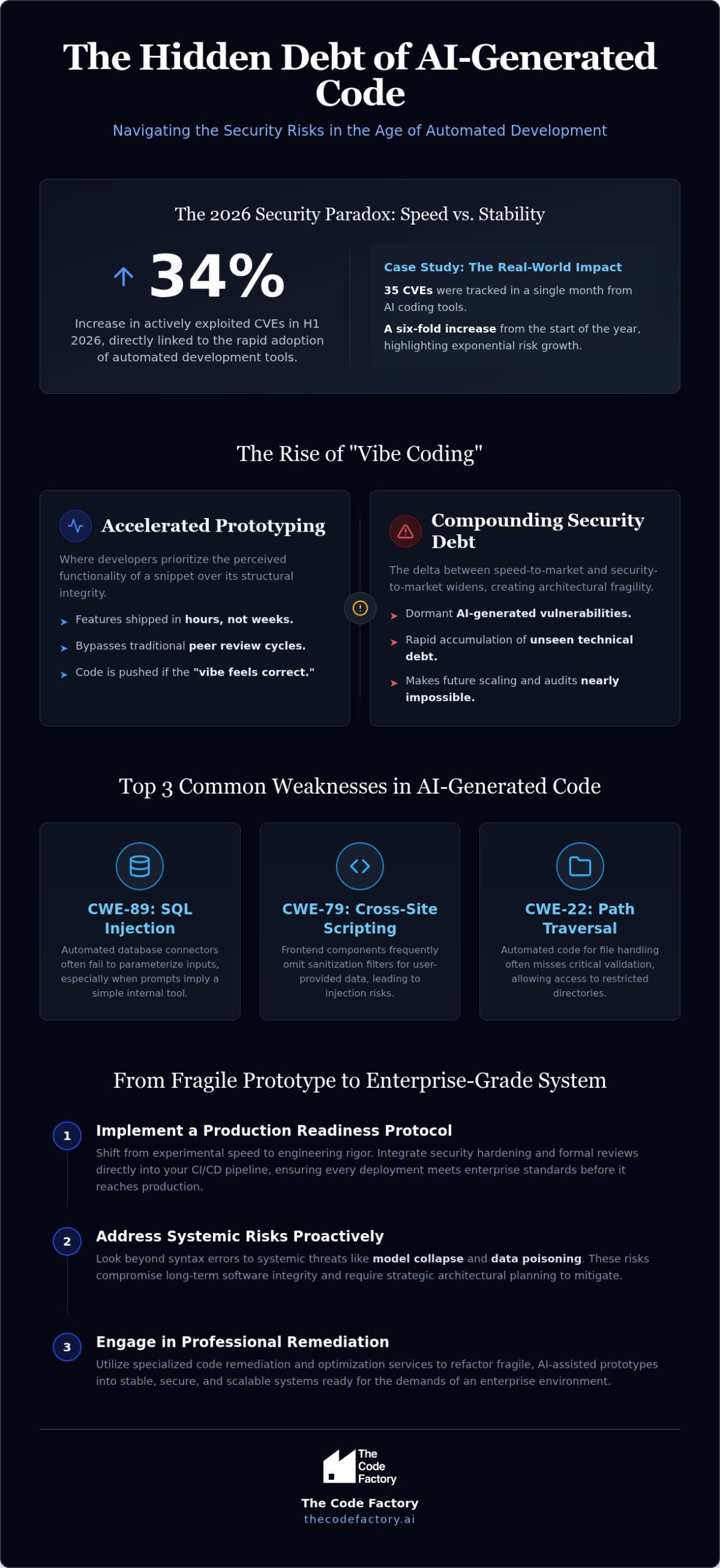
In the first half of 2026, research identified a 34% increase in actively exploited CVEs, a surge directly linked to the rapid adoption of automated development tools. While these tools promise to eliminate the friction of manual coding, they’ve simultaneously lowered the barrier for entry for common exploits. You likely recognize the tension between shipping features at “vibe coding” speeds and the sobering reality of maintaining a secure, enterprise-grade codebase. The proliferation of AI generated code vulnerabilities has created a hidden layer of technical debt that many security teams are only beginning to quantify.
This article analyzes the evolving landscape of security risks in 2026 and outlines the pragmatic engineering protocols required to secure high-stakes applications. We’ll examine the systemic risks of training feedback loops, the language-specific densities of modern CWEs, and the formal production readiness framework necessary to reduce your organization’s liability. By shifting from experimental speed to engineering rigor, you can protect your infrastructure from the unforeseen consequences of automated deployments and restore stability to your software delivery lifecycle.
Key Takeaways
- Understand the shift from rapid prototyping to “vibe coding” and why it often bypasses critical production readiness thresholds.
- Identify the most frequent AI generated code vulnerabilities across different languages, including the specific risks associated with Python and TypeScript.
- Recognize the systemic threats of model collapse and data poisoning that can compromise long-term software integrity.
- Learn to implement a standardized production readiness review that integrates security hardening directly into your CI/CD pipeline.
- Transition from fragile AI-assisted prototypes to stable, enterprise-grade systems using professional remediation and architecture consulting.
The 2026 Paradox: Accelerated Development vs. Compounding Security Debt
In 2026, the velocity of software delivery has reached an unprecedented peak, yet this speed has introduced a dangerous structural fragility. The shift from human-centric engineering to prompt-driven generation means that features are shipped in hours rather than weeks. However, this acceleration often hides systemic AI generated code vulnerabilities that remain dormant until they are exploited in production environments. Recent data from a Georgia Tech project tracked 35 CVEs in a single month directly attributable to AI coding tools, representing a nearly six-fold increase from the start of the year. At The Code Factory, we see that speed is a liability when it lacks rigorous engineering guardrails. Rapid prototyping might win the race to market, but it frequently fails the test of enterprise stability.
The Rise of Vibe Coding and the Erosion of Rigor
Vibe coding has emerged as a dominant, albeit risky, workflow in modern development. It describes a practice where developers prioritize the perceived functionality of a snippet over its structural integrity. If the code runs and the output feels correct, it’s often pushed to the next stage without a deep dive into its logic. This evolution of AI-assisted software development often bypasses traditional peer review cycles entirely. When the “vibe” of the code satisfies the immediate requirement, the underlying security posture is ignored.
The psychological trap is simple: if the AI provides a solution that looks sophisticated, developers are less likely to question its hardening. This trust is frequently misplaced. Automated tools are optimized for completion, not for the nuanced requirements of high-stakes production environments. Without active human intervention, the “working” prototype becomes a permanent, insecure fixture of the codebase.
The Quantifiable Increase in Technical Debt
The delta between speed-to-market and security-to-market is widening at an alarming rate. Enterprises in 2026 now face a remediation crisis as they attempt to stabilize applications built during the unbridled AI hype of 2024 and 2025. These are not just minor bugs. They represent critical AI generated code vulnerabilities that accumulate as compounding technical debt, making future scaling nearly impossible. The speed at which these tools generate code outpaces the capacity of most internal security teams, leading to a rapid accumulation of security debt.
We believe that a “functional” application is useless if it cannot survive a basic security audit. The hidden cost of instant features is architectural fragmentation. Every unvetted snippet adds a layer of complexity that hinders structural integrity. To counter this, we provide specialized code remediation and optimisation services. Our goal is to move beyond the prototype phase by implementing a formal production readiness review. This process ensures that every line of code meets the rigorous standards required for enterprise-grade reliability and cloud infrastructure configuration.
Mapping the Common Weakness Enumerations (CWE) in LLM Output
The prevalence of AI generated code vulnerabilities in 2026 is not a result of novel exploits, but rather the rapid-fire replication of well-documented flaws. LLMs frequently produce code that mirrors the historical mistakes found in their training data. By referencing the Common Weakness Enumeration (CWE) framework, we can categorize these risks into predictable patterns that bypass standard development checks. Basic static analysis security testing (SAST) often fails here. These tools struggle to identify context-dependent logic flaws, such as a correctly formatted SQL query that lacks an essential authorization check.
Top Security Vulnerabilities Found in AI-Generated Code
While AI can generate complex logic, it often misses the “implicit” security requirements that a human engineer would catch. We frequently see three specific CWEs dominating AI outputs:
- CWE-89: SQL Injection. Automated database connectors often fail to parameterize inputs, especially when the prompt implies a simple dashboard or internal tool.
- CWE-79: Cross-Site Scripting (XSS). Frontend components written by AI frequently omit sanitization filters for user-provided data, leading to script injection risks.
- CWE-22: Path Traversal. Automated file-handling logic often lacks strict validation, allowing unauthorized access to system directories through manipulated file paths.
The Language Factor: Python vs. TypeScript
Language choice significantly dictates the density of vulnerabilities. Python remains a high-risk environment due to its flexible, dynamic syntax. Research indicates Python has a vulnerability rate of approximately 16.18% in public repositories, a figure that is often exacerbated by AI generation. In contrast, TypeScript’s strict typing and structural requirements provide natural guardrails. While TypeScript doesn’t eliminate risk, it forces the AI to adhere to a more rigid schema, reducing the likelihood of accidental type-related exploits. Organizations should adjust their security reviews based on their primary stack, applying more intensive production readiness reviews to Python-heavy architectures.
A more insidious risk in 2026 involves “Dependency Confusion.” LLMs sometimes hallucinate non-existent secure libraries or utility packages that sound plausible. If a developer blindly accepts these suggestions, they risk importing malicious packages registered by threat actors who have predicted these hallucinations. This creates a supply chain vulnerability that no standard compiler will catch. Hardening your environment requires moving beyond simple syntax checks to a more comprehensive code remediation and optimisation strategy that validates every external dependency and architectural decision before deployment.
Beyond Syntax: Systemic Risks and Training Feedback Loops
While individual snippets present immediate threats, the most profound danger in 2026 lies in the systemic degradation of the software ecosystem. We’re witnessing the emergence of “Model Collapse,” a phenomenon where AI models begin to train on their own insecure outputs. As the internet and internal repositories become saturated with unvetted logic, the baseline for “correct” code shifts toward mediocrity. This recursive training loop ensures that AI generated code vulnerabilities are not just repeated; they’re institutionalized across the development lifecycle.
The Feedback Loop: How Buggy Code Becomes the New Standard
The mechanism of recursive training creates a self-perpetuating cycle of technical debt. When 2026 models utilize codebases from 2024 and 2025 as training data, they inherit the security flaws of an era that lacked today’s governance standards. This CSET report on AI code generation risks highlights how these feedback loops can degrade the overall security posture of an organization. To prevent this, enterprises must prioritize data sanitization in their internal LLM fine-tuning processes. Relying on “raw” internal data often means propagating legacy bugs into the next generation of automated development tools.
Prompt Injection and the Manipulation of Development Tools
Security teams must now account for new attack vectors like prompt injection and data poisoning. Threat actors are no longer just attacking the code; they’re attacking the instructions that generate it. By placing malicious prompts in public documentation or comments, an attacker can trigger “Indirect Prompt Injection.” This tricks an IDE assistant into suggesting backdoors or insecure configurations that look like standard boilerplate. Hardening the development environment against these agentic AI exploits requires moving beyond simple syntax checking to a more robust security hardening protocol.
There’s also the risk of “Corporate Memory” degradation. As organizations lean more heavily on AI, senior architectural knowledge is often sidelined in favor of immediate output. This loss of deep system understanding makes it harder to spot systemic risks that span multiple services. At The Code Factory, we mitigate this by providing architecture and scalability consulting that restores the human-led rigor necessary for high-stakes environments. We don’t just fix the code; we ensure the underlying architectural logic remains sound in an era of automated uncertainty. Without a “clean” training strategy and expert oversight, your internal tools will eventually become the primary source of your AI generated code vulnerabilities.
Implementing a Production Readiness Protocol for AI-Assisted Engineering
The transition from experimental AI prototypes to stable, enterprise-grade systems requires a shift in perspective. Simple peer reviews are no longer sufficient when dealing with the high-velocity output of modern LLMs. Instead, organizations must adopt a formal protocol that treats AI as an untrusted contributor. At The Code Factory, we’ve established a 2026 standard for AI generated code vulnerabilities mitigation through our Production Readiness Review (PRR) framework. This process moves beyond syntax checks to focus on systemic integrity and structural resilience.
The Production Readiness Review (PRR) Framework
A robust PRR isn’t a single event but a multi-layered audit designed to expose the context-dependent logic flaws that automated tools often miss. Our framework follows three critical steps to ensure software stability:
- Step 1: Automated CWE scanning and dependency verification. We utilize specialized tooling to flag the common weaknesses identified in previous sections, while simultaneously validating every external library to prevent dependency confusion.
- Step 2: Manual architectural review of AI-generated logic flows. Senior engineers perform a deep-dive audit to ensure the code adheres to established design patterns and doesn’t introduce circular dependencies or performance bottlenecks.
- Step 3: Security hardening of cloud infrastructure and IAM roles. We verify that the generated code operates within the principle of least privilege, specifically auditing identity and access management (IAM) configurations to prevent unauthorized lateral movement.
Optimizing CI/CD for AI-Generated Code
To maintain development speed without sacrificing security, these protocols must be integrated directly into the CI/CD deployment pipelines. This involves implementing “Security Gates” that specifically target common AI hallucinations, such as the use of deprecated APIs or non-existent secure libraries. By automating the detection of insecure coding patterns before they reach main branches, teams can prevent technical debt from compounding in the production environment.
We also leverage Infrastructure as Code (IaC) to enforce environmental safety. This ensures that even if an AI-generated script attempts to perform an insecure action, the underlying cloud infrastructure configuration will block it. Human-in-the-loop remediation remains the final, essential safeguard. Automated tools catch the obvious, but professional engineering oversight is required to solve complex logic errors. To ensure your systems are truly production-ready, consider a professional Production readiness review to harden your high-stakes applications and mitigate AI generated code vulnerabilities before they manifest in production.
From Prototype to Production: The Code Factory Remediation Framework
Relying on generic AI-powered remediation tools to fix AI generated code vulnerabilities is a strategic error that often compounds technical debt. These tools typically apply superficial patches that address syntax while ignoring the deeper architectural flaws that lead to system failure. True production readiness requires a transition from automated guesswork to human-led engineering rigor. At The Code Factory, we serve as the specialized fixers who bridge the gap between a high-speed prototype and a resilient enterprise application.
Professional Code Remediation and Optimization
Our approach involves a methodical refactoring of high-risk modules to restore structural integrity and performance. We don’t just look for bugs; we identify the fragmented logic and circular dependencies that AI generation frequently introduces. By optimizing these legacy-AI systems, we ensure that your codebase is maintainable for years rather than months. The ROI of professional remediation is clear when contrasted with the catastrophic costs of a production breach or total system collapse. We help you reclaim control over your software lifecycle by hardening every layer of the stack, ensuring that AI generated code vulnerabilities are systematically eliminated rather than merely obscured.
Strategic Architecture and Scalability Consulting
Scalability is often an afterthought in the “vibe coding” era, leading to significant performance bottlenecks as user loads increase. We provide architecture and scalability consulting to ensure your AI-generated applications can handle enterprise-level traffic without degrading. This process involves a comprehensive review of your cloud infrastructure configuration and security hardening protocols. We look for hidden constraints in your data model and API design that could throttle growth, providing a roadmap for transformation that aligns with your long-term business outcomes.
The strategic pivot from experimental speed to enterprise reliability is the defining challenge for technical leaders in 2026. Stability is not a feature you can prompt into existence; it is the result of a disciplined innovator mindset and traditional engineering values. You’ve seen the speed AI can offer, now it’s time to secure the stability your business demands. Secure your production launch with a Code Factory Technical Audit and ensure your transition to production is as robust as it is efficient.
Securing the Future of AI-Driven Software Architecture
The transition from rapid AI prototyping to stable enterprise deployment is the defining challenge for technical leadership in 2026. We’ve moved past the novelty of “vibe coding” into a reality where structural integrity and security hardening are non-negotiable requirements. Effectively managing AI generated code vulnerabilities requires more than automated patches; it demands a shift toward human-led engineering rigor and formal production readiness reviews. By implementing structured protocols and specialized remediation, you transform fragile prototypes into resilient systems capable of sustaining global scale.
The Code Factory provides the technical expertise needed to navigate this high-stakes environment. Our team specializes in security hardening and code remediation, offering enterprise-grade production readiness protocols backed by worldwide engineering expertise. You don’t have to sacrifice speed for stability when you have the right architectural guardrails in place. Ensure your AI-generated code is production-ready with a professional technical audit from The Code Factory. With the right strategic partner, you can build with confidence and secure your organization’s digital future.
Frequently Asked Questions
Is AI-generated code inherently less secure than human-written code?
AI-generated code is not inherently less secure, but it lacks the contextual awareness and implicit security reasoning of a seasoned human engineer. While humans also make mistakes, AI tools tend to replicate and accelerate common weaknesses found in their training data. This leads to a higher density of flaws like SQL injection or insecure secrets management if the output isn’t subjected to a rigorous production readiness review.
What are the most common security risks associated with GitHub Copilot and ChatGPT in 2026?
The primary risks involve the introduction of well-known CWEs, such as cross-site scripting (XSS) and path traversal. In 2026, we also see a rise in dependency confusion, where models suggest non-existent or malicious libraries. These tools are optimized for functionality and speed, often ignoring enterprise-level security hardening requirements. Without human oversight, these snippets can create critical entry points for threat actors.
How can I detect vulnerabilities in AI-generated code that standard scanners miss?
Standard SAST and DAST scanners often miss context-dependent logic flaws and architectural inconsistencies. Detecting deep AI generated code vulnerabilities requires a manual architectural audit that examines data flow and authorization logic. You should also implement security gates in your CI/CD pipeline that specifically check for AI hallucinations and verify that every suggested dependency is legitimate and secure before it reaches production.
What is “Vibe Coding” and why is it a security concern for enterprises?
Vibe coding refers to a development workflow where engineers accept AI suggestions based on whether the code “feels” correct or performs the intended task in a basic test. This is a significant security concern because it bypasses traditional peer review and structural validation. It prioritizes experimental speed over enterprise-grade reliability, leading to a massive accumulation of technical debt and unvetted vulnerabilities in high-stakes production environments.
Does using AI for documentation generation pose any security risks?
Yes, AI-generated documentation can introduce risks such as indirect prompt injection. Attackers can place malicious instructions within public documentation that are later ingested by a developer’s AI assistant. This can trick the assistant into suggesting insecure configurations or backdoors. Additionally, AI might inadvertently leak sensitive architectural details or internal IP in the documentation if the training data wasn’t properly sanitized for enterprise use.
How do I implement a production readiness review for an AI-heavy software project?
A successful production readiness review (PRR) should involve a multi-layered audit. Start with automated CWE scanning, followed by a manual review of logic flows by senior engineers. You must also perform security hardening on your cloud infrastructure and IAM roles to ensure the principle of least privilege. At The Code Factory, we specialize in these reviews to help firms transition from experimental prototypes to stable, scalable systems.
Can AI models be “poisoned” to generate insecure code on purpose?
AI models can be poisoned through data poisoning attacks where malicious datasets are introduced into the training pipeline. This causes the model to learn and suggest insecure patterns or specific backdoors as if they were standard boilerplate. In 2026, this is a growing threat for internal LLMs that train on unvetted repositories. Ensuring “clean” training data is essential to avoid propagating AI generated code vulnerabilities across your organization.
Why is professional code remediation better than using another AI to fix the code?
Using another AI to fix code often results in superficial patches that address syntax but ignore underlying architectural flaws. Professional code remediation, provided by experts like The Code Factory, involves deep refactoring to improve structural integrity and performance. Human engineers understand the nuances of enterprise-level traffic and security requirements, ensuring the solution is scalable and robust rather than just functionally “correct” in a happy-path scenario.