


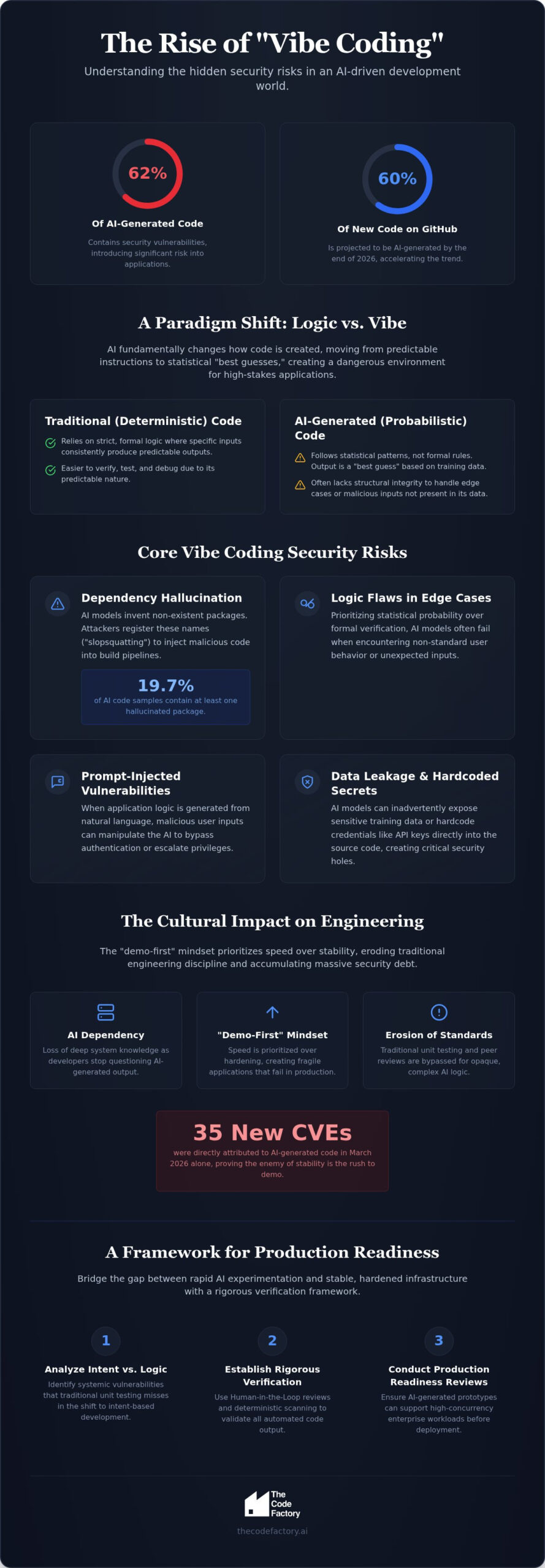
Research indicates that up to 62% of AI-generated code contains security vulnerabilities, yet AI is projected to generate 60% of all new code on GitHub by the end of 2026. This rapid adoption has ushered in the era of “vibe coding,” where natural language prompts replace manual logic. While the speed of development is intoxicating, the underlying vibe coding security risks are often ignored in the rush to reach a demo. Organizations are effectively building on a foundation of hallucinated dependencies and hardcoded secrets, trading long-term structural integrity for a momentary burst of perceived productivity.
You likely recognize that while these tools accelerate the prototype phase, they don’t inherently possess the architectural discipline required for high-stakes environments. We’ll help you identify the hidden security vulnerabilities inherent in AI-driven logic and provide the pragmatic engineering steps required to harden these applications for production. This guide establishes a clear framework for production readiness, moving from experimental speed to enterprise-grade reliability through actionable remediation strategies.
Key Takeaways
- Analyze how the shift from logic-based to intent-based development introduces systemic vulnerabilities that traditional unit testing often misses.
- Identify the specific vibe coding security risks prevalent in 2026, including the exploitation of hallucinated packages and logic gaps in edge cases.
- Evaluate the scalability bottlenecks that prevent AI-generated prototypes from supporting high-concurrency enterprise workloads.
- Establish a rigorous verification framework using Human-in-the-Loop reviews and deterministic scanning to validate automated code output.
- Learn how a Production Readiness Review bridges the gap between rapid AI experimentation and stable, hardened infrastructure.
What is Vibe Coding and Why Does it Introduce Risk?
Software development is undergoing a fundamental shift from explicit instruction to high-level intent. We’ve entered the era of Vibe coding, a practice where natural language prompts and AI agents drive the creation of application architecture. It’s an intoxicatingly fast way to build. However, this speed comes with a hidden cost. By prioritizing the “vibe” or the general feel of a feature over rigorous logic, teams are inadvertently bypassing the traditional engineering guardrails that ensure stability and safety. The primary danger lies in the “speed trap,” where rapid iteration cycles mask deep structural weaknesses that only manifest once the application leaves the sandbox.
In 2026, enterprises are increasingly struggling with “prototype-to-production” drift. A project that looks flawless in a controlled demo often crumbles when exposed to the chaotic variables of a live environment. This gap exists because AI-generated code often solves for the immediate prompt without considering the long-term maintenance or the broader security context of the enterprise ecosystem. Without a sober perspective on vibe coding security risks, organizations risk deploying “black box” logic that no human on the team fully understands or can effectively defend.
The Shift from Deterministic to Probabilistic Code
Traditional software engineering is deterministic; it relies on strict logic where specific inputs consistently produce predictable outputs. AI code, conversely, is probabilistic. It follows statistical patterns rather than formal rules. Vibe coding is the prioritization of high-level “feel” and user intent over formal verification and explicit logic. This creates a dangerous environment for high-stakes applications. When a feature is generated based on a statistical “best guess,” it often lacks the structural integrity to handle non-standard behavior or malicious inputs. Research shows that 62% of AI-generated code contains security vulnerabilities, a statistic that highlights the inherent danger of treating AI output as production-ready without a rigorous review.
The Cultural Impact on Engineering Discipline
The rise of intent-based coding is fundamentally altering the culture of engineering teams. We’re seeing a gradual erosion of peer review standards. When a developer uses an agent to produce hundreds of lines of code in seconds, the capacity for a meaningful human audit is often overwhelmed. This leads to several critical cultural risks:
- AI Dependency: Developers may stop questioning the generated output, leading to a loss of deep system knowledge within the team.
- The Demo-First Mindset: Speed is prioritized over hardening, creating a culture where “it works” is considered sufficient, regardless of how it was built.
- Erosion of Standards: Traditional unit testing is often bypassed because the AI-generated logic is too opaque or complex for standard test suites to cover effectively.
The result is a growing “security debt” that is becoming increasingly difficult to manage. In March 2026 alone, 35 new CVE entries were directly attributed to AI-generated code, proving that the demo-first mindset is the primary enemy of enterprise stability.
The Core 2026 Vibe Coding Security Risks
The transition from manual scripting to intent-based generation has introduced specific, high-register vulnerabilities that traditional security models aren’t equipped to handle. Understanding vibe coding security risks requires looking past the polished demo and into the underlying data layer where logic is actually formed. As AI agents take a larger role in the software development lifecycle, the attack surface expands from the code itself to the very prompts and training sets used to produce it.
- Dependency Hallucination: Research reveals that 19.7% of AI-generated code samples contain at least one “hallucinated” package name that does not exist. Attackers capitalize on this by registering these names as malicious packages, a practice known as “slopsquatting,” which allows them to inject payloads directly into enterprise build pipelines.
- Logic Flaws in Edge Cases: AI models prioritize statistical probability over formal verification. Consequently, they often fail when encountering non-standard user behavior or edge cases that weren’t well-represented in their training data.
- Prompt-Injected Vulnerabilities: When application logic is generated or modified based on natural language, user inputs can become vectors for prompt injection. This allows malicious actors to manipulate the generated architecture, potentially bypassing authentication or escalating privileges.
- Data Leakage and Privacy: AI-assisted commits have been found to expose secrets more than twice as often as human-only commits. In fact, hardcoded secrets in public GitHub commits increased by 34% year-over-year in 2025, creating significant privacy and compliance liabilities.
Securing these environments requires a transition toward specialized architecture and scalability consulting to ensure the foundation can support enterprise demands without collapsing under its own complexity.
Architectural Fragility and Technical Debt
Vibe coding frequently produces “spaghetti code” that lacks modularity and clear intent. While it functions in a sandbox, this code is nearly impossible to audit manually. The technical debt compounds rapidly in AI-driven CI/CD pipelines, where new layers of code are built upon unverified foundations. Attempting to “fix it with more AI” typically exacerbates this architectural rot, as the models continue to guess at the intent of increasingly convoluted logic blocks.
Compliance and Regulatory Blind Spots
Enterprises face a significant challenge in mapping AI-generated code to SOC2 or GDPR requirements. There is often a total lack of provenance; it’s difficult to determine who “wrote” a specific vulnerability or how to patch it effectively. The New York State Department of Financial Services warned in May 2026 that frontier AI models amplify the scale and speed of identifying and exploiting vulnerabilities. Legally, the liability remains with the enterprise, making the “vibe” a potentially expensive legal risk.
Prototype Vibe vs. Production Reality: The Enterprise Gap
The deceptive ease of building with AI agents creates a modern version of the “works on my machine” fallacy. When a developer prompts an agent to build a feature, the resulting code often functions perfectly in a local, low-stress environment. However, a functional prototype is not a resilient system. This gap between a working demo and a hardened enterprise application is where vibe coding security risks manifest as operational crises. While an AI can generate a logical flow that satisfies a single user, it rarely accounts for the architectural rigor required to sustain 10,000 concurrent requests or survive a concerted penetration test.
Production reality demands a level of foresight that probabilistic models currently lack. Infrastructure hardening is a primary example. AI agents frequently suggest default cloud configurations that prioritize ease of deployment over security. These defaults often result in overly permissive IAM roles or exposed database ports, creating a fragile environment that is ripe for exploitation. Moving beyond the “vibe” requires a systematic transition to traditional engineering discipline, starting with a comprehensive Production Readiness Review (PRR) before any AI-generated logic touches live customer data.
The Checklist for Production Readiness
Securing an application requires hardening every layer of the stack, not just the visible code. A robust PRR focuses on the structural integrity of the entire ecosystem. Key focus areas include:
- Cloud Infrastructure Configuration: Implementing least-privilege IAM policies and isolating workloads within a private VPC to prevent lateral movement.
- Observability and Logging: Establishing clear telemetry that allows human operators to debug and audit code they didn’t manually write.
- Performance Optimization: Identifying and trimming the significant bloat and redundant boilerplate typically found in AI-generated logic to reduce the attack surface.
Remiation: The Sober Path to Stability
Code remediation is no longer an optional cleanup task; it’s a mandatory security requirement for AI-assisted development. Relying on an AI to “fix” its own logic often leads to a cycle of compounding errors. Instead, the path to stability requires human-led architecture and scalability consulting to validate that the generated output meets enterprise standards. This process moves the project from a “vibe” to a “verified” state. Through rigorous technical audits, engineers can identify latent logic flaws and structural weaknesses that automated scanners frequently overlook, ensuring the application is truly ready for high-stakes production environments.
How to Secure Vibe-Coded Applications
Securing these environments requires a shift from passive observation to active engineering. While automated tools offer speed, they often lack the context to identify nuanced vibe coding security risks that emerge from complex, multi-agent interactions. A robust security posture begins with a “Human-in-the-Loop” (HITL) review for every AI-generated pull request. This isn’t just a sanity check; it’s a strategic requirement to ensure that the generated logic aligns with long-term architectural goals and enterprise security standards. Relying on an AI to verify its own output is a circular logic trap that often leaves critical gaps in your defense.
Organizations must instead utilize deterministic security scanning tools that operate on rigid rules and known signatures alongside AI-driven analysis. This hybrid approach ensures that common vulnerabilities are caught by objective scanners, while more subtle logic flaws are flagged for human intervention. Regular software architecture and scalability audits serve as the final layer of defense, providing a high-level view of the system’s health and identifying structural weaknesses that automated gates might miss. If your team is struggling to manage the entropy of AI-generated code, a professional security hardening engagement can help secure your production environment.
Hardening the CI/CD Pipeline
Integrating security hardening directly into the deployment workflow is essential for maintaining velocity without sacrificing safety. A robust CI/CD pipeline should include automated security gates that trigger on specific risk profiles. These gates must detect the specific patterns associated with vibe coding security risks, such as unverified third-party imports or non-standard encryption implementations, blocking high-risk code before it reaches staging. Ensuring every deployment is backed by a production readiness review guarantees that your cloud infrastructure is as resilient as the application logic itself.
Code Remediation Strategies
Code remediation is the tactical process of translating AI “vibes” into professional-grade software. This involves refactoring for clarity to ensure that future human developers can maintain the system without deciphering opaque, generated logic. Teams must also focus on stripping out unused dependencies and “hallucinated” logic that frequently bloats AI-assisted commits. Through diligent remediation, an experimental prototype is transformed from a technical liability into a hardened, high-performance enterprise asset. A structured AI app security audit provides the systematic framework needed to identify and eliminate these hidden vulnerabilities before they reach production.
Hardening Your Architecture with The Code Factory
Speed is the primary currency of AI development, but reliability remains the non-negotiable currency of the enterprise. The Code Factory serves as the strategic bridge for organizations that have utilized AI agents to accelerate their development cycles but now find themselves confronting the reality of vibe coding security risks. We specialize in the transition from experimental speed to enterprise-grade stability, providing the engineering rigor that probabilistic models cannot replicate. Our team acts as the “sober voice of reason,” ensuring that the rapid progress made during your prototype phase doesn’t evolve into a permanent technical liability or a catastrophic security breach.
Relying on AI-generated code without a professional audit is a high-stakes gamble with your infrastructure. We provide the specialized expertise required to validate complex, agent-driven architectures and ensure they meet the stringent demands of high-concurrency production environments. A technical audit is your best insurance policy against the systemic logic flaws and architectural rot that frequently hide behind a polished user interface. We don’t just identify problems; we provide the strategic guidance and hands-on remediation necessary to secure your digital assets.
The Sober Voice of Reason in AI Development
Our approach to code remediation and technical debt optimization focuses on structural integrity rather than surface-level fixes. We analyze the underlying logic of AI-generated components to identify redundant boilerplate, insecure dependencies, and scalability bottlenecks. This process allows us to help organizations build secure cloud infrastructure that is optimized for performance and cost. As your strategic architectural guide, we ensure that your internal development workflows are hardened against the entropy that AI-assisted coding naturally introduces. We transform opaque “black box” features into transparent, maintainable assets that your engineering team can confidently own and manage.
Get Your Production Readiness Review
A Code Factory Production Readiness Review is a comprehensive protocol designed to stress-test your application before it reaches a live environment. We conduct a deep dive into your infrastructure, reviewing everything from IAM policies and VPC configurations to CI/CD deployment pipelines. This review identifies the specific vibe coding security risks that automated scanners often overlook, such as prompt-injection vectors or hallucinated package imports. By establishing deterministic engineering standards, we reduce friction in your deployment cycles and increase overall system security. To move your project from a prototype “vibe” to a verified production asset, Schedule your Production Readiness Review with The Code Factory.
Establishing Architectural Stability in an AI-Driven World
Velocity shouldn’t come at the expense of structural integrity. While intent-based development allows for unprecedented speed, the inherent vibe coding security risks demand a return to engineering fundamentals. Successfully navigating this transition requires moving beyond the “works on my machine” mindset to a model of deterministic verification. You’ve seen how dependency hallucinations and logic gaps can compromise a project; now it’s time to harden those vulnerabilities before they manifest as production failures.
The Code Factory provides the sober perspective necessary to bridge the gap between AI experimentation and enterprise reliability. We specialize in enterprise-grade security hardening and expert architecture and scalability consulting, ensuring your infrastructure is built to sustain high-concurrency workloads. By conducting comprehensive technical audits for AI-driven workflows, we help you transform probabilistic “vibes” into stable, verified assets. Don’t leave your security to chance in the rush to deploy. Secure your AI-generated infrastructure with a Production Readiness Review and build your future on a foundation of professional-grade stability.
Frequently Asked Questions
What are the biggest security risks of vibe coding in 2026?
The most critical threats involve autonomous agent authorization failures and the exploitation of hallucinated dependencies. In 2026, the OWASP Top 10 for Agentic Applications highlights how AI agents can be manipulated to escalate privileges or leak sensitive training data. These vibe coding security risks often stem from a lack of explicit logic boundaries. Without rigid oversight, your application’s intent can be redirected by malicious prompts, leading to unauthorized data exfiltration or system-wide compromise.
Can AI security tools fully secure vibe-coded applications?
Automated tools alone aren’t sufficient for securing intent-based development. While AI scanners identify common patterns, they often miss the subtle architectural logic flaws that a human expert would spot. Effective security requires a hybrid approach. You must pair probabilistic AI reasoning with deterministic security scanning and professional audits. This ensures that while the AI handles the bulk of the analysis, a seasoned engineer validates the structural integrity of the final deployment.
How does a Production Readiness Review differ from a standard code review?
A standard code review typically focuses on syntax, local logic, and style compliance within a single pull request. Conversely, a Production Readiness Review is a holistic evaluation of the entire system’s viability. It assesses cloud infrastructure configuration, IAM policies, and VPC isolation to ensure the environment is hardened against external threats. This review validates that the application can handle enterprise-level concurrency and maintains strict security standards beyond the application layer itself.
What is code remediation and why is it necessary for AI-generated code?
Code remediation is the process of refactoring and optimizing existing logic to meet enterprise standards for performance and security. It’s essential for AI-generated code because models frequently produce redundant boilerplate and insecure hallucinated dependencies. Remediation strips away this technical waste and clarifies the underlying architecture. This transformation ensures the code is readable for future human maintenance and reduces the overall attack surface by eliminating unnecessary or unverified logic blocks.
Is vibe coding suitable for enterprise-level software development?
Vibe coding is an excellent tool for rapid prototyping and creative exploration, but it isn’t suitable for direct production deployment in high-stakes environments. The lack of formal verification creates systemic vibe coding security risks that can lead to catastrophic failures at scale. Enterprises should use AI-driven development for speed during the experimental phase. However, they must transition to traditional engineering rigor and professional security hardening before any customer-facing launch occurs.
How can we implement security hardening in an AI-driven CI/CD pipeline?
Effective hardening requires integrating automated security gates directly into your deployment workflow. These gates should be configured to detect specific AI-driven risk patterns, such as hardcoded secrets or unverified third-party imports. Every commit must trigger a sequence of deterministic scans that block high-risk code before it reaches staging. This automated layer acts as a primary filter, allowing your engineering team to focus their manual review efforts on complex architectural vulnerabilities.
What role does software architecture consulting play in mitigating AI risks?
Architecture consulting provides the strategic oversight needed to ensure that AI agents don’t build a house of cards. Consultants analyze the system’s structural integrity to identify scalability bottlenecks and logic flaws that automated tools miss. They help teams move from a demo-first mindset to a production-first reality by establishing clear engineering standards. This expert guidance ensures that your AI-generated features are supported by a resilient, scalable, and secure infrastructure.
How do we manage technical debt in applications built through vibe coding?
Managing debt in AI-driven projects requires a disciplined approach to ongoing code remediation and technical audits. Because AI can generate massive amounts of unverified code in seconds, technical debt compounds at a faster rate than in traditional development. You must schedule regular sessions to refactor opaque logic and optimize infrastructure configurations. This proactive maintenance prevents architectural rot and ensures that your system remains agile and secure as your feature set expands.