


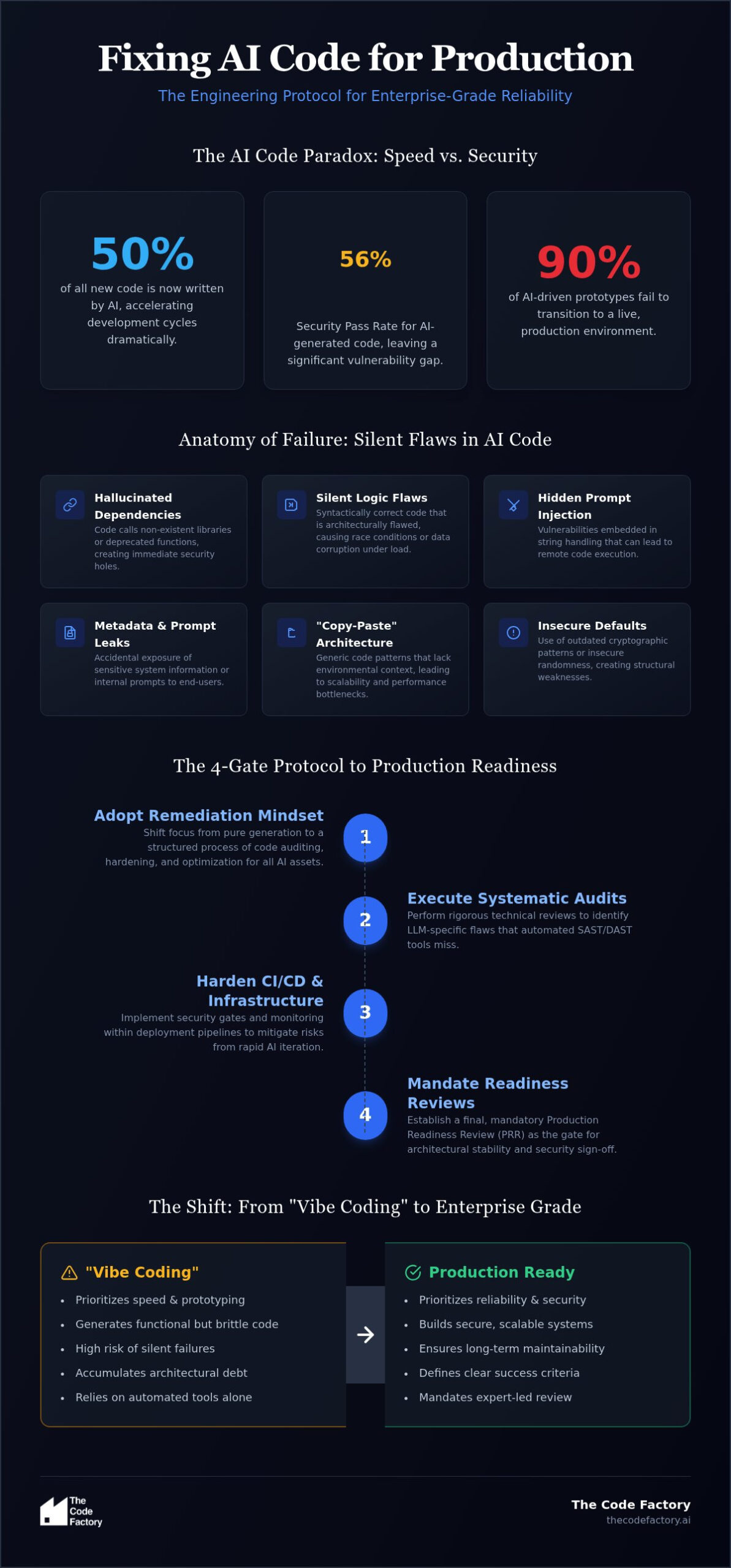
AI now writes approximately 50% of all committed code, yet recent 2026 data reveals a sobering reality: the security pass rate for these generated blocks has stagnated at just 56%. While “vibe coding” allows for unprecedented speed in prototyping, it often leaves behind a trail of silent logic flaws and architectural debt that traditional automated tools simply cannot catch. Transitioning from a functional prototype to an enterprise-grade system requires more than just a cursory review; it demands a rigorous engineering methodology for fixing AI code for production.
You’ve likely felt the anxiety of deploying a feature that feels right but lacks the structural integrity your infrastructure requires. This article provides a repeatable protocol for code hardening, moving beyond the experimental stage to achieve true reliability. We’ll examine the critical gates of the 2026 Engineering Protocol, from identifying hidden prompt injection vulnerabilities to implementing the Model Context Protocol security standards. By the end, you’ll have clear criteria for what constitutes production-ready software in an AI-driven environment.
Key Takeaways
- Bridge the gap between generative “vibe coding” and enterprise-grade reliability by adopting a structured remediation mindset for all AI-generated assets.
- Identify silent logic flaws and system metadata leaks that are essential checkpoints when fixing AI code for production in high-stakes environments.
- Execute a systematic engineering protocol that utilizes Production Readiness Reviews as the mandatory final gate for architectural stability.
- Harden your CI/CD pipelines and cloud infrastructure to mitigate the security risks inherent in rapid AI iteration and the adoption of agentic tooling.
- Define clear success criteria using remediation roadmaps that transform experimental prototypes into secure, scalable, and maintainable software.
The Prototype-to-Production Gap in AI Engineering
The industry has reached a tipping point where AI models generate approximately half of all committed code, yet 90% of AI-driven prototypes fail to survive the transition to a live environment. This “Last Mile” problem isn’t a failure of creativity but a failure of engineering rigor. Generative tools excel at “vibe coding,” a process that prioritizes immediate functional output over long-term maintainability. However, the software development lifecycle demands more than just code that runs; it requires code that is secure, scalable, and resilient. Traditional security tools like SAST and DAST often fail to identify LLM-specific logic flaws, leaving organizations vulnerable to systemic failures and massive technical debt.
The Risk of Unmediated AI Code
Unmediated AI code frequently introduces “hallucinated” dependencies, calling upon non-existent libraries or deprecated functions that create immediate security holes. Beyond these obvious errors, suboptimal algorithmic choices can silently throttle enterprise scalability, leading to performance bottlenecks that only appear under heavy load. We define the Prototype-to-Production Gap as the delta between functional output and enterprise-grade reliability. Without a systematic approach to fixing AI code for production, these small inconsistencies compound into structural weaknesses that threaten the integrity of the entire system. Logic flaws that automated scanners miss can lead to catastrophic data leaks or unauthorized access, especially when AI agents are granted tool-use capabilities.
Shifting from Generation to Remediation
The era of prompt engineering as a standalone solution is ending. To reach production, teams must pivot toward code remediation and optimization. This shift involves moving beyond the initial generation phase to apply rigorous technical audits and architectural oversight. Establishing enterprise standards for code quality before the first deploy is no longer optional; it’s a requirement for stability. Professional technical audits in 2026 serve as the essential filter, ensuring that every line of code meets the same security and performance benchmarks as manually written software. This transition from creation to hardening is the only path toward sustainable AI implementation. It requires a specialized fixer who understands the nuances of high-stakes environments and possesses the foresight to prevent issues before they manifest.
Identifying Common Vulnerabilities in AI-Generated Code
In 2026, software vulnerabilities have become the top entry point for data breaches, accounting for 31% of incidents. This risk is amplified by the fact that AI-generated code samples from major LLMs show a confirmed vulnerability rate of nearly 26%. The Cybersecurity Risks of AI-Generated Code go beyond simple syntax errors. They include logic-based security flaws that standard scanners often overlook, such as system prompt leakage and the accidental exposure of sensitive system metadata. These issues make the process of fixing AI code for production a non-negotiable step in the development lifecycle. LLMs frequently rely on outdated cryptographic patterns or insecure randomness, creating structural weaknesses that are invisible until they are exploited in a live environment.
Recent disclosures, such as CVE-2025-53773, highlight how hidden prompt injections can lead to remote code execution through seemingly benign pull request descriptions. This demonstrates that vulnerabilities are often embedded directly in the generated string-handling logic. Without a sober, expert-led review, these patterns move from the prototype stage into your core infrastructure, creating a significant security debt that grows with every new feature.
The Silent Failures: Logic and Context Errors
AI agents frequently misunderstand the nuanced business logic required for enterprise stability. They tend to generate “copy-paste” architecture based on generic training data, which lacks the context of your specific environment. A common example is code that appears functional during unit testing but triggers a race condition when subjected to high-concurrency production traffic. These logic errors are difficult to detect with automated scanners because the code is syntactically correct but architecturally flawed. When an agentic tool misunderstands a constraint, it doesn’t just fail; it fails in a way that can compromise your entire data layer.
Security Hardening for AI-Driven Workflows
Hardening your application requires a proactive approach to input sanitization and string handling. Developers must be vigilant against “ASCII smuggling” and Unicode-based injection, where hidden characters manipulate how the LLM interprets commands. Implementing zero-trust principles during the remediation phase ensures that no generated block is trusted without manual verification. This includes auditing for insecure randomness and cryptographic weaknesses that LLMs often default to. For organizations looking to bridge this gap, a comprehensive security hardening strategy is the only way to ensure that rapid iteration doesn’t lead to long-term liability.
Systematic Protocol for Fixing AI Code for Production
The transition from an AI-generated prototype to a stable enterprise asset requires a disciplined, multi-stage remediation framework. Relying on “continuous inspection” tools alone is insufficient; engineers need a manual, step-by-step protocol for fixing AI code for production to ensure structural integrity. This 2026 protocol establishes the mandatory gates every block of generated code must pass before deployment. By treating AI output as raw material rather than a finished product, organizations can mitigate the 44% increased risk of outages associated with unverified generative code.
- Production Readiness Review: Conduct a high-level architectural audit to confirm the code aligns with existing infrastructure and security policies.
- Dependency Audit: Verify all external libraries, specifically auditing for the Model Context Protocol (MCP) standards, which saw over 30 CVEs filed in early 2026.
- Refactoring for Scalability: Restructure logic to eliminate technical debt and ensure the code can handle enterprise-level concurrency.
- Security Hardening: Apply patches for logic-based vulnerabilities and prompt-injection risks identified during the initial audit phase.
- Load Testing: Execute stress tests to identify performance bottlenecks that only manifest under production-level traffic.
The Remediation Phase: Beyond Simple Bug Fixing
Remediation is not merely about patching errors; it’s about transforming a functional output into a maintainable asset. This involves refactoring code to comply with enterprise architecture standards and optimizing token usage for agentic calls to reduce operational overhead. To verify AI-generated logic against a source-of-truth specification, engineers should map every generated function to a documented business requirement, ensuring no “hallucinated” logic persists. This process ensures that the resulting software is not just working, but optimized for the long-term health of the codebase. It’s the difference between a fragile script and a resilient service.
Verification and Validation Protocols
Rigorous testing is the final line of defense. While automated tools are useful, they often ignore the edge cases that AI models consistently miss. Implementing unit tests specifically for these boundary conditions is a critical component of fixing AI code for production. A human-in-the-loop code review remains essential for high-stakes applications, as it provides the contextual oversight that LLMs lack. Finally, integrate these remediation standards into your CI/CD pipelines to automatically enforce quality gates, preventing unvetted AI code from ever reaching a live environment. This structured approach moves the organization from reactive patching to proactive engineering excellence.
Hardening Infrastructure and CI/CD for AI-Driven Workflows
Most discussions regarding AI security focus exclusively on the model’s output, yet the infrastructure supporting that output is often the weakest link. In 2026, where software vulnerabilities are the top entry point for data breaches, an unhardened cloud environment is an invitation for disaster. Establishing a resilient framework for fixing AI code for production requires a shift from viewing infrastructure as a static container to treating it as a dynamic, secure ecosystem. Infrastructure as Code (IaC) acts as the foundational safety net in this process. By defining environments through code, organizations can enforce security policies automatically, preventing the configuration drift that often accompanies rapid AI prototyping.
Cloud Configuration and Security Hardening
Isolation is the primary defense against the unpredictable nature of AI-generated logic. AI execution environments must be sandboxed to prevent lateral movement in the event of an exploit, ensuring that a compromised agent cannot access sensitive core systems. Identity and Access Management (IAM) for AI agents needs to follow the principle of least privilege, granting access only to the specific metadata or databases required for a specific task. Furthermore, infrastructure must be optimized to handle the unique latency requirements of LLM integration. This involves balancing high-performance compute needs with strict security protocols to ensure that speed does not come at the cost of structural integrity.
The Role of CI/CD in AI Quality Control
The CI/CD pipeline serves as the ultimate quality gate for AI-driven development. It’s not enough to run standard SAST/DAST scans; the pipeline must include custom logic scanners designed to detect AI-specific patterns and prompt-injection risks. Automating the rollback of any code that fails a production readiness review is essential for maintaining system stability. This level of automation ensures auditability and compliance, providing a clear record of every change and its security status. For teams struggling to secure their deployment workflows, our cloud infrastructure configuration services provide the expert oversight needed to stabilize AI-driven environments and mitigate the risks of “vibe coding.”
A secure pipeline also integrates automated security gates that target AI-generated flaws specifically. These gates should verify that all dependencies comply with the latest Model Context Protocol (MCP) security standards before any code reaches the staging environment. By enforcing these remediation standards automatically, you reduce the risk of production outages and ensure that every commit meets your enterprise-grade reliability criteria. This structured approach moves the organization from reactive patching to proactive engineering excellence, turning the speed of AI generation into a sustainable competitive advantage.
Implementing an Enterprise-Grade Production Readiness Review
The final gate in the 2026 Engineering Protocol isn’t an automated script; it’s a rigorous, human-led Production Readiness Review. In an era where 82% of organizations carry significant security debt, simply pushing “functional” code is a strategic risk. A professional review provides a deep-dive analysis of how generated logic interacts with your specific cloud environment, data layers, and existing security protocols. When fixing AI code for production, this review serves as the definitive boundary between a fragile experimental prototype and a resilient enterprise asset. It’s the sober voice of reason that ensures your speed doesn’t lead to systemic failure.
The outcomes of this process move beyond simple bug reports. You’ll receive a comprehensive suite of deliverables designed to stabilize your infrastructure. These include detailed remediation roadmaps that prioritize critical architectural fixes, security audits targeting LLM-specific logic flaws, and scalability plans to ensure performance remains stable under enterprise-level concurrency. This shift in focus moves your AI initiatives from the liability column to the asset column. By hardening your code before it reaches a live environment, you achieve a measurable ROI through reduced emergency patching costs and the total elimination of preventable production outages.
Why Hire a Specialized Engineering Fixer?
Internal development teams are often incentivized by speed, which can lead to the “vibe coding” traps mentioned earlier. Hiring a specialized engineering fixer provides the external, sober perspective necessary to identify high-stakes risks that internal teams might overlook. We don’t just find problems; we provide the architectural oversight required to solve them. The Code Factory acts as your strategic guide, bridging the gap between rapid AI iteration and enterprise-grade reliability. This partnership reduces your time-to-market by avoiding the catastrophic post-launch failures that often plague unvetted AI deployments.
Next Steps for Enterprise Leaders
Transitioning to a secure AI workflow starts with a decision to prioritize engineering rigor over experimental hype. To initiate a code remediation project for your existing AI prototypes, you must first acknowledge the delta between “it runs” and “it’s production-ready.” Integrating Production Readiness Reviews into your standard software development lifecycle ensures that every AI-generated feature passes through a mandatory gate of technical audit and optimization. This disciplined approach is the only way to scale new technology without compromising your structural integrity. If you’re ready to secure your technical future and harden your infrastructure, Schedule a Production Readiness Review with The Code Factory to begin your remediation journey.
Securing the Future of AI-Driven Software
AI’s speed is a significant competitive advantage, but it shouldn’t come at the cost of your system’s structural integrity. The 2026 Engineering Protocol provides the framework needed to move beyond experimental prototypes and toward enterprise-grade reliability. By shifting from generation to remediation, you address silent logic flaws and security vulnerabilities before they manifest as production outages. Hardening your cloud infrastructure and CI/CD pipelines ensures that rapid iteration remains a sustainable strategy rather than a source of growing technical debt.
The transition to stable software requires more than automated tools; it demands a disciplined approach to fixing AI code for production. Implementing a human-led Production Readiness Review serves as the essential final gate for any high-stakes application. The Code Factory is specialized in Enterprise Engineering and Infrastructure Optimization, providing the expertise in Security Hardening and CI/CD Pipeline Deployment your organization needs to scale safely. It’s time to move from “vibe coding” to rigorous engineering standards that protect your long-term roadmap.
Secure your AI application for production with The Code Factory and transform your generative prototypes into durable business assets. You have the tools to build faster than ever; now, ensure you’re building to last.
Frequently Asked Questions
What is the biggest risk of deploying AI-generated code without remediation?
The primary risk is the accumulation of silent logic flaws that bypass traditional testing, leading to a 25.7% vulnerability rate in AI-generated samples. Deploying unmediated code often results in critical security breaches or performance collapses under load. Without a systematic protocol for fixing AI code for production, these errors remain hidden until they are exploited. Organizations face massive remediation costs later if they ignore these structural weaknesses during the initial development phase.
Can automated tools fix all security vulnerabilities in AI code?
Automated tools cannot address the nuanced architectural risks inherent in generative models. While scanners catch standard syntax errors, the average security pass rate for AI code has remained stagnant at 56% because tools miss complex logic vulnerabilities. Human expertise is required to identify hallucinated library calls and prompt injection pathways. Relying solely on automation creates a false sense of security while leaving your core infrastructure exposed to sophisticated exploits.
How does a Production Readiness Review differ from a standard code review?
A Production Readiness Review is a comprehensive architectural audit that evaluates how code interacts with your entire cloud ecosystem. Unlike standard reviews that focus on syntax or style, this process examines security hardening, infrastructure configuration, and scalability constraints. It serves as the final gate to ensure software meets enterprise standards before deployment. The Code Factory provides these reviews to bridge the gap between rapid prototyping and long-term technical stability.
What are the most common logic flaws found in AI-generated software?
Common flaws include race conditions, hallucinated dependencies, and insecure string handling that allows for system prompt leakage. These issues are often copied directly from training data that lacks context for your specific environment. Recent 2026 data shows that prompt injection remains one of the most consistently exploitable bug types across all major models. These logic errors require manual remediation to ensure the software functions reliably in high-stakes production environments.
How can I secure my CI/CD pipeline for AI-driven development?
Securing your pipeline requires integrating custom logic scanners and automated security gates that specifically target AI-generated flaws. You should implement the Model Context Protocol (MCP) standards to govern how agents interact with your APIs and tools. Automating rollbacks for code that fails readiness checks prevents unvetted changes from reaching live servers. This structured approach ensures that every commit is audited for security and compliance before it impacts your users.
Is AI code remediation worth the investment for smaller applications?
Remediation is essential for any application that handles sensitive data or requires consistent uptime. Software vulnerabilities are now the top entry point for data breaches, accounting for 31% of incidents in 2026. Investing in fixing AI code for production early prevents the exponential growth of technical debt. Smaller teams often find that the cost of a security breach far outweighs the initial investment in professional code optimization and architecture consulting.
What is “vibe coding” and why is it dangerous for enterprises?
“Vibe coding” refers to the practice of accepting AI-generated code because it appears functional, without verifying its architectural integrity or security. This approach is dangerous for enterprises because it prioritizes experimental speed over reliability, increasing the risk of outages by 44%. It creates a fragile codebase full of hidden dependencies and logic gaps. Professional engineering remediation is the only way to transform these vibe-based prototypes into secure, scalable software.
How do I ensure my AI application scales effectively in the cloud?
Effective scaling depends on precise cloud infrastructure configuration and the isolation of AI execution environments. You must sandbox AI agents to prevent lateral movement and optimize IAM roles to follow the principle of least privilege. Infrastructure as Code (IaC) provides the necessary safety net by ensuring your environment remains consistent and secure. Professional architecture and scalability consulting can help you identify performance bottlenecks before they impact your production traffic.