



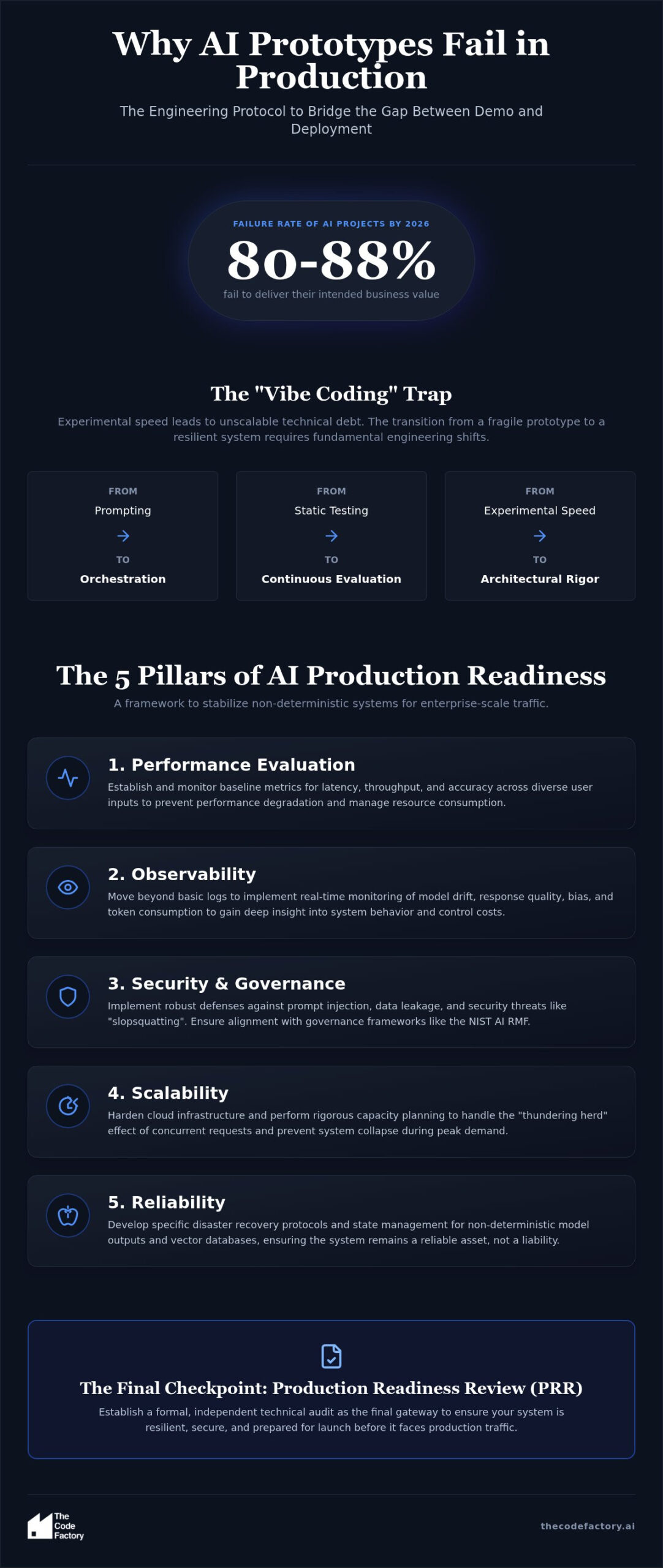
Between 80% and 88% of AI projects in 2026 fail to deliver their intended business value according to recent data from RAND and Gartner. It’s a sobering reality for engineering leaders who’ve spent months refining prototypes only to see them crumble under the weight of production traffic. You likely feel the pressure to innovate at speed, yet you’re haunted by unpredictable latency spikes, hidden security vulnerabilities like “slopsquatting,” and the lack of observability in your RAG pipelines. Achieving true production readiness for AI applications requires more than just a successful demo; it demands a rigorous, strategic engineering transition.
We understand that the shift from experimental “vibe coding” to enterprise-grade reliability is where most initiatives stall. This article provides a definitive engineering protocol to help you reclaim control over your technical debt and stabilize your cloud infrastructure costs. We’ll examine the core pillars of the 2026 Enterprise Engineering Protocol, including code remediation, security hardening, and the architectural shifts necessary to move from a fragile prototype to a resilient, high-stakes production system.
Key Takeaways
- Identify the structural weaknesses inherent in “vibe coding” and why experimental speed frequently leads to unscalable technical debt.
- Implement a five-pillar framework to achieve production readiness for AI applications by prioritizing performance evaluation, accuracy, and operational stability.
- Learn why code remediation and security hardening are mandatory steps for securing non-deterministic logic in enterprise environments.
- Discover how to configure cloud infrastructure to mitigate latency spikes and handle the “thundering herd” effect of concurrent AI requests.
- Establish a formal Production Readiness Review (PRR) protocol as an independent technical audit to ensure your system is resilient before launch.
Why 85% of AI Prototypes Fail the Transition to Production
The transition from a successful proof-of-concept to a stable deployment is where most technical leaders stumble. A 2026 Gartner report confirmed that 88% of AI proofs-of-concept fail to reach wide-scale deployment. This high failure rate often stems from the “vibe coding” trap, where developers prioritize experimental speed over structural integrity. While a few clever prompts might satisfy a demo, they rarely hold up against the rigors of enterprise traffic. Achieving production readiness for AI applications requires moving beyond the “it works on my machine” mentality to a disciplined engineering approach. You must shift your focus from mere creation to long-term maintenance and structural reliability.
Unpredictability is the primary enemy of enterprise-grade software. When a system relies on probabilistic outputs rather than deterministic logic, traditional deployment strategies break down. To bridge the gap between a working prompt and a resilient service, your team must adopt several critical engineering shifts:
- From Prompting to Orchestration: Moving beyond single-turn interactions toward complex, stateful agents.
- From Static Testing to Continuous Evaluation: Implementing real-time monitoring for accuracy and bias.
- From Experimental Speed to Architectural Rigor: Prioritizing security hardening and infrastructure scalability over rapid feature deployment.
The Fragility of Non-Deterministic Systems
Traditional software engineering relies on deterministic outputs; given input A, you always receive output B. AI applications break this paradigm. Standard unit tests fail to capture model drift or the subtle degradation of response quality over time. Relying heavily on third-party LLM stability introduces a massive external dependency that can shift without notice. Engineering leaders must prioritize structural integrity over simple prompt engineering, integrating MLOps principles to manage these probabilistic workflows. Without a strategy to monitor and remediate non-deterministic behavior, your application remains a liability rather than an asset.
The Hidden Costs of Scaling AI Prototypes
Scaling exposes the fiscal and technical gaps that prototypes hide. Token cost explosions can happen overnight without robust fiscal observability and guardrails in place. Many teams discover too late that their Retrieval-Augmented Generation (RAG) architectures suffer from severe latency bottlenecks when subjected to concurrent requests. These performance constraints often lead to “thundering herd” scenarios that crash infrastructure. Addressing these issues requires a shift in perspective. You aren’t just building a feature; you’re hardening a system for 10k requests per second. Realizing production readiness for AI applications necessitates proactive technical debt remediation before the first production user ever logs in.
The Five Pillars of AI Production Readiness
Engineering a stable AI system requires a departure from traditional software deployment cycles. While a standard application might focus on uptime and response codes, production readiness for AI applications demands a multi-vector protocol that accounts for the inherent volatility of large language models. Success isn’t measured by a single successful interaction but by the system’s ability to maintain structural integrity under load. A recent Gartner survey from April 2026 revealed that only 28% of AI use cases fully meet ROI expectations. This gap often exists because teams fail to address the foundational pillars of reliability before they scale.
The 2026 Enterprise Engineering Protocol categorizes readiness into five critical vectors:
- Performance Evaluation: Establishing baseline metrics for latency, throughput, and accuracy across diverse user inputs.
- Observability: Moving beyond basic logs to monitor model drift and real-time token consumption.
- Security and Governance: Implementing defenses against prompt injection and ensuring alignment with frameworks like the NIST AI RMF.
- Scalability: Hardening cloud infrastructure and conducting rigorous capacity planning to prevent system collapse during peak demand.
- Reliability: Developing disaster recovery protocols specifically for non-deterministic model outputs and vector database state management.
For engineering leaders who recognize these complexities, a professional production readiness review provides the necessary diagnostic depth to identify architectural weaknesses before they manifest in a live environment.
Model Performance and RAG Evaluation
Evaluating non-deterministic systems requires a shift in how we define Service Level Indicators (SLIs) and Objectives (SLOs). You can’t simply test for a “correct” answer; you must benchmark the statistical probability of accuracy over thousands of iterations. Automated testing frameworks are now mandatory for measuring RAG performance, specifically focusing on retrieval precision and context relevance. High-stakes environments also require benchmarking inference times across different geographical regions to ensure that global users don’t experience debilitating latency bottlenecks.
Observability Beyond the Application Layer
Standard application monitoring is insufficient for AI workloads. Effective observability must include cost-tagging frameworks that provide granular visibility into LLM spend at the user or feature level. You need to monitor for prompt degradation, where a previously effective instruction begins to yield sub-optimal results due to underlying model updates. Tracing complex AI agent workflows is equally vital. It allows your team to pinpoint exactly where a multi-step reasoning process failed, turning a “black box” failure into a remediable engineering task.
Code Remediation: Hardening AI-Generated Logic
The velocity provided by AI coding assistants is seductive, yet it often obscures a growing mountain of unverified logic. While these tools excel at generating functional snippets, they lack the architectural foresight required for high-stakes environments. This disconnect creates a liability where “vibe coding” sessions produce fragmented, unmaintainable technical debt that looks correct but fails under edge-case stress. Achieving production readiness for AI applications requires a transition from accepting AI-generated outputs at face value to a disciplined process of code remediation and optimization.
The Code Factory approaches this challenge through a lens of structural integrity. Our team specializes in identifying where AI-generated logic diverges from enterprise standards, ensuring that every block of code is not just functional, but resilient and secure. We bridge the gap between rapid prototyping and stable deployment by applying rigorous engineering standards to the non-deterministic outputs of LLMs.
Identifying Vulnerabilities in AI Code
AI-generated code introduces unique security risks that traditional scanners might overlook. A significant threat emerging in 2026 is “slopsquatting,” where an LLM hallucinates a non-existent software package that an attacker has proactively registered with malicious code. Beyond supply chain attacks, AI logic often lacks proper input validation or error handling, creating openings for prompt injection or data leakage. Code remediation is the process of refactoring AI logic for enterprise safety. To mitigate these risks, engineering leaders must implement a multi-layered review protocol that combines automated security scanners (SAST and SCA) with manual technical audits. Relying on automation alone is insufficient; human expertise is required to catch the nuanced logic flaws that AI models frequently repeat.
Refactoring for Scalability and Maintenance
Refactoring AI-generated architecture is essential for long-term performance. Many prototypes suffer from redundant logic or “hallucinated” dependencies that bloat the codebase and complicate the CI/CD pipeline. To ensure production readiness for AI applications, we advocate for “context-first” development. This involves providing AI tools with specific system constraints, performance priorities, and edge cases before code generation begins. Once the code exists, it must be streamlined to remove inefficiencies in token usage and API calls. Establishing enterprise standards for AI-assisted development ensures that your team builds on a foundation of maintainable, scalable logic rather than a collection of disconnected prompts. This proactive hardening transforms a fragile prototype into a durable enterprise asset.
Infrastructure Hardening and Scalability Framework
While model accuracy and code quality are vital, they represent only half of the equation. True production readiness for AI applications depends heavily on the resilience of the surrounding cloud environment. Most failures occur not within the model itself, but in the brittle infrastructure layers that connect the application to its users. Without a hardened foundation, your system remains vulnerable to performance degradation and cost volatility. Engineering leaders must shift from manual environment management to a disciplined, automated infrastructure strategy.
Infrastructure as Code (IaC) is no longer optional; it’s the prerequisite for a reproducible, audit-ready environment. By defining your AI infrastructure through code, you eliminate the risk of manual configuration errors that lead to security gaps. Automated CI/CD deployment pipelines act as a mandatory safety net, ensuring that every update undergoes rigorous security hardening and performance checks before reaching production. This structured approach prevents the “thundering herd” effect, where concurrent AI requests overwhelm unoptimized resources and cause systemic failure. Engineering teams navigating these challenges can benefit from a comprehensive production launch readiness protocol that addresses both infrastructure configuration and LLM-specific deployment risks.
Cloud Configuration and Security Hardening
Securing model endpoints and API keys is a high-stakes task that requires more than basic encryption. You must implement network isolation to protect sensitive data during processing, preventing exposure to the public internet. Robust IAM (Identity and Access Management) policies are required to limit service permissions to the absolute minimum necessary for operation. If you need assistance securing these environments, our team provides specialized cloud infrastructure configuration to ensure your deployment meets enterprise security standards.
Scaling AI Without Infrastructure Bloat
Scaling often leads to massive infrastructure waste if not managed with architectural foresight. Engineering leaders must choose between the flexibility of serverless inference and the raw power of dedicated GPU clusters based on predictable workload patterns. To prevent cost spikes, implement aggressive throttling and rate-limiting strategies that protect your budget from unpredictable usage bursts. Optimizing data pipelines for RAG efficiency is equally critical; reducing the distance between your vector database and inference engine minimizes latency and lowers operational overhead. This ensures your system scales logically rather than reactively, maintaining performance without unnecessary expenditure.
The Production Readiness Review (PRR) Protocol
Deployment is often viewed as a victory, yet without a formal protocol, it is merely the start of a high-stakes liability. An independent technical audit is no longer a luxury for enterprise launches; it is a mandatory safeguard against systemic failure. Internal development teams, often exhausted by the rapid pace of “vibe coding” sessions, may overlook the subtle architectural cracks that scale into million-dollar outages. The Production Readiness Review (PRR) Protocol provides the objective, expert-led scrutiny required to ensure production readiness for AI applications.
The Code Factory methodology bridges the gap between discovery and resolution. We don’t just hand you a list of problems; we provide a clear path from audit to remediation. By integrating PRRs into your existing software delivery lifecycle, you transform reliability into a strategic asset. This disciplined approach ensures that your infrastructure, code, and security frameworks are hardened before the first production request is processed, protecting both your reputation and your bottom line.
Conducting a Software Scalability Audit
A generic load test is insufficient for AI workloads. You must stress test your application under realistic conditions that mirror the non-deterministic nature of user prompts. Identifying architectural bottlenecks, such as unoptimized vector database indexing or slow inference loops, allows you to resolve issues before they impact the end-user experience. Documenting a clear “Definition of Ready” for your AI services establishes a high bar for stability that every deployment must meet. This ensures that production readiness for AI applications is a measurable engineering standard rather than a subjective feeling.
Finalizing the Launch Protocol
The “Go/No-Go” decision matrix serves as your final defensive line. It provides a structured framework to evaluate risk across performance, security, and cost vectors. If a model’s accuracy drops below a specific threshold or latency exceeds established SLOs, the protocol dictates a rollback or remediation phase. Once live, the protocol shifts to post-launch monitoring and continuous improvement, ensuring that model drift and latency spikes are addressed in real-time. To eliminate the uncertainty of your next deployment, secure your launch with The Code Factory Production Readiness Review.
Securing the Path to Enterprise-Grade Reliability
The transition from a functional prototype to a resilient system represents the most significant hurdle in modern software development. Success requires a departure from experimental speed in favor of disciplined code remediation and infrastructure hardening. By focusing on the five pillars of reliability and implementing a formal technical audit, you can transform a volatile experiment into a stable, value-driving asset. The gap between a demo and a deployment is bridged through architectural rigor, not just better prompts.
Don’t let your initiative become another failure statistic. As architecture and scalability experts, The Code Factory offers a global reach for comprehensive enterprise technical audits and specialized AI-generated code remediation. We help you identify hidden vulnerabilities and optimize your cloud configuration before they impact your users. To ensure true production readiness for AI applications in this demanding environment, Book a Production Readiness Review with The Code Factory. Your path to a stable and scalable AI future starts with a commitment to engineering excellence.
Frequently Asked Questions
What is a production readiness review (PRR) for AI?
A PRR is a formal technical audit conducted before deployment to verify a system’s stability, security, and scalability. It goes beyond traditional software checks to include model evaluation and cost guardrails. The Code Factory uses this protocol to identify architectural weaknesses that could lead to outages. It ensures that the transition from prototype to production is managed with engineering rigor rather than optimistic assumptions.
How does AI-generated code impact production security?
AI-generated code often lacks proper input validation and can introduce vulnerabilities like slopsquatting, where non-existent packages are hallucinated. These snippets frequently bypass standard security reviews if they aren’t subjected to rigorous remediation. Attackers exploit these gaps to inject malicious code or leak sensitive data. Hardening these applications requires a multi-layered approach that treats all AI-generated logic as untrusted until it’s verified by professional technical audits.
What are the most common scaling bottlenecks for AI applications?
Scaling bottlenecks typically emerge in RAG architectures where vector database latency and LLM API rate limits collide. Thundering herd scenarios occur when concurrent requests overwhelm unoptimized infrastructure, causing systemic failure. Inefficient data pipelines and a lack of proper caching also degrade performance under load. Addressing these issues requires specialized architecture and scalability consulting to ensure the environment handles high-stakes traffic without collapsing or inflating operational costs.
How do you monitor for model drift in a production environment?
Monitoring model drift involves tracking the statistical distribution of model outputs over time to detect performance degradation. You must establish baseline metrics for accuracy and relevance, then compare live interactions against these benchmarks. Real-time observability tools allow engineering teams to pinpoint when a model begins to provide sub-optimal results due to underlying updates. This process is a core component of maintaining production readiness for AI applications in volatile digital environments.
Can I use a standard DevOps checklist for AI production readiness?
Standard DevOps checklists are insufficient because they assume deterministic software behavior. While uptime and response codes matter, AI applications introduce non-deterministic variables like prompt sensitivity and token cost volatility. You need a specialized protocol that accounts for model evaluation and vector database state management. Relying on a traditional checklist leaves significant gaps in your security and reliability framework, increasing the risk of expensive post-launch failures.
What is code remediation and why is it necessary for AI apps?
Code remediation is the process of refactoring and hardening AI-generated logic to meet enterprise safety and performance standards. It’s necessary because AI assistants often produce redundant logic or insecure code blocks that create long-term technical debt. The Code Factory specializes in this optimization, ensuring that fragmented snippets are transformed into maintainable software assets. Without this step, your application remains a fragile prototype that is vulnerable to security breaches and performance bottlenecks.
How can I control the costs of scaling LLM-based features?
Controlling costs requires implementing granular cost-tagging frameworks and aggressive rate-limiting strategies. You must monitor token consumption at the user or feature level to identify and mitigate usage spikes before they drain your budget. Optimizing prompt efficiency and utilizing caching mechanisms also significantly reduces API overhead. Establishing clear fiscal guardrails during the production readiness for AI applications phase ensures that your scaling remains sustainable and predictable.
What security measures are specific to generative AI applications?
Specific security measures include prompt injection defenses, PII filtering, and robust IAM policies for AI service endpoints. You must also implement network isolation for sensitive data processing to prevent exposure during inference. Defensive strategies should align with frameworks like the NIST AI RMF to ensure comprehensive risk management. These measures protect your application from unique adversarial attacks that target the probabilistic nature of large language models and their training data.