


The AI-generated code that accelerated your development cycle is often the same technical debt that dismantles your production environment on day one. You’re likely feeling the mounting pressure to ship while grappling with the very real fear of post-launch outages or security breaches. It’s a rational anxiety. In a landscape where “Software Supply Chain Failures” top the OWASP Top 10:2025 incidence rates at 5.72%, the stakes for production launch readiness have never been higher. You know that a successful deployment isn’t just about crossing the finish line; it’s about ensuring the platform doesn’t collapse once the users arrive.
This article provides an engineering-led protocol to transform fragile prototypes into resilient enterprise assets. You’ll learn how to navigate the transition from experimental speed to hardened reliability through a pragmatic framework of code remediation and architectural discipline. We’ll examine the specific requirements for securing LLM-based applications, configuring Kubernetes 1.37 infrastructure, and establishing a repeatable deployment pipeline that guarantees stability. By the end of this guide, you’ll have a clear roadmap to achieve a verified, incident-free launch that stands up to the rigors of the 2026 technological landscape.
Key Takeaways
- Learn why the 2026 technological landscape requires a shift from simple functional code to verified operational maturity.
- Master a two-phase protocol for production launch readiness that combines rigorous technical audits with systematic code remediation.
- Identify and resolve the unique structural vulnerabilities inherent in AI-generated software prototypes before they reach a live environment.
- Implement a pragmatic architectural framework that balances immediate deployment pressure with long-term scalability and security hardening.
- Transform your CI/CD pipeline into a robust safety mechanism that ensures every future update maintains enterprise-grade reliability.
What is Production Launch Readiness for Enterprise Systems?
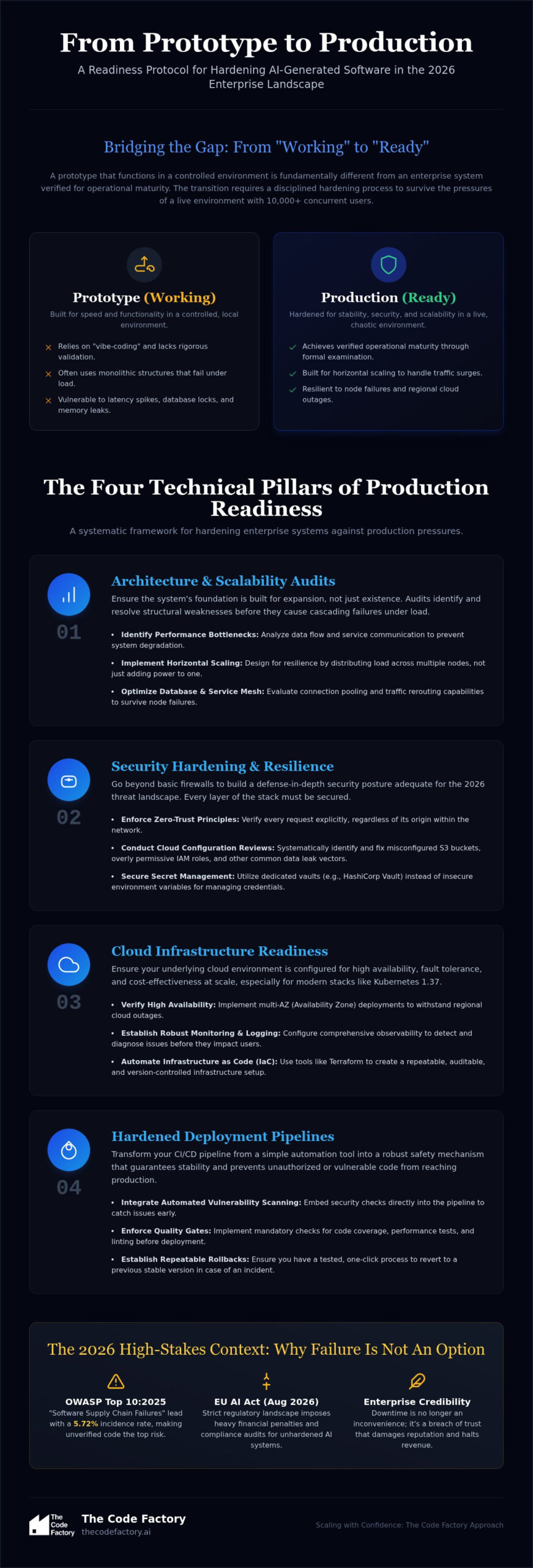
Production launch readiness isn’t a checkbox on a Trello board. It’s a state of verified operational maturity. In an era where AI-generated prototypes are built in hours, the gap between code that runs on a local machine and a system that survives 10,000 concurrent users has widened into a chasm. The financial and reputational cost of “vibe-coding”-the practice of deploying software based on a general sense of functionality rather than rigorous validation-is catastrophic for the modern enterprise. High-stakes applications require a fundamental shift from focusing on functional code to building resilient infrastructure that can withstand the pressures of a live environment.
The Difference Between “Working” and “Ready”
A prototype that functions in a controlled development environment often disintegrates when exposed to the chaotic variables of a live network. Local environments don’t simulate the latency spikes, database locks, or memory leaks that occur under sustained load. In high-stakes environments, edge-case handling is the difference between a minor log entry and a total system collapse. While a feature-complete product has all the buttons in the right places, a production-ready system has the structural integrity to keep those buttons working during a traffic surge or a regional cloud outage. Production readiness is the bridge between development speed and enterprise stability. This transition is a critical phase in the Software Release Life Cycle, ensuring that software moves beyond the experimental phase into a state of true reliability.
The High-Stakes Context: Why Failure is Not an Option
In 2026, downtime is no longer a mere inconvenience; it’s a breach of trust that carries heavy financial penalties. With the full implementation of the EU AI Act on August 2, 2026, and the finalized OWASP Top 10:2025 standards, the regulatory landscape has become a minefield for unhardened launches. An outage doesn’t just halt revenue. It triggers compliance audits, exposes security vulnerabilities, and damages enterprise credibility. The industry is moving away from the “move fast and break things” mantra. Instead, the most successful organizations move fast with discipline. They understand that production launch readiness is an engineering requirement, not a marketing milestone. Failure to harden a system before launch isn’t just a technical oversight. It’s a strategic risk that can end a product’s lifecycle before it truly begins.
The Technical Pillars of Production Readiness
Achieving production launch readiness requires more than a stable codebase. It demands a formal examination of a program to ensure it can withstand the pressures of a live environment. We categorize this examination into four technical pillars: architecture, security, cloud infrastructure, and deployment pipelines. Each pillar must be hardened individually to create a system that is collectively resilient.
Architecture and Scalability Audits
Prototypes often rely on monolithic structures that collapse under concurrent load. An audit identifies bottlenecks in data flow and service communication before they trigger a system failure. While vertical scaling provides a temporary fix by adding more power to a single node, high-stakes apps require horizontal scaling strategies for true resilience. Engaging in software architecture consulting prevents post-launch performance degradation by ensuring your foundation is built for expansion, not just existence. A robust audit evaluates how your database handles connection pooling and whether your service mesh can reroute traffic during a node failure.
Security Hardening and Infrastructure Resilience
Basic firewalls are insufficient for the 2026 threat landscape. You must implement zero-trust principles throughout your production environment. This means verifying every request, regardless of its origin. A comprehensive cloud security configuration review identifies misconfigured S3 buckets or overly permissive IAM roles that often lead to data leaks. Your CI/CD pipeline shouldn’t just be a speed tool; it must be a hardened asset that prevents unauthorized code from reaching production. This involves integrating automated vulnerability scanning and ensuring that secrets are managed through dedicated vaults rather than environment variables.
Cloud infrastructure must be optimized for both resilience and cost-efficiency. Over-provisioning leads to wasted capital, while under-provisioning leads to outages. Automated rollback capabilities within your CI/CD pipeline provide a critical safety net. If a deployment fails health checks, the system reverts to the last known stable state without manual intervention. Organizations looking to mitigate these risks often start with a production readiness review to identify structural gaps before they become liabilities. This methodical approach ensures that your infrastructure is as disciplined as your development team.
AI-Generated Fragility: The New Launch Risk
AI has dramatically lowered the barrier to entry for complex software development, yet it has simultaneously introduced a new category of technical debt. Large Language Models (LLMs) excel at generating functional snippets, but they often lack the contextual awareness to account for enterprise-scale constraints. This discrepancy creates a “fragility gap” where a prototype appears ready for the market while being fundamentally incapable of handling real-world stress. For organizations operating in high-stakes environments, production launch readiness now requires a specific focus on identifying and neutralizing these AI-induced vulnerabilities.
The rapid adoption of AI-assisted development has led to the rise of “hallucinated” vulnerabilities. These aren’t just security bugs; they are non-standard logic patterns that automated scanners frequently overlook. While a human developer might recognize a potential race condition or an inefficient recursive loop, an AI agent might prioritize the “vibe” of the solution over its structural integrity. This makes a specialized Production Readiness Review essential for any application built with significant AI involvement. You cannot rely on the tool that built the problem to provide the solution.
The “Vibe Coding” Liability
Modern prototyping tools often generate a false sense of security by providing code that executes without immediate errors. However, shipping code that merely “looks right” ignores the deep architectural requirements of a resilient system. In 2026, enterprise standards demand more than just passing unit tests; they require proof of performance under load and adherence to the OWASP Top 10 for LLM Applications (v1.1). AI-generated tests often fail to catch these issues because they are frequently limited by the same logic constraints as the code they were built to verify. This creates a circular logic where the system appears stable only because the testing parameters are as shallow as the implementation. Understanding the full scope of production readiness for AI applications is essential for engineering leaders who need to move beyond the demo phase and into reliable enterprise deployment.
Code Remediation: The Essential Hardening Step
Relying on raw AI output for a high-stakes launch is a strategic gamble. The transition from a fragile prototype to a resilient asset requires a disciplined phase of code remediation and optimisation. This process involves refactoring AI-generated logic into efficient enterprise code that prioritizes performance and security. Human-led remediation identifies the subtle logic gaps and security flaws that automated tools miss, such as insecure data handling or improper cloud resource allocation. Hardening your application through this protocol ensures that your production launch readiness is based on technical reality rather than the optimistic output of a generative model. By treating AI-generated code as a raw material rather than a finished product, you maintain the speed of modern development without sacrificing the rigor of traditional engineering.
The Hardening Protocol: A Step-by-Step Implementation
Hardening an application is not a reactive scramble. It is a methodical, five-phase protocol designed to move a system from functional to resilient. Achieving production launch readiness requires a disciplined sequence: starting with a comprehensive audit, progressing through technical debt remediation, hardening cloud configurations, validating scalability through load testing, and finally stress-testing the deployment pipeline. This structured approach ensures that every component is scrutinized before it faces live traffic. It transforms the launch from a moment of high anxiety into a predictable engineering event.
Conducting the Audit and Gap Analysis
A successful audit begins with objectivity. Internal development teams often suffer from “internal bias,” overlooking structural flaws because they are too close to the code. Utilizing a standardized production readiness checklist allows you to identify critical failures in architecture and security before they manifest as outages. This audit must prioritize remediation tasks based on business impact versus technical effort. For instance, a vulnerability in the authentication logic takes precedence over a minor memory leak in a non-critical microservice. Engaging external experts during this phase provides a sober, third-party perspective that internal teams often lack.
Executing the Remediation Roadmap
Once the gaps are identified, the focus shifts to active hardening. This phase is about closing the security loopholes that were discovered during the audit and optimizing cloud infrastructure for both performance and cost. If your application relies on Kubernetes 1.37, you must ensure your resource limits and pod disruption budgets are correctly configured for high-availability. Documentation is equally vital. Your runbooks and incident response playbooks must match the actual production architecture, not the idealized version from the initial design phase. This alignment ensures that when an anomaly occurs, your team has a verified path to resolution. To ensure your system is truly prepared for the demands of 2026, you should schedule a production readiness review to validate your remediation efforts before the final deployment.
The final step in this protocol is the deployment pipeline stress-test. This involves simulating a failed deployment to verify that your automated rollback mechanisms function as intended. If the system cannot revert to a stable state within seconds, the pipeline itself is a liability. Only after these five phases are complete can an organization claim true readiness. This engineering-led approach replaces hope with verification, ensuring your high-stakes application is a reliable enterprise asset from the moment of launch.
Scaling with Confidence: The Code Factory Approach
The Code Factory acts as the sober voice of reason in a market obsessed with generative speed. While AI tools accelerate the initial creation phase, they frequently bypass the structural rigor required for high-stakes enterprise environments. Our approach bridges this gap by applying a “Pragmatic Architecture” model. This framework focuses on building for immediate stability while maintaining a clear, scalable path for future growth. We don’t just evaluate your system; we transform it into a resilient asset that can withstand the pressures of a live launch.
Our credit-based engineering model provides the flexibility required for high-impact remediation. Instead of navigating rigid, slow-moving contracts, you gain access to a dynamic resource pool that allows your team to address technical debt, security gaps, or infrastructure bottlenecks as they arise. This ensures that production launch readiness remains a continuous state of improvement rather than a static, one-time goal. By treating readiness as an ongoing engineering discipline, we help you avoid the common pitfalls of post-launch degradation.
From Audit to Execution
Identifying a risk is only the first half of the equation. Through our technical consulting services, we actively remediate the vulnerabilities identified during the audit phase. An objective, third-party perspective is essential to uncovering the architectural blind spots that internal teams often miss due to their proximity to the project. We don’t just hand over a list of problems. We embed ourselves in the engineering process to ensure your infrastructure is hardened to enterprise standards. Post-launch, we ensure your internal team is fully equipped with the runbooks and knowledge necessary to maintain this hardened state independently.
Securing Your Next High-Stakes Launch
A zero-incident deployment is the result of disciplined, expert-led preparation. By following our hardening protocol, organizations successfully transition from the “move fast and break things” mentality to a culture of moving fast with discipline. This shift ensures that every future deployment follows a repeatable framework of verification and validation. An external production readiness review is a strategic investment in your brand’s credibility, preventing the catastrophic costs associated with system failure. It turns a high-stakes launch into a predictable, manageable event.
Ready to secure your platform and protect your reputation? Schedule your Production Readiness Review with The Code Factory to ensure your next launch is defined by stability, not stress.
Transitioning from Prototype to Enterprise Asset
The speed of modern development tools often creates a dangerous illusion of stability. Achieving true production launch readiness in 2026 requires moving beyond functional prototypes to hardened, resilient infrastructure. You must address the hidden fragility of AI-generated code and prioritize architectural discipline to prevent the catastrophic costs of post-launch failure. By implementing a methodical hardening protocol, you replace the anxiety of “vibe-coding” with the confidence of verified engineering. This transition is what separates a temporary experiment from a reliable enterprise asset.
The Code Factory serves as an independent engineering consultancy focused on pragmatic results. We specialize in enterprise engineering and infrastructure optimization, providing the expert-led path to stability that high-stakes applications demand. Our expertise in AI-generated code remediation and security hardening ensures your platform is built for the long term. Don’t leave your reputation to chance. Secure your production launch with a Technical Readiness Audit from The Code Factory. Your path to a stable, incident-free deployment starts with a commitment to technical rigor.
Frequently Asked Questions
What is the difference between product readiness and production readiness?
Product readiness focuses on feature completeness and user experience requirements to ensure the application meets market needs. In contrast, production launch readiness evaluates the operational integrity of the system. This includes verifying that the infrastructure, security protocols, and monitoring systems are capable of handling live traffic. While a product might be finished from a user perspective, it isn’t ready for production until its underlying architecture is hardened against failure.
When should a production readiness review (PRR) actually begin?
A production readiness review should ideally begin during the late stages of development, at least four to six weeks before the scheduled launch. This timeframe provides the necessary runway for deep technical audits and subsequent code remediation. Starting too late often results in a check-the-box exercise that ignores fundamental structural risks. By initiating the review early, your team can integrate security hardening and architectural improvements without delaying the final release date.
How does AI-generated code specifically impact production launch readiness?
AI-generated code frequently introduces non-standard logic patterns and hallucinated vulnerabilities that automated security scanners often miss. These prototypes are built for speed rather than long-term maintenance or enterprise-grade scalability. This fragility necessitates a more rigorous production launch readiness protocol, specifically focusing on manual code remediation. You must verify that AI-produced snippets adhere to established security standards like the OWASP Top 10 for LLM Applications to prevent runtime failures. A comprehensive understanding of production readiness for AI applications provides the strategic framework needed to address these unique vulnerabilities before they reach a live environment.
What are the most common “hidden” risks in a production environment?
Hidden risks typically manifest in areas where development environments fail to simulate production-level stress. Common examples include database connection pooling limits, improper IAM role configurations, and unmonitored third-party API dependencies. These issues remain invisible during local testing but can trigger a total system collapse under concurrent load. A professional audit identifies these bottlenecks by scrutinizing the service communication layers and verifying that your cloud infrastructure is configured for high availability.
How long does a typical production readiness hardening protocol take?
The duration of a hardening protocol varies based on the complexity of the application and the volume of technical debt discovered. A typical engagement involving an audit and essential remediation often spans two to four weeks. This period allows for comprehensive load testing, security patching, and the optimization of deployment pipelines. For high-stakes enterprise systems, rushing this process undermines the primary goal of stability; a methodical approach is required to ensure a zero-incident launch.
Can we automate the entire production readiness process?
No, you cannot automate the entire process because automation lacks the contextual judgment required to evaluate complex architectural decisions. While tools can identify known vulnerabilities or misconfigured buckets, they can’t determine if your service communication logic is fundamentally flawed. Expert-led reviews provide the necessary oversight to identify edge cases and logic gaps. A truly resilient system combines automated safety checks with the specialized foresight of experienced engineering consultants who understand high-stakes environments.
What role does CI/CD play in ensuring a successful launch?
CI/CD serves as a critical safety mechanism rather than just a tool for deployment speed. A robust pipeline integrates automated health checks and rollback capabilities that protect the production environment from unstable updates. If a new deployment fails to meet predefined performance metrics, the system automatically reverts to the previous stable version. This reduces the risk of downtime and ensures that every change to the production environment is verified against your hardening standards.
Why should we hire external consultants for a production readiness review?
External consultants provide an objective, third-party perspective that is free from the internal bias of the original development team. They bring specialized expertise in infrastructure optimization and security hardening that might not exist in-house. By hiring a specialized firm like The Code Factory, you ensure that your production environment is scrutinized by professionals who have seen what goes wrong at scale. This independent review acts as a strategic safeguard for your reputation.