


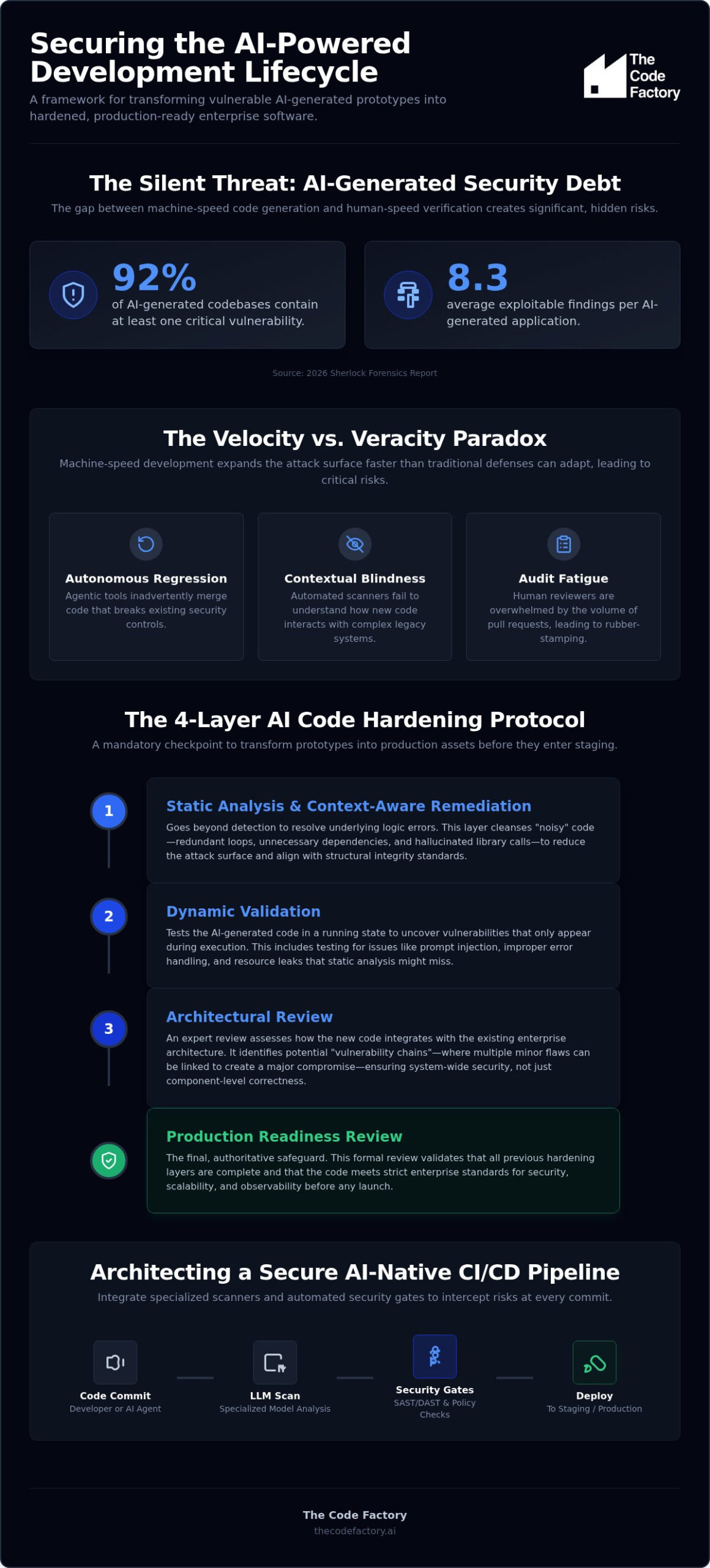
A 2026 report from Sherlock Forensics reveals that 92% of AI-generated codebases contain at least one critical vulnerability, averaging 8.3 exploitable findings per application. This statistic highlights a sobering reality for engineering leaders: while your team is shipping features at record speed, you’re likely accumulating security debt just as fast. You recognize the tension between the current industry hype and the absolute necessity of platform stability. Traditional SAST tools frequently fail in this new context, producing high false positives that mask genuine risks like prompt injection or excessive agency. Mastering how to secure AI generated code is no longer about slowing down innovation; it’s about building a technical foundation that won’t collapse under the weight of automated errors.
You need a strategy that replaces the risks of “vibe coding” with disciplined engineering oversight. This article outlines the rigorous protocols required to transform vulnerable AI-generated prototypes into hardened, production-ready enterprise software. We will explore a robust security framework for the AI-DLC that lowers the risk of platform compromise from chained vulnerabilities. By the end, you’ll have a clear path to a formal Production Readiness Review, ensuring every line of machine-written code meets the same structural integrity standards as your most critical legacy systems.
Key Takeaways
- Identify the widening gap between machine-speed code generation and the human capacity for verification, which creates hidden security debt in your platform.
- Master how to secure AI generated code by implementing a multi-layered hardening protocol that transitions experimental prototypes into production-ready assets.
- Understand why automated scanners alone are insufficient and how expert code remediation provides the necessary context to resolve complex logic flaws and architectural vulnerabilities.
- Architect secure AI-native CI/CD pipelines that integrate specialized LLM scanners and automated security gates to intercept risks at every commit.
- Establish the Production Readiness Review as your final authoritative safeguard to validate security, scalability, and observability before any enterprise launch.
Understanding the AI-Generated Security Debt Crisis
AI-generated security debt is the quantifiable gap between machine-speed code creation and human-speed security verification. In 2026, this debt isn’t just a technical hurdle; it’s a systemic risk that threatens the stability of enterprise platforms. As organizations integrate LLMs into every layer of the development stack, they often prioritize deployment speed over structural integrity. This leads to a backlog of unverified logic that accumulates faster than any traditional security team can manage. The result is a fragile infrastructure where the sheer velocity of creation masks a fundamental lack of engineering oversight.
Learning how to secure AI generated code starts with recognizing that functional code isn’t necessarily secure code. AI models excel at producing syntactically correct snippets that pass unit tests but harbor deep architectural flaws. A recurring threat is the hallucination of library calls, where an AI references a package that doesn’t exist. Attackers exploit this by registering malicious versions of these hallucinated names on public registries, creating an immediate supply chain vulnerability. This risk is compounded by Vibe coding, a dangerous trend where developers accept code based on its apparent functionality rather than performing a rigorous, line-by-line audit.
The Velocity vs. Veracity Paradox
AI tools compress the development lifecycle by orders of magnitude, yet they simultaneously expand the enterprise attack surface. Machine-speed development requires a corresponding machine-speed defensive architecture to maintain parity. If your generation tools outpace your defensive gates, you’re essentially building a high-speed engine without brakes. Without a disciplined approach, organizations face several critical risks:
- Autonomous regression: Agentic tools merging code that inadvertently breaks existing security controls.
- Contextual blindness: Automated scanners failing to understand how new code interacts with complex legacy architecture.
- Audit fatigue: Human reviewers becoming overwhelmed by the sheer volume of machine-generated pull requests, leading to rubber-stamp approvals.
Chained Vulnerabilities: The AI Attack Vector
Modern threats don’t rely on a single catastrophic bug but instead utilize vulnerability chaining to bypass defenses. Vulnerability chaining in agentic software engineering is the strategic linking of multiple minor, low-severity flaws into a complex sequence that results in a total platform compromise. Standard SAST tools frequently struggle with these vectors because they lack the contextual awareness to see how a minor input validation error in one service can be leveraged to bypass authentication in another. For 2026 enterprises, the era of experimental speed must give way to a protocol of security hardening and expert remediation. Relying on “good enough” code is no longer a viable strategy for production-grade software.
The Multi-Layered Framework for AI Code Hardening
The transition from a vulnerable prototype to a production-grade asset requires more than a simple scan. It demands a 4-layer hardening protocol: Static Analysis, Dynamic Validation, Architectural Review, and Remediation. In this model, security hardening acts as a mandatory checkpoint after code generation but before the software enters a staging environment. This structured approach ensures that the speed of AI creation doesn’t bypass the rigor of enterprise engineering. While automated tools might flag a syntax error, they often miss the structural instability that leads to cascading failures under load.
Layer 1: Context-Aware Code Remediation
Effective strategies for how to secure AI generated code must move beyond mere detection. Identifying a flaw is only half the battle; the real value lies in code remediation and optimisation that resolves the underlying logic errors. LLMs frequently produce “noisy” code, characterized by redundant loops, unnecessary dependencies, and dead code that increases the attack surface. Expert remediation cleanses these outputs, ensuring that every line of code serves a functional purpose and aligns with established structural integrity standards. This refinement process doesn’t just fix bugs; it actively reduces technical debt by streamlining the codebase for long-term maintenance.
Layer 2: Hardening the Cloud Infrastructure
Securing the code is futile if the environment it inhabits remains porous. Modern AI applications require robust cloud infrastructure configuration to mitigate risks at the network and service layers. Implementing Zero Trust principles is non-negotiable, especially for autonomous AI agents that require granular permission sets to interact with sensitive data. By utilizing Infrastructure as Code (IaC), engineering teams can ensure that security hardening is consistent across every deployment. This layer also addresses the “AI Supply Chain,” protecting model weights and data pipelines from unauthorized access or poisoning.
Integrating architecture and scalability consulting during this phase prevents security bottlenecks that often emerge when AI apps scale. Hardening the infrastructure ensures that the code’s environment is as resilient as the code itself, creating a unified defense against both known and emergent threats. This comprehensive approach is a prerequisite for any successful production readiness review.
Automated Detection vs. Expert Code Remediation
Automated scanners are the first line of defense, yet they often provide a false sense of security when dealing with machine-generated outputs. While SAST and DAST tools excel at identifying known signatures or common syntax errors, they lack the cognitive depth to understand architectural intent. Recent industry benchmarks indicate that over 40% of AI-generated code snippets harbor vulnerabilities that standard scanners fail to categorize as critical risks. This gap suggests that relying solely on automation creates a dangerous blind spot in your development lifecycle. Understanding how to secure AI generated code requires a transition from passive detection to active engineering. You need a sober voice of reason to interpret tool findings, filter out the high volume of false positives, and address the systemic flaws that scanners simply cannot see.
When Tools Fail: The Logic Gap
Automated tools frequently overlook “insecure by design” patterns because the code remains syntactically valid. For instance, an AI might generate a perfectly functional authentication module that lacks proper rate limiting or utilizes a deprecated cryptographic standard. These aren’t bugs in the traditional sense; they are foundational architectural failures. Specialized architecture consulting bridges this gap by evaluating how AI-generated components interact with the broader ecosystem. High-stakes applications, particularly those handling sensitive financial or health data, demand a manual production readiness review to ensure that speed hasn’t compromised the platform’s long-term stability. Human experts identify the subtle logic flaws that automated gates are programmed to ignore.
The Remediation Workflow
Patching vulnerabilities on the fly is a reactive strategy that leads to fragmented, unmaintainable systems. A disciplined engineering protocol prioritizes remediation tasks based on business risk and technical impact rather than just severity scores. This workflow transforms a fragile prototype into production-hardened software by streamlining logic and removing the redundant patterns typical of LLM outputs. Utilizing professional Code remediation and optimization services allows your internal team to focus on core innovation while experts harden the technical foundation. This strategic shift ensures that your AI-driven initiatives are built on a bedrock of security, rather than a collection of unverified patches. The goal is a clean, optimized codebase that meets enterprise standards for both performance and safety.
Architecting Secure AI-Native CI/CD Pipelines
High-velocity code generation requires a high-integrity delivery mechanism. Traditional pipelines aren’t designed for the non-deterministic nature of machine-written software, which often introduces subtle logic flaws that standard unit tests miss. Mastering how to secure AI generated code requires a fundamental redesign of the delivery pipeline to include specialized validation layers. This architectural shift ensures that the speed of creation never outpaces the capacity for defense. A secure AI-native pipeline follows a disciplined five-step protocol:
- Step 1: Implement automated security gates at every commit to intercept unverified code before it enters the repository.
- Step 2: Integrate LLM-specific scanners that detect risks like prompt injection and sensitive information disclosure.
- Step 3: Establish “Shadow Production” environments to observe how non-deterministic code behaves against real-world traffic patterns without risking stability.
- Step 4: Require a human-led Production Readiness Review for any changes affecting the critical path or core security modules.
- Step 5: Deploy continuous monitoring with automated rollback protocols to neutralize AI agents that exhibit behavioral drift.
The Role of DevSecOps in AI Workflows
Building “Security as Code” into the AI-DLC is essential for maintaining enterprise standards at scale. This involves automating the validation of AI-generated infrastructure configurations, which frequently harbor misconfigured permissions or insecure network ports. A robust CI/CD deployment pipeline reduces human error by enforcing these security standards programmatically rather than relying on manual checklists. By codifying your security requirements, you ensure that every deployment is consistent, auditable, and resilient against emergent threats. Organizations looking to harden their release cycles should prioritize the implementation of expert-led CI/CD deployment pipelines to bridge the gap between creation and security.
Monitoring AI Agents in Production
Observability for autonomous agents is critical to detect malicious behavior or unintended architectural changes in real-time. Standard logging isn’t enough; you need deep visibility into the decision-making logic of agentic workflows. Agentic guardrails are programmatically enforced constraints that restrict an AI’s ability to execute high-risk operations or modify core system architecture without explicit human authorization. These guardrails prevent agents from escalating their own privileges or creating “backdoor” dependencies during autonomous tasks. Implementing these controls ensures that even as your software becomes more autonomous, your engineering team retains ultimate authority over the platform’s structural integrity.
The Production Readiness Review: The Enterprise Safe-Guard
A Production Readiness Review (PRR) serves as the final, authoritative audit that determines whether a system is fit for the scrutiny of live traffic. While earlier stages of the AI-DLC focus on creation and initial validation, the PRR is where the sober voice of reason takes precedence. It’s the logical conclusion of any strategic framework for how to secure AI generated code, moving beyond the noise of automated alerts to provide a definitive assessment of structural integrity. Without this final gate, enterprises risk deploying prototypes that may function in isolation but fail under the complex pressures of a high-stakes production environment. The review evaluates four core pillars: Security, Scalability, Observability, and Remediation.
AI models generate code with unprecedented speed, but this velocity often introduces architectural fragility. A formal PRR pivots this momentum toward stability by identifying the precise remediation steps required for enterprise-grade performance. The Code Factory’s PRR protocol is designed to mitigate the inherent risks of machine-written software by enforcing a disciplined engineering standard. This ensures that every deployment is not just functional, but resilient, maintainable, and aligned with your organization’s broader security posture.
The PRR Checklist for AI Applications
The checklist for AI-native applications must account for the unique failure modes of non-deterministic software. This involves verifying security hardening at the service level and ensuring that cloud configuration integrity remains intact across all environments. When you engage in Production readiness reviews for AI, you’re validating that the architecture and scalability of your system can meet the rigorous demands of 2026 enterprise performance. This includes a deep audit of resource allocation, latency constraints, and the robustness of your automated rollback protocols to ensure that unexpected AI behavior doesn’t lead to platform-wide downtime.
From Prototype to Production
Moving from prototype to production requires a fundamental psychological shift from experimental speed to enterprise reliability. It’s relatively simple to build a functional AI agent; it’s significantly more difficult to build one that maintains its integrity under sustained load and adversarial conditions. By implementing a disciplined engineering protocol for how to secure AI generated code, you ensure that machine-generated code remains an asset rather than a liability. A formal review process provides the strategic confidence necessary to scale AI initiatives across the entire organization without accumulating unmanageable technical debt. Secure your AI-generated code with a professional Production Readiness Review to transform your unverified prototypes into hardened, production-ready software.
Establishing a Resilient AI Engineering Standard
The transition from experimental AI prototypes to stable enterprise platforms requires more than just faster tools; it demands a fundamental commitment to engineering rigor. By implementing a multi-layered hardening framework and integrating security directly into your CI/CD pipelines, you can successfully navigate the complexities of 2026 software development. You’ve learned that understanding how to secure AI generated code isn’t about halting innovation. It’s about ensuring your innovations are built on a foundation of structural integrity and technical safety.
The Code Factory acts as your independent engineering consultancy, providing the sober voice of reason needed to scale high-stakes applications. We specialize in enterprise security hardening and expert architecture audits that identify the risks automated scanners miss. Our team bridges the gap between machine-speed creation and production-grade reliability through specialized scalability audits and expert remediation. Book a Production Readiness Review for your AI-generated applications to secure your platform’s future. With the right protocols in place, you can lead your organization toward a secure and scalable AI-driven future.
Frequently Asked Questions
Can I trust AI-generated code for enterprise production environments?
AI-generated code cannot be trusted implicitly and requires a formal verification protocol before entering production. While functional, these outputs often contain structural flaws or insecure dependencies that automated tests fail to catch. Building a strategy for how to secure AI generated code involves treating every machine-written line as an unverified prototype. Trust is only established through rigorous security hardening and a manual audit that validates the code against your specific enterprise standards.
How does AI-generated code increase technical debt?
AI increases technical debt by generating code at a velocity that far outpaces human review, leading to a backlog of unverified logic. This code often includes redundant patterns, “dead” functions, and bloated dependencies that complicate future maintenance. Without active code remediation and optimisation, these inefficiencies accumulate into a fragile architecture. The speed of creation creates an illusion of progress while burying deep structural risks that eventually require expensive, manual intervention to resolve.
What is the difference between AI code remediation and standard debugging?
Standard debugging focuses on fixing immediate errors that prevent execution, whereas AI code remediation addresses broader structural and security flaws. Remediation involves streamlining logic, removing redundant machine-generated patterns, and hardening the code against sophisticated attack vectors. While debugging makes the code work, remediation makes it production-ready. This process ensures the software aligns with enterprise-grade reliability and security standards rather than just passing basic functional tests.
Why are traditional SAST tools often insufficient for AI code?
Traditional SAST tools are often insufficient because they rely on known vulnerability signatures and struggle with the contextual logic of AI-generated exploits. AI models frequently produce code that is syntactically correct but architecturally insecure, such as improper permission scopes or vulnerability chaining. These tools produce high false-positive rates that mask genuine risks. Effective security requires expert-led audits to interpret tool findings and identify the subtle logic gaps that automated scanners simply aren’t programmed to detect.
What is a Production Readiness Review (PRR) in the context of AI?
A Production Readiness Review is the final authoritative audit that validates a system’s security, scalability, and observability before launch. In the AI-DLC, the PRR acts as a critical gate to ensure that machine-speed development hasn’t bypassed enterprise engineering standards. It involves a comprehensive evaluation of cloud infrastructure configuration and security hardening. This review provides the strategic confidence needed to scale AI initiatives by confirming that the software is resilient enough for high-stakes environments.
How do I secure the supply chain for AI-generated applications?
Securing the AI supply chain requires a focus on model provenance, training data integrity, and the validation of third-party libraries. AI models often hallucinate library calls, which attackers exploit by registering malicious packages under those names. Organizations must implement automated security gates to verify all dependencies and secure the environments where models reside. Protecting the supply chain ensures that your AI-generated applications aren’t compromised by upstream vulnerabilities or unauthorized architectural changes during development.
What role does architecture consulting play in AI security?
Architecture consulting provides the strategic oversight necessary to prevent security bottlenecks as AI applications scale. Experts evaluate how AI-generated components interact with legacy systems and cloud infrastructure to ensure long-term stability. This consulting identifies systemic risks, such as improper microservice isolation or inefficient resource allocation, that standard development tools overlook. By focusing on structural integrity, architecture consulting transforms a collection of functional snippets into a cohesive, secure, and performant enterprise platform.
How can I automate security gates for AI-generated code in my CI/CD pipeline?
Automating security gates involves integrating specialized LLM scanners and behavioral testing directly into your CI/CD deployment pipelines. These gates intercept unverified commits and enforce “Security as Code” standards programmatically. By utilizing shadow production environments, you can observe how AI-generated code behaves under real-world traffic without risking platform stability. This automated approach ensures that every deployment is consistent and auditable, providing a repeatable process for how to secure AI generated code at scale. For a deeper look at the specific engineering gates required, the 2026 Engineering Protocol for fixing AI code for production outlines the critical checkpoints from prototype to enterprise-grade deployment.