


The speed of generative AI has outpaced the capacity for human oversight, leaving enterprise leaders with a choice: slow down innovation or accept a terrifying level of structural risk. Your developers are likely generating code faster than your security team can audit it, creating a compounding debt that standard automated scanners simply cannot resolve. While identifying a vulnerability is a necessary first step, it’s the actual repair and architectural hardening that determines whether your application is a liability or an asset. You already know that “code that works” is not the same as “code that is production-ready,” yet the gap between those two states is widening every day.
This 2026 guide provides a pragmatic framework for evaluating AI code remediation services to help you bridge that divide. You’ll learn how to move beyond noisy security alerts and implement a strategy that transforms fragile, AI-generated prototypes into hardened, enterprise-grade systems. We’ll explore the essential criteria for selecting a remediation partner, the shift from detection to active engineering, and how to ensure your infrastructure is resilient against modern threats. It’s time to replace the anxiety of unvetted code with the confidence of a disciplined, production-ready environment.
Key Takeaways
- Understand why traditional automated scanners create alert fatigue and fail to resolve the “insecure-by-default” patterns typical of AI-generated code.
- Learn the strategic difference between simple detection tools and expert AI code remediation services that actively fix structural vulnerabilities.
- Identify the critical role of agentic governance in monitoring autonomous AI commits and hardening the cloud infrastructure those agents build.
- Discover why a rigorous engineering review is the only way to bridge the gap between a working prototype and a production-ready system.
- Adopt a Production Readiness Protocol to ensure your 2026 deployments are hardened against evolving architectural and security threats.
Beyond the Hype: Why AI-Generated Code Requires a New Remediation Protocol
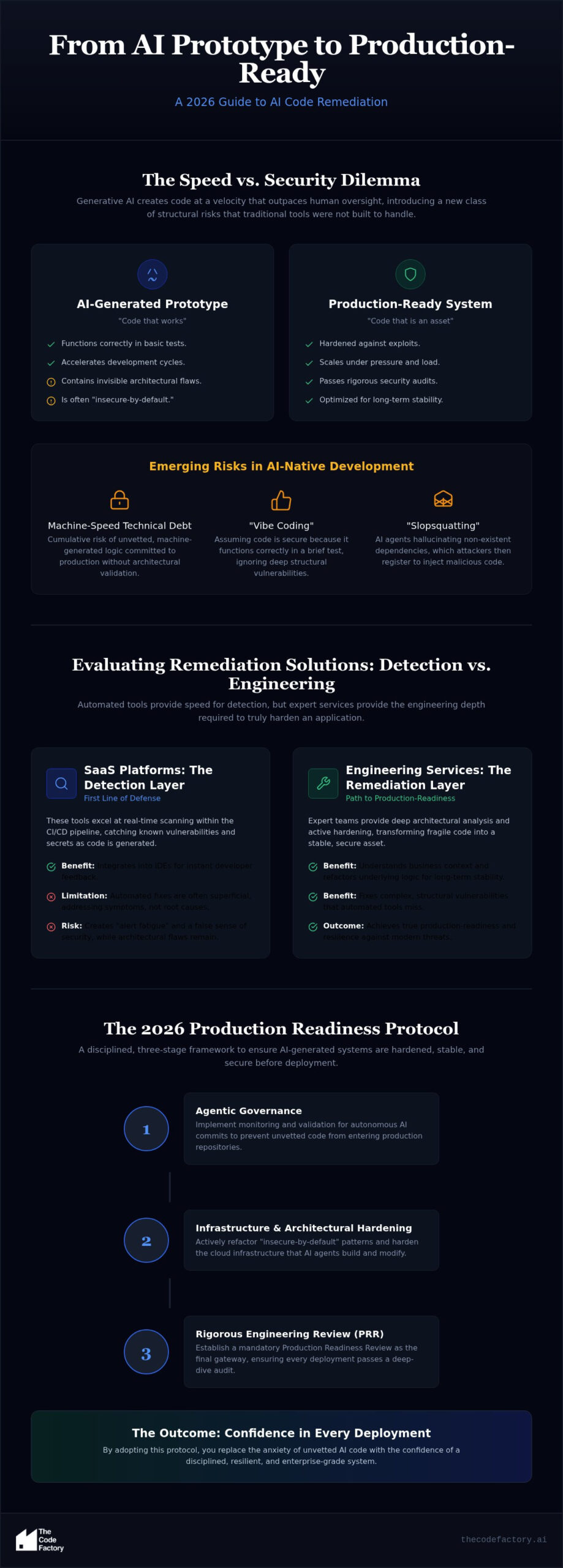
By 2026, the paradigm of software development has fundamentally shifted. AI agents no longer just suggest snippets; they autonomously commit entire modules to production repositories. While the efficiency gains are undeniable, this speed has introduced a critical oversight gap that humans can’t fill manually. The concept of automatic programming has moved from academic theory to enterprise reality, yet our defensive measures haven’t kept pace. Traditional Static Application Security Testing (SAST) and Dynamic Application Security Testing (DAST) tools were built to catch predictable human errors like buffer overflows. They frequently fail to remediate the “insecure-by-default” patterns inherent in large language model outputs, which often look syntactically perfect while remaining architecturally flawed.
This reality has led many teams into the “Vibe Coding” trap. This occurs when an application functions correctly during a brief test, leading developers to assume it’s secure. In reality, rapid prototyping often creates invisible structural vulnerabilities that only manifest under load or during a targeted exploit. Professional AI code remediation services provide the necessary pivot from passive scanning to active hardening. This isn’t just about finding bugs; it’s about the disciplined refinement of machine-generated logic into stable, enterprise-grade software.
The Machine-Speed Technical Debt Problem
AI generates code at a velocity that traditional security teams can’t match. This creates a new category of risk known as machine-speed technical debt. In 2026, we’re seeing an increase in “slopsquatting,” where AI agents hallucinate non-existent dependencies or libraries that attackers then register to inject malicious code. Because these agents work autonomously, these hallucinated packages can enter your codebase without a single human eyes-on review. Security Debt in AI-native development is the cumulative risk of unvetted, machine-generated logic that remains in production without rigorous architectural validation.
From Prototype to Production Readiness
There’s a massive difference between code that functions and code that is production-ready. A functioning prototype might handle a basic user flow, but production-ready code must survive a high-stakes audit, scale under pressure, and maintain a hardened security posture. To bridge this gap, the Production Readiness Review (PRR) has become the new enterprise standard. It acts as a final gateway, ensuring that every line of AI-generated infrastructure is optimized for long-term stability. Ask yourself: if your AI-generated application were subjected to a deep-dive security audit tomorrow, would it pass, or would the structural shortcuts be its downfall?
Evaluating AI Code Remediation: SaaS Platforms vs. Engineering Services
Enterprise security in 2026 relies on two distinct but complementary pillars: automated detection and expert remediation. While automated tools provide the necessary speed to keep up with machine-generated commits, expert services provide the depth required to protect the business from structural failure. Choosing between a SaaS platform and a specialized consultancy depends on your current development phase. A software tool might flag a vulnerability, but it won’t understand the architectural context of your specific cloud environment. To achieve true production-readiness, you must distinguish between finding a problem and actually fixing it.
SaaS Platforms: The Detection Layer
SaaS platforms act as the first line of defense in the modern CI/CD pipeline. These tools excel at real-time developer feedback, integrating directly into the IDE to catch hardcoded secrets or known vulnerable libraries as code is generated. However, they have inherent limitations. Most automated fixes are superficial; they address the symptom without refactoring the underlying logic. High-velocity teams often suffer from automated patch fatigue, where the sheer volume of suggested “fixes” creates a noise problem that developers eventually ignore. This creates a false sense of security, as teams “green-light” code that still contains fundamental architectural flaws.
Engineering Consulting: The Remediation Layer
Professional AI code remediation services represent the “last mile” of application security. While a scanner identifies a risk, an engineering partner like The Code Factory performs the deep-dive refactoring necessary to eliminate it. This involves more than just patching; it includes architecture and scalability consulting to ensure machine-generated components don’t degrade system performance. Human-led audits identify logic errors and integration risks that scanners consistently miss. This disciplined engineering approach ensures that your AI-native workloads align with the NIST AI Risk Management Framework (AI RMF), moving beyond simple compliance toward genuine resilience.
The ROI of “fixing it right” far outweighs the long-term cost of managing technical debt. Automated tools are an excellent investment for the detection phase, but they aren’t a substitute for professional hardening. If your goal is to move from a fragile prototype to a system that can withstand the threats of 2026, a production readiness review is the most effective way to secure your infrastructure. Investing in expert remediation now prevents the catastrophic cost of a structural breach later, turning your AI initiatives from a liability into a competitive advantage.
Critical Components of Enterprise-Grade AI Remediation in 2026
Enterprise security in 2026 has moved beyond simple code scanning. It now encompasses a sophisticated ecosystem of governance and infrastructure verification. As AI agents begin to commit code autonomously, the risk profile of the modern enterprise shifts from human error to machine logic flaws. Managing this risk requires agentic governance, a framework for monitoring and validating every commit made by an autonomous agent before it reaches a production branch. This oversight ensures that the speed of AI development doesn’t bypass the necessary architectural guardrails required for stability.
A critical part of this framework is the AI Bill of Materials (AI-BOM). This inventory tracks the specific models, prompts, and training data used to generate a codebase. Without this transparency, identifying the root cause of a recurring vulnerability becomes nearly impossible. Recent analysis of the Cybersecurity Risks of AI-Generated Code suggests that these models often repeat insecure patterns across different applications. By maintaining an AI-BOM, organizations can perform targeted AI code remediation services when a specific model is found to produce compromised logic.
Hardening the Cloud Infrastructure
AI agents don’t just write application logic; they frequently generate Infrastructure as Code (IaC) to deploy it. This often results in overly permissive cloud configurations that leave databases or internal APIs exposed to the public internet. Security hardening must extend beyond the repository and into the actual deployment environment. Robust securing CI/CD pipelines serve as the final enforcement gate, running automated readiness checks and preventing misconfigured infrastructure from ever reaching a live state. A secure application is useless if the cloud environment hosting it is fundamentally broken.
Remediation and Optimization
Effective AI code remediation services go beyond reactive patching. It’s a proactive engineering task that refines machine-generated logic to improve both security and performance. AI-generated code is notoriously bloated, often including redundant functions or inefficient loops that increase the attack surface. Optimization services simplify this complexity, reducing the number of potential entry points for an attacker. Technical Hardening for 2026 AI workloads is the process of stripping away machine-generated inefficiencies and reinforcing the remaining logic to meet enterprise scalability and security standards.
The Implementation Gap: Why Automated Scanners Fail Without Expert Remediation
A scanner is a map, not a mechanic. While automated tools can identify common syntax errors or insecure library versions, they lack the contextual awareness to understand how those flaws interact with your specific business logic or data flow. This creates the “Alert Fatigue” problem. Security teams are often buried under thousands of low priority notifications, which masks the critical structural failures that could lead to a breach. More scanners don’t necessarily lead to more security; they frequently lead to a paralyzed development team that spends more time triaging lists than hardening systems.
There’s a common misconception among enterprise leaders that having a scanner provides a shield against liability. This is a dangerous assumption. In a 2026 production environment, “vibe coded” applications require a sober engineering review to verify that the machine-generated logic actually meets corporate safety standards. Simply finding a vulnerability doesn’t mitigate risk if the remediation is either ignored or incorrectly applied by another AI agent. Professional AI code remediation services provide the human expertise needed to distinguish between a minor syntax warning and a catastrophic performance bottleneck.
The Architecture and Scalability Bottleneck
AI-generated code is notorious for functioning in isolation while failing under the pressure of real world traffic. These models often produce “flat” logic that doesn’t account for database connection pooling, cache invalidation, or asynchronous processing. Without expert Architecture & Scalability consulting, your AI-native application may suffer from massive latency or total system failure as soon as it scales. Security is inherently tied to stability. A system that crashes under load is a system that cannot maintain its defensive posture, making architectural integrity a non-negotiable component of remediation.
CI/CD as a Security Enforcer
To bridge the implementation gap, security must be baked into the delivery process. Implementing robust securing CI/CD pipelines for enterprise production allows you to catch AI-generated errors before they ever reach a production branch. These pipelines act as a series of automated and manual gates where AI code remediation services can be applied systematically. By integrating rigorous automated testing with human led verification, you ensure that every machine-generated commit is hardened against 2026 threats. If you want to move beyond the noise of automated alerts and secure your infrastructure, you need a partner who understands the nuance of production readiness. Contact The Code Factory today to begin your comprehensive technical audit.
Hardening Your AI Infrastructure: The Code Factory’s Production Readiness Protocol
The Code Factory operates as the sober voice of reason in an industry currently obsessed with the velocity of creation at the expense of structural integrity. Our approach to AI code remediation services is rooted in disciplined engineering rather than the passive observation of automated dashboard alerts. While tools provide a broad overview of potential risks, our protocol focuses on the active refinement and hardening of machine-generated logic. We transform fragile, “vibe coded” scripts into resilient enterprise systems by addressing the fundamental architectural flaws that machine learning models consistently overlook.
The transition from experimental speed to enterprise reliability requires a shift in perspective. You cannot rely on the same tools that generated the code to validate its safety. Instead, you need a specialized fixer who understands the nuances of high-stakes production environments and possesses the foresight to prevent issues before they manifest. Our protocol is designed to bridge the gap between a functioning prototype and a system that can withstand the complex threat landscape of 2026.
Our Protocol for AI Code Remediation
Our methodology begins with an exhaustive technical audit that goes deeper than simple syntax checking. We perform deep code optimization to strip away the redundant logic and performance bottlenecks common in AI-native development. This process ensures that every module is not only secure but also optimized for enterprise-grade scalability. Beyond the application layer, we provide comprehensive cloud infrastructure configuration and security hardening. This ensures that the environment hosting your AI workloads is as robust as the code itself, preventing the misconfigurations that frequently lead to high-profile breaches in unvetted deployments.
Engage for a Production Readiness Review
In the 2026 technological landscape, launching an AI-powered application without a professional audit is an unacceptable business risk. A production readiness review for enterprise AI deployments serves as the final, critical gate between an experimental prototype and a stable production environment. Our team of specialized fixers evaluates your system across three primary vectors: architectural validation, security hardening, and scalability consulting. We provide the technical depth necessary to ensure your machine-generated logic meets the highest standards of structural integrity and performance.
If you are responsible for a high-stakes AI deployment, the time for experimental speed has passed. You need the stability that only expert remediation can provide. Book a Production Readiness Review with The Code Factory to ensure your infrastructure is hardened against 2026 threats and ready for the rigors of enterprise production. Moving from “code that works” to “code that is production-ready” is not an automated task; it is an engineering requirement.
Securing the Future of Your AI-Native Infrastructure
The transition from rapid AI prototyping to enterprise-grade production requires more than automated scanning; it demands a disciplined engineering approach. Relying solely on software tools to fix the logic they helped create is a circular strategy that leaves your organization vulnerable to structural debt. By prioritizing professional AI code remediation services, you move beyond the noise of alert fatigue and begin the active process of hardening your cloud infrastructure and application logic for the 2026 threat landscape.
Expert-led remediation ensures that your machine-generated code is not just functional, but architecturally sound and scalable. The Code Factory is specialized in enterprise-level software architecture and infrastructure hardening, providing the pragmatic engineering necessary for high-stakes production environments. Don’t let machine-speed technical debt compromise your stability. Secure your AI-generated applications with a Production Readiness Review from The Code Factory. With the right strategic partner, you can deploy AI-native workloads with the confidence that your systems are resilient, optimized, and ready for scale.
Frequently Asked Questions
What are AI code remediation services in 2026?
AI code remediation services are specialized engineering workstreams designed to refactor and harden machine-generated logic. While automated tools identify vulnerabilities, these services involve expert intervention to optimize architecture and eliminate technical debt. This process ensures that “vibe-coded” prototypes are transformed into stable, enterprise-grade applications. It addresses the gap between rapid machine generation and the rigorous standards required for high-stakes production environments where structural integrity is a non-negotiable requirement.
Is AI-generated code inherently less secure than human-written code?
AI-generated code isn’t inherently malicious, but it’s frequently insecure by default. Models are trained on vast datasets that often include outdated or non-standard practices, leading them to repeat those errors. The primary risk is the sheer velocity of generation, which creates technical debt faster than most security teams can audit. Without expert remediation, these invisible logic flaws and hallucinated dependencies can become permanent, high-risk fixtures in your production environment.
Do I need specialized remediation if I already use an AI code scanner?
Scanners are detection tools, not resolution tools. While a scanner might flag a hardcoded secret or an insecure library, it won’t refactor your application architecture to be more resilient. Relying solely on automated alerts leads to noise and alert fatigue. Professional AI code remediation services provide the engineering expertise needed to fix the root cause of a vulnerability rather than just applying a superficial, automated patch.
How can we implement AI security without slowing down our developers?
The most effective way to balance speed and security is through robust CI/CD deployment pipelines. By embedding automated security gates early in the development lifecycle, you catch low-level machine errors instantly. For high-stakes modules, you should trigger a specialized engineering review. This tiered approach allows developers to maintain their momentum while ensuring that only hardened, production-ready code actually reaches your live environment and customer-facing systems.
What is a Production Readiness Review for AI applications?
A Production Readiness Review is a disciplined technical audit used as the final gate before an application goes live. It moves beyond simple bug hunting to evaluate the system’s structural integrity, performance constraints, and security posture. This review ensures that machine-generated infrastructure is properly configured and that the application logic is optimized for enterprise-level scalability. It’s the ultimate tool for mitigating risk before a high-stakes launch.
What are the biggest risks of ‘vibe coding’ in an enterprise environment?
“Vibe coding” relies on the assumption that if an application functions during a brief test, it’s safe for production. In an enterprise setting, this creates significant legal liability and structural risk. The biggest dangers include invisible performance bottlenecks that crash under load and insecure architectural patterns that expose sensitive data. Without a sober engineering audit, these applications remain fragile liabilities rather than reliable, scalable business assets.
How does cloud infrastructure hardening relate to AI code remediation?
Remediation isn’t just about the code in your repository; it’s about where that code lives. AI agents frequently generate Infrastructure as Code (IaC) with overly permissive settings that leave your cloud environment exposed. Cloud infrastructure configuration and security hardening work alongside code remediation to ensure your entire stack is resilient. A secure application is only as strong as the hardened cloud environment that supports its high-performance workload.
Can AI tools automatically fix the security vulnerabilities they create?
AI tools can suggest patches for simple syntax errors, but they often struggle with complex architectural flaws. An AI tool that creates a vulnerability might lack the contextual reasoning to fix it without introducing new logic errors or performance issues. Enterprise reliability requires a sober human perspective to validate that a remediation actually improves the system’s long-term stability and doesn’t just silence a security scanner’s alert.