


If your AI application was built primarily through rapid prototyping and “vibe coding,” it isn’t an asset yet; it’s a liability waiting to be exploited. The speed of AI-generated development often comes at the cost of architectural rigor, leaving your system vulnerable to threats that traditional security measures aren’t designed to catch. Conducting a rigorous AI app security audit is no longer optional for teams moving toward enterprise deployment. Most engineering leaders feel the mounting pressure to ship agentic features while simultaneously fearing the fallout of a prompt injection attack or a catastrophic data leakage event. You know that experimental speed is no substitute for enterprise-grade reliability, especially when regulatory requirements demand proof of safety.
This article provides a professional-grade checklist to help you identify hidden vulnerabilities in AI-generated code and secure your agentic applications for high-stakes environments. We’ll move beyond surface-level scans to address the structural integrity of your LLM integrations and the security of your third-party dependencies. By following this roadmap, you’ll gain the technical verification needed to prove your application is truly production-ready. We’ll examine the specific hardening steps required to transform a fragile prototype into a resilient, enterprise-ready solution that stands up to the scrutiny of the most demanding stakeholders.
Key Takeaways
- Identify why AI-generated code creates high-risk technical debt and learn the specific engineering protocols required to harden these modules for production.
- Execute a rigorous AI app security audit that focuses on prompt integrity and output sanitization to block malicious code execution.
- Secure your infrastructure by auditing agentic permissions and enforcing strict network isolation to prevent unauthorized lateral movement.
- Map your application architecture to isolate high-risk logic, enabling targeted code remediation that standard automated scanners typically miss.
- Establish a definitive roadmap for enterprise deployment by transforming experimental prototypes into stable, resilient software through professional readiness reviews.
The AI Security Audit: From Experimental Prototype to Enterprise Liability
Speed is the currency of modern development, yet it’s often financed by security shortcuts. Many teams rely on “vibe coding” (building based on prompts that feel right) without verifying the underlying logic. When an experimental prototype moves toward enterprise deployment, it transitions from a proof of concept to a significant liability. A comprehensive AI app security audit is the only way to identify these hidden risks before they become public failures. This isn’t just about finding bugs; it’s about establishing the structural integrity required to survive an enterprise-level risk assessment.
AI-generated code introduces a distinct category of technical debt. Unlike manual code, which reflects a developer’s intent, AI code is a statistical approximation. It might work perfectly in a sandbox but fail catastrophically under edge cases or malicious inputs. Standard SAST and DAST tools aren’t enough; they struggle to interpret the non-deterministic nature of large language models. You need a protocol that treats AI logic as high-risk infrastructure. This approach ensures that your application meets the growing regulatory pressure to prove AI safety and data privacy.
The “Vibe Coding” Trap: Speed vs. Security
Rapid prototyping tools allow developers to ship features at a pace that traditional security gates can’t match. This speed creates “black box” modules where no single engineer fully understands the logic flow or the security implications of the generated dependencies. To establish a baseline for reliability, you must shift from a mindset of creation to one of rigorous maintenance. Hardening these systems requires moving beyond the “vibe” and into documented, verifiable engineering standards that can withstand the scrutiny of enterprise procurement teams.
Defining the AI Attack Surface in 2026
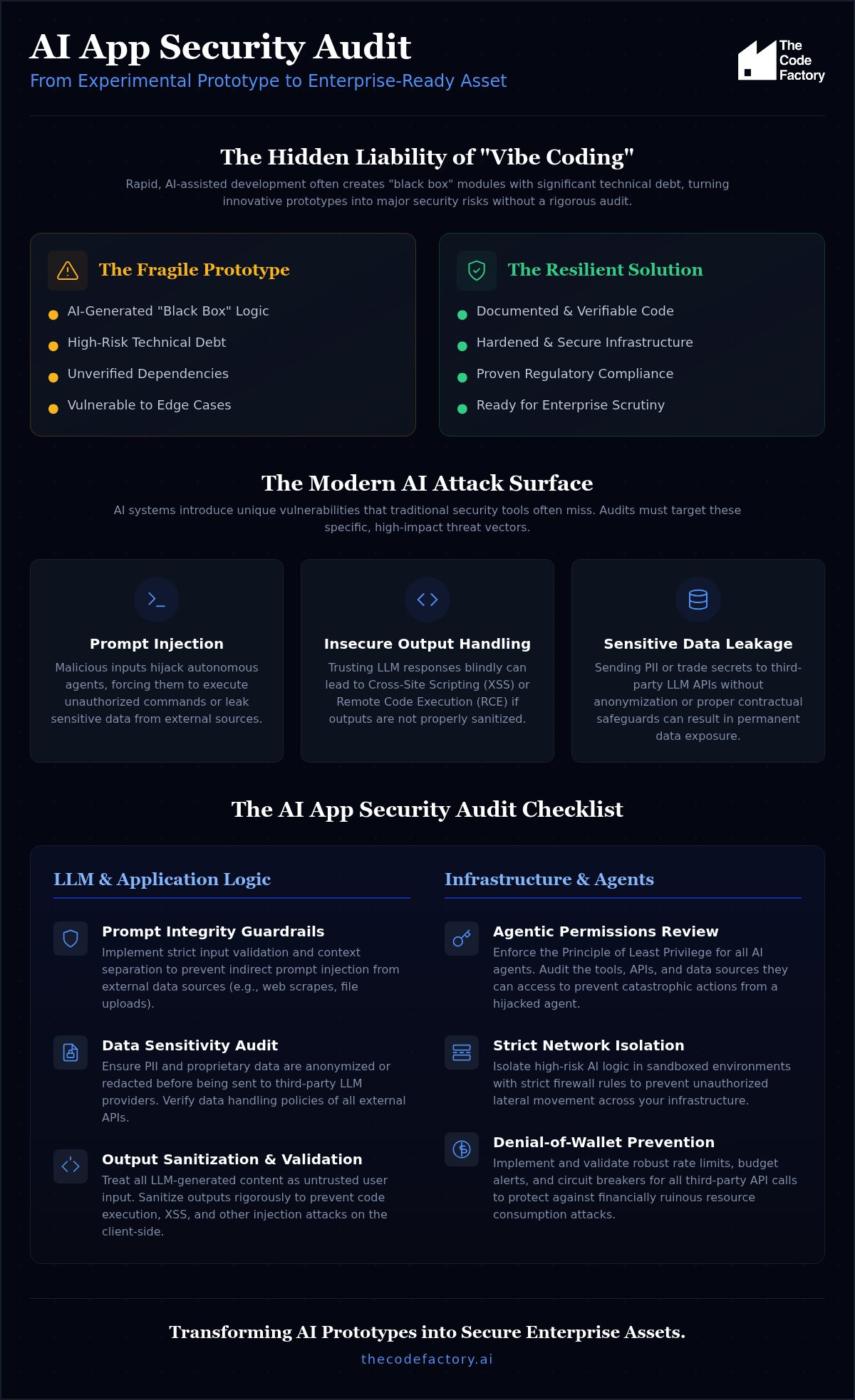
The attack surface for AI applications has expanded far beyond simple SQL injections. Modern threats include prompt injection attacks that can hijack autonomous agents, forcing them to execute unauthorized commands or leak sensitive data. Insecure output handling can lead to cross-site scripting (XSS) or remote code execution (RCE) if the AI’s response is trusted blindly by the application. These risks are deeply tied to foundational AI safety principles, which emphasize robustness and monitoring as core requirements for any production system. Without a specialized AI app security audit, these vulnerabilities remain invisible until a breach occurs, leaving your data and your reputation exposed.
The Comprehensive AI App Security Checklist: 2026 Edition
A checklist isn’t just a list of tasks; it’s a strategic framework for risk mitigation. To move beyond experimental speed, you need a structured AI app security audit that scrutinizes every layer of the stack. This process aligns with emerging AI risk management frameworks, ensuring your deployment meets the stringent procurement standards of enterprise clients. Executing a consistent AI app security audit ensures that your technical debt doesn’t become a security breach.
LLM-Specific Vulnerability Checklist
Prompt integrity is your first line of defense. You must implement guardrails to prevent indirect prompt injection, where malicious data is ingested from external sources like web scrapes or user uploads. Next, audit the sensitivity of data sent to third-party providers. Sending PII or proprietary trade secrets to an external LLM without anonymization is a critical failure that can lead to permanent data leakage. Finally, validate your rate limits. Unchecked API calls don’t just slow down your system; they expose you to denial-of-wallet attacks that can drain your operational budget in hours.
Code-Level Security Requirements
AI-generated logic often ignores basic security hygiene. You must review all generated scripts for common OWASP vulnerabilities, such as SQL injection or broken access control, which LLMs frequently overlook in favor of functional speed. Dependency integrity is equally vital. LLMs occasionally suggest “hallucinated” packages that don’t exist in official registries. Attackers often register these names to facilitate supply chain attacks, so every library import requires manual verification. Ensure your scripts utilize strict type safety and robust error handling to prevent the model from failing into an insecure state.
Credential management requires a zero-tolerance policy for hardcoded secrets. AI-generated files frequently include placeholder API keys or environment variables that can easily slip into production if not caught during a review. If your application utilizes autonomous agents, you must restrict their blast radius. Never grant an agent full database access or write permissions to critical infrastructure. Using a production readiness review can help you establish the principle of least privilege, ensuring a compromised agent cannot compromise your entire enterprise.
Beyond the LLM: Auditing Infrastructure and Agentic Permissions
Securing the LLM interface is only half the battle. If the underlying infrastructure is porous, even the most robust prompt guardrails will fail. A truly comprehensive AI app security audit must look beyond the model to the cloud environment and the specific permissions granted to autonomous agents. Many organizations focus heavily on the “vibe” of the AI’s response while ignoring the lateral movement risks inherent in their cloud configuration. You can’t protect an application if the surrounding environment is left open to exploitation.
Infrastructure Hardening for AI Workloads
Modern AI workloads require strict network isolation to prevent data exfiltration. You shouldn’t allow your LLM processing environments to sit on an open network; instead, configure VPCs to create a hardened perimeter around sensitive compute instances. Auditing your API gateway security is equally critical. You need to ensure that authentication protocols and mutual TLS (mTLS) are enforced at every entry point to prevent unauthorized service-to-service communication. Encryption for data at rest and in transit isn’t a luxury; it’s a foundational requirement for any system handling enterprise data.
Managing Agentic Risk and Third-Party Connections
The rise of agentic AI introduces a new, volatile variable into your security posture. Over-permissioned agents represent a significant liability that most standard scanners miss. If an agent possesses the authority to modify records in Salesforce or broadcast sensitive data on Slack, a single prompt injection can lead to enterprise-wide disruption. This risk is exactly why adhering to CISA Guidance on Agentic AI Security is essential for any deployment aiming for production readiness.
You must define a strict principle of least privilege for every autonomous agent in your ecosystem. Agents should only have the specific, scoped permissions required for their immediate task, rather than broad administrative access. For high-risk actions, such as database deletions or financial transactions, implement human-in-the-loop triggers to ensure a verified engineer validates the model’s intent. Auditing your app-to-app connections regularly ensures that legacy permissions don’t create backdoors into your core business systems.
Finally, secure your CI/CD pipeline to prevent the injection of malicious models or poisoned weights. Every deployment should utilize signed artifacts and automated integrity checks. Once live, you must maintain exhaustive logs of all AI-to-infrastructure interactions. If an agent begins making unusual API calls or attempts to access unauthorized data stores, your security team needs immediate, actionable alerts to mitigate the threat before it scales. This level of granular visibility is what separates an experimental tool from a hardened enterprise application.
Remediating AI-Generated Code: A Protocol for Security Hardening
Identifying the cracks in your foundation is only the first step of a comprehensive AI app security audit. The real engineering challenge begins with remediation, the methodical process of transforming a fragile prototype into a hardened enterprise asset. Finding a vulnerability is a diagnostic success, but resolving it requires a deep understanding of how AI-generated logic interacts with your broader system architecture. You can’t just patch these issues; you have to re-engineer the modules that were built on “vibes” rather than rigorous standards.
Our remediation protocol starts with architectural mapping to isolate high-risk modules. We track the data flow from the LLM interface to your internal databases, identifying every point where unverified AI logic could execute a privileged command. Once these zones are mapped, we move to manual code review and logic verification. Automated scanners often fail to catch the subtle logical fallacies that AI models introduce, such as circular dependencies or improper state management. We scrutinize these scripts to ensure they follow defensive programming principles, providing the stability your enterprise clients expect.
The Process of Code Remediation
The transition from a “vibe-coded” prototype to a production-ready asset requires aggressive refactoring. AI-generated code is frequently redundant, carrying unnecessary library imports and inefficient loops that create performance bottlenecks. We eliminate this technical debt before it becomes a security liability. By streamlining the codebase, we don’t just improve execution speed; we reduce the attack surface. A leaner, more purposeful codebase is inherently easier to monitor and defend against the evolving threats we identified during the initial AI app security audit.
Architecture and Scalability Consulting
Enterprise deployment demands more than just secure code; it requires an architecture that scales without compromising safety. We refine your data flow to minimize exposure risks, ensuring that sensitive information is never cached or processed in insecure environments. This architectural hardening includes preparing the system for enterprise-level loads, where minor logic errors in an AI agent can quickly cascade into a system-wide failure. We integrate security as a core pillar of your infrastructure, not an afterthought added just before launch.
If your prototype is struggling under its own technical debt or failing to meet security standards, our team provides the code remediation and optimisation services needed to restore structural integrity. We specialize in fixing what rapid AI development broke, ensuring your application is resilient enough for the most demanding production environments. Don’t let an unverified prototype jeopardize your enterprise reputation; let us harden your code for the long term.
Securing the Future: Why a Specialized AI Production Readiness Review is Non-Negotiable
Automated security scanners provide a false sense of security for AI-driven applications. They identify known CVEs and common syntax errors but lack the cognitive context to understand how an LLM might bypass an application’s core business logic. An effective AI app security audit requires more than a tool scan; it demands a manual, architectural deep dive into how AI-generated code interacts with your enterprise data. You can’t automate the verification of a non-deterministic system. You need an engineering audit that treats AI logic as high-risk technical debt requiring expert intervention.
The Code Factory serves as the sober voice of reason for teams that have prioritized development speed over structural integrity. We understand the pressure to ship agentic features, but we also recognize the catastrophic cost of a security failure at scale. Our protocol bridges the gap between experimental prototyping and enterprise-grade reliability. We provide the technical oversight necessary to ensure your application doesn’t just work in a demo, but survives the rigors of a high-stakes production environment where data leakage is a non-starter.
The Code Factory’s Engineering Protocol
Our approach centers on comprehensive production readiness reviews that scrutinize every layer of your stack. We go beyond merely identifying vulnerabilities to provide active code remediation and optimisation, ensuring your AI-generated software is both secure and performant. Our team configures hardened cloud infrastructure and establishes robust CI/CD deployment pipelines specifically tailored for the unique requirements of AI workloads. This structured engineering model provides an independent architectural guide, preventing the common pitfalls of “vibe coding” from ever reaching your production servers.
Booking Your AI App Security Audit
Transitioning from an audit finding to a production-ready system requires a clear, actionable roadmap. When you engage with us for a Production Readiness Review, you receive a detailed breakdown of your application’s security posture along with specific engineering tasks required for hardening. We provide the technical verification your enterprise clients demand, proving that your agentic features are stable, resilient, and safe for deployment. Don’t let an unverified prototype stall your market entry or expose your organization to unnecessary risk.
Take the final step toward enterprise stability and risk mitigation. Schedule your AI App Security Audit with The Code Factory today to transform your experimental AI application into a hardened, production-ready asset.
Building for Enterprise Resilience
Transforming a high-speed prototype into a hardened enterprise system requires a shift from experimentation to disciplined engineering. We’ve explored how prompt integrity, infrastructure isolation, and agentic permissioning form the backbone of a secure deployment. Relying on automated tools alone leaves your application vulnerable to the subtle logical failures inherent in AI-generated code. A rigorous AI app security audit ensures that your system doesn’t just function but remains resilient under the scrutiny of global security standards.
As an independent engineering consultancy, The Code Factory specializes in bridging the gap between rapid AI development and production stability. Our expertise in code remediation and production readiness reviews provides the structural integrity your stakeholders demand. With worldwide engineering support, we help you navigate the complexities of AI optimization and security hardening. It’s time to move past the uncertainties of “vibe coding” and establish a foundation built for long-term growth.
Secure your AI application for production with The Code Factory. Your path to a stable, enterprise-ready deployment starts with a commitment to engineering excellence.
Frequently Asked Questions
What is an AI app security audit?
An AI app security audit is a specialized technical review designed to identify vulnerabilities in applications built with AI-generated code. It evaluates the structural integrity of LLM integrations, the security of autonomous agent permissions, and the robustness of the underlying cloud infrastructure. This process ensures your application is resilient against prompt injection and data exfiltration. It’s the critical bridge between an experimental prototype and an enterprise-grade production system that protects your reputation.
How does auditing AI-generated code differ from traditional code reviews?
Traditional reviews focus on human intent and established patterns, whereas AI-generated code requires verification of statistical approximations. AI models often introduce subtle logical fallacies or “hallucinated” dependencies that standard scanners miss. You must audit for non-deterministic behavior and verify that the generated logic adheres to defensive programming standards. The focus shifts from checking for syntax errors to validating the security of complex, automated decision-making paths within the software.
Can automated tools replace a manual AI security audit?
Automated tools are useful for identifying known vulnerabilities and syntax errors, but they cannot replace a manual AI app security audit. Scanners lack the cognitive context to understand how an LLM might bypass business logic through indirect prompt injection. Manual reviews are essential for identifying architectural flaws and over-permissioned agents. You need human expertise to verify the structural integrity of your code and ensure your specific implementation meets enterprise safety requirements.
What are the most common vulnerabilities found in AI-generated apps?
Common vulnerabilities include prompt injection, where malicious inputs hijack model behavior, and insecure output handling that leads to cross-site scripting. AI-generated scripts often contain hallucinated dependencies or hardcoded credentials left over from the prototyping phase. Over-permissioned agents also pose a significant risk, as they may have broader access to internal databases than necessary. These structural weaknesses create a substantial attack surface that requires targeted remediation before any high-stakes enterprise deployment.
How long does a professional AI app security audit take?
The duration of a professional audit depends on the complexity of your application architecture and the volume of AI-generated code. Most production readiness reviews for mid-sized agentic applications typically take between one and three weeks to complete. This timeline includes the initial mapping of high-risk modules, manual code review, and the delivery of a comprehensive remediation roadmap. Complex enterprise systems with multiple third-party integrations may require additional time for thorough infrastructure hardening.
What is the cost of neglecting an AI security review before launch?
Neglecting a security review exposes your organization to catastrophic data breaches and significant regulatory fines. If a prompt injection attack leaks proprietary data, the loss of enterprise trust can be permanent and irreversible. You’ll also face the mounting costs of technical debt as you’re forced to patch fragile logic under emergency conditions. Proactively securing your application is far more cost-effective than managing the fallout of a public security failure after launch.
How do we secure AI agents that have access to our internal data?
Securing AI agents requires enforcing the principle of least privilege for every autonomous action. You should restrict agent permissions to specific, scoped data stores and implement human-in-the-loop triggers for high-risk operations like record deletions. Isolating your processing environments within a hardened VPC prevents lateral movement if an agent is compromised. Continuous monitoring and logging of all agent-to-infrastructure interactions are also essential for detecting and mitigating unusual behavior in real time.
What are the compliance requirements for AI applications in 2026?
By 2026, compliance requirements emphasize the need for verifiable AI safety and robust risk management frameworks. Organizations must provide proof of robustness against adversarial attacks and demonstrate strict adherence to data privacy regulations like GDPR and CCPA. Enterprise procurement teams increasingly demand documented production readiness reviews as a condition for deployment. You must show that your AI logic is transparent, monitored, and shielded from unauthorized access to meet these evolving global standards.