


Speed is a liability when it lacks a structural foundation. In the rush to deploy AI-driven features and scale cloud infrastructure, many enterprises have inadvertently built their digital future on a house of cards. You’ve likely felt the tension between the need for rapid deployment and the paralyzing fear that a single security configuration could trigger catastrophic downtime. Managing production environment security at scale is no longer just a technical checkbox; it’s a high-stakes balancing act where hidden vulnerabilities in AI-generated code and complex supply chain failures can compromise years of growth in an instant.
We understand the anxiety that comes with scaling modern infrastructure while maintaining compliance with evolving standards like PCI DSS 4.0 and the 2026 CCPA updates. This guide provides the pragmatic framework you need to shift from experimental speed to enterprise-grade stability. We’ll explore how to harden your systems, secure your automated CI/CD pipelines, and implement the “Govern” function of NIST CSF 2.0 to ensure your architecture remains resilient against the sophisticated threats of 2026. By refining your deployment strategy and eliminating technical debt, you can achieve a state of production readiness that survives any audit.
Key Takeaways
- Learn why experimental deployment speed often creates technical debt that compromises structural integrity at scale.
- Implement zero-trust principles and advanced IAM protocols to fortify your production environment security against modern threat vectors.
- Prevent cross-environment contamination by strictly isolating secrets and credentials between staging and production tiers.
- Harden your CI/CD pipeline by integrating automated vulnerability scanning for third-party dependencies and AI-suggested code.
- Establish a sustainable production readiness framework that prioritizes regular technical audits over one-off security checklists.
Beyond the Prototype: Why Production Security Demands a Different Protocol
The “it works on my machine” mentality is a dangerous relic of the development phase. While a prototype functions in a controlled sandbox, enterprise-scale systems operate in a volatile environment where every latency spike or misconfigured port is a potential entry point. Experimental speed is often prioritized during the initial build, but this velocity creates a specific type of technical debt. When you bypass rigorous hardening in favor of rapid deployment, you aren’t just moving fast; you’re accumulating a security liability that will eventually come due.
Effective production environment security requires a fundamental shift from a developer-centric mindset to an operator-centric one. In development, success is defined by a feature that functions. In a “live” production environment, success is defined by data integrity, high availability, and the preservation of corporate reputation. A single breach doesn’t just crash a service; it erodes trust and can lead to severe regulatory penalties under frameworks like the CCPA 2026 updates, which now include expanded definitions for sensitive personal information and neural data. Stability is no longer a luxury. It’s the baseline for survival.
The Security Debt of AI-Driven Development
Rapid AI prototyping has accelerated the “vibe coding” trend, where developers rely on the perceived correctness of AI-generated snippets without deep architectural validation. These tools often bypass traditional security gates, introducing subtle vulnerabilities that only manifest under heavy production loads. To achieve enterprise reliability, code remediation is non-negotiable. You cannot treat AI-suggested code as production-ready until it’s been audited for structural integrity and alignment with your specific security protocols. This refinement process is the difference between a fragile prototype and a hardened system.
Defining “Enterprise-Grade” in 2026
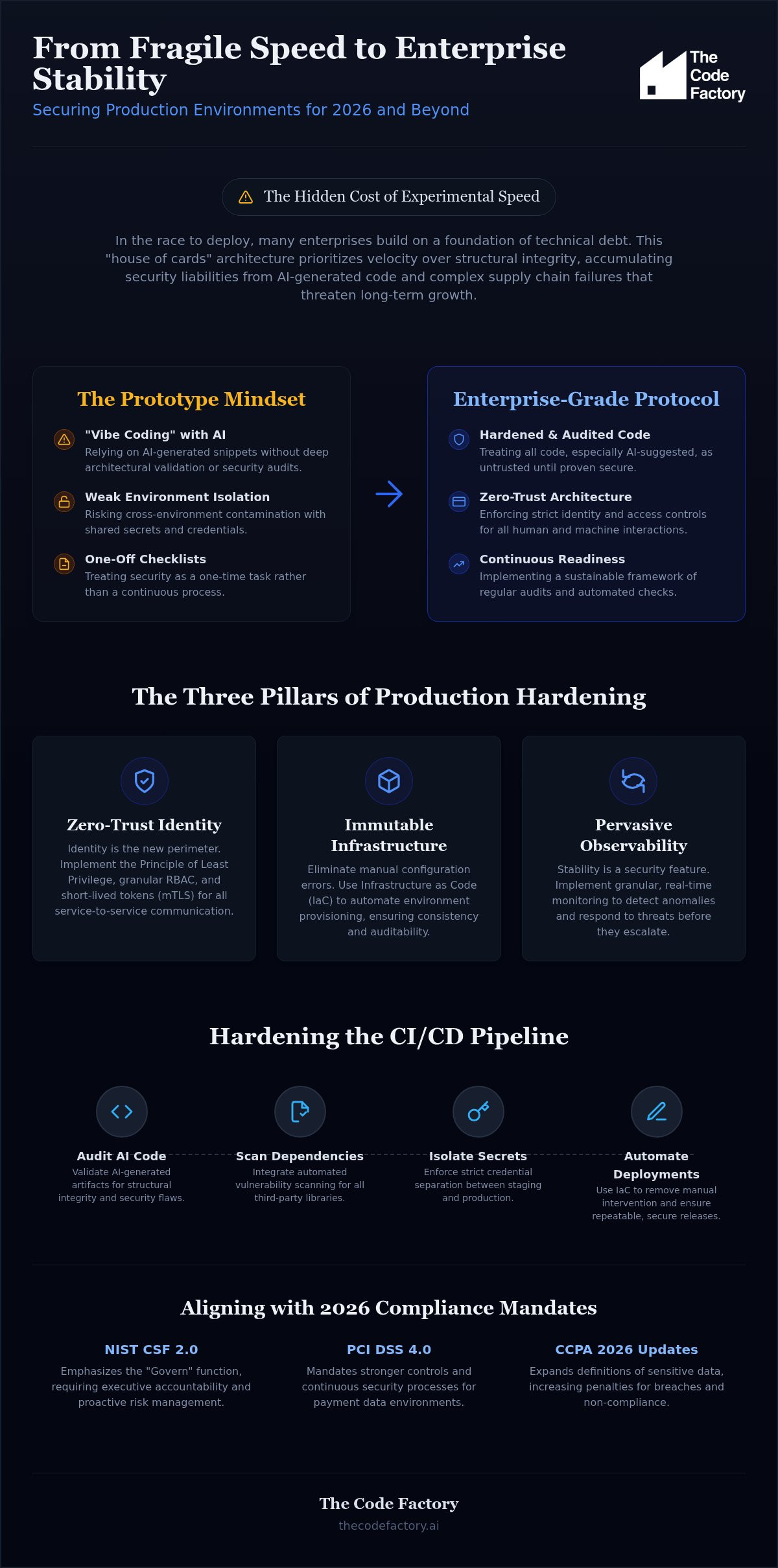
In 2026, enterprise-grade infrastructure extends far beyond basic firewalls. It demands a proactive stance aligned with the NIST Cybersecurity Framework 2.0, specifically the “Govern” function which emphasizes executive accountability and risk management. Modern production environment security treats stability as a core security feature. If a system is unstable, it’s vulnerable. Hardening your architecture involves:
- Implementing granular observability to detect anomalies in real-time.
- Automating infrastructure as code (IaC) to eliminate manual configuration errors.
- Aligning technical debt reduction with business risk mitigation strategies.
True reliability is found in the transition from simply creating a tool to maintaining a resilient asset. This shift ensures that your technical architecture supports long-term business outcomes rather than creating a cycle of emergency fixes and reactive patches.
The Three Pillars of Enterprise-Grade Production Hardening
Static perimeters are obsolete. In the modern threat landscape, production environment security cannot rely on a single defensive layer like a firewall or a VPN. True structural integrity requires a multi-dimensional approach that treats every request, whether internal or external, as potentially hostile. To move from a fragile prototype to a resilient enterprise system, you must anchor your architecture in three specific pillars: identity-centric security, immutable infrastructure, and pervasive observability.
Zero-Trust Identity Architecture
Identity is the new perimeter. Moving beyond simple passwords means implementing a Zero-Trust architecture where trust is never assumed and always verified. This requires granular Role-Based Access Control (RBAC) that defines exactly what each entity can do. In a cloud context, the Principle of Least Privilege dictates that every module, service, and user must operate using the absolute minimum set of permissions required to complete its specific task. This prevents lateral movement if a single service is compromised.
Service-to-service communication must also be secured. Traditional multi-factor authentication (MFA) is standard for human users, but enterprise systems in 2026 utilize automated mutual TLS (mTLS) and short-lived tokens for machine identities. This ensures that even if a secret is leaked, its utility is severely limited by time and scope. If your current IAM strategy still relies on long-lived credentials, you are maintaining a significant architectural risk that demands immediate security hardening to prevent credential harvesting.
Infrastructure Hardening and Cloud Configuration
The control plane is the most common point of failure. Misconfigurations in AWS, Azure, and GCP often stem from manual adjustments made during the “experimental speed” phase. To eliminate these risks, you must adopt immutable infrastructure. This means you never “patch” a live production server. Instead, you update the base image, run it through your security pipeline, and redeploy the entire stack. This approach ensures that your production state always matches your verified configuration.
Automating this process via Infrastructure as Code (IaC) is essential for consistency. By defining your environment in code, you can:
- Enforce encryption at rest and in transit by default across all storage volumes.
- Identify and block public S3 buckets or open security groups before they reach production.
- Audit configuration changes through standard git-based workflows.
Finally, robust production environment security depends on observability. You cannot defend what you cannot see. Monitoring must move beyond basic uptime checks to sophisticated anomaly detection. By establishing a baseline of normal behavior for your network traffic and API calls, you can identify the subtle deviations that signal a breach in progress. This proactive stance allows you to neutralize threats before they escalate into high-stakes downtime or data loss.
Environmental Isolation: Solving the Staging-to-Production Contamination Risk
Hardening the production core is ineffective if the perimeter remains porous at the staging level. Staging environments frequently serve as the “soft underbelly” of an enterprise attack surface because they mirror production complexity but often lack its rigorous monitoring and access controls. The most critical failure in production environment security is the use of shared credentials or overlapping network permissions. When a compromise occurs in a lower-tier environment, shared secrets provide a direct roadmap into high-stakes production data. True isolation requires a total decoupling of secrets, networks, and data assets.
Isolation is not merely a technical configuration; it’s a strategic necessity that protects the structural integrity of the entire organization. While developers require a representative environment to catch bugs, this must not come at the cost of production safety. Achieving this balance involves moving away from manual credential management and adopting automated, policy-driven isolation that persists throughout the software development lifecycle.
Eliminating Secret Leakage
Centralized secret management is the baseline for modern enterprise reliability. Utilizing tools like HashiCorp Vault or AWS Secrets Manager ensures that developers never interact with raw production tokens. However, the tool itself is only part of the solution. You must implement automatic credential rotation to minimize the blast radius of any potential leak. If a token is compromised, its utility should expire within hours, not months. Additionally, you must audit CI/CD logs for accidental exposure. A common pitfall is the “leaky build” where production environment variables are inadvertently logged during a failed staging deployment, creating a permanent record of sensitive access keys in your version control history.
The Myth of Perfect Parity
Developers often demand “perfect parity” between staging and production to simplify debugging, yet this desire often introduces unnecessary security risks. Identical environments shouldn’t mean identical security profiles. You must practice selective parity. While infrastructure architecture and code versions should match, identity providers and data stores must remain strictly isolated. For high-security sectors, air-gapped deployment strategies or strictly defined VPC peering limits are necessary to prevent lateral movement between tiers.
Managing data parity is equally sensitive. Using raw production data in staging is a major compliance risk under CCPA 2026 regulations. To maintain production environment security, you must implement automated sanitization pipelines. These pipelines mask or tokenize personally identifiable information (PII) before it ever leaves the production boundary. This ensures your testing teams have the high-fidelity data they need without exposing the “crown jewels” of customer data to the less-secure staging tier.
Hardening the CI/CD Pipeline and AI-Generated Artifacts
Speed is a liability without governance. In the rush to achieve high-velocity deployments, many organizations transform their CI/CD pipelines into delivery vehicles for unverified vulnerabilities. True production environment security requires a shift-left approach where security is not a final hurdle but an integrated component of the build process. By the time code reaches your production branch, it must have already passed through a series of automated, rigorous validation gates designed to catch structural flaws before they can be exploited in a live setting.
The rise of AI-assisted development has introduced a new class of risk: the “vibe coding” fallacy. While AI can generate functional logic at unprecedented speeds, it often prioritizes immediate execution over long-term security. These tools frequently suggest deprecated libraries or insecure default configurations that bypass traditional manual reviews. To maintain enterprise reliability, you must implement a formal production readiness review as a mandatory gate in your deployment architecture.
Steps to Secure Your Deployment Pipeline
- Step 1: Implement SAST and DAST. Integrate static application security testing to catch vulnerabilities in the source code and dynamic testing to identify flaws in the running application.
- Step 2: Sign all build artifacts. Ensure the provenance and integrity of every container image and binary. If an artifact lacks a verified cryptographic signature, it should never be allowed to execute in production.
- Step 3: Enforce automated remediation for AI logic. Use specialized scanners to audit AI-generated code for common anti-patterns and supply chain failures, which the OWASP Top 10 2025 now identifies as a critical risk category.
- Step 4: Use canary deployments. Limit the blast radius of new updates by routing a small percentage of traffic to the new version before a full rollout.
Remediating AI-Generated Vulnerabilities
AI-generated software often suffers from subtle security anti-patterns, such as insecure direct object references or improper handling of exceptional conditions. Manual code review is no longer sufficient for high-velocity teams; the sheer volume of code produced by LLMs outpaces the capacity of human auditors. You need a disciplined engineering approach to strip away the technical debt inherent in rapid prototyping. If your current pipeline lacks these automated safeguards, you are operating with an unacceptable level of risk. Engaging an expert for a comprehensive production readiness review is the most effective way to identify these hidden flaws before they manifest as downtime or data breaches. This proactive hardening ensures your production environment security remains resilient against the sophisticated supply chain attacks that have become a hallmark of the 2026 threat landscape.
Implementing a Continuous Production Readiness Framework
Security is not a destination. It is a persistent operational state. Many organizations treat production environment security as a project with a defined finish line, but this perspective ignores the reality of technical decay and evolving threat vectors. As your code base grows and your infrastructure scales, the initial hardening you performed during launch begins to erode. Maintaining enterprise reliability requires a transition from one-off checklists to a continuous production readiness framework. This disciplined approach ensures that your architecture remains a resilient asset rather than a liability under pressure.
The Production Readiness Review (PRR) Protocol
An enterprise-grade Production Readiness Review (PRR) serves as the definitive audit of your system’s structural integrity. Unlike a standard security scan, a PRR evaluates the intersection of scalability, performance, and security. It identifies where technical debt has accumulated and where AI-generated artifacts may have introduced subtle vulnerabilities. Engaging external experts for these reviews provides the unbiased perspective necessary to uncover risks that internal teams, often too close to the code, might overlook. The outcome is not just a list of flaws; it is an actionable engineering roadmap that prioritizes remediation based on business risk. This protocol transforms the “vibe-based” confidence of experimental development into the documented assurance required for enterprise operations.
Scaling with Confidence
The ROI of proactive security hardening is often invisible because it is measured in the absence of catastrophic failures. While reactive incident response is expensive and damaging to reputation, a hardened production environment creates a stable foundation for growth. When your team isn’t constantly consumed by emergency patches and downtime-induced fire drills, they can focus on delivering high-value features. Technical architecture becomes a competitive advantage. It allows you to scale rapidly without the fear that your next major release will trigger a system-wide collapse. Building a culture of engineering rigor over hype-driven speed is the only way to survive the high-stakes landscape of 2026. To ensure your production environment security remains resilient, Schedule a Production Readiness Review with The Code Factory today.
Building Resilience in a High-Velocity Era
Transitioning from rapid prototyping to enterprise-grade stability is no longer an optional phase of development; it’s a structural necessity for survival in 2026. True production environment security requires a move away from experimental speed toward a disciplined framework of zero-trust identity, immutable infrastructure, and strictly isolated environments. By hardening your CI/CD pipeline and auditing the subtle vulnerabilities inherent in AI-generated code, you transform your technical architecture from a source of anxiety into a competitive advantage for scaling.
The path to stability is paved with engineering rigor. Our specialized production readiness protocols and expert code remediation for AI-generated applications provide the expert-led path you need to mitigate risk. With enterprise-grade architecture and scalability consulting, you can focus on innovation while we handle the structural integrity of your systems. Secure your production environment with an expert Technical Audit from The Code Factory and turn your infrastructure into a foundation for growth. Your systems can be as reliable as they are innovative.
Frequently Asked Questions
What are the most common production environment security risks in 2026?
Common risks include software supply chain failures, broken access control, and cryptographic failures. In 2026, the rise of AI-assisted development has introduced subtle anti-patterns that bypass traditional security gates. High-stakes environments also face increased scrutiny regarding neural data protection under the latest CCPA updates. Addressing these requires a shift from basic firewalls to comprehensive production environment security protocols that prioritize structural integrity over experimental speed.
How does production environment security differ from staging security?
Production security prioritizes the protection of real customer data and system availability, while staging is a sandbox for feature validation. Staging environments often have broader permissions and shared credentials, which makes them a soft underbelly for attackers. True isolation means production must have its own unique identity providers, secrets, and sanitized data sets. You can’t rely on staging configurations to survive a live enterprise-scale audit.
Is AI-generated code safe for production environments?
AI-generated code is a powerful accelerant, but it’s rarely production-ready without expert intervention. These tools often suggest deprecated libraries or prioritize immediate function over long-term security. To safely deploy AI-generated artifacts, you must implement specialized code remediation and optimization. This process strips away the technical debt and vibe coding risks that often manifest only under the heavy loads of a live enterprise environment.
What is a Production Readiness Review and why do I need one?
A production readiness review is a specialized technical audit that serves as the gold standard for enterprise launch. It evaluates your entire architecture for security hardening, scalability, and performance constraints. You need one to ensure your system doesn’t collapse under load or suffer a preventable breach. It transforms a fragile prototype into a resilient, operator-centric system that meets the highest standards of enterprise reliability and regulatory compliance.
How can I automate security hardening in my CI/CD pipeline?
Automation starts with integrating security gates directly into your build process. This includes static and dynamic application testing (SAST/DAST) and signing all build artifacts to ensure integrity. By enforcing automated remediation for common vulnerabilities, you catch flaws before they reach the production branch. This shift-left approach ensures that production environment security is an inherent part of your CI/CD pipeline rather than a final, manual hurdle.
What is the role of Infrastructure as Code (IaC) in production security?
Infrastructure as Code allows you to define your security configuration as repeatable, version-controlled code. This eliminates the manual click-ops errors that frequently lead to open S3 buckets or insecure ports. By using IaC, you can implement immutable infrastructure where servers are never patched live but are instead redeployed from a hardened base image. This ensures your production state always matches your verified security baseline.
How often should I conduct a security audit of my production environment?
Security isn’t a one-time event; it’s a continuous marathon. While automated scans should run daily in your CI/CD pipeline, you should conduct a comprehensive Production Readiness Review before every major release. For established enterprise systems, a deep-dive technical audit every quarter is recommended. This frequency allows you to identify technical decay and adapt to new threat vectors, such as the supply chain failures highlighted in the OWASP Top 10 2025.
What happens if we skip a production deployment security review?
Skipping a review invites catastrophic risks, including unpatched vulnerabilities in your supply chain and downtime-inducing misconfigurations. Without a formal review, you lack the documented assurance required for CCPA 2026 compliance and enterprise audits. The cost of a reactive incident response far outweighs the investment in proactive hardening. You essentially bet your corporate reputation on the hope that your experimental speed didn’t create a fatal architectural flaw.