

The biggest consulting firm isn’t automatically the best fit for your cloud program. Deloitte cloud consulting competitors include Accenture, IBM Consulting, Tata Consultancy Services, Cognizant, Capgemini, PwC, EY, KPMG, and McKinsey & Company. The right alternative depends on whether you need broad transformation support or a more focused approach. There’s no single best choice for every technology organization.
Deloitte’s scale can suit complex enterprise transformations, but another provider may better match a specific cloud challenge. This comparison outlines how leading alternatives differ, which criteria matter, and how to narrow the field based on your technical priorities. It also explains when specialized engineering support can help strengthen cloud architecture, security, or production readiness.
Key Takeaways
- There’s no single best Deloitte alternative for every organization; the right fit depends on your cloud priorities and the scope of transformation required.
- Compare providers by the work your program needs, from broad enterprise transformation to focused architecture and engineering support.
- PwC, EY, and KPMG are Big Four competitors, but their shared group membership doesn’t make their approaches interchangeable.
- When cloud architecture, scalability, or production readiness is the main concern, focused engineering support can help address those needs directly.
Deloitte alternatives for technology organizations
Accenture and Deloitte are large consulting firms with broad professional services. Accenture may suit transformation programs spanning technology and operations; Deloitte brings cloud work together with wider advisory services. Their suitability depends on the strategy, delivery scope, and technical capabilities your program requires.
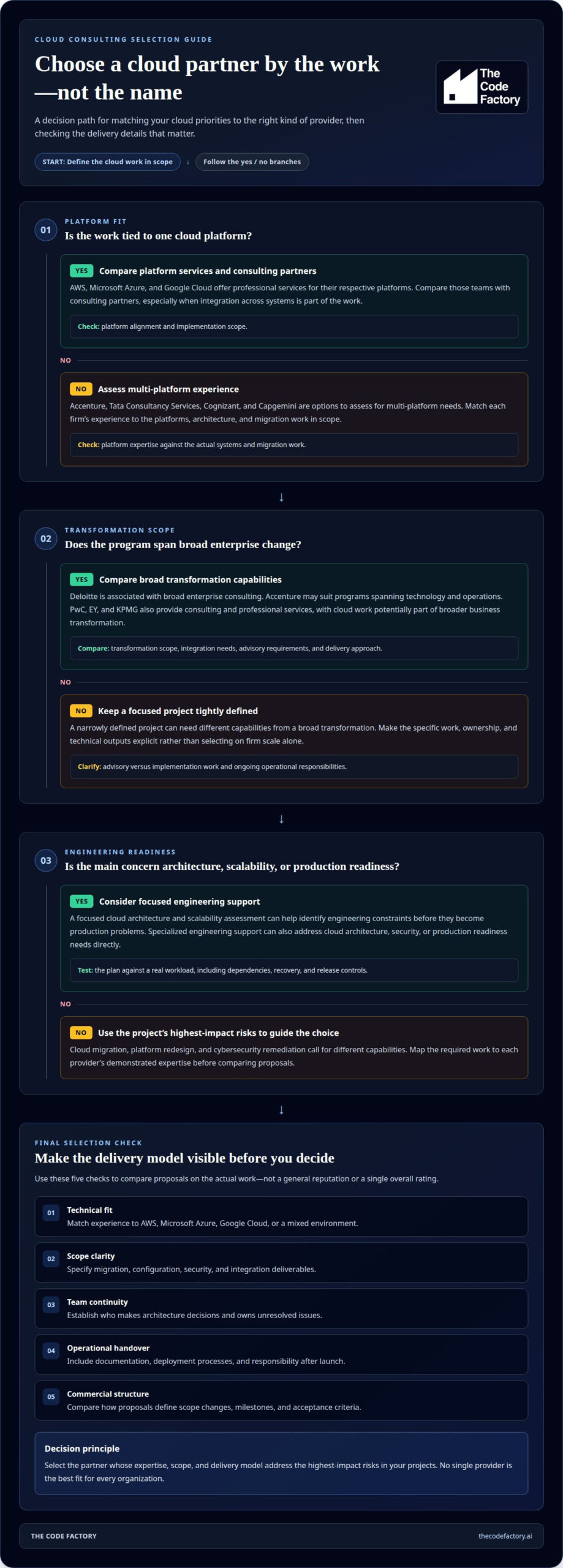
Start by distinguishing platform guidance from independent implementation support. AWS, Microsoft Azure, and Google Cloud offer professional services for their respective platforms. Deloitte and other consulting firms can plan or deliver broader technology programs. Platform teams focus on their own environments, while independent partners may support integration across systems.
For AWS, Azure, or Google Cloud expertise, compare each platform’s professional-services organization with consulting partners that work across cloud environments. Accenture, Tata Consultancy Services, Cognizant, and Capgemini are options to assess for multi-platform needs. Match each firm’s experience to the platform, architecture, and migration work in scope.
Client reviews don’t establish a universal winner between Deloitte and other cloud consulting firms. Look for recurring, project-specific feedback on technical depth, communication, delivery continuity, and how teams handle implementation issues. Compare reviews of work similar to yours, such as cloud migration or infrastructure configuration, rather than relying on a single overall rating.
US cloud consulting costs depend on scope, platform, migration complexity, security requirements, and delivery model. Estimates are based on a defined scope and quote request; no single rate applies to every organization or engagement.
| Option | Primary fit | Useful comparison criteria |
|---|---|---|
| Deloitte | Broad enterprise consulting | Transformation scope, cloud architecture |
| Accenture | Technology and operations programs | Integration needs, delivery approach |
| The Code Factory | Custom cloud and technology solutions | Platform fit, technical depth |
| AWS, Microsoft, Google Cloud | Services tied to each platform | Platform alignment, implementation scope |
Choose a provider whose platform expertise and engagement scope match the work your organization needs done.
Factors for selecting a Deloitte alternative
Start with the outcome, not a firm’s reputation. Cloud migration, platform redesign, and cybersecurity remediation require different capabilities. A Microsoft Azure migration, for example, may hinge on identity controls and workload dependencies, while a multi-cloud project may require architecture spanning platforms. Map the work to each provider’s demonstrated expertise before comparing proposals.
Large firms such as Deloitte and Accenture can offer broad transformation capabilities, but scale alone doesn’t determine whether a provider fits. Risks include an overly broad strategy for a narrowly defined project, unclear ownership across specialist teams, and recommendations that leave implementation gaps. Make scope, decision rights, technical deliverables, and handover responsibilities explicit to reduce these risks.
Use a structured selection process. Define the cloud platforms and systems in scope, then distinguish advisory work from implementation and ongoing operational responsibilities. Assess how each firm handles architecture decisions, cybersecurity controls, integration dependencies, and knowledge transfer. For innovation initiatives, determine how experimental workloads will meet production standards.
- Technical fit: Match provider experience to AWS, Microsoft Azure, Google Cloud, or a mixed environment.
- Scope clarity: Specify migration, configuration, security, and integration deliverables.
- Team continuity: Establish who makes architecture decisions and owns unresolved issues.
- Operational handover: Include documentation, deployment processes, and responsibility after launch.
- Commercial structure: Compare how proposals define scope changes, milestones, and acceptance criteria.
Finally, test the plan against a real workload rather than a generic presentation. A customer-facing service with strict availability needs, for example, exposes design assumptions around dependencies, recovery, and release controls. A focused cloud architecture and scalability assessment can help identify engineering constraints before they become production problems. Select the partner whose scope and delivery model address the highest-impact risks in your projects.
Deloitte is often associated with large-scale transformation and enterprise consulting, while some businesses prioritize specialized insight, clear benchmarks, or cost-effective engagements. Treat these as selection criteria, not assumptions about any provider. Ask each candidate to show how its expertise maps to the work, what supports its benchmarks, and how its commercial approach fits the defined scope. A useful comparison makes trade-offs visible and ties the decision to your needs.
Big Four competitors PwC, EY, and KPMG
PwC, EY, and KPMG are Deloitte’s closest Big Four competitors. Each provides consulting and professional services, so cloud work may form part of a broader business transformation program. For technology leaders, the practical comparison is less about group membership than scope, advisory needs, and delivery model. A cloud program tied to operating-model change requires a different fit from a narrowly defined infrastructure project.
PwC reported annual revenue of $50.3 billion in 2022 and was founded in 1998. Those figures indicate organizational scale, not the quality or suitability of a specific cloud team. Assess PwC against the actual work: cloud strategy, platform implementation, application modernization, or operational change. A proposal should make clear which outcomes belong to advisory work and which require hands-on technical delivery.
EY and KPMG are also Big Four alternatives, but the available comparison facts do not establish a universal ranking among them. KPMG was founded in 1987; that date, like a firm’s overall size, cannot determine whether its proposed team suits your architecture or international operations. Compare the named team’s responsibilities, project boundaries, and transition plan instead of treating brand recognition as a proxy for engineering fit.
- For transformation: Identify whether the cloud program also changes business processes or operating responsibilities.
- For technical delivery: Define platform, architecture, migration tasks, and implementation ownership.
- For international operations: Clarify how decisions, documentation, and handoffs work across participating teams.
- For advisory engagements: Specify the concrete decisions and deliverables the recommendations must support.
Apply the same criteria to Deloitte, PwC, EY, and KPMG. For example, a company modernizing a customer application should compare how each proposal handles dependencies, deployment, and post-launch ownership. This grounds the choice in project requirements rather than broad claims about innovation or transformation.
The Big Four designation groups EY, KPMG, and PwC with Deloitte, but it does not distinguish their individual offers. Separate the category from the decision: compare each proposal with the required work and assess firms on equal terms. The group label identifies providers for comparison, not which one to select.
Deloitte’s Big Four competitors
Deloitte’s Big Four competitors are PwC, EY, and KPMG. These consulting firms offer alternatives for enterprise programs combining cloud work with broader digital transformation. Deloitte is often associated with large-scale transformation and enterprise consulting. That context is useful, but it doesn’t mean one firm leads every cloud engagement.
Compare specific capabilities rather than broad brand claims. A retailer moving customer applications to cloud infrastructure, for example, needs engineering decisions about dependencies, access, and deployment. A global company changing its operating model may need advisory work alongside technical delivery. Similar project labels can conceal different responsibilities, so proposals should separate strategy, implementation, and handover.
To compare Deloitte with PwC, EY, and KPMG, assess each proposal against the same criteria:
- Technical scope: Identify the cloud platform, systems, and engineering work covered.
- Industry context: Look for experience relevant to the operating environment and application requirements.
- Delivery ownership: Clarify who makes architecture decisions and resolves implementation issues.
- Transition model: Define what documentation, knowledge transfer, and post-launch responsibilities are included.
Revenue provides context about company scale, not cloud consulting market share. Deloitte reported global revenue of $59.3 billion in 2022, while PwC reported annual revenue of $50.3 billion in 2022. Those company-wide figures do not show how much revenue came from cloud consulting, or establish which firm has a larger share of that market.
Cloud consulting market share varies with how the market is defined, including which services and providers are counted. For a practical decision, compare the proposed work with your program’s needs. A digital transformation across multiple business functions requires different capabilities from focused infrastructure engineering. Check that each proposal connects advisory recommendations to accountable delivery and a clear operational handoff.
For a cloud program, evaluate architecture and infrastructure against real application constraints before selecting a consulting model. Assess your cloud engineering requirements to clarify where focused technical work fits.
The Code Factory: Architecture & Scalability consulting
The Code Factory helps technology teams address cloud architecture and scalability challenges through focused engineering support. Consider this support when a growing application faces performance constraints, complex infrastructure, or design decisions that could limit future growth.
Architecture & Scalability consulting clarifies structural trade-offs and guides systems toward enterprise-level performance. Cloud infrastructure configuration supports the underlying environment, while production readiness reviews assess whether software is prepared for demanding production conditions. Code remediation and optimisation address implementation issues affecting reliability or maintainability.
This focused approach suits organizations strengthening an existing system or preparing software for production, rather than outsourcing a broad enterprise transformation. Contact The Code Factory to discuss your cloud architecture needs.
Turn your cloud decision into an engineering plan
A provider decision matters most when it establishes clear technical ownership. Before a cloud initiative expands, align architecture decisions, implementation boundaries, and production responsibilities with the people accountable for operating the system. This clarity helps leadership distinguish strategic advice from engineering work that must be completed before launch.
Comparing Deloitte cloud consulting competitors can narrow the field. Next, translate the preferred approach into concrete system requirements. If your team faces architectural constraints, scalability concerns, or code that needs remediation, The Code Factory can help focus on the engineering work needed for a dependable production environment.
Use the conversation to describe the system, its constraints, and the decisions that are blocking progress. Contact The Code Factory to discuss your cloud engineering needs and identify a practical next step. A well-defined plan gives your team a stronger basis for moving forward.
Frequently Asked Questions
Who are Deloitte’s main competitors in cloud consulting?
The Deloitte cloud consulting competitors most often considered include Accenture, IBM Consulting, PwC, EY, KPMG, Tata Consultancy Services, Cognizant, and Capgemini. McKinsey & Company is another option for broader consulting support. AWS, Microsoft Azure, and Google Cloud offer professional services for their own platforms. When comparing Deloitte cloud consulting competitors, distinguish platform-specific assistance from providers suited to broader consulting engagements.
What do client reviews say about Deloitte versus other cloud consulting firms?
Client reviews don’t establish a universal winner. Compare project-specific feedback on technical depth, communication, delivery continuity, and how teams handle implementation issues, especially for work like yours.
