


The most popular framework isn’t automatically the right choice for your microservices. Choosing a microservices framework means matching your team’s language and operating model to performance needs, independent deployment, and the realities of distributed systems. Spring Boot with Spring Cloud is a strong option for Java teams that need a broad ecosystem, while lighter frameworks may suit services with tighter startup or memory constraints.
A framework can speed development, but at scale its impact on operations and deployment matters just as much. This comparison explains how to assess performance, scalability, service communication, and ecosystem fit, with practical trade-offs across about ten options. You’ll also see where Spring Boot and Spring Cloud fit, and how to decide based on the system you need to run, not popularity alone.
Key Takeaways
- Choose a framework around your team’s language, operating needs, and deployment model, not popularity alone.
- Compare performance under realistic workloads, including memory use, startup behavior, and the cost of service-to-service communication.
- Assess whether the framework and its supporting tools make independent releases, observability, and security practical across distributed services.
- Use architecture and production-readiness reviews to identify scaling constraints before they become operational problems.
Spring Boot and Spring Cloud
Spring Boot gives Java teams an application foundation, while Spring Cloud adds patterns and tools for distributed services. Compare their operational fit with alternatives, not just their development speed.
Cloud-Native Features and Database Support
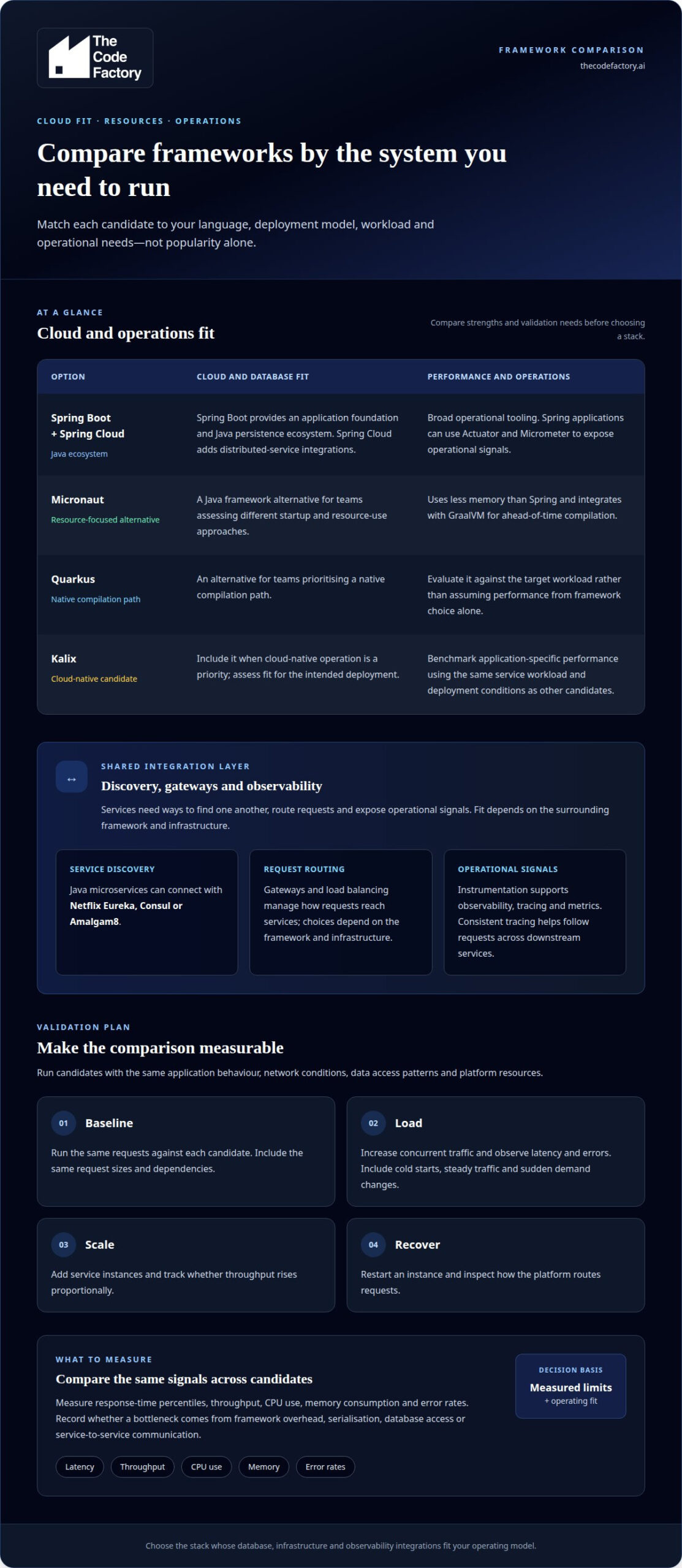
Spring Boot supports applications that connect to databases through Java’s persistence ecosystem, while cloud infrastructure choices shape deployment and operations. Spring Cloud extends the stack with distributed-system integrations. Quarkus and Micronaut are alternatives for teams prioritising native compilation paths. Micronaut uses less memory than Spring and integrates with GraalVM for ahead-of-time compilation.
Include Kalix in the comparison when cloud-native operation is a priority. Assess its performance with the same service workload, database calls, and deployment conditions as the other candidates. This keeps framework-level claims from substituting for measurements of the application your team will operate.
Service Discovery and API Gateways
Service discovery lets services locate one another as instances change; gateways and load balancing manage how requests reach them. Netflix Eureka, Consul, and Amalgam8 can connect with Java microservices, while Spring Cloud can provide a familiar integration path for Spring applications.
Which frameworks support service discovery, API gateways, and load balancing? Spring Boot applications can use Spring Cloud integrations, and Java services can connect with Eureka, Consul, or Amalgam8 for discovery. Gateway and load-balancing choices depend on the surrounding framework and infrastructure.
Tool integration also affects production readiness. Check how each candidate fits your deployment platform, build pipeline, and monitoring stack. Frameworks commonly integrate with instrumentation and monitoring tools for observability, tracing, and metrics. Spring applications can use Actuator and Micrometer to expose operational signals. Consistent tracing across service calls helps teams follow a request through its downstream activity.
Security architecture matters too: National Institute of Standards and Technology says NIST SP 800-204A covers building secure microservices-based applications using service-mesh architecture.
| Option | Cloud and database fit | Performance and operations |
|---|---|---|
| Spring Boot and Spring Cloud | Java ecosystem and distributed-service integrations | Broad operational tooling |
| Micronaut | Java framework alternative | Lower memory use than Spring; GraalVM support |
| Quarkus | Native compilation path | Evaluate against the target workload |
| Kalix | Assess cloud-native fit for the deployment | Benchmark application-specific performance |
Choose a stack whose database, infrastructure, and observability integrations fit your operating model.
Evaluating performance and scalability
A framework’s benchmark results won’t predict how your distributed microservices architecture behaves under production load. When choosing a microservices framework, compare candidates using the same application behaviour, network conditions, data access patterns, and platform resources. For example, test Spring and Micronaut services with identical request sizes and dependencies. Measure response-time percentiles, throughput, CPU use, memory consumption, and error rates.
Keep the workload representative. A service that mostly reads cached data behaves differently from one that makes several network calls and writes to a database. Include cold starts, steady traffic, and sudden demand changes in your test plan. Record whether the bottleneck comes from framework overhead, serialisation, database access, or service-to-service communication. This helps avoid changing frameworks to solve an architecture problem.
- Baseline: Run the same requests against each candidate.
- Load: Increase concurrent traffic and observe latency and errors.
- Scale: Add service instances and track whether throughput rises proportionally.
- Recover: Restart an instance and inspect how the platform routes requests.
Customisation changes the trade-off. Spring Boot offers a broad extension ecosystem, while Micronaut and Quarkus take different approaches to startup and resource use. Every custom interceptor, library, or framework module adds behaviour to maintain. Assess whether a customisation addresses a measured need, such as reducing repeated work, or simply expands the implementation surface.
Framework scalability is only one part of system scalability. A service may use little memory yet struggle when its database connection pool fills or a downstream service slows. Test these dependencies under load, then inspect queueing, timeouts, retries, and backpressure. In a network of services, one overloaded component can increase latency across the request path.
Choosing a microservices framework should be guided by measured limits, operational complexity, and the effort required to tune each candidate. If the architecture needs a closer technical assessment, an architecture and scalability review can help surface constraints before they reach production.
Benefits and challenges of microservices frameworks
A framework provides reusable components for building services, such as request handling, configuration, and integration patterns. It differs from a programming language like Java or Python, which defines how code is written. A platform such as Kubernetes runs and manages applications; it doesn’t replace the framework.
Spring Boot is a common choice for Java, while .NET teams often use ASP.NET Core. Node.js provides a JavaScript runtime, and Python teams can build services with frameworks such as FastAPI or Django REST Framework. GoKit is an option for Go services.
Costs extend beyond framework licensing. Consider applicable licence terms, hosting infrastructure, operational tooling, and the engineering time required for upgrades and maintenance. Kubernetes can support orchestration, but operating its environment also adds work. Compare the full lifecycle rather than treating framework adoption as a standalone expense.
Frameworks can standardise configuration, request handling, and service integration across teams. Spring Boot, for example, gives Java developers a consistent application structure. Separate services can also be deployed and scaled independently. The trade-off is more coordination: teams must manage network failures, data consistency, and monitoring across a more complex system.
Reactive programming can help applications handle asynchronous requests, but it changes development and debugging patterns. Use it when the request flow benefits from non-blocking work, not by default. To evaluate it, trace a user request across services, identify dependencies, and test how failures affect the whole flow.
Security remains an application responsibility, even when frameworks provide integration points. Services should authorize protected operations, including internal calls, and authenticate calling services separately from user context. API keys can suit internal or less-sensitive access; JSON Web Tokens support stateless authentication, while OAuth 2.0 enables delegated API access. Use TLS to protect token-based traffic.
Assess security controls during implementation, not as a later add-on. Check how each service validates credentials, enforces authorisation, and handles sensitive data in logs. A focused security-hardening review can help identify gaps in authentication, authorisation, and service communication before deployment.
Independent deployment and distributed systems
Independent deployment means releasing one service without rebuilding or coordinating a release of every other component. This works only when service boundaries are clear. For example, a payment service can change internally while keeping its published API compatible with the checkout service. Shared databases and tightly coupled software can undermine that separation, even when each component has its own deployment package.
Framework choice affects how teams package, configure, and test services, but the release process depends on more than programming language. Java and Python services can coexist if their interfaces and data contracts remain stable. Teams still need versioning rules, automated compatibility tests, and a way to roll back one service without reverting unrelated changes.
Distributed systems also introduce failure paths that may not exist in a single application. A request can time out between services, arrive twice after a retry, or fail because a dependency is unavailable. Design explicit timeouts, idempotent operations, and bounded retries. For example, a delivery service should handle a repeated order-status request without creating a duplicate order.
Authentication can introduce another dependency. Online token validation adds latency and makes each validating microservice reliant on the token service’s availability. Account for that relationship when designing request flows, service resilience, and recovery behaviour. A framework can provide integration points, but the architecture determines how services behave when a dependency fails.
Deployment automation makes service independence practical. A CI/CD pipeline can build, test, and release a service when its own changes pass defined checks. A practical pipeline should cover:
- Building the service and its deployment artifact.
- Running unit and API compatibility tests.
- Deploying to a staging environment and checking health signals.
- Releasing gradually, with a rollback path for failures.
For teams refining release workflows across distributed components, develop CI/CD deployment pipelines that support repeatable, controlled releases.
The Code Factory
The Code Factory helps teams turn a framework decision into a production-ready architecture. When performance, service boundaries, or deployment processes remain unresolved, its Architecture & Scalability consulting can clarify the design trade-offs. Production readiness reviews assess operational risks, while code remediation and optimisation address implementation issues affecting reliability or performance.
As the system moves towards release, cloud infrastructure configuration can align the runtime environment with the application’s needs. These services are useful when a framework works in development but the wider system needs stronger production foundations. Discuss your architecture, deployment requirements, and current technical constraints with The Code Factory as a next step.
Make the Next Decision Deliberately
Choosing a microservices framework is more than a technology selection. It shapes how your team maintains, deploys, and evolves services as requirements change. Connect the framework decision to your architecture, operational constraints, and engineering priorities. That may mean addressing design risks before launch or improving an existing system that isn’t meeting production needs.
The Code Factory supports this work through Architecture & Scalability consulting, Production readiness reviews, and Code remediation and optimisation. These services help teams assess structural constraints, identify readiness gaps, and improve code where it affects system reliability or performance. The right focus depends on the challenges your system faces now.
Discuss your framework choice with The Code Factory and identify a practical next step for your architecture. A sound decision gives your team a clearer foundation to build on.
Frequently Asked Questions
Which should you choose?
Choose a framework that fits your team’s existing skills and the system’s operational demands. For a Java team already invested in Spring, Spring Boot may reduce integration friction. If startup or memory constraints dominate, include Micronaut in your evaluation. Start by selecting a representative service and testing candidate frameworks against its real dependencies and release process.
How do Spring Boot, Quarkus, Micronaut, and Helidon compare for microservices?
Spring Boot is a familiar Java option with a broad ecosystem, while Quarkus and Micronaut offer different approaches to building Java services. Micronaut uses less memory than Spring and integrates with GraalVM for ahead-of-time compilation. Helidon is another Java framework to assess. Compare ecosystem compatibility, implementation effort, runtime requirements, and your team’s ability to maintain each stack.
What criteria should teams use to choose a microservices framework?
Prioritise language and team expertise, deployment workflow, required integrations, security controls, and maintainability. Then examine a concrete service, such as order processing, and identify its database, external APIs, and release dependencies. A framework is a stronger fit when it supports these needs without adding unnecessary complexity. Include operational ownership in the decision, not just developer productivity.
How do microservices frameworks compare for performance, memory use, and startup time?
There’s no reliable winner for every workload. Runtime behaviour depends on application code, dependencies, deployment configuration, and traffic patterns. Micronaut uses less memory than Spring, and its GraalVM integration supports ahead-of-time compilation. Treat these differences as reasons to benchmark, not as a guarantee of faster service. Test the built application in its intended runtime environment.
How well do leading frameworks integrate with Docker, Kubernetes, and major cloud providers?
Integration depends on framework tooling and each service’s deployment configuration. Assess whether the application can be packaged consistently, receive environment-specific settings, expose health information, and work with your chosen cloud infrastructure. For example, trace a service from container build through Kubernetes deployment, including configuration, secrets, and rollback procedures.
What risks and trade-offs come with adopting a microservices framework?
A framework can speed implementation, but it also creates dependencies on its conventions, extensions, and upgrade path. In a system split across services, inconsistent framework choices may complicate shared support and incident response. Before adopting one, identify who will maintain each service, how upgrades will be handled, and whether it introduces operational components your team must run and monitor.
