


The safest modernization plan doesn’t begin with a rewrite or a cloud migration. It begins by reducing uncertainty. A practical application modernization strategy helps you decide which systems to refactor, replatform, replace, or retain before hidden dependencies turn estimates into surprises.
If you’re concerned about outages, expanding scope, or committing resources without clear business value, that caution is justified. Modernization isn’t one decision applied across an entire portfolio. Each application has different operational risks, technical constraints, and business importance, so the sequence matters as much as the destination.
This guide shows you how to assess your application portfolio, connect priorities to measurable business and operational outcomes, and build a phased roadmap that limits disruption. You’ll learn how to weigh modernization options, uncover dependencies that affect sequencing, and improve delivery readiness before making major platform changes. The goal isn’t transformation for its own sake. It’s a controlled engineering plan that reduces risk while making applications easier to maintain.
Key Takeaways
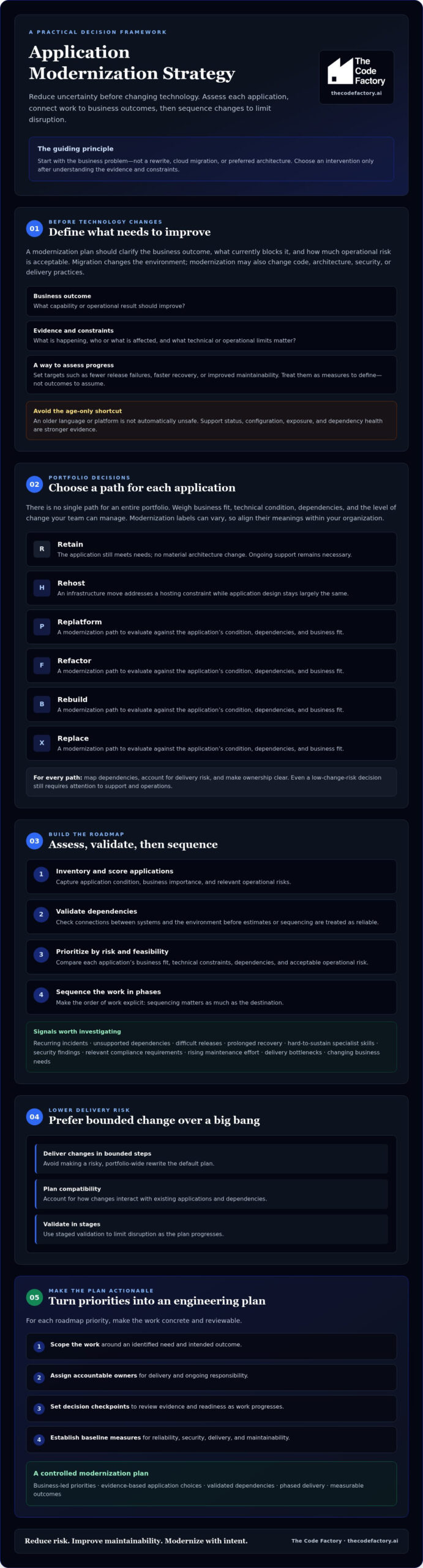
- Define modernization around business outcomes, not a predetermined platform or architecture change.
- Choose whether to retain, rehost, replatform, refactor, rebuild, or replace each application based on its condition, dependencies, and business fit.
- Build an application modernization strategy by inventorying and scoring applications, validating dependencies, and sequencing work according to risk and feasibility.
- Reduce disruption by delivering bounded changes with compatibility planning and staged validation instead of attempting a big-bang rewrite.
- Turn roadmap priorities into scoped work with accountable owners, decision checkpoints, and baseline measures for reliability, security, delivery, and maintainability.
What an application modernization strategy should solve before technology changes
Choosing a new platform is not the same as solving an application’s underlying problems. An application modernization strategy should first clarify what the business needs to improve, what currently prevents that improvement, and how much operational risk is acceptable. Without that connection, teams can move existing complexity to new infrastructure without making the system easier to secure, change, or operate.
Application modernization is a business-led plan for changing applications and their supporting platforms to improve defined outcomes, with implementation choices determined by evidence and constraints. Migration moves an application to another environment; modernization may include migration, but can also involve code remediation, architectural changes, security improvements, or better delivery practices. Routine maintenance keeps a system functioning, while modernization addresses structural limitations. None of these goals requires an automatic move to cloud-native architecture.
A sound approach begins with analysis, not a preferred technology. The Architecture-Driven Modernization (ADM) perspective reinforces the value of examining an application’s architecture before designing changes. The result should be a clear rationale for each proposed intervention, whether that means improving release reliability, reducing operational friction, addressing a confirmed security weakness, or supporting a new business capability.
What does application modernization mean in practice?
Modernization can change architecture, code, infrastructure, security controls, or the way teams build and release software. It can also happen incrementally. For example, a team might first improve deployment controls, then remediate a high-risk component, and later adjust infrastructure if there is a demonstrated need. Give each step an intended outcome and a way to assess it, such as fewer release failures, faster recovery, or improved maintainability. Treat these as targets to define and measure, not results to assume.
Which signals indicate an application needs attention?
Look for operational evidence: recurring incidents, unsupported dependencies, difficult releases, prolonged recovery, or specialist skills that are becoming hard to sustain. Review security findings and relevant compliance requirements in the context of your organization. Then distinguish verified risks from assumptions. An older language or platform isn’t automatically unsafe; support status, configuration, exposure, and dependency health provide stronger evidence than age alone.
Rising maintenance effort, delivery bottlenecks, and changing business needs can all justify a closer assessment, but they point to different interventions. A release bottleneck may call for changes to the delivery process, while a documented vulnerability may require focused remediation. Establish what is happening, who or what it affects, and which outcome matters before selecting a technical response. That discipline keeps modernization anchored to a business case rather than a technology trend.
Which application modernization strategy fits: retain, rehost, refactor, or replace?
No single modernization path suits every application. Choose based on the business need, the system’s technical condition, its dependencies, and the level of change your team can manage. The labels below are common, but taxonomies vary; align their meanings with your organization’s framework before comparing proposals. Forrester’s modern application disposition framework offers another reference point for portfolio decisions.
| Path | Business fit and architectural change | Dependencies, delivery risk, and ownership |
|---|---|---|
| Retain | The application still meets needs; no material architecture change. | Keep dependencies and ownership in view. Low change risk, but ongoing support remains necessary. |
| Rehost | An infrastructure move addresses a hosting constraint; application design stays largely the same. | Map environment and integration dependencies. Migration risk remains; teams own existing code and operations. |
| Replatform | A limited platform adjustment targets operational or infrastructure needs. | Validate compatibility and service dependencies. Risk is higher than a simple move; new platform components need clear owners. |
| Refactor | Targeted code or architectural changes improve a viable application. | Trace affected components and interfaces. Scope can be bounded, but teams must maintain and test changed code. |
| Rebuild | A new implementation is justified when the existing design blocks defined requirements. | Behavior and integrations must be understood. Delivery risk rises; ownership shifts to the new system and its interfaces. |
| Replace | A different application better fits business needs than continued investment in the current one. | Plan data, process, and integration transitions. Cutover risk can be substantial; clarify vendor and internal responsibilities. |
When is rehosting or replatforming a reasonable first move?
Rehosting can be reasonable when an infrastructure constraint is urgent and the application works acceptably as-is. Replatforming may fit when a limited platform change addresses a specific operational need without requiring redesign. Neither automatically improves code quality, tight coupling, or slow releases. Before moving, record relevant baselines, such as availability, incident frequency, deployment effort, and infrastructure performance. Afterward, compare the same measures under comparable conditions to test whether the intended benefit materialized.
When should teams refactor, rebuild, replace, or retain?
Refactor when targeted changes can address known weaknesses in a product that remains valuable. Consider rebuilding or replacing only when evidence shows smaller interventions can’t meet defined business, security, or operational needs, and account for transition dependencies. Retain is also a deliberate choice if the application remains fit for purpose and the risk, value, or timing doesn’t justify change. For complex trade-offs, software architecture consulting can help clarify constraints and options. The Code Factory provides architecture and scalability consulting for this kind of engineering consideration.
A sound application modernization strategy makes the rationale explicit before committing to a path. For more information, explore The Code Factory’s engineering services.
How to assess applications and prioritize a modernization roadmap
A useful roadmap starts with a reliable view of the portfolio, not a list of technologies teams want to adopt. Assess each application against business value and technical evidence, then map dependencies before deciding what to change first. This makes the application modernization strategy easier to explain, challenge, and sequence.
Prioritization should combine business criticality with technical evidence, then account for dependencies and the capacity to deliver change safely.
What evidence belongs in an application assessment?
Gather architecture diagrams, application and data dependency information, incident history, release patterns, known security findings, and ownership details. Interview business stakeholders to confirm what the application supports and engineering teams to surface operational constraints that documents may miss. Record evidence gaps explicitly. An unverified dependency or assumed risk should prompt investigation, not be treated as a confirmed finding.
For production risk, a production readiness review protocol can help frame a structured examination of reliability, security, and delivery readiness.
How should teams rank modernization candidates?
Use a transparent scoring model and agree on its criteria before ranking applications. A shared scale can help teams compare evidence consistently, but the weights should reflect business priorities and the organization’s tolerance for risk. Define each rating in practical terms so different teams assess applications consistently.
- Inventory: List applications, business owners, users, purpose, hosting, and known support status.
- Assess: Review technical condition, security exposure, incident patterns, release friction, and expected change demand.
- Score: Rate business criticality, technical condition, security exposure, change demand, and implementation feasibility. Define what each rating means so teams apply it consistently.
- Validate dependencies: Map upstream and downstream applications, shared data, integrations, and operational services. Confirm the map with teams before proposing scope or sequence.
- Sequence: Balance expected business value against delivery risk, dependency complexity, and available team capacity. Identify prerequisite work and schedule initiatives only when ownership and key constraints are understood.
A high-priority application isn’t automatically the best place to start. If it depends on several systems with unclear interfaces, first resolving those dependencies may reduce risk across the roadmap. Conversely, a bounded improvement to a less critical application may be a practical early initiative if it addresses a verified issue and builds delivery confidence.
Keep the scoring model revisable. As teams confirm dependencies, uncover evidence gaps, or learn more about implementation feasibility, update the ranking and document why. The roadmap is a decision tool, not a fixed verdict.
How to execute modernization without a risky big-bang rewrite
Modernization doesn’t require replacing an entire application in one release. Large rewrites concentrate technical and operational risk: teams must reproduce existing behavior, preserve integrations, move data, and deliver new functionality before the old system can be retired. An incremental approach limits the size of each change, making it easier to test assumptions and respond to problems before expanding the work.
For an application modernization strategy to reduce risk in practice, define each increment around a bounded capability, a clear acceptance criterion, and a rollback path. A change might update one interface or improve one deployment process while leaving other components untouched. Small changes aren’t automatically safe, but they’re easier to reason about when dependencies, compatibility, and ownership are explicit.
How can teams modernize incrementally?
The strangler fig pattern is one way to shift functionality gradually: new components take on selected responsibilities while the existing application continues to serve the rest. Before separating components, identify service boundaries, data ownership, and the interfaces that connect them. A feature that appears isolated in a diagram may still depend on shared data or undocumented behavior.
Start with a small, reversible change. Validate it under representative conditions, review operational evidence, and use what you learn to refine the next increment. Expand the scope only when the new boundary behaves as expected and teams understand how to support it.
How should teams protect production during change?
Production protection starts before deployment. Agree on representative test coverage and acceptance criteria, then prepare monitoring that can reveal failures or degraded behavior after release. Assign an owner to review signals and respond. Document rollback steps, verify that they’re workable, and define how access controls and release permissions will be managed.
- Test: Check changed behavior, critical integrations, and relevant failure paths.
- Observe: Monitor service health and user-facing outcomes against a baseline.
- Recover: Set thresholds for pausing, rolling back, or investigating a release.
- Control: Use reviewable deployment steps and appropriate access restrictions.
Automated pipelines can make release steps repeatable, but they also need appropriate safeguards. Review CI/CD pipeline security practices when defining deployment controls. If security, scalability, or production-readiness risks exceed the team’s available expertise, seek an independent technical review before increasing the scope. The Code Factory offers production readiness reviews, security hardening, and CI/CD deployment pipelines as potential engineering support. Explore engineering support for modernization.
Turn the application modernization strategy into an engineering plan
A roadmap becomes actionable when every priority translates into owned work. For each application, document its scope, business rationale, selected approach, dependencies, sequence, and key risks. Then break that approach into work items with accountable owners, delivery prerequisites, and decision checkpoints. State who can approve a change in direction and what evidence will determine whether to continue, revise, or stop an initiative.
What should a modernization roadmap contain?
Keep assumptions and evidence gaps visible alongside confirmed findings. For each phase, record unresolved decisions, affected teams, and the conditions that must be met before work proceeds. This makes the application modernization strategy a working plan rather than a fixed commitment, and gives technical and business stakeholders a shared basis for reviewing scope and risk.
How can teams measure progress beyond migration completion?
Set baselines before implementation and define target measures that fit the application’s purpose. A move is complete when the work is deployed, but modernization progress depends on whether the intended operational or business outcome follows. Review measures at agreed checkpoints, investigate gaps, and use what you learn to adjust subsequent phases.
- Reliability: Track relevant incidents, service disruptions, or recovery performance.
- Delivery flow: Review release frequency, deployment failures, or time spent resolving release issues.
- Security: Monitor identified findings, remediation status, and changes to exposure.
- Maintainability: Assess code quality, supportability, and operational effort using indicators relevant to the system.
Choose measures with care. A single metric rarely captures whether an application is safer to operate, easier to change, and better aligned with business needs. Pair operational indicators with stakeholder feedback, and revisit the roadmap when evidence shows that assumptions, dependencies, or priorities have changed.
Specialist engineering support can help teams assess readiness or address gaps identified during planning. The Code Factory provides production readiness reviews, code remediation and optimisation, architecture and scalability consulting, cloud infrastructure configuration, security hardening, and CI/CD deployment pipelines. These capabilities may support specific assessment or implementation needs; define the scope around the findings and outcomes your organization requires.
If an independent technical perspective would help clarify risks or next steps, discuss an engineering assessment with The Code Factory.
Move from modernization priorities to measured progress
A strong application modernization strategy starts with business outcomes, not a predetermined technology choice. Assess applications using evidence, choose an approach that fits each system, and sequence work around dependencies and delivery risk. Then turn priorities into owned engineering tasks with clear checkpoints.
Keep progress tied to outcomes after deployment. Baselines for reliability, security, delivery flow, and maintainability help teams see whether changes are addressing the problems that justified modernization. Use those findings to refine the roadmap as business needs and technical understanding evolve.
The Code Factory can support modernization work through production readiness reviews and code remediation, alongside architecture and scalability consulting, cloud infrastructure configuration, security hardening, and CI/CD deployment pipelines. These capabilities can help address specific assessment or engineering needs without assuming every application requires the same intervention.
Ready to clarify your next steps? Discuss your application modernization engineering needs with The Code Factory. A measured plan can help your team make progress while keeping risk and operational realities in view.
Frequently Asked Questions
What is an application modernization strategy?
An application modernization strategy is a plan for changing applications and their supporting platforms to achieve defined business or operational outcomes. It connects priorities, such as improving security or making releases more reliable, to the work required and the risks involved. The strategy also identifies what to retain, what to change, and how to measure progress. It doesn’t assume that every system should move to the cloud or adopt the same architecture.
What are the main application modernization approaches?
Common approaches include retaining an application, rehosting it on different infrastructure, replatforming it with limited platform changes, refactoring its code or architecture, rebuilding it, or replacing it with another solution. Each involves different levels of change, dependencies, delivery risk, and ongoing ownership. The right choice depends on the application’s condition and business role. Organizations should define these terms consistently because modernization frameworks may use different labels or group approaches differently.
How do you create an application modernization roadmap?
Create a roadmap by inventorying applications, assessing their business importance and technical condition, scoring candidates against shared criteria, validating dependencies, and sequencing initiatives. Record each application’s rationale, chosen approach, risks, prerequisites, accountable owner, and decision checkpoints. Include evidence gaps and unresolved decisions rather than presenting assumptions as facts. Set baseline measures before work begins, then review results at planned checkpoints so the roadmap can adapt to delivery findings and changing business priorities.
Does application modernization always require a complete rewrite?
No. Modernization can be delivered through bounded changes to code, architecture, infrastructure, security, or release practices while the existing application continues to operate. A team might address a specific code weakness or improve deployment controls before deciding whether broader changes are necessary. Rebuilding or replacing is more appropriate when evidence shows smaller interventions cannot meet defined needs. A complete rewrite adds transition and integration work, so it should be justified rather than assumed.
How do you prioritize legacy applications for modernization?
Prioritize applications using both business importance and technical evidence. Assess criticality, technical condition, security exposure, demand for change, and implementation feasibility. Then map application, data, and service dependencies before deciding sequence, since a high-priority system may rely on components that need attention first. Consider delivery risk and available team capacity as well as expected value. Older technology alone doesn’t prove an application is unsafe or urgent; verify support status, incidents, and exposure.
How can teams reduce risk during application modernization?
Reduce risk by delivering small, clearly scoped changes with defined acceptance criteria, representative testing, and explicit compatibility requirements. Before each production release, assign owners for monitoring and response, verify access controls, and document rollback steps. Use release automation to make deployment processes consistent, while protecting the pipeline itself. Track relevant reliability, security, and delivery measures against baselines. If an increment behaves unexpectedly, pause, investigate, and adjust before expanding scope.
When should a company hire application modernization consultants?
Consider specialist support when internal teams lack capacity or an independent technical view is needed to assess production readiness, architecture, scalability, security, infrastructure, or delivery practices. A consultant can help clarify evidence, dependencies, and remediation priorities, but the engagement should have a defined scope and decision owner. The Code Factory provides production readiness reviews, code remediation and optimisation, architecture and scalability consulting, cloud infrastructure configuration, security hardening, and CI/CD deployment pipelines.
