
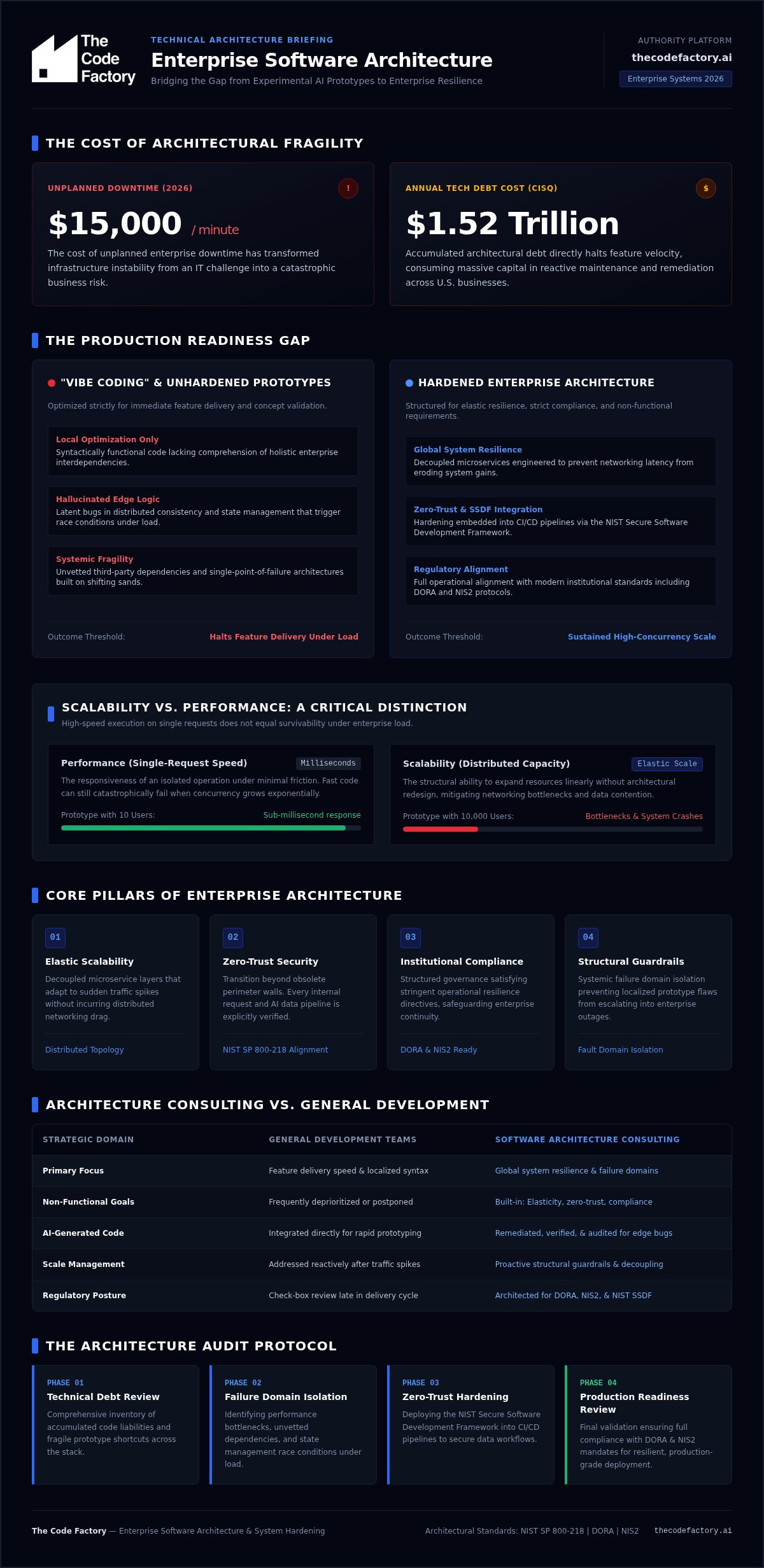
At $15,000 per minute, the cost of unplanned enterprise downtime in 2026 is no longer just an IT headache; it’s a catastrophic business risk. You’ve likely seen the incredible speed at which AI-generated code can produce a working prototype, yet that same velocity often leaves behind a trail of technical debt and structural fragility. It’s a common tension where the drive for rapid innovation directly compromises the stability required for high-stakes production environments. Specialized software architecture consulting offers the strategic pivot you need to bridge this gap, moving your systems from experimental speed to enterprise-grade reliability.
We understand the anxiety that comes with scaling a system built on shifting sands. This article provides a clear roadmap for hardening your infrastructure, remediating legacy code, and aligning with modern compliance standards like DORA and NIS2. You’ll discover how to transform fragile architectures into resilient, production-ready platforms that reduce infrastructure risk and improve your overall security posture. We will examine the specific protocols for architectural audits and the disciplined engineering required to sustain long-term growth without the constant fear of systemic collapse.
Key Takeaways
- Identify the structural risks inherent in AI-generated code and why rapid prototyping often fails to meet non-functional enterprise requirements.
- Explore the essential pillars of hardened systems, including designing for elastic demand and transitioning to a zero-trust security posture.
- Understand the strategic value of software architecture consulting in establishing the structural guardrails that general development teams often overlook.
- Learn how to execute a rigorous production readiness review to identify performance bottlenecks and prioritize critical code remediation.
- Gain a clear roadmap for transforming experimental prototypes into stable, scalable assets that reduce infrastructure risk and technical debt.
Why Prototypes Fail at Scale: Architecture Consulting
Rapid prototyping has entered a new era of “vibe coding,” where speed is prioritized over structural integrity. While this approach allows for immediate validation of a concept, it often bypasses the fundamental software architecture principles necessary for long-term survival. The transition from a functional prototype to a production-ready system isn’t a linear progression; it’s a structural overhaul. Without professional software architecture consulting, many organizations find themselves scaling a house built on sand, only to realize the structural flaws when user traffic spikes or security audits begin. This gap between “it works” and “it’s ready” is where enterprise risk lives.
The AI-Generated Code Liability
Large Language Models (LLMs) excel at generating syntactically correct code, but they lack a holistic understanding of system interdependencies. They prioritize immediate task completion over global scalability. This often introduces unvetted third-party dependencies or inefficient logic that creates performance bottlenecks. We frequently see AI tools “hallucinate” logic in critical production pathways, such as complex state management or distributed data consistency. These errors aren’t always obvious during development. They manifest as silent data corruption or race conditions under load. Expert code remediation is required before an enterprise launch to ensure the codebase is resilient, not just functional.
When “Good Enough” Becomes a Production Risk
The concept of “good enough” is a dangerous metric in high-stakes digital environments. There’s a specific threshold where accumulated architectural debt stops being a manageable inconvenience and starts halting feature development entirely. According to the Consortium for Information & Software Quality (CISQ), technical debt costs U.S. businesses roughly $1.52 trillion annually in maintenance and remediation. When a prototype fails during initial scaling, it’s rarely due to a single bug; it’s the result of systemic failure domains.
Managing this risk requires a shift from experimental speed to enterprise-grade reliability. Strategic software architecture consulting identifies these failure domains early. It transforms experimental assets into hardened systems. It replaces fragile workarounds with robust infrastructure. By addressing architectural debt before it compounds, you protect your innovation pipeline from the weight of its own success. The sober reality is that production environments don’t forgive structural shortcuts; they exploit them.
The Core Pillars of Enterprise-Grade Software Architecture
Enterprise architecture isn’t about making things work; it’s about making them endure. True stability rests on four core pillars that distinguish a hobbyist project from a production-ready asset. Engaging in software architecture consulting helps leadership move past surface-level functionality to address the structural requirements of a high-stakes environment. Without these foundations, even the most innovative features will eventually buckle under the weight of their own technical debt.
Scalability vs. Performance: A Critical Distinction
Many teams confuse performance with scalability. A system might respond in milliseconds for ten users but crash at ten thousand. Performance is about the speed of a single request; scalability is about the system’s ability to handle increasing work by adding resources without a complete redesign. In cloud-native infrastructures, identifying bottlenecks often reveals that the issue isn’t the code itself but how the distributed performance is managed. Microservices engineering can solve this by decoupling components, but it introduces complexity that requires expert oversight to prevent networking latency from eating your gains. Understanding the full scope of scaling AI applications from experimental prototypes to enterprise production is essential for teams navigating this transition. For engineering leaders who need a structured approach to validating their system’s capacity limits, conducting a thorough software scalability audit provides the disciplined protocol needed to identify serialization bottlenecks and quantify your elasticity curve before they become production failures.
Security as an Architectural Foundation
Security can’t be an afterthought or a checkbox at the end of a sprint. Modern threats require moving beyond basic perimeter defense toward a zero-trust architecture where every request is verified, regardless of its origin. Integrating the NIST Secure Software Development Framework into your CI/CD deployment pipeline ensures that hardening happens during the build process. This is especially critical for AI-integrated software workflows, where unvetted data flows can create new attack vectors. Conducting a thorough production readiness review is a vital step in validating these security controls before they face real-world traffic.
A hardened system must also be maintainable and resilient. If the “cognitive load” for your engineering team is too high, they’ll inevitably introduce errors during routine updates. High-quality architecture reduces this load through clear abstraction and strict modularity. Finally, resilience is a fiscal necessity. With the average cost of downtime reaching $15,000 per minute, implementing fault tolerance and automated recovery protocols is non-negotiable. This involves circuit breakers, retries, and bulkhead patterns that prevent a single component failure from cascading through the entire system. Professional software architecture consulting ensures these patterns are baked into the system’s DNA, providing the foresight needed to prevent outages before they manifest.
Software Architecture Consulting vs. General Development: The Strategic Choice
Internal engineering teams are almost always measured by their ability to ship features and meet sprint deadlines. This focus on velocity is necessary for growth, but it creates a natural blind spot regarding the underlying structural health of the system. While general developers build the visible rooms and the facade, software architecture consulting focuses on the foundation and the load-bearing walls. When a system reaches a critical scale, the skills required to add a new API endpoint are fundamentally different from those needed to remediate a distributed state synchronization issue. High-stakes environments don’t just need more builders; they need a specialized fixer who can identify structural rot before the roof collapses.
An outside auditor provides a sober voice of reason that is often missing in fast-moving, hype-driven development cycles. Internal teams frequently fall victim to the “Sunk Cost” bias, where they continue to patch a failing architecture because they’ve already invested months of effort into it. A consultant provides the objective distance necessary to identify when a pattern is no longer viable. This pragmatic urgency focuses purely on what must be fixed to survive enterprise production, stripping away the ego and internal politics that can cloud technical decision-making.
The Value of an Independent Technical Audit
An independent audit uncovers blind spots in internal development workflows that are often invisible to those too close to the code. This process involves a rigorous evaluation of cloud infrastructure configuration and an objective assessment of non-functional requirements. By applying methodologies such as the Architecture Tradeoff Analysis Method, consultants help leadership balance competing priorities like availability, performance, and security. This structured approach ensures that your architecture is evaluated against global standards rather than just your internal team’s current capabilities.
Engineering for ROI: Remediation over Rebuilding
Building from scratch is rarely the most efficient path to stability in an enterprise context. Strategic code remediation allows organizations to save existing investments by isolating and repairing specific failure domains within the current system. This process often involves optimizing CI/CD pipelines to reduce human error and streamlining deployment times to increase operational confidence. If your current codebase was heavily influenced by generative tools, the need for this refinement is even more pressing. You can learn how to fix AI code for production to ensure your experimental speed doesn’t lead to an expensive system failure. The goal is always a hardened, production-ready system that supports innovation without compromising integrity.
The Architecture Audit Protocol: A Roadmap to Production Readiness
Transitioning a prototype into a high-stakes production environment requires more than just a deployment script; it demands a methodical, five-step engineering protocol. This roadmap serves as the core of professional software architecture consulting, ensuring that every structural choice is validated against enterprise requirements. It isn’t enough to check if the code runs. You must verify if it survives. The protocol begins with a baseline assessment and moves rapidly into active hardening.
- Step 1: Production Readiness Review (PRR). This phase establishes the health baseline of your current system, identifying immediate risks to stability.
- Step 2: Security Hardening. We move beyond surface-level scans to perform deep vulnerability assessments and zero-trust configuration.
- Step 3: Scalability Stress Testing. Infrastructure optimization is driven by data from simulated high-concurrency events.
- Step 4: Code Remediation. This involves refactoring legacy or AI-generated logic to meet strict enterprise standards.
- Step 5: CI/CD Automation. The final step hardens the deployment pipeline to prevent human error and configuration drift.
Conducting a Production Readiness Review
A Production Readiness Review is an exhaustive engineering audit focused on stability and security. It provides the technical foundation for all subsequent remediation efforts. Following The Enterprise Protocol for Production Readiness ensures that your infrastructure checks align with 2026 industry benchmarks. This review identifies the silent failure domains that often escape standard testing cycles, providing a sober assessment of your system’s actual health.
Infrastructure as Code (IaC) and Automation
Hardening cloud infrastructure is no longer a manual task; it requires automated configuration through Infrastructure as Code. This approach eliminates the “snowflake server” problem and ensures that your security posture remains consistent across all environments. DevSecOps plays a critical role here by embedding security controls directly into the delivery process rather than treating them as a final hurdle. For teams looking to minimize deployment risk, Securing CI/CD Pipelines for Enterprise is the standard for modern automation hardening.
The move toward a production-ready system is a strategic investment in your company’s resilience. If you’re ready to transition from experimental code to a hardened enterprise asset, you can book a production readiness review with The Code Factory today. Professional software architecture consulting provides the rigor needed to scale with confidence and protects your systems from the hidden liabilities of rapid development.
Partnering with The Code Factory for Architectural Excellence
The Code Factory operates with a level of discipline and rigor that standard development agencies often lack. We don’t just build features; we provide the technical authority required to stabilize high-stakes digital environments. Our software architecture consulting is designed to bridge the gap between rapid, experimental innovation and the uncompromising demands of enterprise production. By focusing on the structural integrity of your systems, we ensure that your growth isn’t sabotaged by the very tools meant to accelerate it. This transition from experimental speed to enterprise-grade reliability is the core of our mission.
Beyond General Consulting: The Specialized Fixer
Enterprise leaders choose us because they need a sober voice of reason in an industry often blinded by technological hype. We specialize in high-stakes production readiness reviews that go beyond simple checklists to uncover deep-seated architectural flaws. Our focus on AI code security and infrastructure hardening addresses the specific risks introduced by modern generative tools. We don’t just identify problems; we act as specialized fixers who remediate code and optimize cloud configurations to meet global standards. This objective distance allows us to provide the pragmatic urgency needed to survive in production.
Get Started with a Production Readiness Audit
Moving from a fragile prototype to a hardened system requires a clear definition of scope and a predictable delivery model. The Code Factory utilizes a credit-based engineering model to provide organized, transparent outcomes for complex architectural tasks. This structure allows us to tackle granular engineering challenges without the overhead of traditional project management friction. Whether you’re dealing with technical debt that has halted your roadmap or you’re preparing for a massive user concurrency spike, our software architecture consulting provides the foresight to prevent outages before they happen.
The path to a production-ready system starts with an honest assessment of your current liabilities. Defining the scope of your architectural remediation is the first step toward reclaiming your innovation pipeline. You can secure your production environment with The Code Factory today. Transitioning from experimental AI prototypes to stable enterprise assets isn’t just about writing more code; it’s about the disciplined engineering required to maintain long-term reliability. Let us guide your architectural remediation and ensure your systems are truly ready for the demands of the modern enterprise.
Securing Your Path to Enterprise-Grade Stability
The transition from a high-speed prototype to a resilient enterprise platform is a critical juncture for any organization. We’ve examined how rapid development cycles often leave behind a trail of technical debt that compromises structural integrity. Specialized software architecture consulting serves as the strategic pivot needed to address these liabilities through rigorous production readiness reviews and expert infrastructure hardening. By focusing on enterprise stability and specialized AI code remediation, you can ensure that your innovation is supported by a foundation capable of handling real-world demand.
Protecting your digital assets requires a sober assessment of current risks and a commitment to engineering excellence. You don’t have to navigate the complexities of system hardening alone; the right expertise can bridge the gap between experimental code and a production-ready asset. You can Request a Production Readiness Review from The Code Factory to start building a more secure, scalable future for your software. Moving toward a hardened environment is the most effective way to mitigate risk and sustain long-term growth with confidence.
Frequently Asked Questions
What is the primary goal of software architecture consulting?
The primary goal of software architecture consulting is to ensure a system’s structural integrity, security, and long-term viability in high-stakes production environments. Unlike general development, this discipline focuses on non-functional requirements such as scalability, failure domains, and data consistency models. Consultants act as strategic guides who transform fragile prototypes into hardened enterprise assets. By identifying and remediating structural rot early, organizations can avoid the catastrophic costs associated with systemic collapse or unplanned downtime.
How does architecture consulting differ from standard software development?
Architecture consulting differs from standard software development by prioritizing the system’s foundation over its functional features. While developers are typically measured by their ability to ship new UI components or APIs within a sprint, consultants focus on cross-cutting concerns like infrastructure decoupling and security posture. They provide the structural guardrails that allow development teams to build more efficiently. This specialized oversight ensures that the software can endure enterprise-level traffic without requiring a complete redesign.
Why is a production readiness review necessary for AI-generated applications?
A production readiness review is critical for AI-generated applications because LLMs often prioritize local syntax over global structural scalability. AI-generated code frequently contains hallucinated logic, unvetted third-party dependencies, or inefficient database queries that manifest only under heavy load. These systems require expert code remediation to identify silent failure domains. Without this specialized audit, organizations risk deploying fragile software that lacks the security hardening and performance optimization necessary for a stable enterprise launch.
What are the most common architectural risks in enterprise software?
The most common architectural risks include technical debt, rigid monolithic structures, and poor security configuration. Many enterprise systems suffer from database lock contention, unindexed queries, and a lack of circuit-breaking protocols, which lead to cascading failures during traffic spikes. Additionally, fragmented microservices often introduce networking latency and distributed state synchronization issues. Professional software architecture consulting identifies these bottlenecks and implements proactive resilience patterns to prevent the unplanned outages that cost Global 2000 companies billions annually.
Can software architecture consulting help with legacy system modernization?
Software architecture consulting is essential for legacy system modernization because it focuses on strategic remediation over the high risk of a complete rebuild. Consultants evaluate the existing codebase to isolate failure domains and refactor critical pathways for better performance. This process often includes cloud infrastructure configuration and security hardening to bring legacy assets up to modern standards. By optimizing CI/CD pipelines and reducing technical debt, organizations can extend the life of their existing investments while improving operational stability.
How does architecture consulting improve software scalability?
Architecture consulting improves scalability by identifying and removing performance bottlenecks within the application and its underlying infrastructure. Consultants design for elastic demand by implementing stateless application layers, asynchronous messaging, and distributed caching strategies. They also optimize cloud infrastructure configuration to ensure resources are utilized efficiently. This structured approach prevents database contention and I/O blocking, allowing the system to handle increasing workloads by adding resources without a decrease in response time or reliability.
What is the typical ROI of a technical architecture audit?
The ROI of a technical architecture audit is realized through reduced infrastructure risk and significantly lower maintenance costs. By remediating architectural debt, organizations can redirect up to 40% of their IT budgets from patching legacy issues to creating new business capabilities. Furthermore, preventing a single hour of unplanned downtime can save an enterprise between $300,000 and $1 million. Hardening your system’s foundation ensures long-term stability and improves your overall security posture against evolving digital threats.
How long does a comprehensive architecture review take?
A comprehensive architecture review typically spans one to four weeks, though the exact duration depends on the complexity of the system and the scope of the audit. The process begins with an exhaustive engineering audit of the codebase and cloud infrastructure, followed by a detailed report on identified failure domains. Once the assessment is complete, the focus shifts to prioritizing code remediation and security hardening tasks. This methodical approach ensures that every critical production pathway is validated for enterprise-grade reliability.
