


If your deployment pipeline treats security as a final checklist rather than a structural foundation, you’re not shipping software; you’re shipping liabilities. The rapid adoption of AI-assisted development has created a paradox where speed often masks systemic vulnerabilities that standard scanners simply can’t catch. You know the anxiety of moving a high-stakes application into production while doubting its underlying integrity. It’s a common struggle to distinguish between superficial tool-based alerts and the deep security hardening for web applications required for true enterprise-grade stability.
We’re here to bridge that gap by providing a definitive engineering protocol for 2026. This guide outlines the pragmatic steps needed to move beyond vulnerable prototypes and achieve a state of rigorous production readiness. You’ll gain a clear, repeatable workflow for code remediation and architecture optimization that reduces technical debt and fortifies your infrastructure. We’ll examine how to integrate automated safety into your CI/CD pipelines, ensuring your software isn’t just functional, but remains resilient under the pressures of a modern threat landscape.
Key Takeaways
- Learn how to shift from perimeter-based defense to a zero-trust architecture by systematically reducing your application’s attack surface.
- Establish a secure baseline using Infrastructure as Code and the Principle of Least Privilege to ensure every service account operates with minimal necessary access.
- Master a repeatable workflow for security hardening for web applications that focuses on rigorous input validation and comprehensive entry-point audits.
- Protect your deployment pipelines and runtime environments against supply chain attacks through container hardening and non-root execution strategies.
- Transition from experimental speed to enterprise-grade reliability by treating security as a structural requirement rather than a post-development checklist.
Defining Security Hardening for Web Applications in 2026
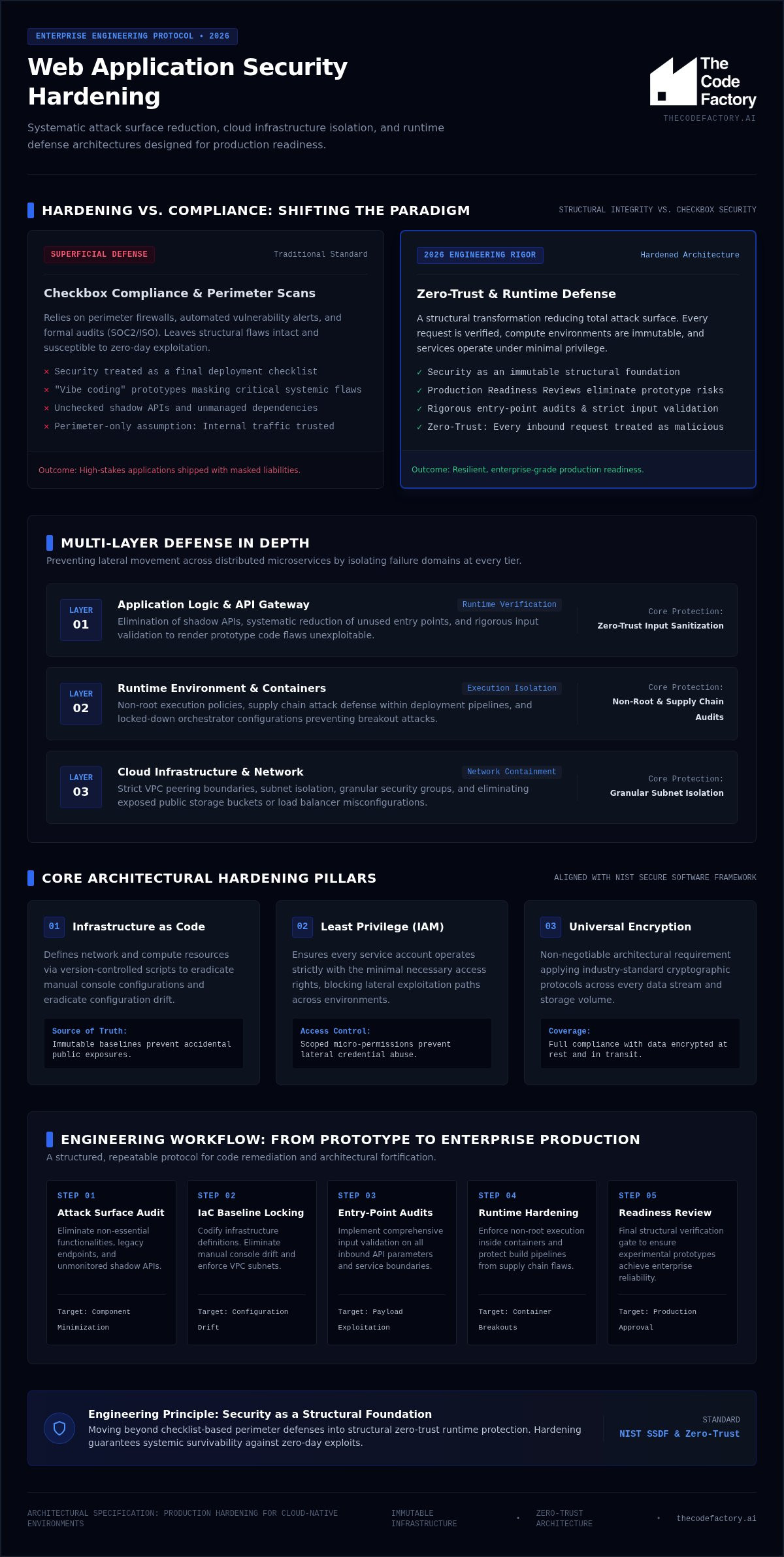
Security hardening for web applications is the systematic process of reducing an application’s attack surface by eliminating unnecessary functionality and reinforcing remaining components. It’s not a one-time event or a generic scan; it’s a structural transformation. In 2026, the industry has shifted decisively beyond the outdated perimeter defense model. We now operate in an era of runtime hardening and zero-trust application architecture where every request is treated as potentially malicious. Many teams confuse vulnerability scanning with hardening. While scanners identify specific flaws, true application and system hardening provides the structural prevention that makes those flaws difficult to exploit. This distinction is critical when dealing with AI-generated code. Vibe coding often produces prototypes that look functional but lack the engineering rigor required for high-stakes production environments.
The Evolution of the Attack Surface
Modern applications are no longer monolithic. They’re a complex web of APIs and microservices. This fragmentation increases the risk of shadow APIs and unmanaged dependencies. In a cloud-native context, defense in depth means securing the container, the orchestrator, and the application logic simultaneously. It’s about ensuring that a failure in one layer doesn’t lead to a total system compromise. You can’t rely on a single firewall to protect a distributed architecture. You need granular controls at every entry point to maintain integrity across the entire stack.
Hardening vs. Compliance: Why Safe Isn’t Enough
Regulatory compliance like SOC2 or ISO provides a baseline, but it doesn’t equate to engineering-led security. Compliance is often a checkbox exercise; security hardening for web applications is a survival strategy. In 2026, protecting against zero-day exploits requires a level of pragmatic urgency that standard audits don’t capture. You need a specialized fixer to bridge the gap between being compliant and being actually secure. This is why a formal production readiness review is essential. It serves as the final gate to ensure that experimental speed hasn’t compromised enterprise-grade reliability. Transitioning from a vulnerable prototype to a hardened environment requires moving past the superficial and addressing the core architectural weaknesses that compliance scans often miss.
Architectural Pillars of a Hardened Web Application
A resilient application cannot exist on a fragile foundation. While code-level fixes are vital, they’re insufficient if the surrounding environment is porous. Enterprise-grade security hardening for web applications begins at the architectural level, where Infrastructure as Code (IaC) establishes a repeatable, immutable baseline. By defining your network and compute resources through version-controlled scripts, you eliminate the human error inherent in manual console configurations. This structural approach aligns with the NIST Secure Software Development Framework, which emphasizes the need to secure the build and deployment environments alongside the software itself.
Encryption is no longer an optional feature; it’s a non-negotiable architectural requirement. Every data point must be encrypted both at rest and in transit using industry-standard protocols. Beyond encryption, the integrity of your system relies on robust cloud infrastructure configuration. Without a hardened environment, even the most secure code remains vulnerable to lateral movement and external exploitation.
Securing the Cloud Infrastructure
Isolation is the first line of defense in a cloud-native stack. You must implement strict VPC peering rules, subnet isolation, and granular security groups to ensure that services only communicate with necessary peers. Configuration drift is a silent killer of security. Engaging in infrastructure as code consulting helps teams maintain a “source of truth” for their environment, preventing accidental public exposures. Regular audits of these configurations are essential to identify hidden public buckets or misconfigured load balancers before they’re discovered by malicious actors.
Identity and Access Management (IAM) Hardening
The Principle of Least Privilege (PoLP) must govern every IAM role and service account within your organization. Moving beyond simple passwords to multi-factor authentication (MFA) and hardware-backed tokens is a prerequisite for administrative access. For automated services, you should implement short-lived credentials to minimize the impact of a potential leak. Over-provisioned service accounts in CI/CD pipelines represent a massive risk, as they often possess broad permissions that can be exploited to compromise the entire deployment lifecycle. If you’re concerned about hidden gaps in your access policies, a professional architecture review can help identify and remediate these vulnerabilities.
A Step-by-Step How-To for Application Layer Hardening
Moving from a secure architectural foundation to the code itself requires a shift from passive monitoring to active intervention. You can’t simply scan for vulnerabilities and hope for the best. Effective security hardening for web applications begins with a comprehensive audit of every entry point and data flow within your system. This process ensures that every path into your application is accounted for and rigorously defended. By following the NIST Secure Software Development Framework, engineering teams can integrate these safety protocols directly into the development lifecycle, ensuring that security is a structural reality rather than a post-development patch.
Input validation and output encoding are your primary tools for preventing injection attacks. Every byte of data entering your system must be treated as untrusted until it’s verified against a strict whitelist. Similarly, all output must be encoded to prevent malicious scripts from executing in the user’s browser. While these concepts are foundational, their implementation is often flawed in rapid development cycles. AI-generated code, in particular, frequently introduces subtle logic flaws that bypass standard automated tools. Utilizing specialized AI code remediation services is a pragmatic way to identify these hidden risks and purge technical debt before it manifests as a production failure.
Phase 1: Code Remediation and Optimization
The first step in hardening the application layer is reducing the internal attack surface. Dead code and unused libraries are more than just clutter; they’re potential entry points for attackers. You should systematically identify and remove these liabilities. High-risk functions, particularly those handling authentication, session management, or file uploads, require deep refactoring. This is where “sober” engineering replaces the shortcuts of “vibe-coded” prototypes. You aren’t just making the code work. You’re ensuring it’s resilient, predictable, and optimized for an enterprise environment where the stakes are high and the margin for error is zero.
Phase 2: Hardening HTTP Headers and API Endpoints
Your front-end defenses must be just as robust as your back-end logic. Properly configuring HTTP headers like Content Security Policy (CSP), HTTP Strict Transport Security (HSTS), and X-Frame-Options is essential to mitigate cross-site scripting and clickjacking. At the API level, you must implement rate limiting and request throttling at the gateway to prevent denial-of-service attacks and brute-force attempts. However, static rules aren’t enough. In 2026, runtime intelligence is necessary to monitor API behavior in real time, allowing you to detect and block anomalous patterns that suggest a targeted exploit. This proactive stance is the hallmark of a truly hardened application layer.
Hardening the Deployment Pipeline and Runtime Environment
A secure application living in a compromised environment is a liability waiting to be exploited. While previous sections focused on architectural foundations and code remediation, the delivery mechanism itself requires equal rigor. Security hardening for web applications must extend into the automated systems that build, test, and deploy your software. If your pipeline lacks structural defenses, it becomes a high-value target for supply chain attacks. Establishing a protocol for securing CI/CD pipelines ensures that every artifact reaching production is verified and untampered.
Runtime resilience depends on more than just code execution. It requires comprehensive cloud infrastructure optimization to handle stressors and prevent unauthorized lateral movement. Automated security gates act as the final arbiter, blocking any deployment that fails to meet your established hardening baseline. This isn’t just about scanning for vulnerabilities; it’s about enforcing a state of engineering integrity throughout the entire application lifecycle.
Container and Orchestration Hardening
Containers provide a layer of isolation, but they’re not secure by default. You should utilize minimal base images, such as Distroless or Alpine, to reduce the internal attack surface. Never include secrets or SSH keys in Dockerfile layers; instead, inject them at runtime using secure secret management tools. Multi-stage builds are essential for keeping build-time dependencies out of your final production image. Within Kubernetes, you must implement strict Network Policies and Pod Security Standards to enforce the principle of least privilege. Auditing container images for known CVEs before they hit your registry is a mandatory step in any professional workflow. If you need help establishing these guardrails, our team can provide a production readiness review to validate your container strategy.
Continuous Security Monitoring and Logging
Hardening isn’t a static achievement. It’s a continuous process that requires visibility into the runtime environment. Centralized logging provides the audit trails necessary for rapid incident response and forensics. You should utilize runtime security tools that monitor system calls and network traffic to detect anomalous behavior that static analysis might miss. This marks a shift from a “set and forget” mentality to a model of perpetual vigilance. By integrating how to harden cloud infrastructure practices into your daily operations, you ensure that your security posture evolves alongside the threat landscape. This structural approach prevents configuration drift and maintains the enterprise-grade reliability your high-stakes applications demand.
The Path to Enterprise Readiness: Why Engineering Rigor Matters
The transition from experimental speed to enterprise-grade reliability is the point where most modern web applications fail. It’s relatively simple to build a functional prototype using rapid development tools, but it’s significantly harder to ensure that prototype survives a targeted exploit in a high-stakes environment. Security hardening for web applications isn’t a secondary task to be handled by a generic service provider. It’s a fundamental engineering protocol that separates stable, resilient businesses from those facing catastrophic data breaches. We view security as a strategic architectural guide rather than a simple checklist. This distinction is vital for decision-makers who require more than just tool-based scanning; they need a structural guarantee of stability.
The Code Factory positions itself as a specialized fixer for these high-stakes production environments. We understand the nuances of scaling new technology while maintaining the rigor of traditional engineering. When you move beyond the “move fast and break things” mentality, you realize that structural integrity is the only way to achieve long-term growth. Hardening is the bridge that carries your application from a working demo to a hardened enterprise asset. Without this bridge, your technical debt will eventually manifest as a production failure that damages both your reputation and your bottom line.
Mitigating the Risks of AI-Driven Development
The rise of AI-assisted development has introduced a sense of pragmatic urgency into the security landscape. While AI can generate functional code in seconds, it frequently lacks the architectural foresight to implement deep security logic. This creates a hidden layer of technical debt that can become a massive liability over time. Expert code remediation is the only effective antidote to this technological hype. By applying disciplined engineering rigor, we replace “vibe-coded” shortcuts with hardened, production-ready logic. This process ensures your application isn’t just fast to market, but safe to remain there. Real security hardening for web applications requires a human-led review to catch the subtle logic flaws that automated scripts inevitably miss.
Executing a Production Readiness Review
A formal audit is the final step in mitigating structural risks before you scale. An enterprise-level readiness review involves an end-to-end analysis of your cloud configuration, CI/CD safety, and application-layer integrity. It’s a comprehensive look at how your systems interact under pressure. The business outcomes of this rigor are clear: improved uptime, enhanced user trust, and seamless scalability. When the stakes are high, you can’t afford to guess if your application is secure. You need to know it’s resilient. We invite you to engage The Code Factory for a Production Readiness Review to ensure your infrastructure meets the highest standards of reliability and safety.
Transitioning to Enterprise-Grade Security Integrity
Functional software is merely the starting point for modern digital products. Achieving true stability requires a shift from superficial scanning to deep structural prevention. We’ve explored how a rigorous protocol for security hardening for web applications bridges the gap between vulnerable AI prototypes and resilient production environments. It’s a process of transformation that ensures your systems are built to withstand modern threats. By focusing on code remediation, cloud infrastructure configuration, and automated pipeline safety, you eliminate the technical debt that often leads to high-stakes failures.
As a global engineering consultancy, The Code Factory provides the specialized expertise needed to navigate these complexities. We offer expert technical audits and enterprise-level code remediation to ensure your architecture remains stable under pressure. Don’t leave your structural integrity to chance. You can secure your enterprise application with a Production Readiness Review today. Building for the future demands a commitment to engineering rigor. With the right protocol in place, you can scale with confidence and turn security into a competitive advantage.
Frequently Asked Questions
What is the difference between security hardening and a security audit?
A security audit is a diagnostic process that identifies vulnerabilities and compliance gaps within your system. It tells you what is wrong. Security hardening is the active engineering resolution that fixes those gaps. It involves reducing the attack surface by removing unnecessary functionality and reinforcing remaining components. While an audit provides the roadmap, hardening is the actual construction of a resilient, enterprise-grade environment.
How often should security hardening for web applications be performed?
Hardening should be a continuous process integrated into your development lifecycle, but major reviews are essential after significant architectural shifts. In the 2026 landscape of rapid deployment, security hardening for web applications isn’t a static task. You must treat it as a structural requirement within your CI/CD pipeline. Quarterly deep-dives or reviews before major production releases ensure that configuration drift hasn’t compromised your security baseline.
Can AI-generated code be truly hardened for enterprise production?
Yes, but it requires expert-led remediation to address subtle logic flaws that automated scanners miss. AI tools prioritize “vibe coding” and speed, which often results in insecure shortcuts and technical debt. Hardening this code involves refactoring high-risk functions and removing unused libraries. It’s about moving from an experimental prototype to a stable asset through disciplined engineering rigor and manual architectural oversight.
What are the most common mistakes in cloud infrastructure configuration?
The most prevalent errors include over-provisioned IAM roles, publicly exposed storage buckets, and unencrypted data-at-rest. Many teams fail to implement strict VPC peering or subnet isolation, allowing for lateral movement after an initial breach. Configuration drift is another silent killer. Using Infrastructure as Code (IaC) is the strategic resolution that prevents these manual errors from becoming systemic vulnerabilities in high-stakes environments.
Does security hardening significantly impact web application performance?
When executed correctly, hardening often improves performance by reducing bloat. Removing unnecessary libraries and disabling unused services lowers resource consumption and speeds up execution times. While some security measures like deep packet inspection can add latency, modern hardware-backed acceleration and optimized logic usually negate these effects. The result is a leaner, more efficient application that is both faster and more secure for end users.
How does a production readiness review differ from a standard pentest?
A pentest is a point-in-time attack simulation designed to find specific exploits. A production readiness review is a comprehensive architectural audit that examines code integrity, infrastructure configuration, and scalability. Pentesters look for a way to “break in,” while a readiness review ensures the system is “built to last.” It’s a holistic assessment of your entire engineering protocol rather than just a search for open doors.
What role does CI/CD automation play in application hardening?
Automation enforces your hardening baseline across every deployment. By integrating security gates into your pipeline, you ensure that no unverified artifacts reach production. This includes automated container scanning, secret detection, and policy enforcement. It transforms hardening from a manual chore into a repeatable, structural requirement. This continuous feedback loop prevents the accumulation of technical debt and maintains your security posture at scale.
