

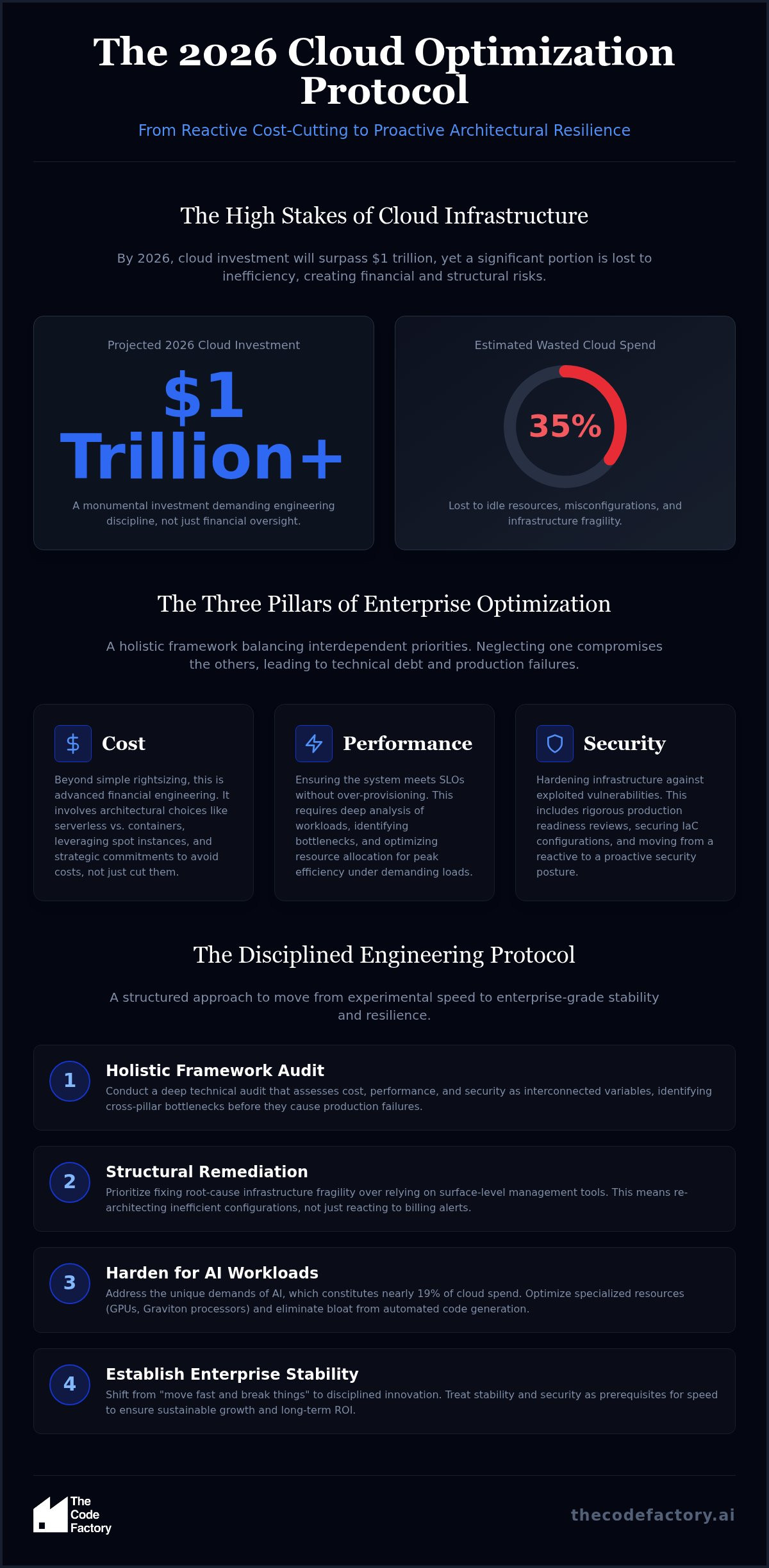
Businesses will invest over $1 trillion in cloud computing in 2026, yet research indicates that up to 35% of this spend is wasted on idle resources and inefficient configurations. This isn’t just a financial oversight; it’s a fundamental engineering failure. Many organizations treat cloud infrastructure optimization as a secondary accounting exercise, leaving them vulnerable to fragile systems that buckle under load. You’re likely facing the same anxieties: costs that outpace performance and security vulnerabilities introduced by rapid, AI-driven development cycles.
It’s a common challenge to scale quickly only to realize your foundation is riddled with technical debt. This article outlines a disciplined protocol to harden your architecture and align technical performance with business outcomes. You’ll learn a pragmatic framework to streamline cloud performance, secure your environment against exploited vulnerabilities, and achieve predictable costs. We’ll move past the hype to focus on the structural integrity required for true enterprise-scale resilience.
Key Takeaways
- Understand why the 2026 landscape demands a shift from reactive cost-cutting to proactive architectural efficiency to solve root-cause infrastructure fragility.
- Learn how to balance the three pillars of cost, performance, and security through a holistic framework that prevents one priority from compromising the others.
- Discover a disciplined engineering protocol for cloud infrastructure optimization that prioritizes structural remediation over surface-level management tools.
- Identify the strategic advantages of specialized production readiness reviews for hardening security and reducing technical debt in AI-driven environments.
- Master the transition from experimental development speeds to enterprise-grade stability using an organized, audit-based approach to scalability.
The 2026 Cloud Landscape: Beyond Simple Cost-Cutting
The 2026 cloud environment has matured beyond the chaotic “growth at all costs” era. Organizations now prioritize architectural efficiency over raw expansion. While businesses are projected to invest over $1 trillion in cloud computing this year, studies suggest that up to 35% of this spending is wasted on idle resources and misconfigurations. Traditional FinOps tools frequently fail because they focus on billing alerts rather than root-cause infrastructure fragility. True cloud infrastructure optimization requires a shift in perspective; it’s an engineering challenge, not just a financial one.
To understand the stakes, one must look at how foundational cloud computing concepts have been strained by modern demands. Optimization isn’t a one-time event or a surface-level cleanup. It’s a continuous balance of cost, performance, and security. When these three pillars aren’t aligned, the resulting technical debt creates a ceiling for enterprise growth. Achieving resilience means moving beyond superficial metrics to address the structural integrity of the environment.
The Hidden Cost of AI-Driven Infrastructure Sprawl
Automated code generation has accelerated the pace of development, but it’s also bloated Infrastructure as Code (IaC) repositories with unoptimized configurations. This “vibe coding” phenomenon allows for rapid deployment but often ignores structural integrity. In 2026, AI-related cloud spending constitutes nearly 19% of total budgets, up significantly from previous years. This surge in spending often masks underlying inefficiencies in how resources are provisioned and managed.
Without rigorous oversight, these automated systems create orphaned resources and security gaps that surface only during peak loads. Modern cloud infrastructure optimization must account for the specific demands of AI workloads, which often require specialized GPU clusters or custom accelerators like AWS Graviton 5 processors. Identifying unoptimized configurations in these high-cost environments is critical for maintaining a sober, results-oriented budget while preventing performance degradation.
Pragmatic Urgency: Why Stability is the New Velocity
Moving from experimental speed to enterprise-grade reliability is the defining challenge for today’s technical leaders. Velocity is meaningless if the underlying system is fragile. Hardening your infrastructure before attempting to scale ensures that growth doesn’t lead to catastrophic failure. A disciplined approach to cloud infrastructure configuration establishes a foundation for long-term ROI.
By treating stability as a prerequisite for speed, organizations can achieve a hardened security posture and predictable costs. This shift requires moving away from the “move fast and break things” mentality toward a model of disciplined innovation. It’s about being the voice of reason in a hype-driven market, ensuring that every deployment adheres to the rigor of traditional engineering. Stability isn’t a roadblock to progress; it’s the engine that makes sustainable growth possible.
The Three Pillars of Enterprise Cloud Optimization
Effective cloud infrastructure optimization requires a holistic framework that treats cost, performance, and security as interdependent variables. Optimizing for a single pillar in isolation often degrades the remaining two. For instance, aggressive cost-cutting can lead to resource throttling that destroys performance; conversely, over-provisioning for security can balloon budgets without delivering clear ROI. A rigorous technical audit is essential to identify these cross-pillar bottlenecks before they manifest as production failures. By transitioning from reactive monitoring to proactive architectural remediation, engineering leads can ensure their systems remain resilient under the most demanding loads.
Pillar 1: Financial Engineering (Advanced FinOps)
In 2026, simple rightsizing is no longer sufficient to manage the complexity of multi-cloud environments. Advanced FinOps involves a sophisticated mix of leveraging spot instances for non-critical workloads and utilizing strategic commitment tiers for predictable compute needs. The choice between serverless and containerized architectures represents a major trade-off in operational overhead versus granular cost control. Many teams find that their “serverless first” strategy actually drives higher costs at scale due to execution limits and cold starts. Effective cloud cost-avoidance is fundamentally an architectural choice rather than a procurement exercise.
Pillar 2: Performance and Scalability Hardening
Latency bottlenecks often hide in the networking and storage layers of distributed cloud environments. Hardening performance requires deep database optimization and sophisticated caching strategies to support high-stakes applications that cannot afford downtime. When systems fail under load, it’s usually a sign that the underlying foundation hasn’t been properly stress-tested for real-world production. Specialized software architecture consulting provides the deep remediation necessary to bridge the gap between experimental speed and enterprise-grade reliability. This ensures that your infrastructure doesn’t just run, but thrives as your user base expands.
Pillar 3: Infrastructure Security Hardening
Security is not a layer to be added at the end of the development cycle; it must be “Secure by Design” within the cloud configuration itself. Organizations must automate safety by securing CI/CD pipelines through hardened deployment protocols and automated vulnerability scanning. This proactive approach prevents security gaps from reaching production, ensuring that rapid development doesn’t introduce critical risks. If you’re seeing persistent security alerts, it’s time to consider a production readiness review to harden your environment against modern threats. Moving toward a zero-trust architecture within your cloud environment is the only way to maintain a hardened security posture in a landscape of increasingly sophisticated exploits.
Managed Services vs. Engineering Remediation: Choosing Your Path
Selecting between a generalist Managed Service Provider (MSP) and a specialized engineering fixer is the difference between managing a mess and fixing the foundation. Many enterprises opt for MSPs to reduce their operational overhead, but these services often lack the depth required for true cloud infrastructure optimization. While an MSP might keep the lights on, they rarely possess the architectural foresight to prevent systemic failures before they occur. Real resilience requires a shift from passive management to active remediation. You must decide whether you want a team that responds to fires or one that ensures the building is fireproof.
Evaluating the long-term ROI of architectural remediation reveals that fixing root causes is far more cost-effective than paying for perpetual monitoring of a broken system. Risk mitigation isn’t a checkbox; it’s a rigorous engineering discipline. Achieving “Production Readiness” requires an independent review to identify the blind spots that internal teams or generalist providers often overlook. This sober perspective is essential for maintaining stability as you scale.
The Limitations of Outsourced Managed Services
Traditional 24/7 monitoring is a reactive safety net. It cannot prevent a system from buckling if the underlying architecture is fundamentally flawed. Relying on generalist providers often leads to the “black box” problem. Internal teams lose visibility into their own infrastructure and become dependent on external ticketing systems that prioritize response times over structural fixes. These providers frequently miss subtle, AI-generated security risks that require deep code-level analysis rather than simple patch management. If your provider doesn’t understand the nuances of your specific software architecture, they’re merely managing your technical debt, not reducing it.
The Case for Specialized Engineering Fixers
Specialized engineering fixers focus on the transition from experimental speed to enterprise-grade reliability. They prioritize code remediation and structural hardening over surface-level maintenance. This approach acts as a sober voice of reason in a market often distracted by the latest AI-hype cycle. Utilizing production readiness reviews provides a definitive roadmap for long-term stability. This independent review is a critical risk mitigation step. It ensures that your architecture supports rapid growth without accumulating unmanageable technical debt. By focusing on cloud infrastructure optimization at the engineering level, you transform your cloud from a liability into a high-performance asset.
The 2026 Engineering Protocol for Cloud Optimization
True cloud infrastructure optimization is not a series of disconnected tasks; it’s a sequential engineering protocol. This methodology moves from discovery to remediation and finally to automation, replacing guesswork with technical rigor. By following a structured five-phase approach, organizations can transition from fragile, experimental setups to hardened, enterprise-grade environments. This protocol ensures that every architectural decision serves the twin goals of resilience and efficiency.
- Phase 1: The Comprehensive Infrastructure Audit – Identifying the gap between current state and production readiness.
- Phase 2: Security Hardening and Vulnerability Patching – Closing gaps at the infrastructure layer and ensuring compliance.
- Phase 3: Performance Tuning and Scalability Implementation – Eliminating latency and resource bottlenecks through deep remediation.
- Phase 4: Cost Rationalization and Resource Right-Sizing – Aligning cloud spend with actual utilization to eliminate waste.
- Phase 5: Continuous Optimization through Automated CI/CD – Ensuring long-term architectural integrity through self-healing protocols.
Step 1: Conducting a Production Readiness Review
Assessing the current state of Infrastructure as Code (IaC) and application architecture is the first priority. Many production environments in 2026 suffer from “Vibe Coding” liabilities, where rapid, AI-assisted deployments have bypassed structural checks. This phase identifies orphaned resources and unoptimized configurations that threaten stability. By defining a clear target state for enterprise-grade reliability, technical leaders can create a definitive roadmap for remediation that prioritizes high-stakes production needs over experimental speed.
Step 2: Hardening the Cloud Configuration
Security must be embedded directly at the infrastructure layer, not treated as an afterthought. This involves implementing Least Privilege access controls to minimize the blast radius of potential exploits. Network security hardening through Web Application Firewalls (WAFs), Virtual Private Clouds (VPCs), and Zero Trust protocols ensures that every request is verified, regardless of its origin. For a detailed technical checklist, see the guide on how to harden cloud infrastructure. These steps prevent security gaps from reaching production and ensure compliance with evolving 2026 regulations.
Step 3: Automating Resilience with CI/CD
Automation is the final stage of the protocol. Integrating security checks and performance gates into the deployment pipeline eliminates human error and ensures that cloud infrastructure optimization remains a continuous process. Robust automation protocols, such as Blue/Green deployments and automated rollback strategies, allow for rapid updates without risking downtime. This transition to a self-healing infrastructure model provides the ultimate insurance against the complexities of modern, distributed environments. If you’re ready to secure your foundation, contact our specialized fixers to begin your audit.
Achieving Long-Term Resilience with The Code Factory
Long-term resilience is not a byproduct of chance; it’s the result of deliberate, disciplined engineering. The Code Factory serves as a specialized fixer for high-stakes production environments, bridging the gap between experimental speed and enterprise-grade reliability. While many organizations struggle with the transition from a successful prototype to a scalable system, we provide the architectural guidance necessary to ensure your foundation is secure. Our “Strategic Fixer” model focuses on identifying and resolving technical debt before it evolves into a critical liability that threatens your growth.
High-stakes applications require more than just generalist oversight. They demand a partner who understands the nuances of cloud infrastructure optimization at the code level. Transitioning from an initial audit to a fully optimized production environment is a complex journey that requires a sober voice of reason. We help technical leaders move past the noise of the hype cycle to focus on the structural integrity of their systems, ensuring that performance and security are never sacrificed for the sake of a release date.
Our Approach to Infrastructure Remediation
We treat code remediation and security hardening as core engineering requirements rather than optional upgrades. Our team delivers results-oriented solutions without the marketing fluff that often obscures real technical progress. By focusing on the granular details of your architecture, we eliminate performance constraints and harden your security posture against modern exploits. This work is supported by our credit-based engineering model, which provides the flexibility needed for high-impact consulting without the friction of traditional procurement cycles. It’s an organized delivery system designed for the rigors of 2026 production needs.
Securing Your AI-Driven Future
The rapid adoption of automated development tools has introduced a new layer of risk to modern infrastructure. Remediating AI-generated code is essential for maintaining production readiness and preventing the accumulation of unmanaged technical debt. We help you build a foundation that supports safe, scalable AI implementation by ensuring your underlying configurations are robust and secure. Don’t let your infrastructure become a bottleneck for innovation. You can schedule a Production Readiness Review with The Code Factory today to begin the process of hardening your environment for the challenges of tomorrow.
Establishing Your Protocol for Enterprise Stability
The 2026 cloud landscape demands a shift from reactive monitoring to disciplined, engineering-led remediation. True cloud infrastructure optimization is achieved by aligning architectural integrity with business outcomes; it ensures that performance and security aren’t sacrificed for experimental speed. By moving beyond surface-level FinOps and addressing root-cause fragility, your organization can achieve the predictable costs and hardened security posture required for sustainable growth.
Scaling new technology shouldn’t introduce unmanageable risk. We act as a sober engineering voice in a hype-driven market, specializing in enterprise-grade reliability and expert AI code remediation. Our team helps you bridge the gap between rapid innovation and long-term production stability through a methodical, results-oriented approach that prioritizes structural health over temporary fixes.
Don’t wait for a system failure to reveal the hidden gaps in your architecture. Secure your infrastructure with a professional Production Readiness Review and build a foundation that supports your most ambitious enterprise goals. Your path to a resilient, high-performance cloud environment starts with a single, strategic audit.
Frequently Asked Questions
What is the difference between cloud cost optimization and infrastructure optimization?
Cloud cost optimization focuses primarily on reducing monthly expenditures through billing adjustments and resource rightsizing. In contrast, cloud infrastructure optimization addresses the entire architectural foundation, balancing spend with performance, security, and scalability. While cost-cutting is often an accounting exercise, infrastructure optimization is a rigorous engineering protocol. It ensures that your system doesn’t just cost less, but actually performs better and remains resilient under high-stakes production loads.
How does AI-generated code impact cloud infrastructure security in 2026?
AI-generated code often accelerates the accumulation of technical debt by bypassing traditional architectural rigor. In 2026, these automated tools frequently introduce “Vibe Coding” liabilities, such as insecure configurations or orphaned resources, that aren’t immediately visible. This sprawl creates security gaps that require specialized remediation. Without expert oversight, rapid AI-driven development can compromise your hardened security posture, making independent reviews essential for identifying vulnerabilities before they reach your production environment.
Why is a Production Readiness Review necessary for existing cloud environments?
A Production Readiness Review acts as a comprehensive audit to identify hidden technical debt and architectural fragility in established systems. Even if your current environment seems stable, it may lack the structural integrity to support sudden enterprise growth. This review provides a definitive roadmap for hardening your configuration and optimizing performance. It’s a critical risk mitigation step that ensures your infrastructure is prepared for high-stakes loads rather than just maintaining the status quo.
Can cloud infrastructure optimization be automated through CI/CD pipelines?
Automation is a key component of long-term architectural integrity. By integrating security checks, performance gates, and automated rollback strategies into your CI/CD deployment pipelines, you ensure that every update adheres to established reliability standards. This eliminates human error and maintains a continuous state of cloud infrastructure optimization. While the initial remediation requires expert engineering, the resulting automation provides a self-healing protocol that safeguards your environment against future regressions or inefficiencies.
What are the most common performance bottlenecks in enterprise cloud architectures?
Performance bottlenecks typically manifest in the networking, storage, and database layers of distributed environments. Common issues include high latency between microservices, unoptimized database queries, and inefficient caching strategies that fail under peak traffic. These constraints often stem from a “growth at all costs” mentality that prioritized speed over structural health. Identifying these bottlenecks requires deep technical analysis to ensure that your scalability consulting leads to genuine, enterprise-grade performance improvements rather than surface-level fixes.
How much can a company realistically save through architectural remediation?
While individual results vary based on existing technical debt, industry benchmarks suggest that up to 35% of cloud spending is wasted on idle or unoptimized resources. Architectural remediation focuses on reclaiming this waste while simultaneously improving system resilience. The real ROI isn’t just a lower bill; it’s the prevention of catastrophic downtime and the reduction of operational overhead. By fixing the foundation rather than just managing the mess, you achieve predictable costs and sustainable scalability.
What is security hardening, and why is it critical for cloud configurations?
Security hardening is the process of securing a system by reducing its surface of vulnerability through disciplined configuration. In a cloud environment, this involves implementing Least Privilege access, hardening network protocols via VPCs and WAFs, and establishing Zero Trust architectures. It’s critical because modern exploits often target the subtle gaps introduced during rapid deployment. Hardening ensures that your infrastructure is “Secure by Design,” protecting your assets against actively exploited vulnerabilities and evolving regulatory requirements.
How do I know if my organization needs a specialized technical architecture consultant?
Your organization likely needs a specialized consultant if you’re experiencing spiraling cloud costs without a clear ROI or if your infrastructure fails under load. Other indicators include persistent security alerts or an unmanaged sprawl of AI-generated resources. If your internal team is overwhelmed by technical debt or if you’re transitioning from experimental speed to enterprise-grade reliability, an expert fixer can provide the sober voice of reason needed to stabilize your environment and ensure long-term resilience.
