

Speed is a deceptive metric if it leads your organization directly toward a systemic failure. While the last decade focused on the rapid adoption of automation, the next will be defined by the rigorous hardening of those systems against unpredictability. Expert infrastructure as code consulting has shifted from a tactical convenience to a strategic necessity for enterprises facing the complexities of 2026. You likely recognize the friction of configuration drift causing outages or the anxiety of deploying AI-generated infrastructure that hasn’t been properly audited for security vulnerabilities. These are not just technical hurdles; they are fundamental risks to your structural integrity.
It’s time to move beyond fragmented scripts and manual intervention. This guide outlines how to transition your environment into a hardened, production-ready IaC protocol that secures your enterprise at scale. We’ll explore the critical role of production readiness reviews, the necessity of code remediation, and the specific steps required to build stable CI/CD pipelines. By the end of this analysis, you’ll understand how to eliminate manual configuration errors and significantly reduce your time-to-production for new features without sacrificing security.
Key Takeaways
- Identify the “speed trap” of unmanaged automation and why rapid deployment without architectural rigor creates long-term technical debt.
- Evaluate the differences between staff augmentation and strategic infrastructure as code consulting to ensure your partners focus on stability rather than just tasks.
- Implement a two-step hardening framework that begins with a comprehensive infrastructure audit to map existing drift before establishing security baselines.
- Secure your CI/CD pipelines by integrating production readiness reviews that address the unique risks of AI-generated and legacy infrastructure code.
- Transition toward a “Golden Template” standard that ensures multi-region resilience and consistent compliance across your entire enterprise scale.
The Enterprise IaC Crisis: Why Automation Is Not Enough
Velocity has become a deceptive metric in the modern enterprise. While the previous decade focused on the rapid adoption of automation to shorten release cycles, many organizations now find themselves trapped by the very scripts designed to set them free. This is the “Speed Trap”: a state where rapid automation outpaces governance, leading to unmanaged configuration drift and increasingly brittle environments. Strategic infrastructure as code consulting in 2026 has shifted its focus. It’s no longer about simply writing Terraform modules; it’s about establishing a rigorous protocol that ensures every line of code translates into a secure, resilient production state.
The industry is moving away from “Vibe Coding,” where infrastructure is built based on what feels functional in the moment, toward “Infrastructure as Protocol.” This transition demands architectural rigor over experimental speed. If your current setup relies on tribal knowledge or unverified scripts, it has likely become a liability. You can identify this shift when “identical” environments behave differently during deployments or when security teams must manually intervene to block non-compliant resource configurations. These signals indicate that your automation lacks the structural integrity required for enterprise scale.
The Reality of Configuration Drift in 2026
Configuration drift represents the silent erosion of your architectural standards. It’s the growing gap between the “source of truth” in your Git repository and the actual, live state of your cloud environment. When engineers apply manual hotfixes during a midnight outage, they often bypass the CI/CD pipeline, leaving the code base behind. Traditional audits frequently fail to catch these deviations because they treat infrastructure as a static entity rather than an ephemeral, shifting ecosystem. Without a hardened deployment protocol, these minor manual changes accumulate into significant technical debt, making your environment unpredictable and prone to systemic failure.
The AI-Generated Infra Problem
The rise of large language models has introduced a specific risk to infrastructure stability. It’s tempting to deploy AI-suggested templates because they appear functional on the surface. However, “it works” is not a synonym for “it is production-ready.” AI-generated code often lacks the nuanced context of enterprise security baselines, identity management, or multi-region resilience. Organizations are increasingly utilizing AI code remediation services to audit and harden these outputs before they reach production. Professional infrastructure as code consulting provides the necessary engineering oversight to transform experimental AI suggestions into stable, repeatable deployment protocols that can withstand high-stakes traffic surges.
Core Pillars of High-Maturity IaC Consulting
A high-maturity approach to infrastructure as code consulting transcends the mere creation of scripts; it focuses on the structural integrity of the entire ecosystem. While entry-level automation solves for speed, enterprise-grade protocols solve for stability and risk mitigation. This requires a shift from viewing infrastructure as a set of instructions to treating it as a governed, observable, and hardened environment. To achieve this, four specific pillars must be integrated into every deployment cycle: security hardening, scalability architecture, observability integration, and policy-driven governance.
Hardening the Cloud Foundation
Security can’t be an afterthought or a layer added at the end of a sprint. It must be embedded at the resource level through strict least-privilege access controls. Security Hardening is the proactive elimination of attack vectors in cloud templates. By codifying identity and access management (IAM) directly into your modules, you ensure that every provisioned resource is inherently locked down. This disciplined approach follows a rigorous how to harden cloud infrastructure protocol, which prevents the credential leakage and lateral movement risks often found in AI-generated or experimental templates. Extending this same discipline to your application layer requires a comprehensive approach to security hardening for web applications, ensuring that both your infrastructure and the services running on it meet enterprise-grade standards.
Codifying Resilience and Scalability
Enterprise workloads in 2026 demand a clear distinction between stateful and stateless resource management. High-maturity consulting ensures that your architecture is designed for multi-region resilience, allowing for seamless failovers during provider outages. This isn’t just about uptime; it’s about financial discipline. Effective cloud infrastructure optimization allows organizations to scale resources based on real-time traffic surges while maintaining strict cost control. By automating disaster recovery through immutable infrastructure patterns, you eliminate the need for manual reconstruction when a system fails. The goal is a self-healing environment where the code base remains the final authority on the desired state.
Beyond resilience, true maturity requires codifying the monitoring stack alongside the resources themselves. Observability integration ensures that every new service is deployed with pre-configured logging, tracing, and alerting. Finally, policy as code provides the governance layer, automatically blocking any deployment that violates enterprise compliance standards. If you’re concerned about the stability of your current environment, a production readiness review can identify the gaps in your existing pillars before they lead to a production failure.
Comparing IaC Consulting Models: Staff Augmentation vs. Strategic Engineering
Selecting an infrastructure as code consulting partner requires a clear understanding of your organizational objectives. Are you looking for temporary capacity or long-term structural integrity? Many enterprises default to staff augmentation, assuming that more “hands on keyboard” will resolve deployment friction. However, without a strategic framework, increasing the headcount often accelerates the accumulation of technical debt. The choice between these models isn’t just about labor; it’s about whether you’re buying hours or outcomes.
The Staff Augmentation Trap
Capacity is not capability. Staff augmentation models typically focus on clearing a backlog of tickets rather than hardening the underlying systems. This approach works for isolated, low-risk tasks, but it lacks the strategic oversight required to prevent configuration drift or resolve deep-seated architectural inconsistencies. Adding more engineers into a fragmented environment often results in a “too many cooks” scenario. Each contributor writes code according to their own preference, which further dilutes the source of truth in your Git repository. Freelancers can be useful for tactical fixes, but they rarely have the incentive to build the robust, cross-functional protocols that define a mature enterprise scale.
The Strategic Fixer Model
Strategic engineering prioritizes the health of the entire ecosystem over individual tasks. This model functions as a specialized fixer, bringing a sober voice of reason to high-stakes production environments. A comprehensive production readiness review is the cornerstone of this approach. It identifies bottlenecks and security vulnerabilities before they manifest as outages. Instead of billing for hours spent on repetitive tasks, strategic consultants focus on code remediation and the establishment of standardized “Golden Templates.”
This shift from hourly labor to result-based engineering ensures that your infrastructure isn’t just functional, but truly production-ready. A strategic partner evaluates your risk tolerance and maturity level to build a deployment protocol that survives the pressures of a 2026 cloud landscape. If you’re struggling with unpredictable outages or security gaps, you don’t need more people; you need a hardened engineering protocol that eliminates manual intervention and secures your environment at scale.
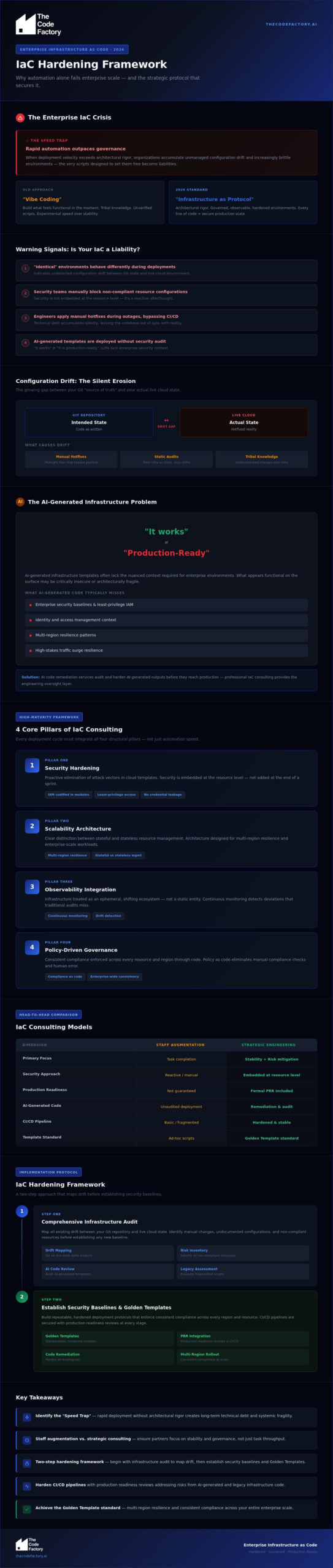
The IaC Hardening Framework: A 2026 Implementation Guide
Transitioning from a fragmented setup to an enterprise-grade environment requires more than just better scripts. It demands a structured engineering framework that prioritizes stability over experimental speed. High-maturity infrastructure as code consulting follows a logical progression from auditing current debt to validating production readiness. This five-step hardening framework ensures your automation functions as a reliable asset rather than a growing liability.
- Step 1: The Infrastructure Audit – Map existing technical debt and configuration drift to understand the gap between your Git repository and the live environment.
- Step 2: Security Baselining – Establish “Golden Templates” that codify encryption, identity management, and network boundaries by default.
- Step 3: Pipeline Integration – Embed automated safety checks by securing CI/CD pipelines against unauthorized changes or vulnerabilities.
- Step 4: State Management – Move away from local files toward robust, remote state backends that support locking and versioning.
- Step 5: Production Readiness Validation – Conduct a final protocol check to ensure the infrastructure can handle high-stakes traffic surges and failure scenarios.
Auditing for Reliability
Finding hidden risks starts with a deep dive into your current cloud infrastructure configuration. Many organizations ignore the silent erosion caused by manual hotfixes and unmanaged drift. A production-ready IaC audit must validate resource tagging, encryption-at-rest, and network isolation before a single line of code is merged. In 2026, automated drift detection tools are non-negotiable for maintaining the integrity of your source of truth. Without this visibility, you’re building on a foundation of unknown variables that will eventually lead to unpredictable outages.
Automating the Safety Net
Hardening your infrastructure requires shifting safety checks as far left as possible in the development lifecycle. Implementing pre-commit hooks and static analysis allows your team to catch syntax errors and security flaws before they ever reach a pull request. Policy as Code serves as the ultimate gatekeeper, automatically blocking deployments that violate enterprise standards. Every PR should include a clear analysis of security and cost impacts, forcing a shift in perspective from simple creation to long-term maintenance. If your current deployment process feels like a gamble, it’s time to implement a production readiness review to secure your environment and eliminate manual configuration errors.
Strategic Infrastructure: Why The Code Factory
In a market saturated with promises of instant automation and AI-driven speed, The Code Factory serves as a sober voice of reason. We understand that enterprise infrastructure isn’t a playground for experimental tools; it’s the foundation of your operational integrity. Our approach to infrastructure as code consulting prioritizes long-term stability over temporary velocity. We don’t just write scripts. We build hardened protocols that turn your infrastructure into a resilient corporate asset rather than a growing technical liability.
We specialize in the high-stakes transition from “it works” to “it’s production-ready.” This is particularly critical in the context of AI-generated templates and aging legacy systems. While these sources can provide a starting point, they rarely meet the rigorous security and scalability standards required for enterprise scale in 2026. Professional infrastructure as code consulting provides the disciplined architectural guidance necessary to remediate these vulnerabilities, ensuring your code base is optimized for performance and security from the first deployment.
Our Engineering Protocol
Our methodology is rooted in the rigor of traditional engineering. We focus heavily on code remediation and security hardening because we’ve seen the consequences of unmanaged drift at scale. Instead of chasing the latest hype-driven trends, we utilize proven architectural patterns that ensure multi-region resilience and multi-tenant security. This pragmatic approach allows us to move clients away from the “Speed Trap” of fragmented automation toward a unified, hardened deployment protocol. We treat your infrastructure with the same level of scrutiny as your primary application code, ensuring that every resource is provisioned according to strict enterprise baselines.
Your Path to Stability
Achieving enterprise readiness is a methodical process, not a one-time event. We help organizations eliminate manual configuration errors and reduce time-to-production through a structured engagement model that prioritizes structural integrity. Our process begins with a comprehensive technical audit to map your existing infrastructure debt and identify the specific bottlenecks preventing reliable scaling. From there, we implement robust CI/CD deployment pipelines that include automated safety checks and policy-driven governance.
This disciplined transition ensures that your team can deploy new features with confidence, knowing the underlying environment is secure and repeatable. If your organization is struggling with unpredictable outages or the anxieties of scaling new technology, it’s time to shift your strategy. You can reach out to our team to schedule a production readiness review and establish a definitive path to engineering stability.
Hardening the Foundation for 2026
The transition from experimental speed to enterprise-grade reliability requires a fundamental shift in perspective. Automation alone is no longer a sufficient objective; it must be coupled with rigorous security hardening and architectural discipline to prevent configuration drift from becoming a systemic liability. As an independent engineering consultancy, The Code Factory provides the sober voice of reason needed to navigate these complexities. We move beyond the hype of rapid deployment to focus on the structural integrity of your cloud environment, ensuring that even AI-generated code meets the highest standards of production readiness.
By prioritizing strategic engineering over simple staff augmentation, your organization can eliminate manual configuration errors and secure its long-term scalability. It’s time to stop reacting to outages and start building with the foresight of seasoned professionals who understand high-stakes production environments. Take the first step toward a more stable and resilient infrastructure by engaging with experts who specialize in code remediation and enterprise-grade reliability. You can Schedule a Production Readiness Review for Your Infrastructure to discover how specialized infrastructure as code consulting transforms your deployment protocol into a strategic asset. Your path to a hardened, predictable environment begins with a commitment to technical excellence.
Frequently Asked Questions
What is the primary difference between IaC implementation and IaC consulting?
Implementation focuses on the tactical execution of writing scripts to provision resources. In contrast, infrastructure as code consulting provides the strategic framework necessary for enterprise readiness. It addresses the underlying architecture, security hardening, and long-term maintenance protocols that simple script writing ignores. While a developer might focus on making a resource exist, a consultant ensures that resource is resilient, compliant, and integrated into a hardened production environment from the outset.
How do I know if my organization needs an IaC security audit?
Your organization requires an audit if you detect discrepancies between your Git repository and your actual cloud state. Frequent manual hotfixes applied during outages are a primary indicator of systemic instability. If your team is deploying AI-generated templates or legacy scripts without a formal production readiness review, you’re likely carrying unquantified security risks. A professional audit identifies these hidden vulnerabilities and establishes a baseline for remediation before they manifest as costly outages.
Can IaC consulting help reduce our monthly cloud spend?
Strategic consulting directly impacts cost control by codifying efficiency into your deployment templates. We utilize cloud infrastructure optimization to identify over-provisioned resources and orphaned assets that inflate monthly billing. By automating the lifecycle of ephemeral environments and implementing right-sizing protocols within the code, organizations can achieve significant financial discipline. This moves cost management from a reactive manual task to a proactive, codified engineering standard that scales with your infrastructure.
How does Infrastructure as Code support production readiness?
Infrastructure as Code ensures production readiness by eliminating the unpredictability of manual configuration. It allows for the creation of identical, repeatable environments that have been pre-vetted for security and performance. When combined with a rigorous engineering protocol, IaC codifies your disaster recovery and scalability standards. This ensures that every deployment meets enterprise requirements for uptime and resilience, transforming your infrastructure from a series of manual steps into a reliable, automated asset.
What are the risks of using AI-generated Terraform scripts?
AI-generated scripts often prioritize functional speed over structural integrity. These templates frequently lack essential security baselines, such as encryption-at-rest or granular identity management, which creates immediate vulnerabilities. Because LLMs lack the specific context of your enterprise architecture, they may suggest configurations that are incompatible with your multi-region resilience or compliance standards. Professional remediation is required to harden these outputs and ensure they are truly production-ready before they reach a live environment.
How long does a typical IaC hardening project take?
The duration of a hardening project varies based on the complexity of your technical debt and the scale of your cloud footprint. Most engagements begin with a comprehensive audit to map existing drift, followed by a prioritized remediation phase. While tactical fixes can be implemented rapidly, establishing a high-maturity infrastructure as code consulting protocol typically involves several weeks of iterative hardening. Our focus remains on delivering long-term stability rather than meeting arbitrary deadlines that sacrifice engineering rigor.
What tools do your IaC consultants specialize in?
Our engineers specialize in the industry-standard tools required to maintain enterprise-grade environments. This includes deep expertise in Terraform and CloudFormation for resource provisioning, alongside specialized knowledge of CI/CD deployment pipelines. We focus on the underlying architectural principles that make these tools effective in a high-stakes production setting. Regardless of the specific provider, our priority is the implementation of a hardened protocol that ensures your infrastructure is secure, observable, and fully optimized for scale.
How do you handle configuration drift in existing production environments?
We handle configuration drift through a methodical process of discovery and alignment. This starts with automated detection to identify where the live cloud state has diverged from the source of truth in your repository. Once mapped, we perform code remediation to incorporate necessary changes or roll back unauthorized manual hotfixes. This process restores the integrity of your deployment protocol and ensures that Git remains the final authority for all future infrastructure changes.
