


Your Delivery Infrastructure Is The Target
Speed is a liability without structure.
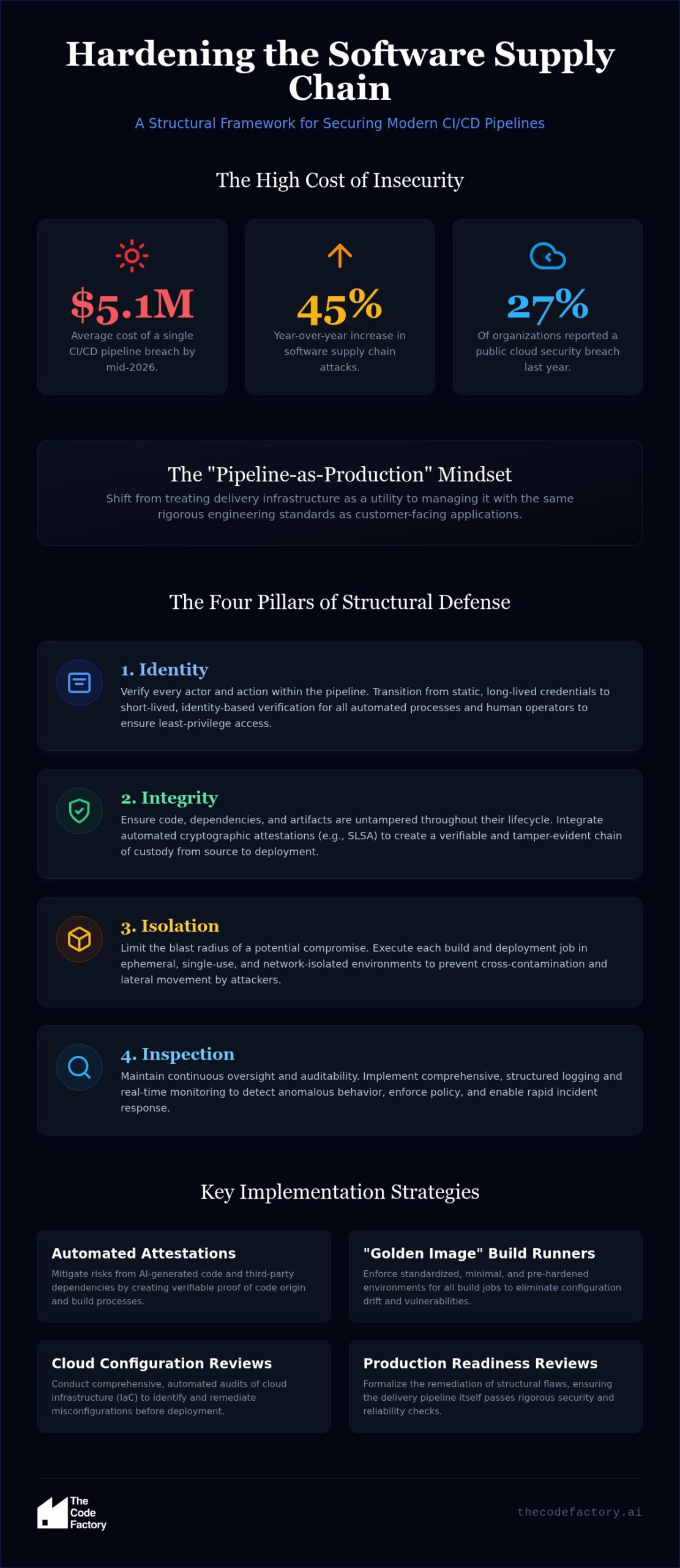
By mid-2026, the average cost of a single CI/CD pipeline breach has surged to $5.1 million, driven by a 45% year-over-year increase in supply chain attacks. Your delivery infrastructure is no longer just a utility — it is the primary target for sophisticated adversaries.
This guide provides a strategic framework for hardening your software delivery infrastructure — a roadmap for automated, secure deployments and the engineering protocols necessary to achieve SLSA Level 3 compliance.
$5.1M
Average cost of a single CI/CD pipeline breach by mid-2026, driven by a 45% year-over-year increase in software supply chain attacks.
45%
Key Takeaways
- Adopt a “Pipeline-as-Production” mindset so your delivery infrastructure meets the same rigorous engineering standards as your customer-facing applications.
- Establish a structural defense based on the four critical pillars of identity, integrity, isolation, and inspection.
- Mitigate the risks of AI-generated code and supply chain attacks by integrating automated attestations and specialized remediation protocols.
- Harden your deployment environment by enforcing “Golden Images” for build runners and conducting comprehensive cloud infrastructure configuration reviews.
- Transition to enterprise-grade reliability by prioritizing structural remediation through a formal Production Readiness Review.
The High Cost Of Technical Debt
A single misconfiguration can invalidate every downstream environment.
Unoptimized pipelines are more than a bottleneck — manual secrets management, inconsistent environment variables, and a lack of architectural oversight let one misconfiguration cascade into a full breach.
27%
of organizations reported a public cloud security breach in the last year — often traced back to a single unhardened pipeline configuration.
The Pipeline-As-Production Framework
Four foundational pillars: Identity, Integrity, Isolation, and Inspection.
When a pipeline is compromised, the integrity of every downstream environment is invalidated. A structural approach moves beyond superficial tooling to make security a core characteristic of the deployment system itself.
Identity
Least-privilege, short-lived access
Replace long-lived credentials with short-lived, OIDC-based tokens that expire immediately after use, aligned with the OWASP CI/CD Security Cheat Sheet.
Integrity
Verified, attested artifacts
A Software Bill of Materials (SBOM) and automated attestations ensure only verified, untampered code moves through the delivery chain — a legal requirement under the EU Cyber Resilience Act from 2026.
Isolation
Ephemeral build environments
Containerized runners spun up for a single task and destroyed on completion create a “clean room” for every build, preventing cached credentials or malicious artifacts from persisting.
Inspection
Continuous automated scanning
DAST and SAST integrated without developer friction, treating security findings as blocking bugs — including human-in-the-loop review before any AI-generated component reaches production.
Hardening must be integrated into your securing CI/CD pipelines workflow to prevent regression. This model supports the “Immutable Infrastructure” pattern, where resources are replaced rather than modified.
Secrets Management & Leak Prevention
AI-assisted development has increased the risk of credential exposure.
AI tools often prioritize functional code over security best practices, leading to hardcoded API keys and long-lived tokens accidentally committed to repositories. Automating secrets scanning at the pre-commit stage and using centralized vaults for dynamic secret injection ensures sensitive data is never stored in plain text.
23.8M
secrets were leaked on public GitHub in 2024 alone, according to GitGuardian — many originating from hardcoded keys in AI-generated configurations.
Mitigating Supply Chain Vulnerabilities
The delivery pipeline can become a high-speed distribution network for "poisoned" packages.
Artifacts moving through CI/CD systems are frequently compromised before they ever reach a build runner. Full transparency through an SBOM, paired with AI code remediation to proactively identify vulnerable third-party libraries, turns passive monitoring into active refinement.
86%
of commercial codebases currently contain known-vulnerable dependencies, according to industry data.
Implementation Strategies
A layered defense, executed in five critical steps.
You can’t secure what you haven’t documented, nor maintain what you haven’t automated.
Step 01
Cloud Config Review
Misconfiguration remains the leading cloud threat. Audit identity drift, IAM complexity, and CIS benchmark compliance.
Step 02
Golden Images
Enforce pre-hardened, patched runner images stripped of unnecessary services before execution.
Step 03
Compliance-as-Code
Define security policies as code to prevent configuration drift and enforce a consistent architectural baseline.
Step 04
Secure Promotion Path
Cryptographic signing of artifacts ensures only verified, untampered code moves from staging to production.
Step 05
Continuous Monitoring
High-fidelity logging identifies anomalous patterns and provides the audit trail required for compliance.
Architecting for scalability. A secure pipeline handles increased load without introducing security regressions — designing for failover so a compromise in one region doesn’t paralyze the entire global deployment.
Hardening at scale. DAST and SAST are integrated without developer friction, treating findings as blocking bugs. The pipeline itself must also resist Denial of Service attacks on the critical path to production.
Navigating The Transition
Refining infrastructure so every deployment is a calculated action, not a gamble.
Success depends on strategically prioritizing the structural flaws that present the greatest architectural risk — hardening identity layers, isolating build environments, and establishing human-in-the-loop review for AI-generated components.
The ROI: a hardened pipeline reduces high-stakes production failures and improves developer productivity — when engineers aren’t fighting fragile pipelines, they focus on high-value features instead.
Next step: a diagnostic evaluation of your current delivery systems, often transitioning into a comprehensive cloud infrastructure configuration and security hardening phase.
Establishing A Resilient Delivery Protocol
You have already built the innovation. Now build the stability that sustains it.
The Code Factory offers a proven protocol for hardening AI-generated code and cloud infrastructure so your delivery systems remain stable under pressure.
