


What if the very prototype that secured your board’s approval is the exact architecture that will compromise your enterprise stability? While vibe coding might spark a successful pilot, scaling AI applications for thousands of concurrent users demands a pivot from experimental speed to rigorous engineering. It’s a transition where latency spikes, unpredictable GPU costs, and security vulnerabilities in AI-generated code often derail even the most promising initiatives. You’ve likely felt the anxiety of watching a demo perform flawlessly in a sandbox, only to see it stutter under the weight of real-world production demands.
We understand that moving beyond the proof-of-concept phase requires more than just adding more compute. This article provides a definitive roadmap for architectural hardening and infrastructure optimization. You’ll discover how to implement disaggregated prefill and decode serving, enforce structured schema validation, and utilize prompt caching to slash costs by up to 90%. We’ll explore the engineering discipline needed to transform brittle agents into reliable enterprise assets. This ensures your AI strategy delivers consistent performance without incurring unmanageable technical debt.
Key Takeaways
- Learn why transitioning from monolithic wrappers to modular, agentic architectures is the essential foundation for long-term enterprise stability.
- Understand the architectural requirements for scaling AI applications without incurring unpredictable GPU costs or significant performance degradation.
- Discover how a formal production readiness review identifies the critical engineering gaps that experimental “vibe coding” often overlooks.
- Master the infrastructure hardening techniques needed to secure AI-generated code and stabilize non-deterministic deployment pipelines.
- Gain a strategic roadmap for transforming fragile prototypes into hardened enterprise assets through structured code remediation and technical audits.
The 2026 AI Scaling Crisis: Why Prototypes Fail in Production
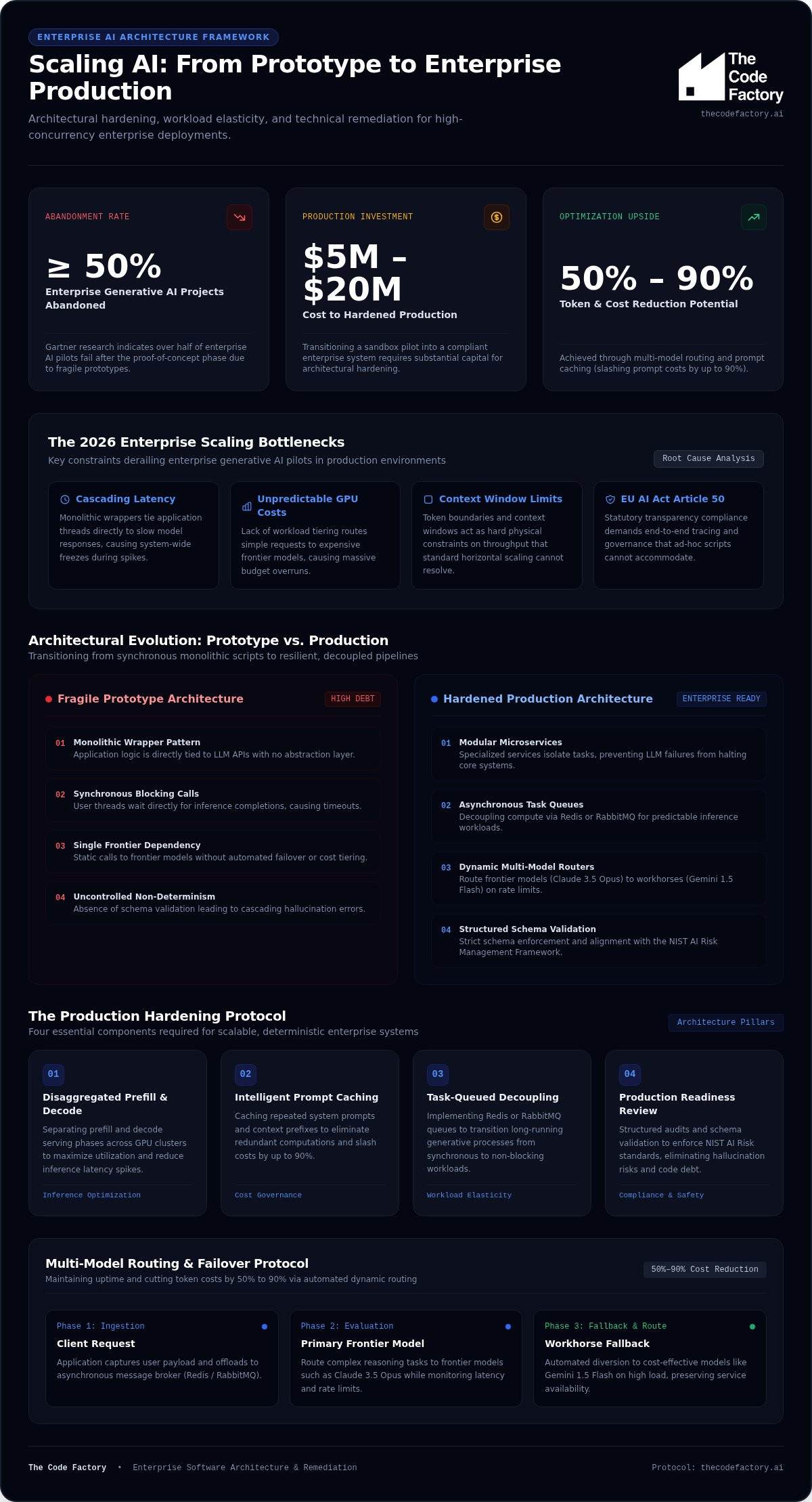
Scaling AI applications involves a fundamental transition from isolated Large Language Model (LLM) calls to deeply integrated enterprise systems. While a prototype might impress in a controlled environment, Gartner research indicates that at least 50% of enterprise generative AI projects are abandoned after the proof-of-concept stage. This failure often stems from a reliance on “vibe coding,” where developers deploy AI-generated code without the rigorous review or structural integrity required for high-stakes environments. It’s a fragile foundation that collapses under the weight of real-world traffic.
The Fallacy of the Infinite Prototype
Successful demos frequently mask deep-seated architectural flaws. When AI-generated code hits production traffic, the resulting technical debt manifests as catastrophic system failures or security breaches. In this context, architectural debt is the accumulation of structural compromises made for rapid prototyping that prevent a system from meeting enterprise reliability or security standards at scale. Moving from a sandbox to a production environment requires a shift in perspective. You can’t simply scale a script; you must engineer a system. This shift necessitates a formal production readiness review to identify hidden vulnerabilities before they manifest as costly outages.
Performance Constraints of Non-Deterministic Software
The engineering challenge shifts when scaling probabilistic AI compared to traditional deterministic logic. In deterministic systems, inputs yield predictable outputs. AI applications, however, introduce non-deterministic behavior that requires constant monitoring and machine learning operations (MLOps) to maintain stability. The financial cost of hallucination remediation at high request volumes can quickly exceed initial budget projections. Additionally, token limits and context windows act as physical constraints on system throughput. These constraints create bottlenecks that standard horizontal scaling cannot fix, forcing a rethink of how we manage data flow and inference logic.
By 2026, the primary bottlenecks for AI adoption have shifted from model access to infrastructure efficiency. High latency in responses, unpredictable GPU costs, and the need for immediate compliance with Article 50 transparency requirements under the EU AI Act have created a crisis of confidence. Moving a pilot to a hardened production environment often costs enterprise organizations between $5 million and $20 million, yet many lack the architectural roadmap to justify this investment. Enterprises must now prioritize engineering remediation. It’s time to replace ad-hoc scripts with hardened, production-ready architectures that can withstand the rigors of an enterprise-grade deployment.
Designing for Elasticity: AI Workload Patterns
Wrappers are not architectures. Scaling AI applications at this magnitude requires a departure from monolithic designs that tether application logic directly to model responses. In a production environment, a single slow inference can block an entire application thread, leading to cascading latency. High-concurrency environments demand modular, agentic architectures where specific tasks are offloaded to specialized microservices. This separation of concerns ensures that the core application remains responsive even when underlying LLM providers experience service degradation or rate limiting. Integrating software architecture consulting early in the lifecycle prevents these modular components from becoming disparate silos of technical debt.
Decoupling Compute from Inference Logic
Production reliability hinges on asynchronous processing. Instead of forcing users to wait for a synchronous LLM response, enterprise systems utilize task queues like Redis or RabbitMQ to manage long-running inference jobs. This decoupling allows for sophisticated fallback mechanisms. If a frontier model like Claude 3.5 Opus fails or hits a rate limit, the system can automatically divert the request to a more cost-effective workhorse model like Gemini 1.5 Flash. Implementing these multi-model routers can result in a 50% to 90% reduction in token costs while maintaining service availability. Following the NIST AI Risk Management Framework provides a standardized approach to hardening these infrastructures against both operational failures and adversarial inputs. For those concerned about current stability, a professional engineering audit often reveals critical bottlenecks in these asynchronous paths.
Unified Data Governance and Retrieval
Scaling AI requires a robust Retrieval-Augmented Generation (RAG) pipeline that remains performant as datasets grow from megabytes to terabytes. Vector database performance often degrades significantly without proper indexing strategies, such as switching from HNSW to IVF as your document count exceeds the millions. Data consistency is another hurdle. Distributed AI agents must share a unified state to avoid contradictory outputs. Modern production stacks solve this by implementing KV cache prompt caching as a first-class citizen. This reduces Time-To-First-Token (TTFT) by over 40% and ensures that agents operate from a synchronized, enterprise-wide knowledge base. It’s not just about retrieving data; it’s about governing the flow of information to ensure deterministic outcomes in a probabilistic environment.
The Engineering Gap: Prototype vs. Enterprise Production Readiness
Prototypes are designed to prove a concept; enterprise applications are designed to survive the market. When scaling AI applications, the distance between “it works” and “it’s reliable” is often measured in months of engineering debt and significant capital. While a pilot might demonstrate potential, the sober reality is that production systems require continuous monitoring and high-availability infrastructure that a demo simply ignores. A demo doesn’t care about rate limits or token exhaustion, but an enterprise application must account for every millisecond of latency and every penny of inference cost.
Bridging this gap requires more than just a bigger cloud budget. It demands a formal production readiness review to audit the structural integrity of the entire stack. This review ensures the system aligns with the NIST Artificial Intelligence Risk Management Framework, providing a benchmark for safety and reliability. Without this rigorous evaluation, scaling an AI application is essentially scaling a liability that could compromise your entire infrastructure.
Security Hardening for LLM Integrations
Scaling increases your attack surface. Prompt injection moves from a theoretical risk to a primary threat when AI agents gain access to sensitive internal databases. Security hardening for AI-mediated data access is the strategic implementation of programmatic guardrails and isolation layers that prevent untrusted model outputs from executing privileged system commands or accessing unauthorized data. Implementing robust Role-Based Access Control (RBAC) ensures that agents operate within strict permissions, mitigating the risk of data leakage at the API level.
Code Remediation: Stabilizing the AI Foundation
AI-generated code is often “vibe-coded,” meaning it looks functional but lacks the depth of traditional engineering. These scripts frequently omit error handling and use inefficient logic that collapses under high request volumes. Utilizing AI code remediation services allows teams to refactor these fragile foundations into performant, readable codebases. This remediation isn’t just about cleaning up syntax; it’s about optimizing the logic to reduce latency and technical debt. Manual review remains the final safeguard against the subtle bugs that AI often introduces into its own generated code.
Hardening the AI Infrastructure Stack
Infrastructure is often the silent killer of enterprise AI projects. Many organizations treat cloud configuration as a static setup, yet scaling AI applications requires a dynamic approach to resource orchestration. Unlike classical microservices, GPU-accelerated models face significant latency during cold starts, often downloading up to 140GB of model weights across network filesystems. Solving this requires persistent local NVMe caching and sophisticated multi-instance scheduling to maintain responsiveness. Utilizing the latest Triton Inference Server (v2.72.0) with its native vLLM backend support allows for disaggregated prefill and decode serving. This architectural hardening ensures that compute-bound prompt processing doesn’t starve memory-bandwidth-bound token generation during peak traffic.
Cloud Configuration for GPU-Intensive Loads
Efficient resource allocation is no longer optional; it’s a requirement for fiscal survival. With Kubernetes 1.37 “Garhwal” graduating new Dynamic Resource Allocation (DRA) capabilities, teams can now schedule AI accelerators with unprecedented precision. This version also deprecates IPVS mode in kube-proxy in favor of nftables, necessitating a shift in how engineers manage high-concurrency network traffic for inference clusters. In hybrid environments, resilience depends on your ability to shift workloads between on-premise clusters and public clouds during provider outages. Implementing prompt caching as a first-class citizen isn’t just a performance trick. It’s a cost-control necessity that offers up to 90% deductions on input tokens, significantly reducing the financial burden of scaled infrastructure. A rigorous software scalability audit can identify where idle or over-provisioned GPU resources are silently inflating your cloud spend before they become unmanageable liabilities.
CI/CD Pipelines for Non-Deterministic Software
Traditional deployment pipelines are ill-equipped for the probabilistic nature of LLMs. A successful build in a standard runner doesn’t guarantee that the model won’t hallucinate or leak sensitive data in a production environment. You must adapt your workflow to include automated evaluation harnesses that test for behavioral regression and prompt integrity. This process involves securing CI/CD pipelines against sophisticated supply chain attacks that target AI model registries and model weights. Integrating security scans into the deployment workflow ensures that third-party dependencies haven’t been compromised before they reach your production GPU clusters.
Continuous monitoring must extend beyond simple uptime. You need granular observability into model drift, token-tracking, and Time-To-First-Token (TTFT) metrics. As of September 2026, production stacks utilize OpenTelemetry (OTel) tracing to track every token through the inference lifecycle. This visibility allows engineers to identify whether latency originates in the vector database retrieval or the model inference itself. If your current deployment process lacks these automated safeguards, it’s time to harden your foundation. Schedule a cloud infrastructure configuration audit to ensure your stack is ready for the rigors of enterprise-grade production.
The Strategic Path to Scalable AI: The Code Factory Protocol
Transitioning from a working prototype to a hardened enterprise asset requires more than incremental updates; it demands a fundamental shift in engineering philosophy. The Code Factory Protocol serves as a structured methodology for identifying the hidden bottlenecks that typically emerge only under production loads. While previous sections focused on the granular details of infrastructure and code remediation, this strategic layer ensures that individual fixes align with a cohesive long-term vision. Scaling AI applications without this oversight often leads to fragmented systems that are impossible to maintain. The Production Readiness Review acts as the final gate, providing a definitive assessment of whether a system is truly prepared for the rigors of an enterprise launch.
Strategic Architecture and Scalability Consulting
Designing for the realities of 2026 means future-proofing your stack against rapid model evolution. Our approach to architecture and scalability consulting prioritizes modularity, allowing you to swap inference providers or integrate new frontier models without a total system rewrite. We align technical architecture with specific business growth objectives, ensuring that your infrastructure costs scale linearly rather than exponentially. This isn’t just about reducing technical debt; it’s about ensuring business continuity in a volatile market. It’s a pragmatic, authority-led engineering model that values structural integrity over the fleeting speed of experimental tools. Achieving true enterprise software scalability requires eliminating architectural bottlenecks before they become catastrophic liabilities under real-world load.
Executing the Remediation Roadmap
The path to enterprise reliability is paved with prioritized remediation. We identify what to fix first by analyzing the impact on security, latency, and operational cost. This roadmap moves your team from the high-velocity, low-certainty phase of “vibe coding” to a disciplined, production-ready environment. Audits reveal what demos hide. Remediation is a requirement, not an option, for those looking to avoid the high failure rates associated with unhardened AI pilots. A final checklist for a successful, production-ready launch includes:
- Validation of Pydantic schemas for all model outputs to ensure deterministic data flow.
- Load testing of asynchronous task queues under 10x peak concurrency to prevent system collapse.
- Verification of RBAC permissions for all agentic tool-calls to mitigate data leakage risks.
- Confirmation of prompt caching triggers to maintain cost efficiency and reduce latency.
By following this protocol, organizations don’t just launch AI; they deploy sustainable assets that drive measurable value. This structured approach mirrors the organized, credit-based engineering model we provide, reinforcing stability at every layer of the stack.
From Pilot Speed to Enterprise Stability
The transition from a successful pilot to a resilient production system is the most critical hurdle in the current technological cycle. Scaling AI applications requires a departure from the fragile methods of the prototyping phase toward the disciplined rigor of software engineering. You must pivot from “vibe coding” to architectural hardening, ensuring your infrastructure is optimized for high-concurrency GPU loads and your code is remediated for long-term maintenance. Without this structural integrity, escalating costs and security vulnerabilities remain a constant threat to your deployment.
As a global engineering authority, The Code Factory provides the specialized expertise needed to transform experimental scripts into enterprise-grade assets. Our architecture and scalability consulting, combined with targeted code remediation, ensures your system is built to last. Don’t let architectural debt derail your innovation. Secure your AI future with a Production Readiness Review from The Code Factory. It’s time to move beyond the demo and build for the scale your business demands. Your path to a stable, high-performance AI environment starts with a commitment to engineering excellence.
Frequently Asked Questions
What are the biggest challenges in scaling AI applications in 2026?
The primary challenges involve GPU resource scarcity, escalating inference costs, and strict compliance with the EU AI Act. Organizations often struggle with the elasticity paradox, where GPU-accelerated models face long cold starts during horizontal scaling. Additionally, managing non-deterministic outputs requires a shift from traditional monitoring to specialized observability. These factors contribute to the 50% failure rate for enterprise AI projects as reported by Gartner research in 2026.
How does technical debt in AI-generated code affect scalability?
Technical debt in AI-generated code, often resulting from vibe coding, creates fragile foundations that collapse under production traffic. AI-generated scripts frequently lack robust error handling, efficient data structures, and security guardrails. As you begin scaling AI applications, these inefficiencies manifest as cascading failures and increased latency. Professional code remediation is necessary to refactor these prototypes into performant, enterprise-grade software capable of handling high-concurrency requests without compromising stability.
Why is a production readiness review necessary for AI?
A production readiness review serves as a formal audit to identify hidden architectural bottlenecks before a system reaches the public. For AI, this process evaluates model-routing logic, KV cache efficiency, and security hardening against prompt injection. It ensures the application aligns with governance benchmarks like the NIST AI Risk Management Framework. This review acts as a critical gate, preventing organizations from scaling a liability that could lead to costly outages.
How can I reduce the latency of my AI application at scale?
Reducing latency at scale requires optimizing the entire inference lifecycle through disaggregated prefill and decode serving. Implementing KV cache prompt caching can reduce Time-To-First-Token (TTFT) by over 40% while slashing input token costs. Additionally, utilizing model routers allows you to divert simple tasks to low-latency models, reserving frontier engines for complex reasoning. Local NVMe caching for model weights also minimizes delays caused by downloading massive weights across network filesystems.
What is the difference between scaling traditional software and AI software?
Traditional software scaling focuses on horizontal expansion of deterministic CPU-bound microservices. In contrast, scaling AI software involves managing probabilistic outputs and memory-bandwidth-bound GPU workloads. AI applications face unique constraints like long cold starts for multi-gigabyte model weights and the non-deterministic nature of LLM responses. While traditional systems scale via standard autoscalers, AI requires specialized orchestration tools like KubeRay to manage distributed inference and maintain consistent performance across heterogeneous hardware.
How do I secure AI agents for enterprise use?
Securing AI agents requires a multi-layered approach involving robust Role-Based Access Control (RBAC) and programmatic guardrails. You must isolate agentic tool-calls from privileged system commands to prevent unauthorized data access. Implementing security hardening at the API level mitigates risks like prompt injection and data leakage. This involves continuous monitoring of agent behavior and enforcing strict output schemas, ensuring the AI operates within defined permissions and complies with Article 50 transparency mandates.
What role does CI/CD play in scaling AI applications?
CI/CD deployment pipelines for scaling AI applications must evolve to handle non-deterministic software. Beyond standard unit tests, these pipelines integrate automated evaluation harnesses to detect hallucinations and behavioral regressions. They also facilitate security scans of model registries and third-party dependencies to prevent supply chain attacks. By automating the testing of model outputs, CI/CD ensures every update maintains the structural integrity and performance standards required for reliable enterprise-grade production environments.
