


An architecture review board that reviews every design detail can create the delivery risk it was meant to prevent. Its value lies in governing high-impact decisions, not acting as a checkpoint for every technical choice. When ownership is unclear, teams can receive conflicting guidance. When reviews reach too far, they can slow delivery and set local needs against enterprise standards. Clear architecture review board responsibilities help resolve that tension.
The board should set direction, assess material risks, and connect architecture choices to business and engineering outcomes. It shouldn’t take ownership of routine implementation decisions that teams can make within agreed standards. This guide explains what an architecture review board owns, where its authority should stop, and how it can make decisions teams can act on. You’ll learn how to use risk-based review paths, define decision rights, and assess proposals for production readiness, security, scalability, and maintainability. The goal is governance that strengthens architecture without turning review into a bottleneck.
Key Takeaways
- Set architecture review board responsibilities around high-impact decisions, and leave routine design and implementation choices with delivery teams.
- Clarify who makes decisions, who provides advice, and who remains accountable for implementation across architecture, engineering, security, operations, and business.
- Use a consistent proposal workflow that captures the problem, alternatives, constraints, risks, and affected systems.
- Match review depth to architectural risk so low-impact changes move quickly and material decisions receive appropriate scrutiny.
- Measure the board by decision quality, review lead time, recurring risks, and adoption of shared architecture, not meeting volume or approvals alone.
What Are Architecture Review Board Responsibilities in an Enterprise?
An architecture review board (ARB) is a cross-functional governance body that evaluates consequential technology decisions against an organization’s business direction, architecture principles, and shared constraints. It operates within enterprise architecture, which connects business and technology change across the organization. The board helps teams make choices that work beyond a single project, while leaving detailed implementation decisions with the people building and operating the solution.
That boundary matters. Architecture governance examines structural decisions and their wider effects; routine code review checks implementation quality. Project management coordinates scope, schedule, and delivery, while operational approval confirms readiness for a particular release or service. An ARB may inform these activities, but it shouldn’t replace them or become a universal sign-off point.
What decisions belong on an architecture review board agenda?
Bring forward proposals whose consequences extend beyond one team or would be costly to reverse. The board’s agenda may include:
- Shared platforms, major technology choices, and integration patterns used across systems.
- Architecture changes that could materially affect security, compliance, scalability, reliability, or operational support.
- Exceptions to enterprise standards, especially when they introduce new dependencies or long-term maintenance needs.
By contrast, a delivery team can usually choose local implementation details, such as an internal module structure, when the choice stays within approved patterns and creates no material cross-team impact. A practical test is whether the decision changes a shared constraint, creates a dependency for other teams, affects a critical quality such as security or supportability, or would be difficult to unwind. If none apply, board review may add process without reducing meaningful risk.
What outcomes should the board protect?
The board should help prevent fragmented solutions by encouraging teams to reuse shared components and established patterns where they fit. Reuse can reduce duplicated capabilities and simplify integration, but standards shouldn’t be applied mechanically. A justified exception may serve the business better than forcing a poor fit.
Good oversight also tests how a design will perform beyond launch. Will it meet security expectations? Can it scale with demand? Can teams support and change it without creating avoidable technical debt? Engineering-led assessment, including a production readiness review, can surface implementation risks and turn them into actionable remediation.
Architectural oversight governs the long-term shape and cross-system consequences of technology decisions; project approval governs whether a specific initiative is ready to proceed. This distinction gives the board authority where enterprise risk is real, while preserving delivery teams’ accountability for implementation.
Who Sits on the Board and How Should Decision Rights Work?
A board needs enough authority to resolve enterprise trade-offs, but it shouldn’t require every specialist to attend every review. Establish a core group with architecture and engineering leadership, then involve security, operations, product, or other stakeholders when a proposal affects their domain. This keeps decisions informed without turning membership into a standing meeting of the entire organization.
Which roles should participate in an architecture review board?
Enterprise or domain architects assess alignment with shared principles and the impact across systems. Technical leads explain implementation options, dependencies, and delivery constraints. Security specialists identify exposure and control implications; operations representatives assess reliability, supportability, and production impact. Product or business stakeholders clarify user needs, strategic fit, and the consequences of technical trade-offs.
Keep a small core responsible for consistent decisions. Invite subject-matter experts for relevant agenda items rather than asking them to review every proposal. For example, a change to a shared integration pattern may need input from affected domain teams, while a change to an internal service component may not.
How should the board divide authority from delivery teams?
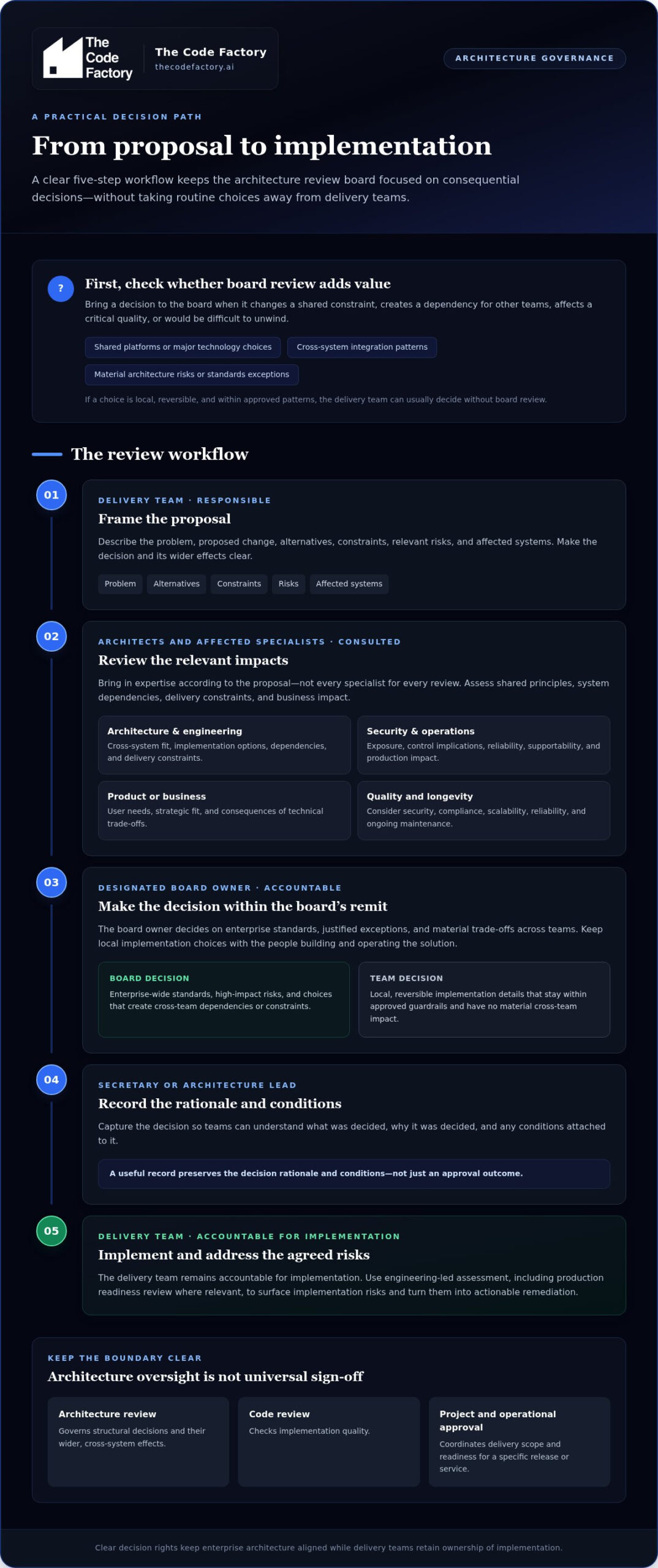
Define decision rights before the first proposal arrives. A lightweight RACI model distinguishes participation from accountability: “Responsible” does the work, “Accountable” owns the outcome, “Consulted” provides input, and “Informed” receives the decision.
- Propose: The delivery team is responsible for documenting the change, alternatives, and relevant risks.
- Review: Architects and affected specialists are consulted on cross-system fit, security, operations, and business impact.
- Decide: The designated board owner is accountable for standards, exceptions, or material cross-team trade-offs within the board’s remit.
- Record and implement: A named secretary or architecture lead records the rationale and conditions; the delivery team remains accountable for implementation.
Reserve board authority for enterprise-wide standards, high-impact risks, and decisions that create dependencies or constraints across teams. Local, reversible choices that stay within approved guardrails belong to the accountable engineering team. If a proposal exceeds delegated authority, define a clear escalation route to the relevant executive or risk owner. Don’t send every uncertainty to the full board.
Document who can approve exceptions, how long an exception remains valid, and who owns any follow-up. These boundaries make architecture review board responsibilities explicit while preserving team autonomy. Engineering-led architecture and scalability guidance can help organizations shape decision rights around real system constraints and delivery accountability. Explore architecture and scalability consulting.
How Should an Architecture Review Board Review Proposals?
A consistent workflow makes decisions easier to explain and act on. It also keeps review effort proportionate to the change. The board should define intake criteria, name a decision owner, set expected response windows, and provide an escalation path for proposals that are incomplete or contested.
What should an architecture proposal include?
Ask teams to describe the problem before recommending a solution. A useful proposal states the business objective, outlines the system context, and identifies constraints such as existing platforms, dependencies, and operational requirements. It should compare viable options, explain trade-offs in resilience, security, scalability, and maintainability, and identify affected teams and unresolved risks.
Keep the submission focused on information that could change the decision. Include a diagram of affected systems when it clarifies dependencies, and explain operational implications such as support ownership or deployment impact. A concise account of the trade-offs is usually more useful than a lengthy presentation that obscures the core question.
How can the board make timely, traceable decisions?
Apply a risk-based workflow. Architecture review board responsibilities include evaluating material risks, recording the decision, and ensuring that conditions or follow-up actions have clear owners. A practical sequence is:
- Intake: Check that the proposal meets submission criteria and has a named owner.
- Triage: Assess potential impact, security exposure, reversibility, and cross-team dependencies. Route low-impact changes through a lightweight review; escalate material risks for deeper scrutiny.
- Review: Compare options against business goals, architecture principles, and operational constraints. Request focused input from affected specialists where needed.
- Decision: Approve, approve with conditions, request changes, or escalate to the designated authority. State the rationale and any conditions clearly.
- Record and follow up: Publish the decision, assign actions, and revisit it when agreed conditions or review dates are reached.
Risk-based review depth keeps scrutiny proportional: reversible, contained changes move efficiently, while decisions with broad or difficult-to-reverse consequences receive closer examination.
Capture the outcome in an Architecture Decision Record (ADR) linked to relevant design materials. The ADR should preserve the context, options considered, decision rationale, accountable owner, conditions, known risks, and any review date. This gives future teams a basis for understanding not just what was chosen, but why.
Traceability depends on accessible records, not meeting minutes alone. A concise ADR lets engineering and operations teams apply the decision consistently, identify required remediation, and revisit assumptions if system conditions change.
How Can Architecture Review Boards Govern Without Creating Bottlenecks?
Governance slows delivery when every technical choice follows the same approval path. A more effective model sets enterprise guardrails, then scales review effort to the change’s impact, security exposure, reversibility, and cross-team dependencies. Teams can move quickly within clear boundaries; the board focuses on decisions that could create lasting risk or constrain other systems.
Which architecture governance model fits different organizations?
Centralized governance places decision authority with a central board. It can strengthen consistency across the enterprise, but routing every decision through one group can delay work and limit local autonomy. Federated governance delegates more authority to business units or domains, enabling locally responsive decisions, but it needs clear enterprise-wide guardrails to prevent fragmented standards.
A hybrid model balances both. The board defines shared principles, standards, and escalation thresholds; domain and delivery teams make decisions within those boundaries. For example, a team could select a reversible implementation detail independently, while a change to a shared platform or integration pattern receives broader review.
When should teams request an exception or escalate?
Escalation is appropriate when a proposal creates material security, reliability, compliance, or cross-system concerns, or falls outside delegated decision rights. An exception should explain why the standard doesn’t fit, which alternatives were assessed, and what risks remain. If compensating controls are needed, record them alongside an accountable owner and a review trigger, such as a system change or a stated date.
Not every exception needs a full board meeting. Published standards and reusable patterns let teams resolve familiar choices without waiting for discussion. Asynchronous review can handle proposals that need specialist input but don’t require debate. Reserve meetings for unresolved trade-offs, significant risks, or decisions that affect multiple domains.
- Lightweight review: Use for low-impact, reversible changes within established guardrails.
- Deeper scrutiny: Apply when risks are material, dependencies span teams, or a decision is difficult to reverse.
- Exception path: Require a rationale, risk assessment, controls, owner, and review point.
These practices make architecture review board responsibilities more focused: maintain shared constraints, assess meaningful risk, and enable teams to act within clear authority. Engineering-led architecture and scalability consulting can help align governance boundaries with implementation realities. Learn about architecture governance support.
How Should an Architecture Review Board Measure Its Impact and Improve?
A board can process proposals quickly and still make weak decisions. Measure whether its guidance improves architectural and operational outcomes, not how many meetings it holds or approvals it issues. Useful indicators show whether review helps teams make sound decisions without adding avoidable delivery friction.
Which indicators show whether the board is effective?
Track a focused set of measures over time, then use the results to refine review scope and workflow. Useful indicators include:
- Review lead time: Measure how long proposals take to reach a decision and investigate delays that teams identify as delivery friction.
- Exception patterns: Look for repeated requests to bypass the same standard. A pattern may signal that the standard needs revision, clearer guidance, or a more practical implementation path.
- Risk and action follow-through: Monitor unresolved risks and whether owners complete agreed remediation or review actions.
- Reuse and outcomes: Assess adoption of shared components and whether decisions support reliability, security, scalability, and maintainability.
Don’t treat a rising approval rate as proof of success. Examine whether decisions hold up in production. Incidents, emerging scalability constraints, or security findings may reveal assumptions the board should revisit. Feed those lessons into standards, reusable patterns, and future reviews. If a decision repeatedly creates operational problems, revisit its rationale and controls rather than simply documenting the incident.
How can engineering expertise strengthen board decisions?
Architecture proposals describe intended designs; engineering evidence helps test whether they can operate as intended. Production readiness reviews can surface architecture, security, and operational risks before release. Code, infrastructure configuration, and CI/CD pipeline evidence can also expose implementation constraints that a diagram alone may not show.
Use these findings to connect board decisions to specific outcomes: assign an owner to each risk, define remediation actions, and revisit the architecture record when operating conditions change. For complex enterprise decisions, software architecture consulting can help assess system design, scalability, and production-readiness concerns.
To put architecture review board responsibilities into practice, establish a charter that defines purpose and scope, confirm membership and decision rights, document the intake and review workflow, maintain decision records, and set a review cadence. Then revisit the measures and process as evidence accumulates. Governance should adapt as the architecture and delivery model evolve.
Make Architecture Governance Work for Delivery
Effective architecture review board responsibilities start with clear boundaries: the board governs decisions with enterprise-wide consequences, while delivery teams retain ownership of local implementation. Defined decision rights, proportionate reviews, and traceable records help manage risk without turning governance into a routine approval queue.
Keep the board accountable for outcomes, not activity. Review turnaround, recurring exceptions, follow-through, and production evidence can reveal whether its decisions strengthen reliability, security, scalability, and maintainability. Use those signals to refine the charter, standards, and review process as the organization changes.
Sound governance also depends on engineering reality. The Code Factory provides architecture and scalability consulting, production readiness reviews, code remediation, cloud infrastructure configuration, and security hardening. These services help teams assess how architectural decisions hold up in implementation and production.
Ready to strengthen a complex architecture decision? Explore software architecture consulting to assess system design, scalability, and production readiness as part of your governance approach.
Frequently Asked Questions
What are the main responsibilities of an architecture review board?
An architecture review board governs technology decisions with significant enterprise impact. Its responsibilities typically include aligning proposals with business goals and shared architecture principles, assessing cross-system risks, maintaining standards, and deciding or escalating exceptions. The board should focus on consequences for security, scalability, reliability, and long-term maintainability. Routine implementation decisions remain with delivery teams when they fit within agreed guardrails and don’t create material dependencies for other teams.
Who should be on an architecture review board?
An architecture review board should include people able to assess enterprise alignment and the practical effects of decisions. Core membership often spans enterprise or domain architecture and engineering leadership. Include security, operations, product, or business stakeholders when a proposal affects their accountabilities. Invite additional specialists for relevant agenda items rather than requiring every expert at every review. This keeps decisions informed while maintaining a focused, workable board.
Does an architecture review board approve every technical decision?
No. The board should decide or advise on enterprise standards, material risks, major shared-platform choices, and cross-team trade-offs, not every design detail. Engineering teams should own local, reversible implementation choices that stay within approved patterns. Clear decision thresholds help teams know when to proceed independently and when to seek review. Escalate decisions that materially affect security, reliability, compliance, or systems beyond the team’s control.
How often should an architecture review board meet?
Set meeting frequency according to proposal volume, risk, and how quickly decisions are needed. A board with a steady stream of high-impact proposals may need regular scheduled sessions, while a lighter workload may suit less frequent meetings paired with asynchronous review. Publish intake deadlines, decision owners, and expected response windows. The goal is a predictable route for consequential decisions, not meetings for their own sake.
What should an architecture review board review?
The board should review proposals with meaningful enterprise-wide or cross-team consequences. Examples include shared platforms, major technology choices, integration patterns, exceptions to standards, and changes with material security, compliance, scalability, or operational implications. A proposal should explain the business objective, affected systems and teams, alternatives considered, constraints, and unresolved risks. Local choices that are easy to reverse and remain within established guardrails generally don’t need board review.
How can an architecture review board avoid slowing down agile teams?
Use risk-based review paths instead of a single approval process for every change. Let teams proceed within published standards, route low-impact proposals through lightweight or asynchronous review, and reserve deeper scrutiny for material risks and cross-team dependencies. Reusable patterns, clear submission requirements, delegated authority, and documented escalation routes reduce unnecessary back-and-forth. Track review lead time and recurring delays, then adjust the process when governance creates avoidable delivery friction.
What is the difference between an architecture review board and a design review?
An architecture review board evaluates whether consequential technology decisions fit enterprise goals, standards, and constraints. A design review typically examines a specific solution’s design and implementation approach, often in greater detail. The two can inform each other, but they serve different purposes: the board addresses broader impact and decision authority, while a design review helps a team validate how its solution will work. Neither replaces code review or operational readiness checks.
How should architecture review board decisions be documented?
Record decisions in an Architecture Decision Record or another accessible decision log linked to relevant design materials. Capture the context, options considered, rationale, outcome, accountable owner, conditions, risks, and any follow-up or review trigger. This lets teams understand why a choice was made, apply it consistently, and revisit it when assumptions change. Meeting notes alone may omit the reasoning and ownership needed for future implementation and governance.
