


From Prototype To Liability
If it was built through "vibe coding," it isn't an asset yet.
The speed of AI-generated development often comes at the cost of architectural rigor, leaving your system vulnerable to threats that traditional security measures aren’t designed to catch. Conducting a rigorous AI app security audit is no longer optional for teams moving toward enterprise deployment.
This guide moves beyond surface-level scans to address the structural integrity of your LLM integrations and the security of your third-party dependencies — the technical verification needed to prove your application is truly production-ready.
Key Takeaways
- Identify why AI-generated code creates high-risk technical debt and learn the engineering protocols required to harden these modules for production.
- Execute a rigorous AI app security audit that focuses on prompt integrity and output sanitization to block malicious code execution.
- Secure your infrastructure by auditing agentic permissions and enforcing strict network isolation to prevent unauthorized lateral movement.
- Map your application architecture to isolate high-risk logic, enabling targeted code remediation that standard automated scanners typically miss.
- Establish a definitive roadmap for enterprise deployment by transforming experimental prototypes into stable, resilient software through professional readiness reviews.
The Vibe Coding Trap
"Black box" modules where no single engineer fully understands the logic flow.
Speed vs. security. Rapid prototyping tools ship features at a pace traditional security gates can’t match. Hardening requires moving beyond the “vibe” and into documented, verifiable engineering standards that withstand enterprise procurement scrutiny.
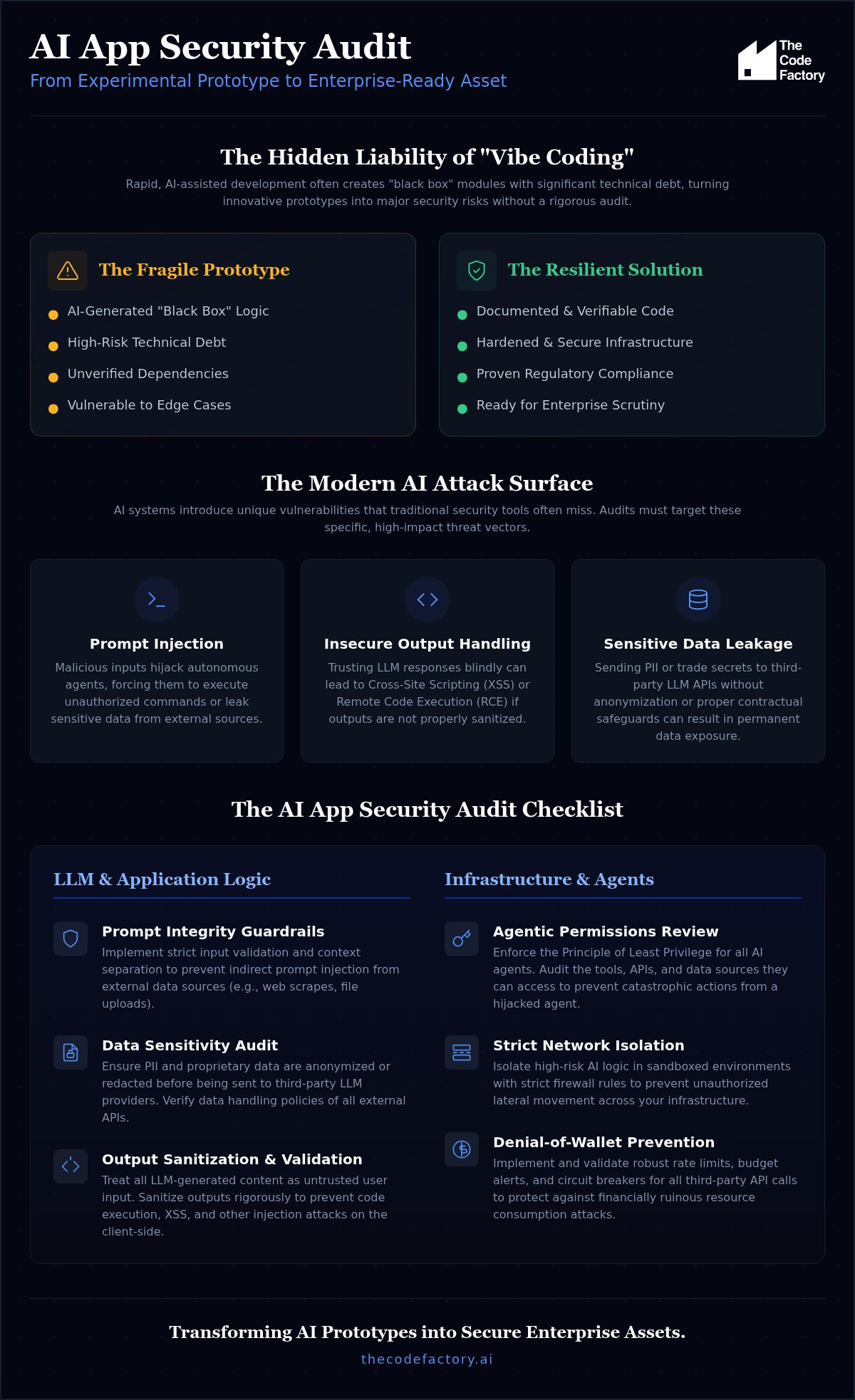
The 2026 attack surface. Prompt injection can hijack autonomous agents into executing unauthorized commands or leaking sensitive data. Insecure output handling can lead to XSS or remote code execution if the AI’s response is trusted blindly.
The Comprehensive Checklist: 2026 Edition
LLM-Specific Vulnerability Checklist
- Prompt integrity: implement guardrails against indirect prompt injection, where malicious data is ingested from external sources like web scrapes or user uploads.
- Third-party data sensitivity: never send PII or proprietary trade secrets to an external LLM without anonymization — a critical failure that can lead to permanent data leakage.
- Rate limit validation: unchecked API calls expose you to denial-of-wallet attacks that can drain your operational budget in hours.
Code-Level Security Requirements
- OWASP review: AI-generated logic frequently overlooks SQL injection or broken access control in favor of functional speed.
- Dependency integrity: LLMs occasionally suggest “hallucinated” packages that don’t exist in official registries — attackers register these names for supply chain attacks, so every import requires manual verification.
- Credential management: zero-tolerance for hardcoded secrets. AI-generated files frequently include placeholder API keys that can slip into production if not caught during review.
- Agent blast radius: never grant an autonomous agent full database access or write permissions to critical infrastructure.
Beyond The LLM
Infrastructure Hardening for AI Workloads
Securing the LLM interface is only half the battle. If the underlying infrastructure is porous, even the most robust prompt guardrails will fail.
- Network isolation: configure VPCs to create a hardened perimeter around sensitive compute instances — never let LLM processing environments sit on an open network.
- API gateway security: enforce authentication protocols and mutual TLS (mTLS) at every entry point to prevent unauthorized service-to-service communication.
- Encryption: data at rest and in transit is a foundational requirement, not a luxury, for any system handling enterprise data.
Managing Agentic Risk & Third-Party Connections
If an agent possesses the authority to modify records in Salesforce or broadcast sensitive data on Slack, a single prompt injection can lead to enterprise-wide disruption.
- Least privilege for agents: scoped, task-specific permissions only — never broad administrative access.
- Human-in-the-loop triggers: for high-risk actions like database deletions or financial transactions, a verified engineer must validate the model’s intent.
- Audit app-to-app connections: regularly, to ensure legacy permissions don’t create backdoors into core business systems.
- Secure CI/CD + logging: signed artifacts and automated integrity checks prevent poisoned model injection; exhaustive logs of AI-to-infrastructure interactions enable immediate, actionable alerts.
Remediating AI-Generated Code
You can't just patch these issues — you have to re-engineer the modules built on "vibes."
Our remediation protocol starts with architectural mapping to isolate high-risk modules, tracking data flow from the LLM interface to internal databases to identify every point where unverified logic could execute a privileged command.
The process of code remediation. AI-generated code is frequently redundant, carrying unnecessary imports and inefficient loops. Streamlining the codebase doesn’t just improve speed — it reduces the attack surface, making it easier to monitor and defend.
Architecture & scalability consulting. We refine your data flow to minimize exposure risks, ensuring sensitive information is never cached or processed in insecure environments — preparing the system for enterprise-level loads where minor agent errors can cascade.
Securing The Future
You can't automate the verification of a non-deterministic system.
Automated scanners identify known CVEs and syntax errors but lack the cognitive context to understand how an LLM might bypass core business logic. An effective audit demands a manual, architectural deep dive into how AI-generated code interacts with your enterprise data.
Our engineering protocol centers on comprehensive production readiness reviews that scrutinize every layer of your stack — configuring hardened cloud infrastructure and CI/CD pipelines specifically tailored for AI workloads.
When you engage us, you receive a detailed breakdown of your application’s security posture along with the specific engineering tasks required for hardening — proof your agentic features are stable, resilient, and safe for deployment.
Building For Enterprise Resilience
Move past the uncertainties of "vibe coding" and build a foundation for long-term growth.
Transform your experimental AI application into a hardened, production-ready asset.
Frequently asked questions
What is an AI app security audit?
A specialized technical review that evaluates the structural integrity of LLM integrations, autonomous agent permissions, and the underlying cloud infrastructure — the bridge between an experimental prototype and an enterprise-grade production system.
How does auditing AI-generated code differ from traditional code reviews?
Traditional reviews focus on human intent. AI-generated code requires verifying statistical approximations, non-deterministic behavior, and defensive-programming adherence rather than just checking for syntax errors.
Can automated tools replace a manual AI security audit?
No. Scanners lack the cognitive context to understand how an LLM might bypass business logic through indirect prompt injection. Manual review is essential for architectural flaws and over-permissioned agents.
What are the most common vulnerabilities found in AI-generated apps?
Prompt injection, insecure output handling leading to XSS, hallucinated dependencies, hardcoded credentials left from prototyping, and over-permissioned agents with broader database access than necessary.
How long does a professional AI app security audit take?
Most production readiness reviews for mid-sized agentic applications take one to three weeks, including module mapping, manual code review, and delivery of a remediation roadmap.
What is the cost of neglecting an AI security review before launch?
Catastrophic data breaches, regulatory fines, permanent loss of enterprise trust, and the mounting cost of patching fragile logic under emergency conditions post-launch.
How do we secure AI agents that have access to our internal data?
Enforce least privilege for every autonomous action, implement human-in-the-loop triggers for high-risk operations, isolate processing environments within a hardened VPC, and continuously monitor agent-to-infrastructure interactions.
What are the compliance requirements for AI applications in 2026?
Verifiable AI safety, robust risk management frameworks, proof of robustness against adversarial attacks, and strict adherence to data privacy regulations like GDPR and CCPA — increasingly demanded as documented production readiness reviews.
