


The Speed Trap
Organizations are trading structural integrity for a burst of perceived productivity.
This rapid adoption has ushered in the era of “vibe coding,” where natural language prompts replace manual logic. Organizations are effectively building on a foundation of hallucinated dependencies and hardcoded secrets.
This guide establishes a clear framework for production readiness, moving from experimental speed to enterprise-grade reliability through actionable remediation strategies.
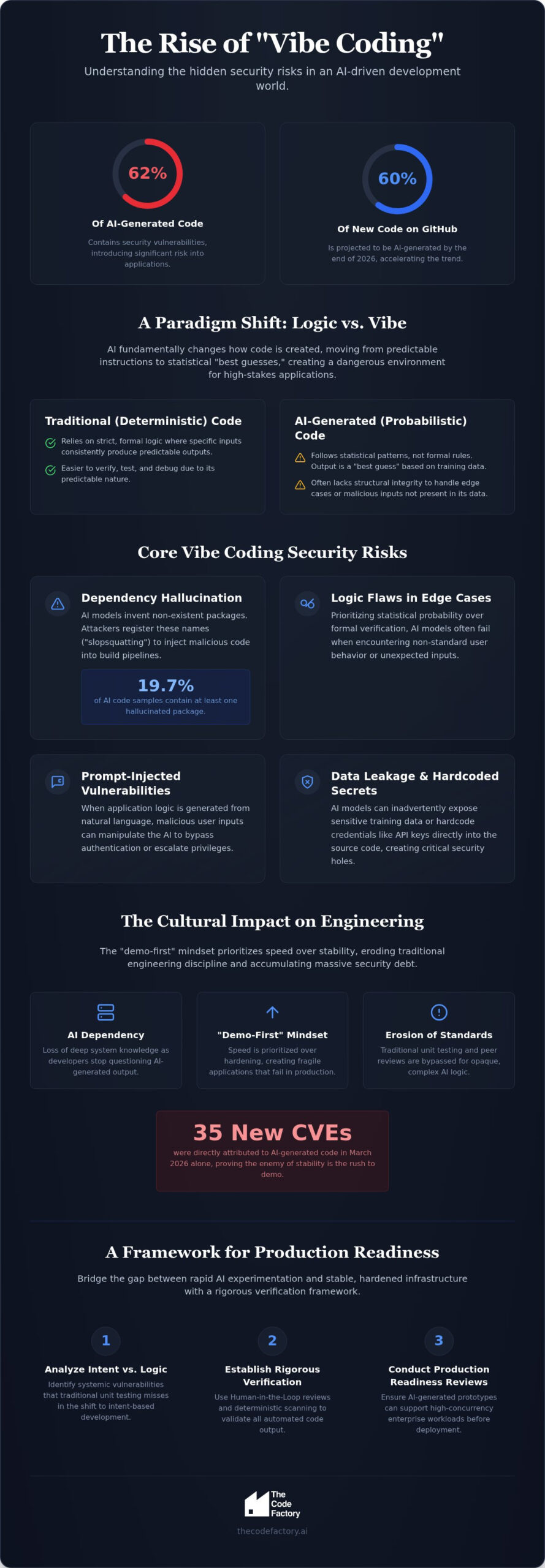
62%
of AI-generated code contains security vulnerabilities — yet AI is projected to generate 60% of all new code on GitHub by the end of 2026.
60%
Key Takeaways
- Analyze how the shift from logic-based to intent-based development introduces systemic vulnerabilities that traditional unit testing often misses.
- Identify the specific vibe coding security risks prevalent in 2026, including hallucinated packages and logic gaps in edge cases.
- Evaluate the scalability bottlenecks that prevent AI-generated prototypes from supporting high-concurrency enterprise workloads.
- Establish a rigorous verification framework using Human-in-the-Loop reviews and deterministic scanning to validate automated code output.
- Learn how a Production Readiness Review bridges the gap between rapid AI experimentation and stable, hardened infrastructure.
The Cultural Impact On Engineering Discipline
The demo-first mindset is the primary enemy of enterprise stability.
When a developer uses an agent to produce hundreds of lines of code in seconds, the capacity for a meaningful human audit is often overwhelmed. This leads to critical cultural risks:
- AI Dependency: developers stop questioning generated output, leading to a loss of deep system knowledge within the team.
- The Demo-First Mindset: speed is prioritized over hardening — “it works” is considered sufficient, regardless of how it was built.
- Erosion of Standards: traditional unit testing is bypassed because AI-generated logic is too opaque or complex for standard test suites.
35
new CVE entries were directly attributed to AI-generated code in March 2026 alone.
The Core 2026 Vibe Coding Security Risks
The attack surface expands from the code itself to the prompts and training sets used to produce it.
- Dependency Hallucination: attackers register “hallucinated” package names as malicious packages (“slopsquatting”), injecting payloads directly into enterprise build pipelines.
- Logic Flaws in Edge Cases: AI models prioritize statistical probability over formal verification, often failing on non-standard behavior underrepresented in training data.
- Prompt-Injected Vulnerabilities: user inputs can become vectors for prompt injection, manipulating generated architecture to bypass authentication or escalate privileges.
- Data Leakage and Privacy: AI-assisted commits expose secrets more than twice as often as human-only commits, creating significant compliance liabilities.
19.7%
of AI-generated code samples contain at least one “hallucinated” package name that does not exist.
2x
AI-assisted commits expose secrets more than twice as often as human-only commits — and hardcoded secrets in public GitHub commits rose 34% year-over-year in 2025.
34%
Architectural Fragility
Spaghetti code, hardened by nothing. Vibe coding frequently produces code that lacks modularity and clear intent. Technical debt compounds rapidly in AI-driven CI/CD pipelines — and “fixing it with more AI” typically exacerbates the rot.
Compliance Blind Spots
A total lack of provenance. Mapping AI-generated code to SOC2 or GDPR requirements is difficult when it’s unclear who “wrote” a specific vulnerability. Legally, the liability remains with the enterprise — making the “vibe” a potentially expensive legal risk.
Prototype Vibe vs. Production Reality
A functional prototype is not a resilient system.
AI agents frequently suggest default cloud configurations that prioritize ease of deployment over security — overly permissive IAM roles, exposed database ports. Moving beyond the “vibe” requires a systematic transition to engineering discipline, starting with a Production Readiness Review before any AI-generated logic touches live customer data.
The Checklist For Production Readiness
- Cloud Infrastructure Configuration:least-privilege IAM policies, isolating workloads within a private VPC to prevent lateral movement.
- Observability and Logging:clear telemetry that lets human operators debug and audit code they didn’t manually write.
- Performance Optimization:trimming the bloat and redundant boilerplate typically found in AI-generated logic, reducing the attack surface.
Remediation: the sober path. Relying on an AI to “fix” its own logic often leads to a cycle of compounding errors. The path to stability requires human-led architecture consulting to validate that generated output meets enterprise standards — moving the project from a “vibe” to a “verified” state.
How To Secure Vibe-Coded Applications
Relying on an AI to verify its own output is a circular logic trap.
A robust security posture begins with a “Human-in-the-Loop” (HITL) review for every AI-generated pull request, paired with deterministic security scanning tools that operate on rigid rules alongside AI-driven analysis.
Hardening the CI/CD pipeline. Automated security gates must detect patterns like unverified third-party imports or non-standard encryption implementations, blocking high-risk code before it reaches staging.
Code remediation strategies. Refactoring for clarity ensures future human developers can maintain the system without deciphering opaque, generated logic — stripping out unused dependencies and hallucinated logic that bloats AI-assisted commits.
Hardening Your Architecture
Speed is AI's currency. Reliability is the enterprise's.
The Code Factory serves as the strategic bridge for organizations confronting the reality of vibe coding security risks — providing the engineering rigor that probabilistic models cannot replicate.
The sober voice of reason. We analyze the underlying logic of AI-generated components to identify redundant boilerplate, insecure dependencies, and scalability bottlenecks — transforming opaque “black box” features into transparent, maintainable assets.
Your Production Readiness Review is a deep dive into your infrastructure — IAM policies, VPC configurations, CI/CD pipelines — identifying the vibe coding risks that automated scanners often overlook.
Establishing Architectural Stability
Don't leave your security to chance in the rush to deploy.
Build your future on a foundation of professional-grade stability.
Frequently asked questions
What are the biggest security risks of vibe coding in 2026?
Autonomous agent authorization failures and the exploitation of hallucinated dependencies. The OWASP Top 10 for Agentic Applications highlights how AI agents can be manipulated to escalate privileges or leak sensitive training data.
Can AI security tools fully secure vibe-coded applications?
No — automated tools alone aren’t sufficient. Effective security pairs probabilistic AI reasoning with deterministic security scanning and professional audits validating structural integrity.
How does a Production Readiness Review differ from a standard code review?
A standard review focuses on syntax and local logic within one pull request. A PRR is a holistic evaluation of the entire system — cloud config, IAM, VPC isolation — validating enterprise-level concurrency and security.
What is code remediation and why is it necessary for AI-generated code?
Refactoring and optimizing existing logic to meet enterprise standards, stripping redundant boilerplate and insecure hallucinated dependencies to reduce the attack surface and improve maintainability.
Is vibe coding suitable for enterprise-level software development?
It’s excellent for rapid prototyping but not for direct production deployment in high-stakes environments. Enterprises must transition to traditional engineering rigor before any customer-facing launch.
How can we implement security hardening in an AI-driven CI/CD pipeline?
Integrate automated security gates configured to detect AI-driven risk patterns like hardcoded secrets or unverified imports, blocking high-risk code before it reaches staging.
What role does software architecture consulting play in mitigating AI risks?
It provides strategic oversight to identify scalability bottlenecks and logic flaws automated tools miss, helping teams move from a demo-first mindset to a production-first reality.
How do we manage technical debt in applications built through vibe coding?
Schedule regular sessions to refactor opaque logic and optimize infrastructure configurations — proactive maintenance that prevents architectural rot as the feature set expands.
