


A Hidden Layer Of Technical Debt
Automated tools have lowered the barrier to entry for common exploits.
While these tools promise to eliminate the friction of manual coding, they’ve simultaneously created a proliferation of AI generated code vulnerabilities that many security teams are only beginning to quantify.
This article examines the systemic risks of training feedback loops, the language-specific densities of modern CWEs, and the formal production readiness framework necessary to reduce your organization’s liability.
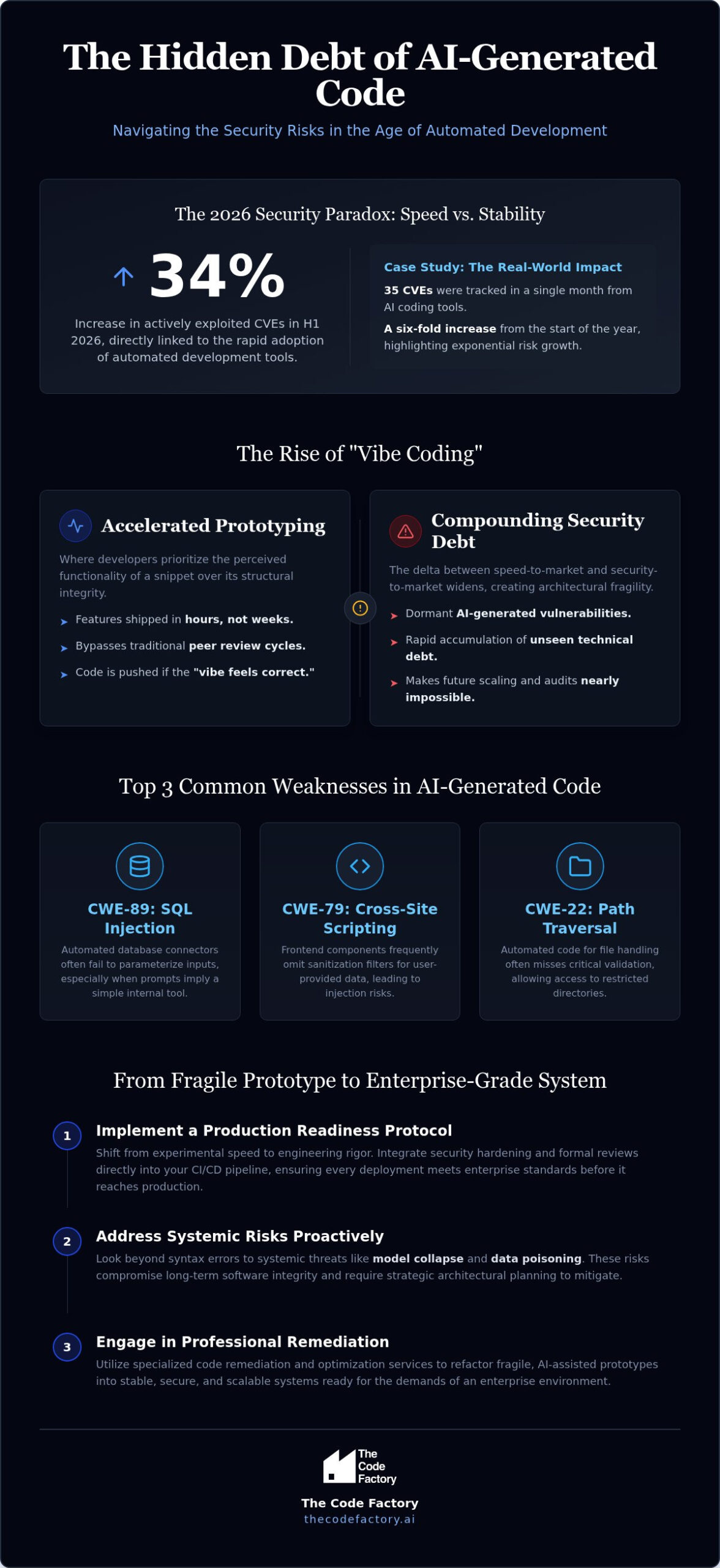
34%
increase in actively exploited CVEs in the first half of 2026 — a surge directly linked to the rapid adoption of automated development tools.
A Hidden Layer Of Technical Debt
- Understand the shift from rapid prototyping to “vibe coding” and why it often bypasses critical production readiness thresholds.
- Identify the most frequent AI generated code vulnerabilities across different languages, including the specific risks associated with Python and TypeScript.
- Recognize the systemic threats of model collapse and data poisoning that can compromise long-term software integrity.
- Learn to implement a standardized production readiness review that integrates security hardening directly into your CI/CD pipeline.
- Transition from fragile AI-assisted prototypes to stable, enterprise-grade systems using professional remediation and architecture consulting.
The 2026 Paradox
Speed is a liability when it lacks rigorous engineering guardrails.
The erosion of rigor. Vibe coding prioritizes the perceived functionality of a snippet over its structural integrity. If the code runs and feels correct, it’s pushed forward without a deep dive into its logic — bypassing peer review entirely.
Quantifiable technical debt. Enterprises now face a remediation crisis stabilizing applications built during the unbridled AI hype of 2024–2025. A “functional” application is useless if it cannot survive a basic security audit.
35 CVEs
tracked in a single month directly attributable to AI coding tools — a nearly six-fold increase from the start of the year, per a Georgia Tech project.
Mapping The CWEs In LLM Output
Rapid-fire replication of well-documented flaws, not novel exploits.
- CWE-89: SQL Injection. Automated database connectors often fail to parameterize inputs, especially for simple dashboards or internal tools.
- CWE-79: Cross-Site Scripting (XSS). Frontend components frequently omit sanitization filters for user-provided data.
- CWE-22: Path Traversal. File-handling logic often lacks strict validation, allowing unauthorized access through manipulated file paths.
The Language Factor
Language choice significantly dictates the density of vulnerabilities.
Python: high-risk by design. Its flexible, dynamic syntax is a high-risk environment, a figure often exacerbated by AI generation.
TypeScript: natural guardrails. Strict typing forces the AI to adhere to a more rigid schema, reducing the likelihood of accidental type-related exploits — though it doesn’t eliminate risk entirely.
16.18%
vulnerability rate for Python in public repositories, according to research — organizations should apply more intensive production readiness reviews to Python-heavy architectures.
Dependency confusion. LLMs sometimes hallucinate non-existent secure libraries. If a developer blindly accepts these suggestions, they risk importing malicious packages registered by threat actors who predicted the hallucination — a supply chain vulnerability no standard compiler will catch.
Beyond Syntax: Systemic Risks
Recursive training doesn't just repeat vulnerabilities — it institutionalizes them.
01
Model Collapse
AI models begin training on their own insecure outputs. As repositories saturate with unvetted logic, the baseline for “correct” code shifts toward mediocrity.
02
Prompt Injection
Attackers place malicious prompts in public documentation, triggering “Indirect Prompt Injection” that tricks an IDE assistant into suggesting backdoors disguised as boilerplate.
03
Corporate Memory Degradation
Senior architectural knowledge is sidelined in favor of immediate output, making it harder to spot systemic risks that span multiple services.
The Production Readiness Review Framework
A multi-layered audit that treats AI as an untrusted contributor.
Step 1
CWE Scanning & Dependency Verification
Flag common weaknesses while validating every external library to prevent dependency confusion.
Step 2
Manual Architectural Review
Senior engineers ensure the code adheres to design patterns without circular dependencies or performance bottlenecks.
Step 3
Cloud & IAM Hardening
Verify generated code operates within least privilege, auditing IAM configurations to prevent unauthorized lateral movement.
Optimizing CI/CD for AI code. “Security Gates” specifically target common AI hallucinations, like deprecated APIs or non-existent secure libraries. IaC ensures that even if a script attempts an insecure action, the underlying cloud infrastructure will block it — with human-in-the-loop remediation as the final safeguard.
From Prototype To Production
Generic AI-powered remediation applies superficial patches. We don't.
Professional code remediation. We identify the fragmented logic and circular dependencies AI generation frequently introduces — optimizing legacy-AI systems so your codebase is maintainable for years, not months.
Architecture & scalability consulting. Scalability is often an afterthought in the “vibe coding” era. We review your cloud infrastructure configuration and hunt for hidden constraints in your data model and API design that could throttle growth.
Securing The Future Of AI-Driven Architecture
Stability is not a feature you can prompt into existence.
You don’t have to sacrifice speed for stability when you have the right architectural guardrails in place.
Frequently asked questions
Is AI-generated code inherently less secure than human-written code?
Not inherently, but it lacks the contextual awareness of a seasoned human engineer and tends to replicate common weaknesses found in its training data, without a rigorous production readiness review.
What are the most common security risks associated with GitHub Copilot and ChatGPT in 2026?
Well-known CWEs like XSS and path traversal, plus a rise in dependency confusion where models suggest non-existent or malicious libraries.
How can I detect vulnerabilities in AI-generated code that standard scanners miss?
A manual architectural audit examining data flow and authorization logic, plus CI/CD security gates that specifically check for AI hallucinations and validate suggested dependencies.
What is "Vibe Coding" and why is it a security concern for enterprises?
Accepting AI suggestions based on whether code “feels” correct, bypassing traditional peer review and structural validation — leading to accumulated technical debt and unvetted vulnerabilities.
Does using AI for documentation generation pose any security risks?
Yes — indirect prompt injection via malicious instructions placed in public documentation can trick a developer’s AI assistant into suggesting insecure configurations or backdoors.
How do I implement a production readiness review for an AI-heavy software project?
Start with automated CWE scanning, follow with manual logic review by senior engineers, then harden cloud infrastructure and IAM roles for least privilege.
Can AI models be "poisoned" to generate insecure code on purpose?
Yes, through data poisoning attacks that introduce malicious datasets into the training pipeline, causing the model to suggest insecure patterns or backdoors as standard boilerplate.
Why is professional code remediation better than using another AI to fix the code?
Another AI typically applies superficial syntax patches while ignoring architectural flaws. Human engineers understand enterprise-level traffic and security requirements for a truly scalable fix.
