


Scalability isn’t a feature you can bolt onto an application when traffic surges; it’s the structural discipline of eliminating bottlenecks before they become catastrophic liabilities. As development teams accelerate delivery through automated tools and rapid prototyping, achieving true enterprise software scalability has become harder, not easier. You’ve likely watched systems buckle under unexpected load spikes, wrestled with brittle dependencies, or inherited codebases burdened by hidden architectural debt. Moving fast proved your concept, but sustaining stability at scale demands an entirely different engineering mindset.
You don’t have to rebuild from scratch or rely on costly over-provisioning to survive peak demand. In this guide, you’ll master the architectural principles and auditing frameworks required to transition fragile prototypes into resilient, enterprise-grade systems. We examine how to isolate technical debt, harden modern cloud infrastructure, and protect your platform against silent failure modes under real-world load. Here is the operational roadmap for engineering teams determined to scale with absolute architectural confidence in 2026.
Key Takeaways
- Achieving enterprise software scalability requires decoupling state from execution, shifting infrastructure from merely functional setups to horizontally elastic architectures.
- Unchecked generative code and rapid prototyping introduce silent architectural churn, demanding targeted code remediation to prevent catastrophic failure under peak load.
- Systematic scalability audits uncover hidden single points of failure by benchmarking real-world capacity and system behaviour against modern telemetry standards.
- Production readiness hinges on pairing reproducible infrastructure automation with strict security hardening to deliver enterprise-grade reliability across scaling environments.
Defining Enterprise Software Scalability in the 2026 Landscape
Many engineering teams confuse survival with scale. Boosting cloud compute instances or adding memory to an overloaded cluster offers temporary relief, but vertical scaling inevitably hits physical and financial ceilings. In contrast, sustainable horizontal scaling distributes demand across modular, interchangeable nodes. While classical principles of system scalability focus heavily on raw resource distribution, production environments demand a deeper shift from functional code to resilient architecture. Code that runs smoothly in a staging sandbox frequently buckles under real-world concurrency and hostile traffic spikes. At its core, enterprise software scalability is the discipline of maintaining system performance through elastic architectural decoupling while enforcing rigorous security hardening across every execution layer. Without that discipline, compounding technical debt quickly turns functional prototypes into unmaintainable production liabilities.
The Difference Between Growth and Scale
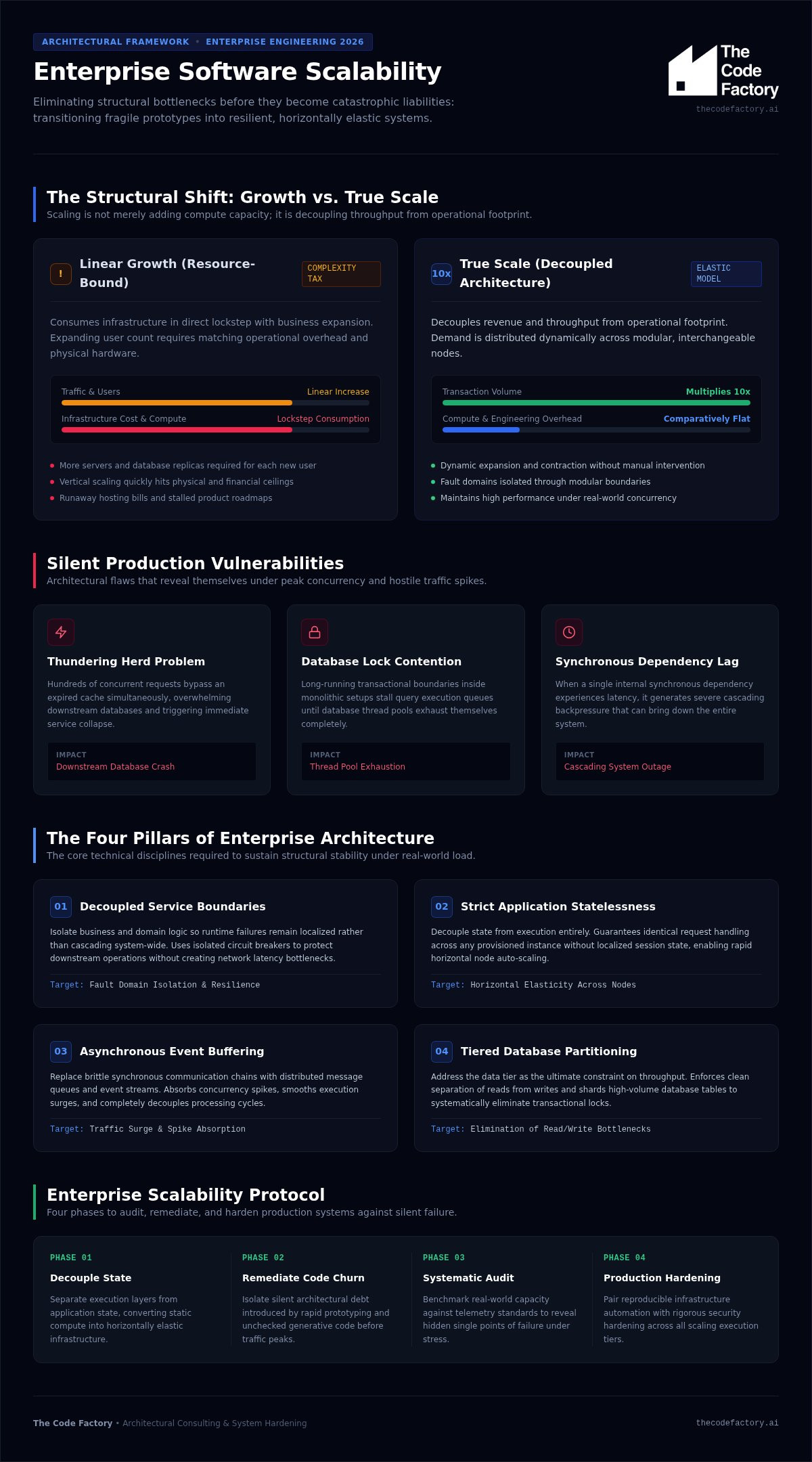
Growth simply consumes infrastructure in lockstep with business expansion, requiring more servers, more database replicas, and expanding operational costs for every new user. True scale decouples revenue from operational footprint. It allows transaction volume to multiply tenfold while compute consumption and engineering overhead stay comparatively flat. When systems fail to decouple these dynamics, organizations pay a steep complexity tax in fragile deployments, runaway hosting bills, and stalled feature development. Elastic cloud infrastructure resolves this imbalance only when the underlying software architecture can dynamically expand and contract without manual intervention.
Common Scaling Failure Modes
Architectural flaws reveal themselves under load with ruthless consistency. The thundering herd problem occurs when hundreds of concurrent requests bypass an expired cache simultaneously, instantly crashing downstream databases. Inside monolithic applications, long-running transactional boundaries trigger database lock contention, stalling query queues until thread pools exhaust themselves completely. Synchronous dependencies worsen this risk; when a single internal service experiences latency, it creates backpressure that can bring down the entire system. Achieving enterprise-grade reliability requires identifying these systemic bottlenecks early and replacing brittle synchronous chains with resilient, asynchronous event streams.
The Four Pillars of Scalable Enterprise Architecture
Cloud vendors often frame scale as a hosting tier configuration. Upgrade the cluster instance, activate automated replication, and system performance supposedly takes care of itself. Real-world engineering tells a different story. If your application layer relies on monolithic couplings and unmanaged state, increasing compute capacity merely conceals deep-seated structural friction. True enterprise software scalability demands a deliberate engineering protocol built on four architectural pillars:
- Decoupled Service Boundaries: Isolating domain logic so failures remain localized rather than systemic.
- Strict Application Statelessness: Ensuring identical request handling across any provisioned instance without localized session state.
- Asynchronous Event Buffering: Using distributed message queues to absorb concurrency spikes and decouple processing cycles.
- Tiered Database Partitioning: Separating reads from writes and sharding high-volume tables to avoid transactional locks.
Decoupling and Microservices
Splitting monolithic systems into targeted microservices or modular monoliths isolates fault domains. When one boundary fails under unexpected load, isolated circuit breakers protect downstream operations. Over-fragmenting services introduces severe network latency and serialization overhead. Balancing these tradeoffs requires aligning system decomposition with rigorous software architecture evaluation practices. For development teams untangling tight runtime couplings, partnering with specialists in software architecture consulting provides the structural guidance needed to refactor critical bottlenecks without stalling product roadmaps.
Data Tier Scalability
Data layers represent the ultimate constraint on system throughput. The CAP theorem dictates that distributed systems must negotiate trade-offs between consistency, availability, and partition tolerance. Relational databases support transactional integrity, yet high write volumes frequently necessitate migrating high-throughput domains to distributed non-relational stores. Introducing distributed caching layers like Redis or Memcached relieves primary datastores by absorbing read-heavy traffic patterns. Caches must be treated as volatile accelerators rather than persistent safety nets, backed by deterministic eviction policies and robust cache-invalidation logic.
Engineering teams preparing their platforms for aggressive production expansion should consider a formal technical assessment to validate data tier boundaries and eradicate single points of failure before production stress tests reveal them.
The AI Bottleneck: Scaling Code in the Age of LLM-Driven Development
Generative development tools let engineering teams ship features at unprecedented velocity. Prototyping speed, however, rarely correlates with operational endurance. The emerging trap of “vibe coding”—prioritizing code that appears functional on the surface while ignoring underlying system boundaries—threatens modern enterprise software scalability. Machine-generated code excels at satisfying localized unit tests, yet it routinely overlooks edge-case connection management, data serialization costs, and concurrency safeguards. According to research from GitClear tracking 623 million code changes, code churn surged from a baseline of 3.3% to 7.1% as AI adoption grew, with duplicate code blocks climbing 81%. When unrefined synthetic logic enters staging environments, it creates fragile systems that silently collapse under heavy concurrent transactions.
Remediating inefficient machine logic before it reaches your core cloud resources is non-negotiable. Teams navigating these high-friction deployments need dedicated engineering strategies for scaling AI applications, converting fragile, auto-generated code into robust, enterprise-ready pipelines.
The Hidden Technical Debt of AI
Synthetic code generators tend to introduce subtle anti-patterns. They write unoptimized loops, trigger repeated redundant database lookups, and mask errors using generic try-catch blocks that hide connection exhaustion. These inefficiencies stay dormant during low-volume testing. Once real users subject the platform to production load, those small memory leaks compound into full thread pool locks. Mitigating these systemic vulnerabilities requires human-led code remediation and rigorous static analysis to enforce structural integrity before deployments hit live users.
Architecture for AI Integration
Integrating large language models directly into application workflows introduces massive external latency and variable compute charges. Systems must insulate themselves against downstream API timeouts and unexpected usage costs by implementing strict token rate limits, fallback queues, and asynchronous workers. Production readiness reviews serve as an essential operational filter, identifying unvetted AI dependencies and architectural vulnerabilities before they cause costly production outages.
Aligning these architectures with the elastic capacity criteria established in the NIST cloud elasticity framework guarantees that external inference calls cannot starve core platform processes of shared CPU or network bandwidth.
The Engineering Protocol: How to Conduct a Scalability Audit
Auditing a platform for scale requires moving past standard vanity metrics. While high-level dashboards show aggregate system health during nominal traffic, they obscure the micro-failures that cascade during traffic spikes. A rigorous evaluation establishes real-world performance baselines under synthetic duress, rooting out architectural vulnerabilities before customers experience them. Achieving enterprise software scalability demands a structured audit framework built on four repeatable phases:
- Telemetry Baseline Capture: Standardizing distributed tracing and metrics to establish empirical capacity boundaries under normal operating conditions.
- SPOF Isolation: Mapping the critical path across all services, third-party APIs, and data layers to expose unbuffered dependencies.
- Synthetic Failure Injection: Introducing latency spikes, killed worker pods, and network drops to verify graceful degradation protocols.
- Tail-Latency Profiling: Pinpointing execution delays across the slowest transactions rather than relying on misleading averages.
Load Testing vs. Stress Testing
Load testing verifies how systems behave under anticipated production volumes. Stress testing goes further, pushing past normal operational parameters to find the structural breaking point. Soak testing runs that traffic for hours to uncover memory leaks and connection pool starvation. Enterprise teams rely on chaos engineering to inject active failure states into distributed clusters, ensuring systems maintain enterprise-grade reliability when primary nodes drop offline. Review our complete guide on how to conduct a software scalability audit to implement a systematic diagnostic across your stack.
Identifying the Bottleneck
Tracing execution bottlenecks requires isolating whether failure originates in CPU limits, memory leaks, I/O wait times, or network congestion. Engineering leaders often scrutinize median response times, but average latency hides serious production risks. The long tail of latency tells the true story; tracking 99th percentile (P99) response times uncovers the thread contention and query blocking that degrade high-value user sessions. Bottlenecks can also originate within slow, unoptimized CI/CD deployment pipelines, causing rollout delays and blocking emergency rollbacks when services fail under load.
When you need an unbiased evaluation of your production boundaries, engage The Code Factory for a Production Readiness Review to systematically isolate your architectural risks.
Hardening Systems for Production: The Path to Enterprise Readiness
Reactive firefighting cannot protect high-throughput applications during rapid market expansion. When traffic surges, undocumented configurations, ad-hoc server setups, and overlooked security holes fail simultaneously. Sustainable enterprise software scalability requires treating infrastructure configuration and operational defenses with the same rigor applied to core business logic. Codifying operational standards across your release cycles turns volatile environments into predictable, resilient platforms. Transitioning from reactive fixes to proactive engineering requires structured verification. Executing a formal production readiness review before major growth initiatives ensures your stack can absorb high load without compromising data integrity.
Infrastructure as Code and CI/CD
Manual infrastructure tweaks introduce configuration drift and operator error at the worst possible moments. Infrastructure as Code (IaC) guarantees reproducible scaling, ensuring every autoscaled node mirrors verified production specifications across isolated environments. Modern CI/CD deployment pipelines must also act as active defense barriers. Hardening these delivery pipelines against software supply chain attacks through automated image scanning, dependency verification, and role-based access controls ensures that speed never compromises structural security.
The Role of Technical Consulting
Internal teams face intense pressure to ship user-facing features quickly. That velocity often blinds internal developers to systemic architectural debt and hidden concurrency limits. Bringing in specialized external guidance provides the objective scrutiny needed to balance delivery speed with engineering rigor. Before selecting an advisory partner, reviewing a comprehensive technical architecture consulting buying guide helps engineering leaders evaluate firms on code-level remediation capability rather than abstract diagramming. The Code Factory bridges the gap between software that is merely built and systems that are truly ready for enterprise scale. Through deep-tier code remediation, cloud infrastructure configuration, and independent architectural reviews, we equip your organization to achieve enterprise-grade reliability under relentless production demands.
Architecting for Resilience: The Next Phase of Enterprise Scale
Scaling software is never about simply adding raw compute or generating faster code; it’s about structural discipline. Achieving lasting enterprise software scalability requires decoupling brittle dependencies, purging synthetic code bloat through rigorous remediation, and continuously verifying runtime limits. When your engineering organization replaces reactive hotfixing with codified infrastructure and empirical audits, high transaction volumes transform from a terrifying operational liability into a predictable engine of business expansion.
Modern architectures can’t afford guesswork. Operating in high-stakes production environments calls for pragmatic engineering and deep technical rigor. Whether you are transitioning automated prototypes into production or decoupling high-throughput services across distributed clouds, expert-led architectural hardening provides the clarity and control you need to grow without disruption. Secure your infrastructure with a professional Production Readiness Review from The Code Factory and build a foundation capable of delivering enterprise-grade reliability through every stage of growth.
Frequently Asked Questions
What is the primary difference between software scalability and performance?
Performance measures how fast a system processes a single transaction under baseline conditions. Scalability measures the platform’s ability to maintain that speed as transaction volume, data load, or user concurrency multiplies. An application can be lightning-fast for ten simultaneous users while failing completely at ten thousand. Enterprise software scalability focuses on architectural elasticity, ensuring throughput expands predictably without exponential compute consumption or degraded user experiences.
When should an enterprise start planning for software scalability?
Architecture teams should design for scalability during initial domain modeling, well before launching public-facing infrastructure. Retrofitting decoupling patterns and stateless transactions onto legacy codebases after traffic surges is vastly more expensive than establishing resilient patterns early. While premature optimization can slow initial prototyping velocity, defining clear data boundaries and isolated service interfaces early prevents painful structural rewrites when production workloads expand.
How does technical debt impact a system’s ability to scale?
Technical debt acts as an architectural ceiling that limits throughput. Hardcoded parameters, tightly coupled monolithic functions, and unindexed database queries might operate adequately in low-concurrency staging environments. Under high load, however, these hidden shortcuts trigger thread starvation, database connection lockouts, and cascading system failure. Unresolved technical debt turns every traffic spike into an operational risk, preventing platforms from scaling out horizontally without massive compute over-provisioning.
Can cloud-native services solve all scalability challenges automatically?
Cloud-native tools and managed autoscaling groups provide elastic hardware, but they can’t fix fundamentally flawed application architecture. If your code maintains sticky session states or issues unbuffered database transactions, adding more virtual instances simply multiplies internal bottlenecks. True enterprise software scalability requires resolving database serialization locks, managing asynchronous queues, and eliminating shared state within the codebase itself before relying on cloud autoscaling mechanics.
What are the security risks associated with scaling enterprise software?
Horizontal expansion broadens your platform’s attack surface. As you spin up microservices and containerized environments across multiple clusters, unhardened internal APIs, misconfigured service meshes, and exposed container registries become immediate vulnerabilities. High concurrency can also expose race conditions in authentication pipelines. Security hardening must proceed hand in hand with architectural expansion, ensuring that access boundaries, token validation, and encryption protocols stay unified across dynamic nodes.
How do I know if my AI-generated code is ready for enterprise production?
Synthetic code is rarely enterprise-ready straight from an AI assistant. While it passes functional checks, it frequently introduces duplicate logic, improper error catching, and unoptimized resource allocations. You know AI-generated code is production-ready only after conducting human-led code remediation, static architectural linting, and rigorous concurrency stress testing. Systems must undergo formal reviews to verify they handle connection pooling and memory consumption cleanly under sustained load.
What is a production readiness review and why is it necessary for scaling?
A production readiness review is a comprehensive engineering audit that assesses whether a software platform can survive high-concurrency production demands. It scrutinizes service boundaries, deployment pipelines, infrastructure automation, and disaster recovery procedures. Conducting this review prevents catastrophic outages by exposing single points of failure before deployment. It bridges the critical operational gap between software that merely runs locally and an enterprise-grade platform built for resilient scale.
How much does a software scalability audit typically cost for an enterprise?
Audit costs vary based on architectural footprint, system complexity, and codebase scale. A focused review of a single decoupled service differs significantly from an end-to-end evaluation of a distributed hybrid-cloud architecture. Enterprises evaluate investments based on the scope of telemetry analysis, load testing requirements, and whether deep code remediation is required. Engaging independent engineering consultants provides a tailored scope aligned with your operational risks and growth timelines.
