
A static slide deck has never prevented a distributed database from collapsing under a sudden traffic spike. You already know the quiet anxiety of watching core services buckle when user volumes surge, especially as accumulated technical debt and unvetted AI-generated code erode system stability. Internal engineering teams are frequently stretched to capacity, maintaining daily feature delivery without the bandwidth or unbiased objectivity needed to audit foundational design. Engaging technical architecture consulting should permanently resolve these bottlenecks, yet the fear of hiring advisory firms that deliver abstract diagrams rather than production-grade solutions remains entirely justified.
Architecture succeeds through code-level remediation and runtime validation, not theoretical recommendations. In this 2026 buying guide, you’ll discover how to evaluate, scope, and select technical architecture consulting services to eliminate system bottlenecks and scale production safely. We break down the practical criteria needed to vet architectural partners, rigorous scoping protocols for discovery and remediation sprints, and the performance benchmarks that guarantee your infrastructure handles enterprise demands without failing.
Key Takeaways
- Learn how to evaluate technical architecture consulting partners on their ability to execute runtime validation and code-level remediation rather than delivering abstract slide decks.
- Identify the critical operational thresholds, from sudden throughput ceilings to ungoverned AI-generated code liabilities, that mandate an external architectural audit.
- Use a structured vetting matrix to separate high-overhead strategy consultancies and generic staffing agencies from hands-on engineering specialists.
- Scope engagement phases around concrete, production-grade artifacts, including formal Architecture Decision Records and verifiable latency benchmarks.
- Protect system stability by pairing cloud infrastructure scaling directly with targeted code remediation to secure measurable engineering ROI.
What Is Technical Architecture Consulting in Modern Software Engineering?
Modern software engineering often mistakes operational activity for structural health. Teams push features rapidly, yet the underlying system silently approaches capacity limits. Technical architecture consulting is an objective, forensic evaluation of software topology, operational data pathways, and runtime execution models designed to eliminate fragility before scale forces an outage. Rather than debating high-level business alignment, this discipline isolates structural friction across services to protect system resilience.
At its core, technical architecture consulting functions as a structural audit of code, data, and infrastructure to ensure systems can safely sustain peak enterprise workloads. It departs fundamentally from corporate IT strategy. While management consulting firms produce conceptual target-state frameworks, hands-on architectural consulting evaluates the mechanical reality of the platform. It inspects whether distributed transactions respect network boundaries, whether database connection pools choke under concurrent bursts, and whether theoretical system designs translate into performant execution in production.
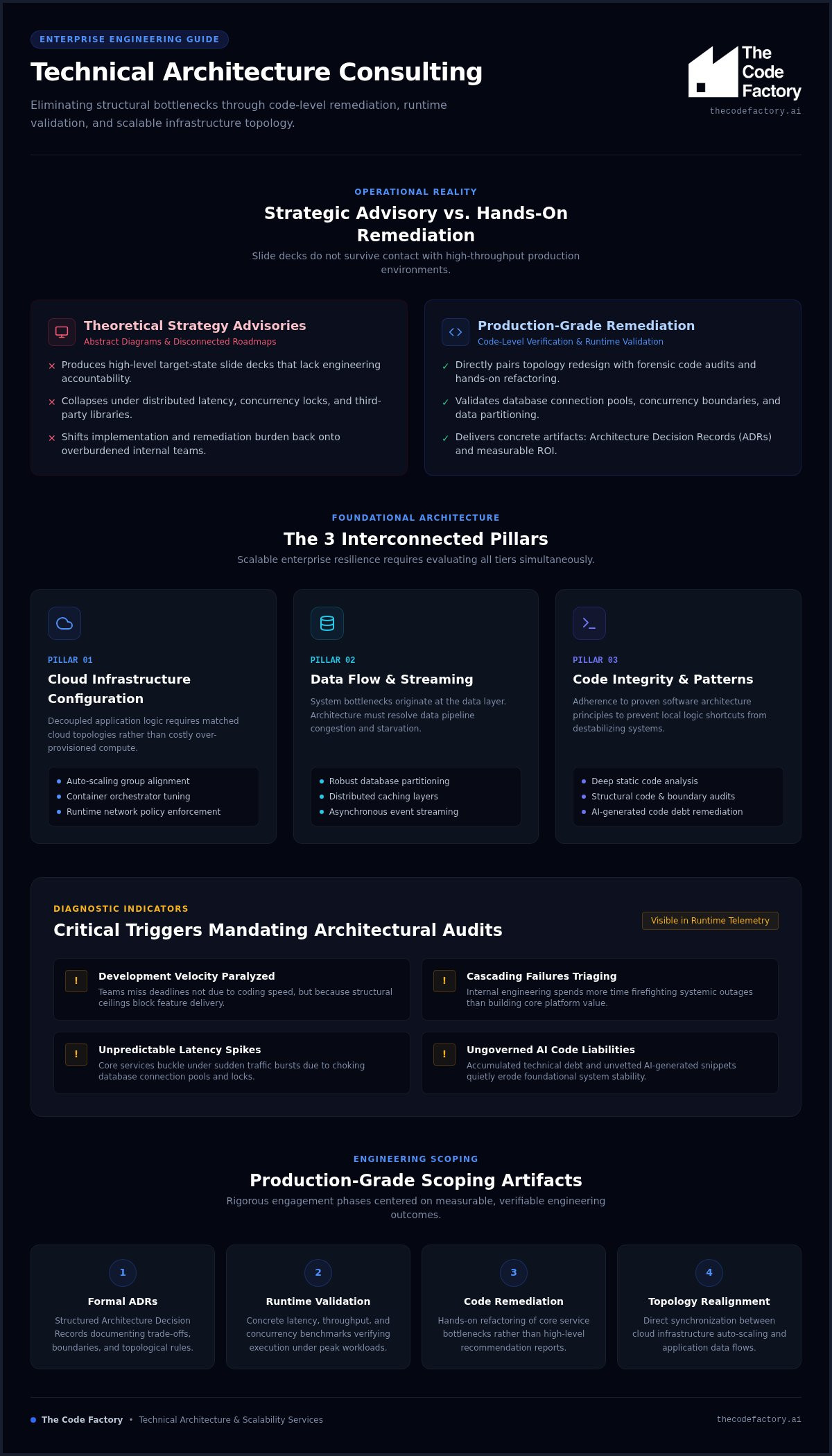
Strategic Advisory vs. Hands-On Engineering Remediation
Slide decks don’t survive contact with production environments. High-level advisory roadmaps frequently gather dust because they lack direct engineering accountability, leaving development teams without actionable paths toward implementation. Theoretical models inevitably fall apart when confronted with distributed latency, unvetted third-party libraries, or complex concurrency locks. True architectural remediation functions as an active engineering protocol. It directly pairs topology design with code-level verification, resolving structural flaws within the code itself rather than shifting the burden back to overburdened internal staff.
Core Pillars: Cloud Infrastructure, Data Flow, and Code Integrity
A reliable architecture relies on three interconnected disciplines that cannot be evaluated in silos:
- Cloud Infrastructure Configuration: Decoupled application logic requires matched cloud topologies. Auto-scaling groups, container orchestrators, and network policies must mirror runtime demands rather than relying on over-provisioned compute to mask architectural waste.
- Data Flow and Streaming: Persistent bottlenecks rarely stem from code execution alone; they originate at the data layer. Designing robust partitioning strategies, distributed caching layers, and asynchronous event streams keeps database locks from starving critical user pathways.
- Code Integrity and Patterns: System stability demands adherence to proven, foundational software architecture principles. Deep static analysis and structural code audits prevent local logic shortcuts from destabilizing wider system boundaries.
Mastering these operational tiers requires an integrated engineering methodology. To examine the baseline frameworks governing modern platforms, explore our foundational guide on software architecture consulting to understand how structured system audits prepare growing applications for mission-critical scale.
Critical Triggers: When Your Enterprise Must Hire an Architecture Consultant
Engineering teams rarely miss deadlines because they lack coding speed. They miss them because structural ceilings paralyze development velocity. Recognizing when your architecture has reached its physical limits is critical to preventing platform outages. While management consultancies treat architectural reviews as administrative checkpoints for corporate restructuring, real engineering triggers are operational, urgent, and visible directly in your runtime telemetry.
Engaging technical architecture consulting becomes necessary when internal teams spend more time triaging cascading failures than shipping features. If you are experiencing unpredictable latency spikes, uncontained cloud infrastructure bills, or brittle release cycles, your platform is signaling structural distress that incremental patches cannot resolve.
Breaking Through Unforeseen Scalability Bottlenecks
Horizontal auto-scaling cannot fix deeply coupled internal state machines. When traffic spikes hit, simply provisioning additional cloud instances often compounds connection contention rather than relieving it. Thread pools exhaust rapidly, p99 latency spikes out of control, and database row locks cascade across dependent services. Systematically executing a software scalability audit reveals precisely where synchronous blocking operations and unpartitioned storage layers choke throughput under enterprise loads.
Remediating AI-Generated Code and Unchecked Technical Debt
AI coding assistants have made local code production instantaneous, but they have introduced widespread structural entropy. Automated code generation frequently produces syntactically correct logic that completely ignores domain boundaries, creating circular dependencies, memory leaks, and redundant microservice calls. When prototypes move directly into production without rigorous oversight, architectural debt accumulates rapidly. Following established IEEE Computer Society architectural guidelines helps teams reassert system governance, untangle unvetted generative code, and insulate core business domains against unmaintainable sprawl.
Preparing for High-Stakes Launches and Enterprise Scale
Scaling to support high-tier enterprise contracts introduces rigorous non-functional requirements that break standard development workflows. Before onboarding major tenants or processing sensitive enterprise data, technical leaders must evaluate perimeter boundaries, distributed zero-trust models, and regulatory compliance protocols.
- Concurrency Resilience: Verifying that shared data stores handle abrupt bursts without deadlocks or degraded read consistency.
- Security Hardening: Validating mutual TLS, service mesh boundaries, and identity propagation across heterogeneous services.
- Operational Recovery: Establishing automated circuit breaking and graceful degradation paths when downstream third-party dependencies fail.
Executing an objective production readiness review ensures every component meets strict availability targets. If internal resources are stretched, bringing in The Code Factory for technical architecture consulting provides the unbiased engineering oversight needed to harden your platform before enterprise traffic lands.
Evaluating Technical Architecture Consulting Firms: A Vetting Framework
Selecting the wrong consulting partner often magnifies technical friction instead of eliminating it. Many engineering leaders hesitate to bring in external reviewers, fearing that an audit will alienate internal developers or delay ongoing sprint commitments. This friction only happens when firms rely on generic compliance questionnaires rather than inspecting the actual codebase. A rigorous evaluation framework separates high-overhead strategy houses from hands-on engineering partners who can pinpoint structural liabilities without disrupting daily team cadence.
Vendor neutrality must remain a non-negotiable vetting requirement. Consultancies tied to specific cloud reseller agreements or enterprise software quotas will naturally bias their recommendations toward heavy, proprietary licensing. Specialized technical architecture consulting requires total independence, ensuring infrastructure and tooling proposals serve your operational efficiency rather than a partner kickback.
Agency Types: Management Consultancies vs. Engineering Specialists
Understanding provider models helps you avoid mismatched expectations and inflated budgets:
- Management Consultancies: These firms produce comprehensive transformation roadmaps and board presentations. However, their partners rarely inspect repositories or configure infrastructure, leaving your internal team to reconcile abstract concepts with runtime limitations.
- Body-Shop Staffing Agencies: Generalist development shops offer engineering headcount rather than deep architectural governance. They lack the forensic auditing toolsets required to identify systemic design flaws, often attempting to solve structural bottlenecks simply by throwing more junior developers at the problem.
- Boutique Engineering Specialists: Specialized technical firms operate directly inside the codebase. They combine macro-architectural design with hands-on profiling, delivering production-grade remediation alongside targeted architectural governance.
Verification Checklist: Assessing Technical Depth and Independence
Before entering any advisory agreement, demand concrete proof of deep engineering capabilities. Prospective partners should demonstrate alignment with the NIST systems security engineering standard to ensure their architectural recommendations build verifiable trust into system boundaries. Require candidate firms to satisfy three core criteria during procurement:
- Telemetry-Driven Profiling: The firm must utilize APM tooling, distributed trace analysis, and thread profiling to identify performance regressions, rather than relying exclusively on interviews.
- Measurable Performance History: Look for documented case studies demonstrating concrete throughput gains, reduced p99 latencies, and stabilized cloud resource allocation.
- Modern Architectural Fluency: The consultants must prove their ability to solve intricate enterprise software scalability hurdles across hybrid cloud deployments, multi-tenant state isolation, and event-driven data fabrics.
Vetting firms through codebase-level technical interviews ensures you select a partner capable of executing meaningful remediation, rather than an advisory committee that delivers shelfware.
Scoping Engagements: Deliverables, Artifacts, and Measurable ROI
An architectural engagement without concrete deliverables is merely an expensive conversation. Engineering leaders must scope consulting projects around tangible, engineering-grade outputs that developers can immediately execute against. Actionable technical deliverables that directly unblock production bottlenecks and lower operational failure rates represent the true indicator of engagement ROI. A successful engagement replaces vague advisory memos with detailed C4 system topology diagrams, comprehensive threat models, and empirical latency profiling reports.
Aligning technical architecture consulting with clear operational metrics protects your budget and your timeline. Accountability metrics must tie directly to infrastructure efficiency, mean time to recovery (MTTR), and system throughput under simulated load. When structured properly, the engagement produces assets that serve both immediate sprint goals and long-term engineering governance.
Phase-by-Phase Engagement Protocol
A rigorous architecture consulting initiative follows four disciplined execution milestones:
- Phase 1: Forensic Baseline Audit: Deep inspection of code repositories, cloud infrastructure configurations, data schemas, and runtime telemetry to establish current operational boundaries.
- Phase 2: Structural Stress-Testing: Concurrency profiling and failure-mode simulations that expose silent thread pool contention, memory leaks, and cascading database locking behaviors.
- Phase 3: Prioritized Remediation Blueprint: A sequence of Architecture Decision Records (ADRs) that map targeted code and infrastructure interventions directly against measurable business risk.
- Phase 4: Implementation Guidance and Validation: Hands-on code remediation reviews, deployment pipeline hardening, and benchmark verification runs to ensure the changes hold under enterprise workloads.
Quantifying Business Impact and Cloud Cost Optimization
Architectural flaws manifest directly on the monthly cloud invoice. When microservices communicate through synchronous, chatty HTTP loops rather than event-driven streaming, data egress fees multiply rapidly while user-facing latency climbs. Decoupling these network boundaries eliminates redundant serialization overhead and slashes baseline cloud compute consumption. At the enterprise level, a properly remediated distributed architecture often yields substantial recurring infrastructure savings while sharply reducing the occurrence of budget overruns.
Downtime carries an even higher price tag. A single cascading outage during peak operational hours can cost hundreds of thousands of dollars in lost transaction volume, compliance penalties, and customer churn. Investing in structural stabilization replaces brittle panic patching with resilient circuit breaking and graceful degradation. Engineering velocity naturally rebounds; when modules possess clean architectural interfaces, merge conflicts disappear and internal teams deploy with confidence.
If your systems are hitting operational ceilings, you can scope your architecture consulting engagement with The Code Factory to audit, remediate, and validate your core platform before performance regressions compromise revenue.
Partnering with The Code Factory: Pragmatic Architecture & Scalability Services
Production environments do not tolerate theoretical engineering. When distributed systems falter under surge traffic or accumulated technical debt, organizations don’t need another generic digital transformation roadmap. The Code Factory operates as a specialized engineering consultancy built specifically for mission-critical software environments. Our approach grounds high-level strategy directly in code execution, helping technology leaders eliminate stability risks, lower infrastructure overhead, and scale operations safely.
True technical architecture consulting requires an uncompromising focus on production readiness, architecture scalability, and code remediation. Rather than treating software design and infrastructure configuration as disconnected disciplines, we audit both simultaneously. This unified perspective stops catastrophic launch failures before they happen, especially in volatile cloud systems and data-intensive AI workloads where resource contention quickly triggers service cascades.
Engineering-First Auditing and Code Remediation
Abstract architecture reviews miss the micro-level faults that cause macro outages. The Code Factory’s senior engineers inspect repositories directly, identifying concurrency hazards, untangling circular dependencies, and eliminating hidden resource leaks. We couple this forensic evaluation with rigorous security hardening, closing network exposure gaps across distributed services and locking down container boundaries. To lock in these improvements over time, we build automated production readiness gates directly into your CI/CD deployment pipelines, ensuring new commits cannot bypass established architectural guardrails.
Initiating Your Architecture and Scalability Assessment
Engaging an external architectural partner shouldn’t derail your active product roadmap. The Code Factory uses a structured, non-disruptive discovery model designed to integrate seamlessly alongside your current engineering sprints:
- Repository and Infrastructure Ingestion: Rapid, read-only analysis of application codebases, cloud resource definitions, and runtime telemetry configurations.
- Targeted Stress and Concurrency Profiling: Empirical validation runs that pinpoint precise throughput ceilings and memory consumption curves under peak loads.
- Remediation Sprint Roadmap: Delivery of prioritized, production-ready interventions that your team can execute immediately or pair with our engineers to remediate.
Stabilizing your platform before your next traffic milestone protects both your team’s sanity and your business reputation. Engage The Code Factory to audit and harden your enterprise technical architecture with engineering-led precision.
Hardening Your Platform for Predictable Enterprise Scale
Scaling mission-critical software demands more than rapid feature delivery; it requires structural integrity across your code, data, and infrastructure. Successful engineering organizations don’t gamble their platform’s stability on theoretical frameworks or hope that over-provisioned cloud compute masks hidden concurrency locks. By vetting your partner through an engineering-first lens and demanding code-level accountability, you ensure that external technical architecture consulting delivers quantifiable resilience rather than shelfware.
The Code Factory provides the specialized engineering oversight necessary to eliminate bottlenecks and scale safely. Through specialized production readiness reviews tailored for high-scale enterprise applications, battle-tested cloud infrastructure configuration, and robust CI/CD engineering protocols, we help you isolate fragility before it compromises runtime performance. When you pair comprehensive code remediation and architectural hardening with seasoned engineering guidance, downtime shifts from an inevitable liability to a solved operational risk. Ready to protect your system’s availability? Schedule an Architecture & Scalability Consultation to secure your platform for enterprise workloads today.
Frequently Asked Questions
What is the difference between a software architect and a technical architecture consultant?
An in-house software architect focuses on ongoing roadmap delivery, internal engineering team standards, and local feature dependencies within a single business context. An external technical architecture consultant brings neutral, cross-industry experience from dozens of high-concurrency production systems. They specialize in forensic audits, identifying latent failure modes, and executing targeted architectural refactoring without organizational bias or internal delivery pressure.
When is the right time to hire an external technical architecture consulting firm?
The ideal time to engage technical architecture consulting is immediately prior to major user scale milestones, high-stakes enterprise launches, or when unexpected throughput ceilings stall developer velocity. Waiting until database deadlocks or cascading microservice timeouts cause widespread production downtime drastically increases the complexity of recovery. Bringing in objective experts early uncovers hidden liabilities before real traffic forces an emergency rebuild.
How much does technical architecture consulting typically cost for an enterprise application?
Engagement costs depend entirely on the operational scope, system complexity, and depth of remediation required. Standard reviews range from targeted, time-boxed audits of critical services to comprehensive multi-phase initiatives covering distributed infrastructure topology, data pipelines, and code-level remediation sprints. Buyers should focus on measurable returns, such as eliminating catastrophic outage risks and reducing ongoing cloud infrastructure waste, rather than hourly metrics.
Can technical architecture consultants help optimize and secure AI-generated code?
Yes, specialized engineering consultants actively audit, untangle, and harden AI-generated logic for high-concurrency production. Automated code tools frequently introduce circular module dependencies, unvetted external dependencies, and poorly managed concurrency locks that pass basic unit tests but fail under heavy concurrent loads. Consulting teams isolate these generated routines, enforce clean domain boundaries, and apply rigorous security hardening across every integration point.
How do architecture consultants evaluate system scalability without disrupting live users?
Consultants evaluate system scalability using read-only codebase inspections, application telemetry reviews, and isolated synthetic stress testing in mirrored staging environments. They analyze database connection lifecycles, memory allocation profiles, and distributed trace metrics to pinpoint where synchronous blockages occur. This forensic approach maps performance ceilings and latency bottlenecks accurately without introducing risks, downtime, or degraded performance to your live user base.
What specific deliverables should our engineering team expect from an architecture audit?
Your team should receive technical, actionable engineering assets rather than generic advisory decks. Core deliverables include formal Architecture Decision Records (ADRs), comprehensive threat models, detailed C4 system topology diagrams, and empirical latency profiling benchmarks. High-impact firms also deliver prioritized code remediation blueprints and CI/CD validation gates that internal developers can immediately implement to stabilize system operations.
What happens if our internal engineering team disagrees with the consultant’s recommendations?
Pragmatic consulting relies on empirical performance telemetry, stress-test profiling, and benchmark data rather than subjective architectural opinions. When debates arise, recommendations are verified using runtime proofs of concept, distributed trace logs, and quantifiable load testing. This data-driven validation transforms subjective disagreements into objective engineering trade-off analyses, helping internal teams reach a confident, informed consensus without internal friction.
