


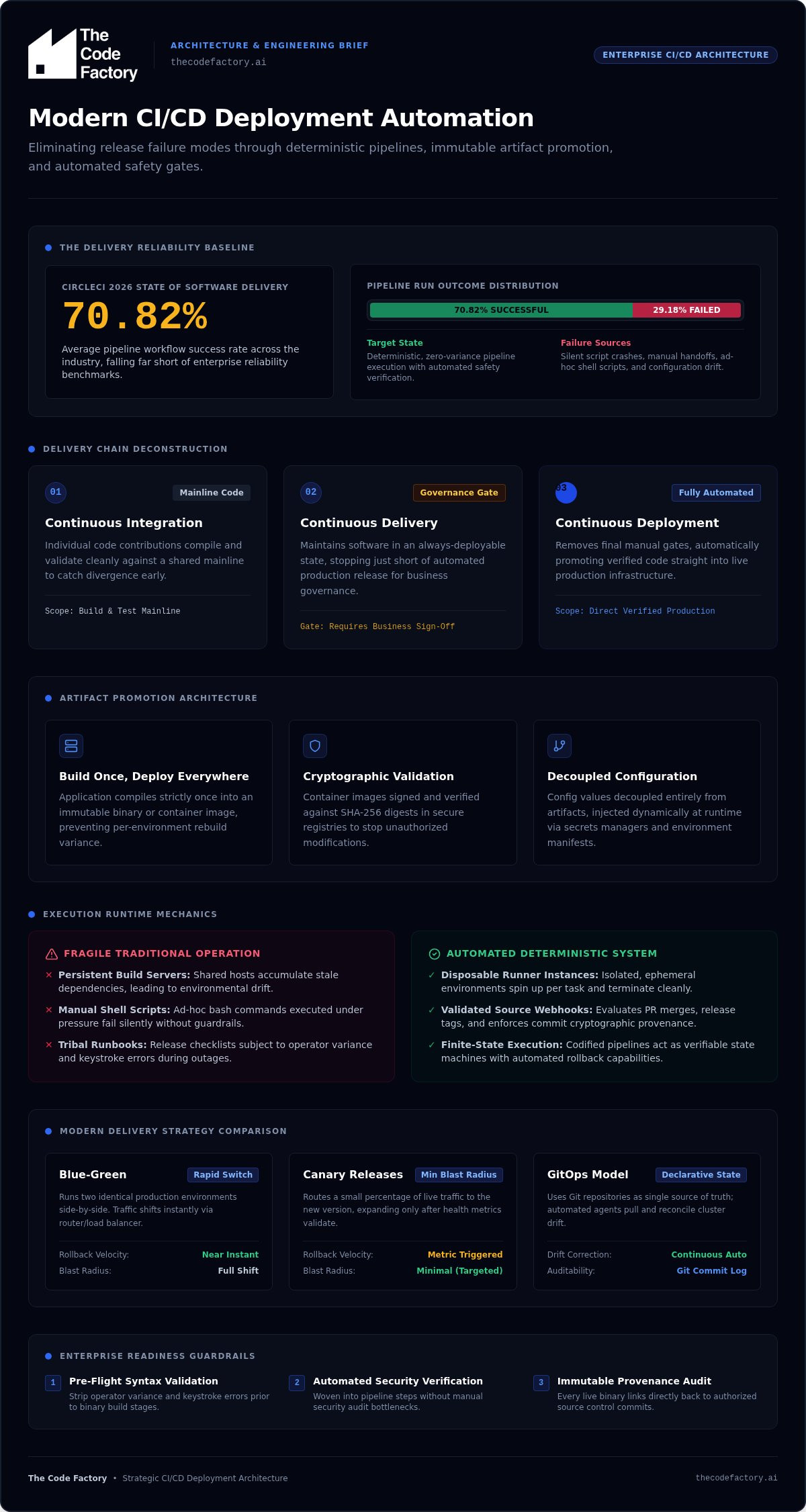
According to CircleCI’s 2026 State of Software Delivery report, the average pipeline workflow success rate sits at just 70.82%, falling far short of enterprise reliability benchmarks. It’s a frustrating reality most engineering leaders know intimately. You’ve likely watched brittle scripts fail silently during midnight releases, or suffered through tedious manual handoffs that stall deployment velocity just to keep environments stable. Accelerating your release cadence means very little when human intervention remains your primary defense against downtime. True CI/CD deployment automation isn’t about script velocity; it’s about embedding deterministic safety directly into the delivery pipeline.
This guide breaks down the core architecture, safety gates, and progressive delivery patterns required to eliminate release failures in modern production environments. You’ll learn how to establish a predictable, resilient path from commit to production, eliminate manual promotion steps, and weave automated security gates into your workflows without sacrificing speed. Here is your strategic framework for building dependable delivery systems in 2026.
Key Takeaways
- Replace fragile manual release checklists with systematic CI/CD deployment automation designed for deterministic, repeatable execution across every environment.
- Establish an unbroken delivery chain that converts source control commits into verified release artifacts through structured pipeline triggers and automated handoffs.
- Eliminate critical failure modes like silent script crashes and configuration drift by enforcing immutable infrastructure and removing ad-hoc operational changes.
- Evaluate the architectural trade-offs between Blue-Green, Canary, and GitOps delivery models to optimize rollback speed and minimize production blast radius.
- Harden automated release workflows with pre-flight checks and automated security verification to guarantee enterprise production readiness before traffic shifts.
What Is CI/CD Deployment Automation in Modern Software Delivery?
CI/CD deployment automation is the software-defined, systematic execution of building, testing, configuring, and releasing applications into target environments without manual intervention. For years, release management relied on static runbooks, tribal knowledge, and ad-hoc shell scripts executed under pressure. These manual practices invite configuration drift and keystroke errors that take critical systems offline. By standardizing application delivery through codified pipelines, enterprise engineering teams replace fragile human handoffs with deterministic, verifiable processes. While modern toolchains often promise friction-free releases out of the box, genuine deployment maturity depends on verification architecture rather than platform tooling alone. Grounded in established CI/CD engineering practices, automated delivery transforms high-risk deployments into routine, low-stress background events.
Deconstructing the Continuous Delivery Pipeline
Continuous Integration ensures that individual code contributions compile and validate cleanly against a shared mainline. From there, Continuous Delivery maintains software in an always-deployable state, stopping just short of automated production release to accommodate business governance. Continuous Deployment removes that final manual gate, automatically promoting verified code directly to live infrastructure.
To make this transition safe at scale, teams must implement strict artifact promotion:
- Build once, deploy everywhere: Applications compile once into an immutable binary or container image rather than rebuilding per environment.
- Cryptographic validation: Images are signed and verified against SHA-256 digests in secure container registries to prevent unauthorized modifications between environments.
- Decoupled configuration: Configuration values decouple entirely from application artifacts, injected dynamically at runtime via secrets managers and environment-specific manifests.
The Core Business and Technical Drivers for Automation
Manual intervention during high-stakes events, such as database schema migrations or stateful service updates, regularly introduces catastrophic operational failure. Enterprise CI/CD deployment automation mitigates this exposure through rigorous, programmatic guardrails:
- Eliminating execution error: Pre-flight checks and automated syntax verifications strip operator variance out of the release equation.
- Compressing recovery cycles: Deterministic state validation enables instantaneous automated rollbacks when an anomaly breaches predefined operational thresholds, drastically cutting mean time to recovery.
- Enforcing compliance and auditability: Every deployment stage generates an immutable, auditable log linking production binaries directly to source control commits, satisfying enterprise governance without manual paperwork.
Core Mechanics: How Automated Delivery Pipelines Function
A resilient pipeline operates as a deterministic finite-state machine. When teams treat automated delivery as a simple chain of bash commands, releases inevitably break under the weight of subtle environmental drift. Reliable CI/CD deployment automation relies on isolated, ephemeral execution environments. Instead of sharing persistent build servers that accumulate stale dependencies, modern pipelines spin up disposable runner instances that execute discrete tasks and terminate immediately. This clean-room approach prevents cross-build contamination and guarantees reproducible execution across every run.
Trigger Mechanics and Source Validation
Every secure deployment cycle begins at the source repository. Webhook listeners evaluate incoming events, differentiating between pull request merges, explicit release tags, and automated scheduling. Rather than triggering deployments blindly, enterprise pipelines validate commit provenance before taking action. Commits must carry verified cryptographic signatures, while semantic versioning tags govern the promotion path. This ensures that only authorized, peer-reviewed changes trigger downstream deployment workflows.
Artifact Generation and Environment Promotion
Compilation must occur strictly once in an enterprise delivery model. The pipeline compiles application code, bundles required dependencies, and packages an immutable container image or binary stamped with a unique cryptographic hash. That identical artifact then advances across development, staging, and production tiers. Configuration parameterization handles the differences between environments. Sensitive credentials and environment-specific endpoints pull dynamically from secure vault storage at runtime, ensuring that secrets never persist inside the built artifact.
Automated Verification and Smoke Testing Gates
Delivering code to target infrastructure represents only half the challenge; verification architecture guarantees its runtime viability. Before routing live production traffic, the pipeline runs automated smoke tests against private endpoints:
- Liveness and readiness probes: Confirm internal process health and verify network routes to downstream dependencies.
- Synthetic transactions: Simulate authenticated end-user interactions to validate critical database read and write paths.
- APM telemetry thresholds: Query telemetry platforms to catch latency regressions and error-rate spikes early.
If any verification check violates an established threshold, the pipeline halts progression and triggers an immediate rollback. Hardening these gates is essential to operational resilience, which is why engineering teams often commission a production readiness review to audit automated handoffs before critical software handles real enterprise traffic.
Critical Failure Modes in Deployment Automation and How to Avoid Them
Automating a broken deployment process merely accelerates the rate at which you break production. When CI/CD deployment automation relies on fragile shell scripts that mask exit codes, pipelines fail silently and report false positives. Teams celebrate a green pipeline indicator while downstream services crash unnoticed. When cascading failures happen, relying on blind roll-forwards intensifies downtime. Rushing unverified hotfixes into a destabilized cluster compounds the original bug with rushed architectural assumptions, extending mean time to recovery when an immediate, deterministic rollback was required. Following a structured production deployment checklist ensures that configuration values, dependencies, and recovery steps are verified before each release rather than left to memory under pressure.
Configuration Drift and State Discrepancies
Out-of-band manual interventions represent the single greatest threat to release predictability. When an engineer SSHs into a staging node to tweak an environment flag, that undocumented change breaks the environment parity your pipeline depends on. Resolving these deep structural misalignments often demands specialized software architecture consulting to reconcile environment designs and eliminate snowflake servers.
To eliminate configuration drift entirely, engineering organizations must enforce strict infrastructural discipline:
- Absolute write-access revocation: Strip direct modification access from human operators; all changes to computing, networking, and runtime parameters must originate as version-controlled commits.
- Reconciliation loops: Employ declarative agents that continuously poll runtime state against source definitions, automatically overriding unrecorded manual alterations.
- Identical infrastructure provisioning: Generate staging and production clusters from identical Infrastructure as Code templates, differing solely by capacity parameters rather than topology.
Data Layer Complications During Continuous Delivery
While stateless microservices scale and cycle with ease, the persistence layer does not tolerate careless automation. Destructive schema changes executed within active deployment pipelines easily trigger table locks that starve worker pools, back up queue depths, and halt transaction processing.
Safe data lifecycle automation requires disciplined patterns:
- Expand-and-contract schema design: Decouple database migrations from application releases. First, expand the schema to support old and new versions concurrently. Next, deploy the new binary. Finally, contract the database by removing legacy columns only after old instances terminate.
- Strict migration timeouts: Cap schema alteration runtimes to prevent long-running table locks from stalling active release jobs.
- Pre-flight data validation: Verify database replica lag, connection thresholds, and query compatibility before promoting workloads to new application targets.
Modern Deployment Strategies: Blue-Green, Canary, and GitOps Compared
Selecting a release pattern isn’t an arbitrary operational preference; it defines your blast radius when runtime defects bypass testing suites. Modern CI/CD deployment automation requires choosing between resource overhead and exposure risk. If your system cannot gracefully route traffic away from faulty versions in seconds, your automation strategy remains incomplete. Evaluating these patterns through their infrastructural trade-offs reveals the real cost of operational safety.
| Strategy | Infrastructure Footprint | Operational Complexity | Rollback Speed | Primary Trade-off |
|---|---|---|---|---|
| Rolling | Low (Shared capacity) | Low | Slow (Requires reverse step-down) | Versions coexist, risking state incompatibility |
| Blue-Green | High (200% capacity during cutover) | Moderate | Instantaneous (Router DNS flip) | High idle infrastructure cost; data sync challenges |
| Canary | Low to Moderate (Targeted capacity) | High (Requires dynamic routing) | Fast (Traffic drain from canary pods) | Demands granular telemetry and metric baselines |
Blue-Green Deployments for Instant Cutover
Blue-green architectures eliminate downtime by running two identical production environments side by side. One environment serves live traffic while the other hosts the newly deployed version. Once the target passes health probes, your ingress router swings all traffic simultaneously. While rollback requires only switching the router back, maintaining duplicate infrastructure doubles your compute costs during cutovers and complicates shared cache management.
Canary Releases and Progressive Traffic Routing
Canary rollouts expose only a tiny fraction of live users to the new version, such as 2% or 5%, using intelligent ingress controllers or service meshes. The pipeline continuously monitors operational metrics, including HTTP 5xx rates and p99 latency. If telemetry detects an anomaly depleting your error budget, automated safety gates instantly terminate the canary instances and redirect users to the baseline build.
GitOps and Declarative Infrastructure Syncing
GitOps shifts pipeline dynamics from push models to pull-based synchronization. In-cluster reconciliation agents monitor version-controlled repositories, reconciling the live cluster state with declarative manifests. This setup eliminates inbound CI access to production clusters, systematically corrects drift, and makes rollbacks as simple as running git revert on the mainline branch.
Selecting and wiring the right release topology requires rigorous architectural alignment. If your team needs to upgrade legacy pipelines into secure, automated delivery paths, engage The Code Factory for cloud infrastructure configuration and build a delivery model engineered for resilience.
Hardening Automated Deployments for Enterprise Production Readiness
Fast delivery pipelines quickly turn into massive security liabilities when governance takes a backseat to velocity. Long-lived cloud access keys stored inside runner configuration files create severe attack vectors across your release cycle. True CI/CD deployment automation requires treating the delivery pipeline as mission-critical infrastructure. Adopting formal protocols for securing CI/CD pipelines eliminates static credentials, replacing them with dynamic, short-lived tokens federated through OpenID Connect. Before any deployment worker initiates changes, strict pre-flight gates must verify runtime environments, cluster quotas, and TLS certificate validities.
Security Gates and Supply Chain Integrity
Modern compliance demands verifying every dependency before code advances to production. Integrating automated security verification directly into release workflows preserves release cadence while enforcing enterprise governance:
- Supply chain provenance: Generate and inspect cryptographic Software Bills of Materials (SBOMs) to block malicious packages before packaging concludes.
- Federated machine identity: Leverage short-lived OIDC tokens that request targeted cloud permissions on demand, eliminating permanent administrative credentials on deployment runners.
- Pipeline configuration protection: Restrict pipeline definition files through multi-party branch protection rules, ensuring rogue build steps can’t slip into deployment jobs undetected.
Production Readiness Verification and Architectural Rigor
Automated delivery works only when your production architecture is structurally sound enough to support it. Implementing robust CI/CD deployment automation won’t save a system built on fragile downstream dependencies that fail during network partitions. Release paths must prove their operational resilience by validating automated rollbacks under simulated failure conditions during staging verifications.
Before releasing mission-critical updates to live users, organizations should conduct a formal production readiness review to audit failure modes, telemetry coverage, and automated rollback triggers. The engineering team at The Code Factory evaluates existing delivery paths, implements security hardening across cloud environments, and deploys resilient CI/CD deployment pipelines engineered to survive real-world scale.
Architecting Resilient Release Engineering for 2026
Flawless software delivery isn’t the byproduct of good fortune; it’s the direct outcome of disciplined verification architecture. Eliminating release failures requires moving beyond brittle shell scripts, decoupling database changes through backward-compatible patterns, and enforcing automated rollback gates driven by live operational telemetry. When you treat CI/CD deployment automation as foundational infrastructure rather than developer convenience, production deployments transform into predictable, low-stress milestones.
Bridging the gap between rapid feature velocity and uncompromising operational stability demands deep architectural rigor. As a specialized engineering practice focused on enterprise production readiness reviews, The Code Factory provides end-to-end expertise in cloud configuration, security hardening, and resilient pipeline delivery. We help engineering leaders replace manual release friction with deterministic, auditable workflows. Explore CI/CD pipeline deployment and infrastructure optimization services to harden your release paths and deliver mission-critical software with complete confidence.
Frequently Asked Questions
What is the primary difference between continuous delivery and continuous deployment?
Continuous delivery automates the release preparation process up to staging, requiring explicit manual sign-off before promoting changes into live environments. Continuous deployment removes that manual approval stage completely, automatically releasing every validated commit directly to production infrastructure. While continuous delivery provides business stakeholders with final governance control over deployment timing, continuous deployment relies entirely on automated testing suites and telemetry health gates to safeguard release integrity without operational friction.
How does CI/CD deployment automation prevent production downtime?
CI/CD deployment automation eliminates human keyboard errors by executing deterministic, version-controlled delivery workflows across target clusters. Pipelines enforce pre-flight environment checks, run automated synthetic transactions against isolated instances, and immediately revert changes if error rates spike. By removing manual command-line interventions and decoupling application rollouts from state changes, automated systems ensure that failed releases abort cleanly before impacting end users or destabilizing core service availability.
Can legacy monoliths utilize modern automated deployment pipelines?
Yes, legacy monoliths can leverage modern automated delivery pipelines by packaging applications into standardized containers or machine images. While monolithic architectures lack microservice granularity, pipelines can still orchestrate automated build compilation, dependency security checks, and rolling instance refreshes behind load balancers. Successful implementation requires decoupling database schema modifications from binary deployment steps and establishing strict health-check timeouts to handle slower application startup sequences.
How are database migrations handled during zero-downtime automated deployments?
Zero-downtime automated deployments handle database changes by implementing the expand-and-contract pattern across separate pipeline stages. Engineers write non-breaking migrations that add new nullable columns or tables without altering existing schemas, allowing active and incoming application versions to query the database simultaneously. Once the pipeline completes traffic migration to the new release and confirms operational stability, a subsequent automated job safely removes legacy tables and deprecated schema objects.
What security risks emerge when automating deployment pipelines to production?
Automating delivery workflows introduces critical attack surfaces, particularly through static cloud credentials embedded in runner configurations and vulnerable third-party dependencies. If an attacker compromises an upstream package or modifies an insecure pipeline script, the automated runner could deploy malicious payloads directly to production. Mitigating these risks requires using short-lived OpenID Connect authentication tokens, enforcing immutable software bills of materials, and requiring multi-party branch approvals for pipeline definition updates.
Which deployment strategy is best: blue-green or canary releases?
The ideal choice depends on your infrastructure budget, traffic volume, and telemetry maturity. Blue-green deployments excel for stateful services or mission-critical applications that require instant, all-at-once rollback capabilities, though running parallel clusters doubles infrastructure compute costs during releases. Canary rollouts work best for high-traffic web applications with mature observability, allowing teams to expose minimal user percentages to new versions and monitor telemetry metrics before committing to full fleet deployment.
How do engineering teams maintain environment parity between staging and production?
Engineering teams maintain environment parity by declaring all infrastructure, runtime variables, and networking topologies as version-controlled Infrastructure as Code. Staging and production tiers must provision from identical code templates, differing strictly in operational capacity rather than structural design. Pairing this discipline with automated drift detection tools and revoking direct human write access prevents snowflake configurations from undermining your enterprise CI/CD deployment automation pipeline.
