

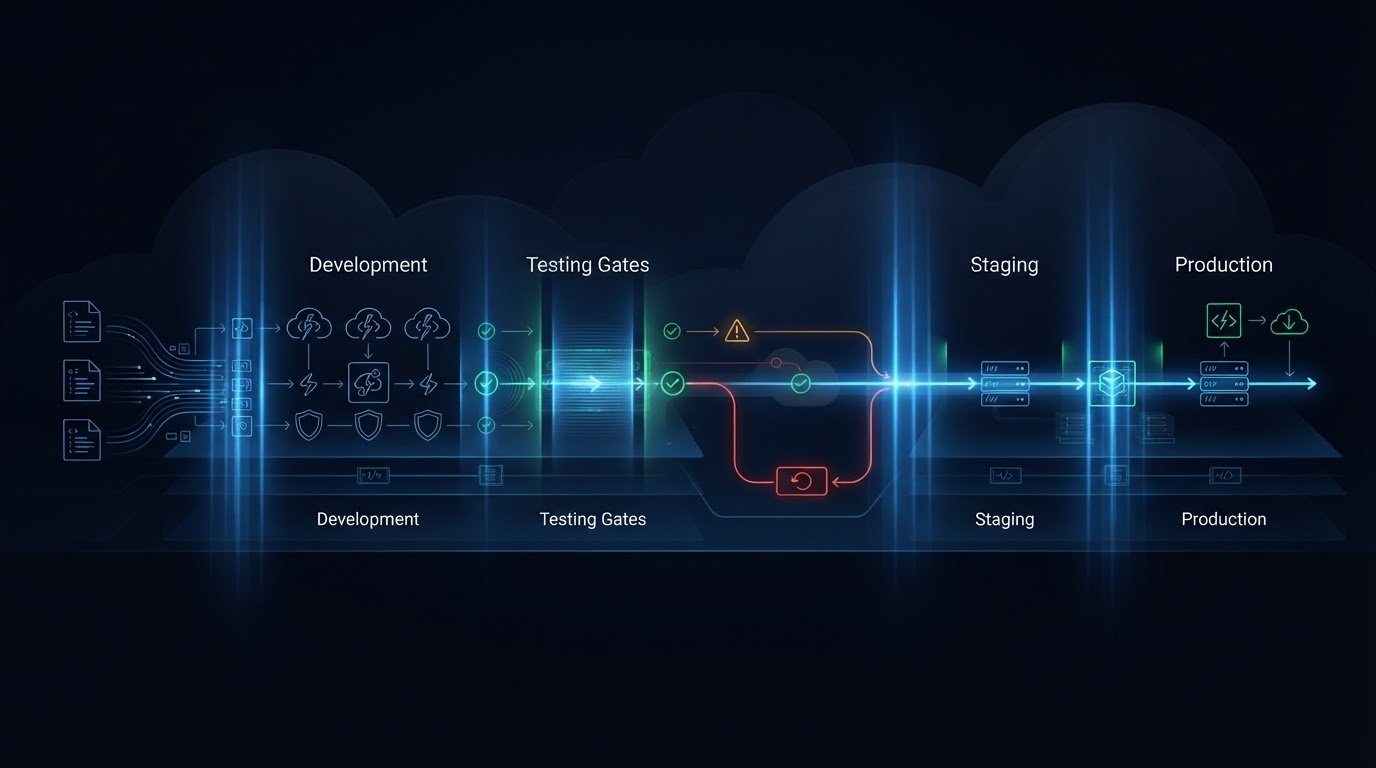
What if a green build still leaves production exposed? A pipeline can pass every code check and still break an event trigger, grant excessive permissions, or change infrastructure in a way that disrupts live traffic. That’s why CI/CD for serverless applications must validate the complete change, not treat cloud functions like conventional servers.
Serverless delivery can move quickly, but speed alone doesn’t make releases safe. Your pipeline needs to account for function code, event sources, permissions, and infrastructure definitions together, with controls that make changes repeatable and recoverable. This guide explains how to design that workflow without adding complexity for its own sake.
You’ll learn which serverless-specific stages belong in a CI/CD pipeline, how to choose tools and deployment patterns for your architecture, and where to place testing, security checks, and environment controls. We’ll also cover deployment verification, monitoring, and rollback planning, so each release has a clear path from change to production and a defined response if something goes wrong.
Key Takeaways
- Build CI/CD for serverless applications as a staged release path, separating rapid developer feedback from the controls required before production promotion.
- Match deployment patterns to release risk by weighing traffic exposure, rollback behavior, observability, and operational complexity.
- Choose tests that target distinct failure modes, from isolated function logic to integration contracts and post-deployment behavior.
- Check dependencies, secrets, identity permissions, and infrastructure changes before they become production risks.
- Assign clear ownership for approvals, pipeline maintenance, alerts, and recovery, then use delivery and reliability signals to refine the process.
Why CI/CD for serverless applications needs an application-level release process
Serverless removes the need to manage servers. It doesn’t remove the work of engineering a safe release. A function change can depend on an updated permission, a modified event source, or a revised infrastructure definition. Deploying only the code can leave the application inconsistent, even when the function itself passes its tests.
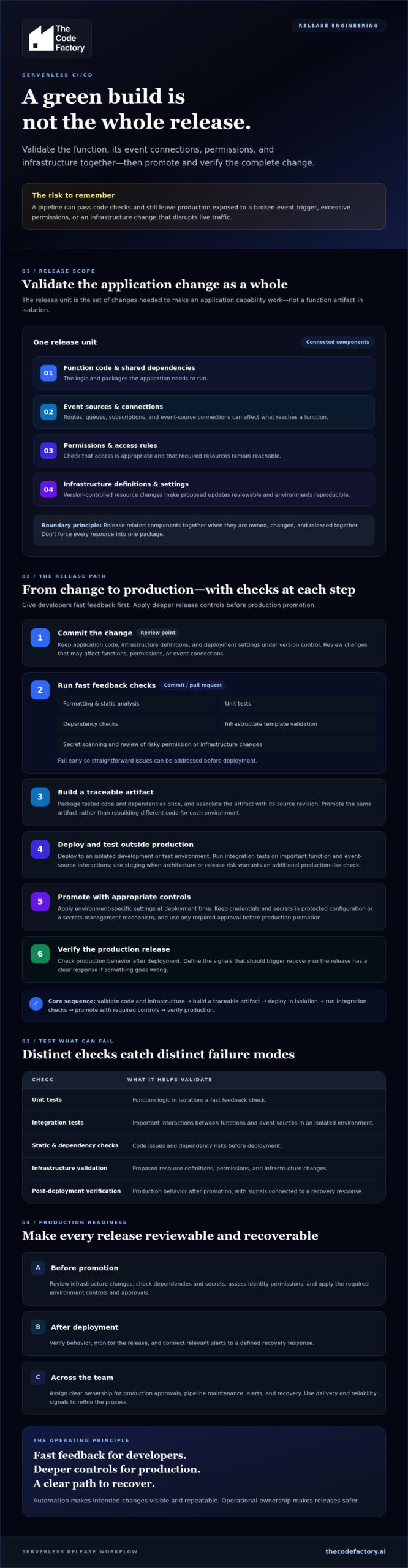
A serverless release pipeline is an automated workflow that validates and deploys application code together with the configuration and cloud resources it needs to operate. This extends the principles of CI/CD beyond building and shipping code. The release unit is the set of changes required to make an application capability work, rather than a function artifact in isolation.
That set may include function code, shared dependencies, API routes, queues, permissions, and event-source connections. A change to a queue subscription, for example, can affect whether a function receives the right events. A permission change can prevent it from accessing a required resource. CI/CD for serverless applications should validate related changes as a whole and make them traceable, reviewable, and recoverable.
What belongs in a serverless application deployment unit?
The right boundary depends on your architecture. A small service might package a function with its route and access rules. A larger system may deploy shared dependencies or event configuration separately. Infrastructure as code describes resources and settings in version-controlled files, so teams can review proposed changes and reproduce environments. Don’t force every resource into one package. Define boundaries around how components are owned, changed, and released together.
What changes when teams automate serverless releases?
Manual console edits can solve an immediate problem, but they’re easy to leave undocumented or reproduce inconsistently across environments. A version-controlled workflow makes intended changes visible, runs checks before deployment, and records what was released. It also gives teams a way to identify configuration drift and investigate failures. For broader launch controls, see the production readiness review protocol.
Automation doesn’t replace operational ownership. Teams still need to decide who approves production changes, how to verify event integrations and permissions, and which signals should trigger recovery. A disciplined pipeline connects these decisions to deployment rather than assuming serverless infrastructure makes them unnecessary.
How to build a CI/CD pipeline for serverless applications, step by step
A reliable pipeline gives developers quick feedback, then applies deeper controls before production promotion. Keep those purposes distinct: fast checks help catch routine defects early, while release gates examine whether the complete change is safe to deploy.
At minimum, a responsible serverless pipeline commits and validates code and infrastructure, builds a traceable artifact, deploys it to an isolated environment, runs integration checks, promotes it through any required approval, and verifies the production release.
- Commit the change. Keep application code, infrastructure definitions, and deployment settings under version control. A pull request provides a review point for changes that may affect functions, permissions, or event connections.
- Run fast feedback checks. On each commit or pull request, run formatting, static analysis, unit tests, dependency checks, and infrastructure template validation. Scan for exposed secrets and flag risky permission or infrastructure changes. Fail early so developers can address straightforward issues before deployment.
- Build a traceable artifact. Package the tested code and dependencies once, and associate the artifact with its source revision. Promoting the same artifact helps avoid rebuilding different code for each environment.
- Deploy and test outside production. Deploy to an isolated development or test environment, then run integration tests against important function and event-source interactions. Use staging when the architecture or release risk warrants an additional production-like check.
- Promote with appropriate controls. Apply environment-specific settings at deployment time. Keep credentials and secrets in protected configuration or a secrets-management mechanism, not in source files or copied environment-specific code. Add human approval gates when organizational risk or compliance requirements call for review.
- Verify after deployment. Check that functions execute, expected events are processed, and application health signals remain acceptable. Make the result visible to the team and define how to respond if verification fails.
Which checks should run before deployment?
Use quick code and unit checks to give developers fast feedback, then make security and integration checks promotion gates according to risk. Validate dependencies, secrets, identity permissions, and infrastructure changes alongside the function package. An integration test can catch a mismatch between a function and its event source that an isolated unit test won’t detect. For broader delivery context, thoughtworks.com offers useful material on software delivery practices.
How should releases move between environments?
Keep development, test, staging, and production isolated where your application and team require them. Promote the same built artifact through the workflow, changing only the approved environment configuration. Don’t copy secrets into source files or embed them in artifacts. These controls make CI/CD for serverless applications repeatable without requiring the same approval burden for every change.
Teams dealing with complex integrations or security requirements may benefit from expert help implementing or reviewing serverless CI/CD pipelines.
Which serverless deployment strategy fits your release risk?
Choose a deployment strategy based on the consequences of a faulty release, not just how quickly the platform can publish a function. An all-at-once rollout replaces the active version in one step. Gradual traffic shifting exposes a new version to a portion of traffic before increasing its share. Version-based patterns keep releases identifiable and can let teams direct or restore traffic between versions. The right approach depends on your architecture, the impact of failure, and the signals available to detect problems.
| Strategy | Risk exposure | Observability needs | Rollback behavior | Operational complexity |
|---|---|---|---|---|
| All-at-once | New version affects all relevant traffic immediately. | Strong baseline monitoring and prompt failure detection. | Restore the prior version or configuration. Recovery speed depends on automation and dependencies. | Lower rollout coordination, but errors can have wider impact. |
| Gradual traffic shifting | Limits initial exposure while traffic increases in stages. | Signals must distinguish new-version behavior and support promotion or pause decisions. | Shift traffic back if predefined health checks fail. | More configuration, monitoring, and release coordination. |
| Version-based release | Impact depends on how traffic or event sources are assigned to versions. | Track version-level health and confirm routing behaves as intended. | Direct traffic to a known-good version where the architecture supports it. | Requires clear version and routing management. |
These patterns aren’t interchangeable guarantees. Supported rollout mechanisms vary by cloud platform and deployment tooling, so verify current capabilities and constraints before designing around a specific approach. A useful release decision also considers the discipline of incremental delivery, discussed by thoughtworks.com. No rollout pattern substitutes for functional tests, production monitoring, and a recovery process the team has exercised.
When is an all-at-once serverless deployment reasonable?
An all-at-once release may suit a contained, lower-risk change when automated tests cover the affected behavior and the team has a clear recovery path. Reassess that choice if the release alters shared dependencies, permissions, or event contracts, since these changes can affect other functions or downstream consumers. Minimal server management doesn’t mean minimal release risk. Review the full change before deciding that a single-step rollout is appropriate.
When should teams use gradual traffic shifting?
Use staged exposure when limiting the initial impact of a defect matters and the service can route traffic between versions. Define health and business signals in advance, and automate pausing or reversing promotion when those signals indicate trouble. Gradual rollout requires suitable platform support and reliable rollback automation. For related threat controls, see enterprise CI/CD pipeline security guidance.
How to test, secure, and roll back serverless deployments
Production safeguards should address more than whether a function compiles. CI/CD for serverless applications needs checks for code behavior, dependencies, secrets, identity permissions, and infrastructure changes, alongside a recovery plan for the full release. Tests reveal different failure modes, so choose them to match how functions interact with APIs, event sources, and other services.
- Unit tests: Catch errors in isolated function logic, such as incorrect input handling or business rules.
- Integration tests: Expose failures between functions and connected services, queues, APIs, or event sources.
- Contract tests: Detect incompatible changes to event schemas or API expectations between producers and consumers.
- Post-deployment tests: Confirm the deployed application responds and its critical workflows operate as expected.
Run security checks against dependency changes, accidental secret exposure, overly broad identity permissions, and infrastructure modifications. Review proposed changes as a set. A secure function package can still be undermined by an unsafe permission update or a misconfigured event connection.
How should a serverless pipeline test event-driven behavior?
Test function logic independently, then exercise critical integrations with representative event payloads. Include retries, duplicate delivery, timeouts, and failure handling when those conditions apply to the architecture. If a change modifies an event schema or API contract, verify that existing consumers remain compatible or are updated in coordination. This helps catch failures that unit tests alone can’t reveal.
What makes rollback and recovery reliable?
Define who or what initiates recovery, which service-health or application-level signals prompt action, and how to restore the last known working release. Set triggers according to the system’s behavior rather than applying universal thresholds. Plan for infrastructure and configuration changes as well as function code, since reverting code alone may not restore dependencies or permissions to a working state.
Before promotion, use this concise safeguard checklist:
- Tests cover function logic, critical integrations, contracts, and post-deployment behavior.
- Dependency, secret, permission, and infrastructure checks have passed review.
- Recovery ownership, triggers, and restoration steps are documented.
- Recovery has been practiced in a suitable non-production environment, and remaining manual steps are recorded.
A practiced recovery path matters. A rollback that has never been tested may conceal missing configuration, dependencies, or access. If your release controls need hardening, review your serverless CI/CD pipeline with The Code Factory.
How to operationalize serverless CI/CD for production
A pipeline needs ongoing ownership, not just an initial implementation. Assign responsibility for maintaining pipeline definitions and dependencies, approving production releases, reviewing alerts, and making recovery decisions. These responsibilities can sit with different people, but handoffs should be explicit. Otherwise, an automated deployment may succeed while no one knows who should act on a warning or update a failing check.
Operationalize CI/CD for serverless applications by treating pipeline health as part of the service. Review whether permissions still match the deployment process, dependencies remain maintained, tests cover current integrations, and failed releases reveal recurring patterns. As architecture changes, revise the workflow rather than letting old assumptions become invisible constraints.
What should teams monitor after a serverless release?
Pair platform metrics and logs with workload outcomes. Execution errors, latency, and resource use can help explain what a function is doing. Application-level signals show whether the underlying task is succeeding. For an event-driven workflow, check whether expected events are processed and downstream work completes, not just whether the function was invoked.
An alert needs an owner and an action. Document who receives it, what they should investigate, and how to escalate or recover. After a failed deployment or incident, review the evidence with the people responsible for the pipeline and service. Use recurring failure patterns to refine tests, promotion gates, alert routing, and recovery procedures. The objective is a workflow that learns from production, not one that merely records failures.
When is expert CI/CD implementation support useful?
Consider an engineering review when cloud configuration is difficult to manage, security requirements create uncertainty, or releases remain unreliable despite automation. These conditions can point to gaps across the pipeline, application architecture, permissions, or production readiness. A structured review can help teams identify missing controls or safeguards that no longer reflect how the system operates.
Specialist support may also be useful when internal capacity is stretched and the team needs to implement or improve a production-grade delivery workflow. The Code Factory provides CI/CD deployment pipelines, cloud infrastructure configuration, security hardening, architecture consulting, and production readiness reviews for teams addressing these engineering challenges.
Discuss CI/CD and infrastructure engineering support for your serverless delivery workflow.
Make every serverless release deliberate
Reliable delivery depends on treating each release as an application change, not just a function update. CI/CD for serverless applications should validate code, configuration, permissions, and event integrations together, then move changes through checks and deployment controls suited to their risk.
The work continues after deployment. Clear ownership, useful service and application signals, and a practiced recovery process help teams respond when production behavior differs from expectations. Review pipeline controls as architecture evolves, and use release failures to strengthen tests and safeguards.
When complex cloud configuration, security requirements, or unreliable releases strain your team’s capacity, The Code Factory can help with CI/CD deployment pipeline implementation, cloud infrastructure configuration, security hardening, production readiness reviews, and code remediation. Discuss CI/CD and infrastructure engineering support to identify practical next steps for your delivery workflow.
Build the controls that fit your system, improve them as it grows, and release with greater confidence.
Frequently Asked Questions
What is CI/CD for serverless applications?
CI/CD for serverless applications is an automated process that validates and releases function code alongside the configuration and cloud resources it depends on. Unlike a code-only deployment, it accounts for permissions, routes, and event connections that determine whether a function works in production. The pipeline also provides traceability, environment controls, and post-release verification, helping teams identify what changed and respond if application behavior differs from expectations.
How do you build a CI/CD pipeline for a serverless application?
Build the pipeline as a sequence of validation, deployment, and verification stages. Start with code review, formatting, static analysis, unit tests, dependency checks, and infrastructure validation. Package a traceable artifact, deploy it to an isolated environment, and test important integrations before production promotion. Keep secrets outside source code, set approval gates according to release risk, and verify service and application behavior after deployment. Document recovery responsibilities before relying on automation.
Which CI/CD tools are best for serverless applications?
The best tools fit your cloud architecture, infrastructure-as-code approach, team skills, and security requirements. Evaluate whether a tool can build and test your runtime, validate infrastructure definitions, protect deployment credentials, and promote consistent artifacts across environments. Also assess permission controls, auditability, integration support, and how releases can be reversed. Avoid choosing based on popularity alone. Confirm compatibility with your actual platform and operational model.
Do serverless applications need separate staging and production environments?
Not every application requires a dedicated staging environment, but production should be isolated from development and test activity. Use staging when realistic end-to-end checks, release approvals, or the consequences of a failed change justify the added environment. Keep configuration and access separated while promoting the same tested artifact. For smaller systems, a carefully controlled test environment and strong production verification may be sufficient, depending on architecture and organizational risk.
How do you test serverless functions before deployment?
Test functions at several levels because each catches a different class of defect. Unit tests check isolated logic. Integration tests exercise connections to APIs, queues, and other services. Contract tests detect incompatible event or API changes. Use representative payloads and test relevant retry, duplicate-delivery, timeout, and error-handling behavior. Then run post-deployment checks to confirm the release works in its target environment. Match coverage to the function’s role and failure impact.
How can you roll back a serverless deployment?
Prepare rollback before release by identifying the last known working version, the signals that warrant recovery, and who can initiate it. Restore related configuration and infrastructure changes too, since reverting function code alone may not repair changed permissions or event connections. Automate the steps that can be safely automated, and rehearse recovery in a suitable non-production environment. Record any manual actions and verify the application’s behavior after restoration.
How do you secure a serverless CI/CD pipeline?
Protect the pipeline’s access to source code, build artifacts, deployment credentials, and cloud resources. Store secrets in a protected secrets-management mechanism rather than source files, restrict deployment identities to necessary permissions, and review permission changes with infrastructure updates. Scan dependencies and code, validate infrastructure definitions, and control who can approve or promote production releases. Keep pipeline components maintained, log changes, and review failed runs for signs of misconfiguration or unauthorized activity.
