


A clean scan isn’t proof that enterprise software is ready for production. Enterprise code review services should do more than flag suspicious lines. They should connect code-level defects to security exposure, architectural weaknesses, and operational risk. If a provider’s scope is vague, proposals are hard to compare, and a list of findings may leave your engineers unsure what matters most or how to address it.
That uncertainty is understandable. Internal teams may not have capacity for a thorough independent review, especially when delivery pressure competes with remediation work. Automated scanning can identify patterns quickly, but it doesn’t replace informed judgment about how a system behaves in its production context.
This article explains what a meaningful enterprise review should assess, how human-led review differs from automated scanning, and what evidence to request from prospective providers. You’ll also learn how to compare scope, risk prioritization, and remediation capability, so you can choose support that reflects your organization’s production risks rather than simply the longest checklist.
Key Takeaways
- Define review scope around your system’s criticality and business risks, not a generic checklist.
- Compare enterprise code review services by reviewer expertise, supporting evidence, deliverables, and follow-up capability.
- Choose manual review, automated tools, or a blended approach based on the risks and review capacity you need to address.
- Prepare engineering, security, and product stakeholders to provide context and take ownership of relevant findings.
- Use review results to decide whether your team can remediate issues internally or needs additional engineering support.
What enterprise code review services assess beyond code style
Enterprise code review services assess whether software is correct, maintainable, secure, and suitable for its intended production environment. The goal isn’t simply to enforce formatting conventions. A reviewer considers how the code behaves, how safely a team can change it, and what could happen if a weakness reaches a live system. The fundamentals of code review provide a useful baseline, but enterprise engagements must also account for system dependencies and business context.
Scope can range from a focused examination of a high-risk component to a broader engineering assessment that includes architecture, scalability, cloud configuration, or deployment practices. A narrow review can answer a specific question. A broader assessment can reveal how concerns interact across system boundaries. Neither is automatically better. Match the scope to the risks you need to understand and the decisions the review should inform.
What can an enterprise code review include?
Reviewers may examine correctness, maintainability, security, and performance risks in selected code paths. They can trace how data enters and moves through a system, how components communicate, and where the application relies on external libraries or services. For example, a dependency issue may be more significant on a critical request path than in an isolated internal tool.
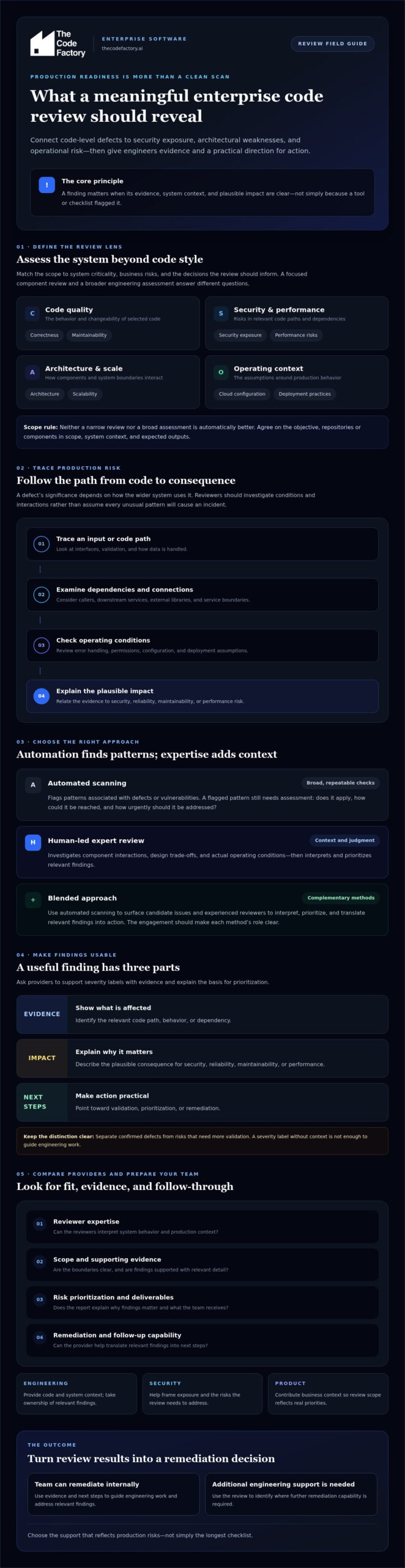
Enterprise systems rarely operate as standalone code. Interfaces, dependencies, deployment assumptions, and operational constraints can all change the significance of a defect. Before access or review begins, agree on the objective, repositories or components in scope, relevant system context, and expected outputs. A useful finding should explain:
- Evidence: the affected code path, behavior, or dependency.
- Impact: the plausible consequence for security, reliability, maintainability, or performance.
- Next steps: a practical direction for validation, prioritization, or remediation.
Code review services versus automated code scanning
Static analysis tools scan code consistently and flag patterns associated with defects or vulnerabilities. This makes them useful for broad, repeatable checks. But a flagged pattern isn’t automatically a meaningful production risk. Teams still need to determine whether it applies to their system, how it could be reached, and how urgently it should be addressed.
Expert review adds context. A reviewer can investigate interactions between components, assess design trade-offs, and explain why a finding matters under the system’s actual operating conditions. The approaches are complementary: automated scanning can surface candidate issues, while experienced reviewers interpret, prioritize, and translate relevant findings into action. A clear engagement explains how each method contributes instead of treating scan output as a complete assessment.
How enterprise code reviews find risks that matter in production
A code defect becomes a production risk through its interactions with the wider system. Reviewers need to connect what a function does with the services that call it, the data it handles, the dependencies it relies on, and the way it is deployed. Enterprise code review services are most useful when review questions reflect system criticality and stated business risks, rather than treating every file or finding as equally consequential.
For a customer-facing service, reviewers might examine whether an error path exposes sensitive information or causes a request to fail across dependent components. For a shared library, they may ask how an unsafe change could affect multiple applications. The goal is to trace plausible consequences, not assume that every unusual pattern will cause an incident.
From code paths to system-level failure modes
Isolated snippets can hide interactions. A reviewer may follow an input from an interface through validation and data handling, then examine how errors are managed and how downstream services or dependencies respond. Deployment settings matter too: code that appears safe in isolation may behave differently when permissions, configuration, or service boundaries are considered.
Findings should distinguish confirmed defects from risks that need more validation. A useful report identifies the relevant code path or behavior, explains the conditions under which the issue could matter, and recommends a practical next step. Ask providers to support severity labels with evidence and explain the basis for prioritization. A label without context isn’t enough to guide engineering work.
Where security and architecture review intersect
Security questions often depend on system design. Reviewers can examine access control, sensitive-data handling, and trust boundaries, where data or requests cross between users, services, or external dependencies. OWASP guidance and CWE classifications can help teams name and organize common weakness types, but referencing either doesn’t prove that a specific vulnerability exists. The reviewer should show how the observed behavior creates risk in the system under review.
Broader design questions may call for software architecture consulting, particularly when a code-level issue points to concerns spanning services, scalability, or deployment. The same principle applies to secure delivery practices: Cloud.gov describes an approach to secure development with Cloud.gov that brings together code review, pipelines, and artifact management. This example shows why review findings should be interpreted alongside the surrounding engineering workflow.
Once evidence and system impact are clear, teams can decide whether to validate, prioritize, or remediate each issue. Organizations seeking help connecting review findings with production readiness or code remediation can explore production readiness and remediation support.
How to compare enterprise code review providers and approaches
Provider proposals are difficult to compare when each defines “review” differently. Before weighing cost or timelines, create a shared scorecard for scope, reviewer expertise, evidence standards, deliverables, and follow-up. Enterprise code review services can range from automated analysis to expert-led investigation or a blended engagement. The right fit depends on your system’s risks and the work your team needs help completing.
Manual review gives experts room to investigate logic, design choices, and system context. Automated tools apply repeatable checks across code and flag patterns for further investigation. A blended approach uses automation to surface candidates and human judgment to assess relevance and priority. No approach is universally best. Ask providers what their method can identify, what it may miss, and how findings are validated.
Questions to ask before selecting a review service
Use consistent questions in provider discussions so differences are visible, not buried in proposal language:
- Scope: Which repositories, components, environments, and risk areas are included? What is explicitly excluded?
- Expertise: Who performs the review, and how does their experience relate to your architecture, technology, and production risks?
- Information handling: What access controls and confidentiality practices apply to sensitive code, credentials, and supporting materials?
- Evidence and outputs: Can the provider describe a sample report structure and explain how each finding is supported?
- Follow-up: Does the engagement end with a report, or can the provider help validate fixes or perform code remediation?
Also ask how findings are ranked. A useful priority reflects likelihood, potential impact, and system context, rather than relying on a severity label alone. Confirm that the proposed deliverables will help your engineers decide what to address first.
How to assess findings and remediation support
Look for findings that give your team enough detail to act: reproduction context where appropriate, the affected component, an explanation of potential impact, and a recommended next step. Ask how the review team handles duplicate findings, disputed conclusions, and validation after a fix. These processes reduce ambiguity and help prevent review output from becoming a backlog of unverified warnings.
A report-only engagement may suit a team with the capacity and expertise to investigate and resolve issues internally. If specialist engineering support is needed, clarify whether remediation is included or separately scoped. Prioritizing fixes alongside accumulated technical debt remediation can help teams direct effort toward risks with the greatest production relevance.
How to prepare your team and turn review findings into action
A review creates value only if the right people can provide context and act on the results. Before engaging enterprise code review services, define the decision the review should support, such as assessing a production release, investigating a security concern, or understanding risks in a critical component. Then agree on scope, prepare access, review findings with relevant stakeholders, and assign owners for follow-up.
What to prepare before an external code review
Give reviewers enough context to understand the system without directing their conclusions. Document the system’s purpose, architecture, known constraints, and review objectives. Agree which repositories and environments are included, how access will be granted, and what data-handling procedures apply. Identify technical contacts who can clarify expected behavior and answer questions while preserving the reviewer’s independence.
Include engineering, security, and product stakeholders where their knowledge is relevant. Engineering can explain implementation and dependencies; security can clarify threat concerns; product can identify user or release impact. Keep the review focused by routing questions through designated contacts and recording assumptions that affect the assessment.
How to move from findings to verified remediation
Once findings are presented, don’t treat them as a flat checklist. For each material issue, record an accountable owner, the decision taken, and the next action. Consider risk alongside dependencies, remediation effort, and release impact. A lower-severity issue that blocks a critical workflow may need attention before a more visible but isolated concern. If a risk is accepted or deferred, document the rationale and revisit it through normal delivery governance.
Verify fixes with tests suited to the affected behavior, then check that the change resolves the issue without introducing regressions. Where a finding touches deployment or release controls, connect remediation to securing CI/CD pipelines. Track unresolved risks and accepted fixes alongside ordinary engineering work so they remain visible beyond the review meeting.
If your team needs help turning review findings into code changes or stronger delivery controls, explore code remediation and CI/CD pipeline support.
When enterprise code review services should lead to remediation
A review is a starting point, not a substitute for engineering work. Internal teams may be well placed to remediate when findings are clear, the necessary skills are available, and planned work can fit alongside delivery commitments. Specialist support can help when capacity is constrained, findings remain difficult to prioritize, or recurring defects and production concerns call for an independent technical perspective.
Match the engagement to the problem. A discrete defect may call for focused code remediation; findings that span services or affect growth may point to architecture or scalability concerns. Issues tied to deployment configuration may require attention to cloud infrastructure or delivery pipelines. Treating every finding as a code-only fix can leave the underlying engineering risk unresolved.
Signs your organization may need specialist review support
Consider additional expertise when your team can’t confidently determine which findings matter most, remediation work repeatedly slips behind other priorities, or unresolved concerns continue to affect production readiness. External review can also add an independent perspective when internal teams are too close to a system’s design decisions. Define the specific outcome you need before selecting support, rather than choosing a broad service label without an agreed scope.
How The Code Factory can support enterprise engineering
The Code Factory offers production readiness reviews, code remediation, and optimisation. Where findings extend beyond individual code changes, its services also include architecture and scalability consulting, cloud infrastructure configuration, security hardening, and CI/CD deployment pipelines. The appropriate scope depends on the engineering issue: a finding that points to an architecture constraint may require a different response from a localized code defect.
Clarify the findings you want addressed, the systems involved, and whether you need assessment, remediation, or related engineering work. Enterprise code review services are most useful when the review and follow-through align with the risks your organization needs to manage. Discuss your enterprise code review needs with The Code Factory to explore a suitable next step.
Turn review findings into stronger engineering decisions
Effective enterprise code review services do more than identify defects. They connect code-level findings to production risks, provide evidence your team can evaluate, and clarify what to address first. The right partner also makes scope, reviewer expertise, deliverables, and remediation support clear before work begins.
After the review, assign owners, validate fixes, and track unresolved risks through your normal engineering processes. If findings point beyond code changes, consider whether architecture, scalability, cloud configuration, security hardening, or deployment practices also need attention.
The Code Factory offers production readiness reviews and code remediation, alongside services in architecture, scalability, cloud configuration, security hardening, and CI/CD deployment pipelines. If you’re assessing a production risk or need help moving from findings to engineering work, discuss your enterprise code review needs.
A clear scope and practical follow-through can help your team address risks with confidence and build a stronger foundation for reliable software.
Frequently Asked Questions
What do enterprise code review services include?
Enterprise code review services can assess code correctness, maintainability, security, performance risks, dependencies, and suitability for production. The scope may focus on a specific component or examine broader engineering concerns, such as system architecture or deployment context. Before work begins, agree on what will be reviewed and what deliverables to expect. Useful findings identify supporting evidence, explain potential impact, and give the team a practical next step.
How are enterprise code review services different from automated code analysis?
Automated code analysis scans for patterns that may indicate defects or vulnerabilities, while expert reviewers interpret results in the context of the system. A tool might flag a risky coding pattern, but an engineer must determine whether it is reachable, how it interacts with other components, and what the production impact could be. The methods complement each other: automation supports consistent checks, and human judgment helps validate and prioritize findings.
When should a company hire an external code review provider?
Consider an external provider when internal reviewers lack capacity, an independent perspective would help, or unresolved findings are difficult to prioritize. Outside expertise may also be useful when recurring defects or production concerns involve systems that span teams or technical domains. Define the specific objective first, such as reviewing a critical component or assessing production readiness, then choose a scope that addresses that need rather than defaulting to a broad engagement.
What should an enterprise code review report contain?
A useful report should describe each material finding, identify the affected code or behavior, and provide evidence that helps the team understand and validate the issue. It should explain potential impact in the relevant system context, distinguish confirmed defects from risks requiring further investigation, and recommend practical next steps. Clear prioritization helps teams decide what to address first. Ask providers how they handle duplicate or disputed findings and document limitations in the review scope.
Can enterprise code review services help fix the issues they find?
Some providers offer remediation support, but it depends on the agreed engagement scope. A report-only review leaves fixes to your internal team; a broader engagement may include engineering work to address findings. The Code Factory offers code remediation and optimisation, as well as production readiness reviews. If a finding points to a wider issue, related services include architecture and scalability consulting, cloud infrastructure configuration, security hardening, and CI/CD deployment pipelines.
How do you choose an enterprise code review provider?
Compare providers using consistent criteria: review scope, relevant reviewer expertise, evidence standards, report deliverables, and follow-up or remediation capability. Ask which repositories and risk areas are included, how sensitive code is handled, and how findings are prioritized by likelihood, impact, and system context. Request a clear description of the report format and how fixes can be validated. Choose the approach that fits your production risks and your team’s capacity to act on results.
