


The best technical debt remediation target isn’t necessarily the code with the worst score. It may be the constraint slowing your next important change. Debt lists can make cleanup look straightforward, but they rarely show which issues are increasing operational risk, delaying delivery, or blocking strategic work. Engineering teams feel that drag, yet remediation competes with features and production commitments. Executives, meanwhile, need a clear reason to invest.
Instead of treating debt reduction as open-ended cleanup, teams can connect remediation to its consequences: where changes happen often, what threatens system reliability, and which constraints limit business priorities. That makes it easier to focus effort and explain why it matters.
This article explains how technical debt remediation is evolving, how to assess business impact and change risk, and how to prioritize work without letting it become an endless project. You’ll learn to connect engineering improvements to observable outcomes, such as more predictable delivery, stronger system resilience, and greater capacity to make changes.
Key Takeaways
- Separate costly, recurring technical compromises from routine maintenance and isolated defects before building a remediation backlog.
- Rank candidate work by business impact, recurrence, exposure, and the risk and effort involved in changing it.
- Use debt inventories and static-analysis findings as evidence, then validate value with observable signals such as change lead time, repeated incidents, or release friction.
- Make technical debt remediation manageable by defining bounded work items with a clear problem statement and a testable outcome.
- Choose incremental fixes or larger restructuring based on the evidence, uncertainty, and validation each approach requires.
Technical debt remediation is becoming a delivery and risk strategy
Technical debt is often treated as a backlog of untidy code. That view misses the business consequence: a design or implementation choice can slow future changes, increase operational risk, or constrain system growth. The goal isn’t to remove every compromise. It’s to identify which ones now make delivery or reliable operation harder, then address them deliberately.
What technical debt remediation means in practice
Technical debt remediation is deliberate engineering work that reduces the future cost or risk created by existing technical compromises. As described in the foundational overview of Technical debt, compromises can arise in design, implementation, dependencies, or infrastructure. A shortcut isn’t automatically harmful. It may be reasonable when its trade-offs are understood and controlled. Debt accumulates when a compromise creates recurring work or exposure that the team can no longer comfortably absorb.
That distinction separates debt from adjacent work. Routine maintenance keeps systems operating. Planned refactoring improves structure, whether or not a harmful compromise is involved. An isolated defect is a specific failure to correct. Remediation targets an existing compromise whose consequences justify the effort to change it.
Why remediation priorities are changing
Counting code warnings or completed cleanup tickets can show activity, but it doesn’t prove that delivery or system health improved. Teams can connect debt discussions to observable friction instead: changes that repeatedly take longer than expected, incidents linked to fragile components, or security exposure that needs attention. These signals help explain why a piece of engineering work matters without assuming every maintainability issue is urgent.
Modern systems distribute decisions across application code, dependencies, cloud infrastructure, and deployment processes. When the reasoning behind a trade-off isn’t documented, teams may not know whether it remains safe or what a change could disrupt. That uncertainty can make routine modifications harder to scope and validate. It is a durable engineering concern, not a claim that a particular technology trend affects every organization in the same way.
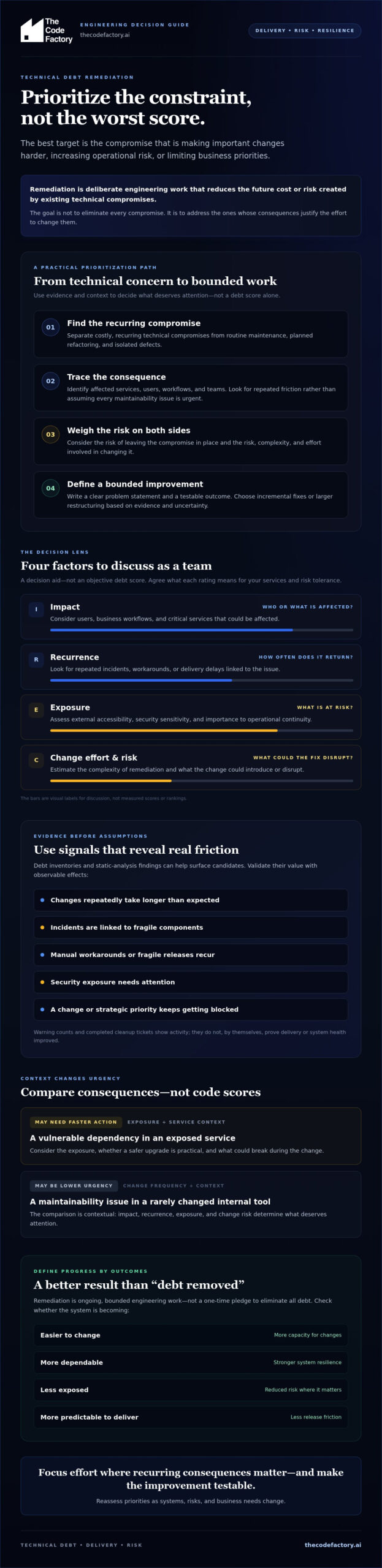
Remediation works best as ongoing, bounded engineering work, not as a one-time pledge to eliminate all debt. Teams can reassess priorities as systems, risks, and business needs change, then select focused improvements with a clear rationale and a way to check the outcome. Progress isn’t just a better debt score. It’s a system that is easier to change, more dependable, or less exposed in ways that matter to the business.
Which kinds of technical debt deserve remediation first?
Start with consequences, not the size of the backlog. A vulnerable dependency in an exposed service, for example, may warrant faster action than a maintainability issue in a rarely changed internal tool. Urgency depends on context: how widely the component is used, whether a safer upgrade is practical, and what could break during the change. Technical debt remediation should account for both the risk of leaving a compromise in place and the risk of changing it.
Assess impact, recurrence, and exposure
Identify the affected services, users, workflows, and teams before estimating value. Then look for evidence that the issue creates a recurring burden: repeated incidents, manual workarounds, fragile releases, or changes that keep getting blocked. These signals help distinguish a costly constraint from a theoretical concern. Carnegie Mellon University’s Software Engineering Institute offers further recommendations for managing technical debt, including practices for making debt visible and manageable.
Use a compact matrix as a team decision aid, not an objective debt score. Agree on what each rating means for your services and risk tolerance:
- Impact: Which users, business workflows, or critical services could be affected?
- Recurrence: How often does the issue contribute to incidents, workarounds, or delivery delays?
- Exposure: Is the system externally accessible, security-sensitive, or important to operational continuity?
- Change effort and risk: How complex is the fix, and what could remediation introduce or disrupt?
High impact or exposure can justify investigation even when the issue is difficult to fix. Low recurrence and limited exposure, by contrast, may support monitoring rather than immediate remediation.
Separate visible symptoms from underlying causes
Slow delivery or recurring defects are clues, not diagnoses. A release that repeatedly requires manual steps might point to infrastructure configuration, a fragile dependency, or a gap in the deployment process. Defects clustered around one component may reflect unclear ownership, insufficient tests, or an architectural constraint rather than unrelated coding mistakes.
Classify the underlying work before ranking it. Dependency debt concerns outdated or difficult-to-update libraries. Architectural debt involves structural choices that constrain change. Code-quality debt makes implementation harder to understand or modify. Infrastructure debt can create reliability or deployment friction. These categories interact, but each calls for different investigation and validation.
Code-review findings and static-analysis tools can surface patterns, but a warning alone isn’t a mandate to refactor. Confirm whether it affects a used path, contributes to observed problems, or creates a credible exposure. When internal teams lack capacity for a thorough independent review, enterprise code review services can connect code-level defects to security exposure, architectural weaknesses, and operational risk. If your team needs specialist assessment or implementation capacity, code remediation and architecture consulting may help focus work on constraints with clear consequences.
How to assess remediation value without relying on debt scores
A debt score can help identify patterns, but it can’t tell you whether a particular issue is slowing a critical release or contributing to production risk. Assess technical debt remediation with several kinds of evidence: a debt inventory to record known constraints, static-analysis findings to surface code patterns, and outcome-based indicators to show how the system behaves. Each answers a different question. None should be a standalone verdict.
Choose indicators that reflect the work
Start with the specific constraint the proposed change is meant to address. If a component repeatedly delays releases, track the time needed to make and validate changes there. If recurring incidents are the concern, record incident frequency and whether those events involve the affected component. For a security-focused change, use an indicator tied to the relevant exposure or remediation status rather than a general code-quality score.
Set a baseline before work begins, define a suitable measurement window, and note other changes that could affect the result. A release process change, shifts in workload, or changes in incident reporting can influence the same indicators. The aim is a fair comparison, not a claim of certainty.
| Remediation hypothesis | Observable signal | Measurement caveat | Review point |
|---|---|---|---|
| Refactoring a frequently changed component will reduce delivery friction. | Change lead time or rework for changes in that component. | Compare similar changes. Scope and team experience may differ. | After enough comparable changes to identify a pattern. |
| Addressing a fragile dependency will reduce related production issues. | Repeated incidents or deployment problems linked to the dependency. | Incident reporting and unrelated system changes may affect counts. | After the next relevant release and subsequent operating period. |
| Improving deployment infrastructure will make releases more dependable. | Release friction, failed deployments, or manual intervention. | Release volume and process changes can alter the baseline. | After a comparable set of deployments. |
Connect engineering outcomes to business impact
Translate the signal into a consequence stakeholders can assess. Fewer repeated deployment problems may mean less interruption to planned work. Shorter change lead time may give teams more capacity to respond to priorities. State what was measured separately from what is forecast or assumed. If the work concerns production risk, a production readiness review protocol can help frame the relevant operational questions.
An improvement after remediation is evidence, but not proof that the remediation alone caused it. Review the hypothesis, baseline, and other changes together, then decide whether to continue, adjust, or stop the effort.
How teams can prioritize technical debt remediation alongside delivery
Remediation competes with feature commitments for the same engineering capacity. Planning gets easier when teams make the work specific, assess change risk before committing, and define how they’ll know whether the fix helped. A practical workflow keeps cleanup connected to delivery rather than creating a separate, unbounded backlog.
- Identify: Capture the constraint and the system it affects.
- Investigate: Confirm the cause, dependencies, evidence, and potential consequences of changing it.
- Rank: Compare impact and recurrence with exposure, effort, and change risk.
- Scope: Define a reviewable change and a testable outcome.
- Implement: Assign ownership and complete the change with appropriate safeguards.
- Validate: Check the outcome against the baseline and reassess the priority.
Turn findings into a bounded remediation plan
Each priority should have an owner, affected system, supporting evidence, defined scope, and intended outcome. “Modernize the service” is too broad to estimate or validate. A bounded item might instead address one dependency that blocks a required update, with tests confirming that key workflows still operate afterward. Break larger architectural changes into stages with decision points rather than committing to a rewrite before dependencies and failure modes are understood.
Teams can reserve capacity for remediation or incorporate it into planned feature, reliability, and infrastructure work when the same systems are involved. The right approach depends on delivery commitments and risk. Review the allocation instead of treating it as a permanent quota. Set a reassessment point so priorities can change when evidence, dependencies, or business needs shift.
Reduce the chance of creating new debt
Protect the improvement with code review, relevant automated tests, and design decisions that fit the system’s operating needs. CI/CD checks can catch regressions, but apply them where they address a real risk. A check that adds noise or slows unrelated changes can undermine adoption. Keep pipeline controls relevant to the change and verify that they catch the regressions they are intended to prevent.
After implementation, verify the intended outcome and record any trade-offs that remain. If your team needs focused implementation support, discuss a code remediation plan with The Code Factory.
What the next phase of technical debt remediation means for engineering leaders
A practical pattern is emerging: teams treat remediation as continuous, risk-informed engineering rather than waiting for a large cleanup project. This is an observed approach, not a universal forecast or a mandate for every organization. It reflects a straightforward reality: system risks and delivery constraints change, so priorities need periodic review.
Balance incremental remediation with architectural change
Focused changes are often easier to scope, test, and fit alongside delivery. Updating a dependency or isolating a fragile component may reduce a specific constraint, but it won’t necessarily address a structural cause, such as tightly coupled services or an architecture that limits capacity to scale.
Broader restructuring may be justified when evidence shows that local fixes leave the same underlying problem in place. It also carries more uncertainty: dependencies, data flows, and operational behavior can make the impact difficult to predict. Establish a clear scope, validate assumptions, and plan checkpoints before committing to a large change. If architectural constraints shape the decision, software architecture consulting can help teams assess the trade-offs.
Move from assessment to credible action
Strong decisions bring together three elements: technical evidence about the affected system, business context about the work or risk it constrains, and explicit criteria for judging the result. This gives engineering leaders a defensible basis for choosing between a bounded fix, a broader redesign, or further investigation. It also keeps expected benefits distinct from outcomes that have actually been measured.
Specialist assessment can help when architecture is complex, ownership is distributed, or the team lacks capacity to investigate and implement remediation without displacing critical commitments. The Code Factory provides code remediation and technical consulting, alongside architecture and scalability consulting. These services can support assessment or implementation, but the value of any work should be evaluated against its defined scope and intended outcome.
Start small and make the result observable. Select one consequential constraint, document the evidence that makes it a priority, and decide in advance how you’ll assess improvement, such as changes in release friction, recurring incidents, or the effort required to make a specific change. Review the result before expanding the effort. To learn more about relevant support, explore The Code Factory’s engineering services.
Make remediation a measurable part of delivery
Technical debt remediation delivers lasting value when it targets constraints that affect delivery, reliability, or risk, rather than simply reducing a backlog or improving a score. Prioritize work using evidence about impact and recurrence, then define a bounded change with an outcome the team can assess.
Measure what matters to the work: changes that become easier to deliver, recurring incidents that can be tracked, or release friction that can be observed. Interpret those signals carefully, since other changes may also influence results. Reassess priorities as systems and business needs evolve, and choose incremental fixes or broader architectural changes based on the evidence.
If your team needs specialist assessment or implementation capacity, The Code Factory offers code remediation and optimization, production readiness reviews, architecture consulting, and CI/CD pipeline implementation. Explore The Code Factory’s engineering services to see what may fit your needs. Start with one consequential constraint and a clear way to evaluate progress. Focused, measured improvements can make the next change easier to deliver.
Frequently Asked Questions
What is technical debt remediation?
Technical debt remediation is planned engineering work that addresses existing compromises when they create meaningful cost, risk, or delivery friction. It may involve changing code, updating dependencies, adjusting architecture, or improving infrastructure. The objective isn’t to eliminate every imperfect decision. Teams identify a specific consequence, choose a proportionate fix, and check whether the work improved the system or made it easier to change.
How is technical debt remediation different from refactoring?
Refactoring changes a system’s internal code structure without intending to change its externally observable behavior. Remediation is broader: it describes work aimed at reducing a consequence of technical debt, and that work may include refactoring. It can also involve updating a dependency, changing architecture, improving infrastructure, or addressing a security concern. Refactoring describes a type of change. Remediation describes the problem the work is intended to solve.
How do you prioritize technical debt remediation?
Prioritize technical debt remediation using evidence about impact, recurrence, exposure, and the risk of making a change. Identify the services, users, or workflows affected, then compare the likely benefit with effort and uncertainty. Don’t rely on a tool’s score or issue count alone. Choose a bounded piece of work with a clear owner, a baseline for comparison, and an outcome the team can review after implementation.
How can a team measure the ROI of technical debt remediation?
Define the expected engineering or operational outcome before work begins, then compare relevant indicators with a baseline. Depending on the problem, useful measures may include repeated incidents, change lead time, or release friction. Treat ROI claims carefully: an improvement after remediation doesn’t prove the change alone caused it. Report what was measured separately from assumptions, forecasts, measurement limits, and potential business benefits that haven’t yet been demonstrated.
When should a company remediate technical debt?
Consider remediation when evidence shows that a compromise repeatedly slows important changes, increases operational or security exposure, or creates recurring maintenance work. Timing depends on the issue’s severity, its dependencies, available capacity, and the risk of changing the system. Not every compromise needs immediate attention. Some can remain acceptable when their trade-offs are understood and monitored, while other work may be more consequential or time-sensitive.
Can technical debt remediation be done alongside feature development?
Yes. Teams can scope remediation within planned feature or reliability work when the same system is involved, or reserve capacity for higher-priority debt. Choose the approach based on the issue’s impact and the risk of changing the affected component. Keep the problem statement, scope, and intended outcome explicit. That discipline helps teams verify the change without letting a focused fix expand into an unbounded rewrite.
What happens if technical debt is left unaddressed?
The consequences depend on the compromise and the system. Some debt remains manageable, while other issues may contribute to repeated workarounds, slower changes, reliability concerns, or greater exposure. Leaving debt in place doesn’t automatically mean a system will fail. Track concrete symptoms, such as recurring incidents or release friction, and reassess their significance as the system and business needs change. This helps distinguish acceptable trade-offs from constraints that warrant action.
