


The Flexera 2026 State of the Cloud Report reveals that 29% of enterprise cloud spend is wasted on idle or over-provisioned infrastructure, often masking critical architectural flaws. You’ve likely experienced the anxiety of a system that handles staging loads perfectly but stutters under the unpredictable concurrency of real-world production. It’s frustrating to watch cloud costs escalate while system reliability remains stagnant. Conducting a rigorous software scalability audit is no longer an optional exercise for engineering leaders. It’s a fundamental requirement in an environment where vibe coding and AI-generated technical debt can introduce hidden bottlenecks. You understand that adding more compute to a broken architecture is a temporary fix that only increases your long-term liabilities.
This article provides a disciplined engineering protocol to move your systems from experimental speed to enterprise-grade reliability. You’ll learn to identify serialization bottlenecks, quantify your elasticity curve using Gunther’s Universal Scalability Law, and align your stack with the FOCUS 1.4 specification for multi-cloud cost normalization. We’ll examine a five-step framework that covers baseline dependency mapping, data layer state auditing, and stress profiling. This roadmap gives you the tools to harden your infrastructure and provides the technical justification required to secure budgets for architectural remediation. You’ll gain a clear path toward predictable performance at scale.
Key Takeaways
- Distinguish between reactive performance testing and a proactive software scalability audit to predict system limits before they manifest as outages.
- Master a five-step protocol that moves from architectural mapping to stress profiling, identifying exactly where your infrastructure will break under load.
- Learn why true horizontal scalability requires addressing statelessness and concurrency rather than simply adding more RAM or CPU resources.
- Move beyond experimental speed to achieve enterprise-grade reliability by prioritizing structural remediation over temporary infrastructure patches.
- Establish a roadmap for hardening production environments by translating audit findings into actionable engineering tasks and budget justifications.
What is a Software Scalability Audit?
A software scalability audit is a systematic evaluation of an application’s capacity to manage increased demand through the strategic addition of resources. It moves beyond basic performance testing to map the relationship between load, throughput, and infrastructure costs. While many teams focus on simple capacity planning, a modern audit examines foundational system scalability concepts to determine if an architecture can truly scale out or if it’s destined to hit a “Scalability Wall.” This wall represents the point where adding hardware yields diminishing returns, often due to lock contention or serialized processes that prevent linear growth.
In 2026, the shift from vertical scaling, which involves increasing a single server’s power, to horizontal scaling, which distributes load across multiple instances, is mandatory for enterprise-grade production. However, horizontal scaling introduces significant complexity in state management and networking. A professional audit identifies these friction points before they trigger a system-wide failure. It provides the sober technical analysis needed to transition from experimental speed to long-term stability.
The Scope of a Professional Audit
A comprehensive software scalability audit must look beneath the surface of the user interface to examine three critical layers. First, code-level constraints are analyzed to identify synchronous bottlenecks and blocking I/O operations that stifle concurrency. Second, the infrastructure topology is evaluated to ensure cloud configurations and network latencies don’t throttle throughput. Finally, data persistence is audited. We look for database locking mechanisms and sharding readiness, ensuring that the data layer doesn’t become a single point of failure as traffic spikes.
Why ‘It Works’ is the Greatest Scalability Lie
Software that functions perfectly for 100 users often collapses under the weight of 10,000. This discrepancy exists because “vibe coding” and rapid prototyping prioritize immediate feature delivery over long-term structural integrity. Technical debt acts as a silent tax on system throughput, where every unoptimized query or inefficient API call compounds at scale. It’s a hidden risk that many teams ignore until it’s too late.
Relying on the fact that a system is currently operational is a dangerous gamble. True stability requires a transition from experimental speed to disciplined engineering. This is where software architecture consulting becomes essential. By establishing a rigorous baseline through an audit, engineering leaders can move from reactive firefighting to proactive infrastructure hardening. It’s the difference between hoping a system stays up and knowing exactly how much load it can handle before it breaks.
The Core Dimensions of Scalability in 2026
A rigorous software scalability audit must move beyond surface-level metrics to examine the structural pillars that support high-concurrency environments. Modern systems often fail not because of a lack of raw compute, but because of architectural friction. Applying the Architecture Tradeoff Analysis Method allows engineering teams to systematically evaluate how these pillars interact under stress. It’s no longer enough to hope for linear growth; you must verify that your system’s fundamental design doesn’t contain hidden ceilings that trigger catastrophic failure during peak demand.
The primary hurdle for horizontal scaling remains the tension between statelessness and statefulness. While stateless services scale with ease, stateful components like session managers or local file systems create “sticky” dependencies that prevent traffic from being distributed evenly. Auditing how your system handles simultaneous requests through concurrency and parallelism is equally vital. We frequently identify resource contention issues where shared locks or global variables create “stop-the-world” events. These bottlenecks effectively serialize your workload, rendering additional server instances useless.
In 2026, we’re seeing a surge in performance degradation caused by “vibe-coded” AI modules. AI-generated code often prioritizes functional correctness over architectural efficiency, leading to hidden performance loops or inefficient memory allocation. A professional software scalability audit must include AI code remediation to strip away these silent throughput taxes. If your team needs to transition from experimental prototypes to enterprise-grade stability, you might consider a production readiness review to identify these risks early.
Infrastructure and Cloud Hardening
Cloud environments offer the illusion of infinite scale, but improper cloud infrastructure configuration often limits actual throughput. We evaluate auto-scaling triggers to ensure they respond before latency spikes, while also auditing cold-start times for serverless or containerized workloads. Network saturation is another silent killer; microservices communication overhead can consume more bandwidth than the actual business logic, requiring a transition to more efficient protocols or service mesh optimizations.
Data Layer Scalability
The database is typically the first component to buckle under pressure. Auditing the data layer involves evaluating read/write splitting and ensuring asynchronous replication doesn’t introduce unacceptable lag. Caching strategies must be scrutinized to prevent “cache stampede” risks, where a single expired key triggers a massive surge in database queries. Finally, we determine if your growth trajectory requires database sharding or if partitioning is sufficient. Choosing the wrong path here can lead to months of wasted engineering effort and unpredictable downtime.
Scalability Audit vs. Performance Testing: The Strategic Difference
Engineering teams often mistake a successful load test for a guarantee of future stability. This is a dangerous conflation. Performance testing is a reactive measurement designed to answer a single question: how fast is the system right now? It captures a point-in-time snapshot of latency and throughput under specific conditions. In contrast, a software scalability audit is a proactive evaluation of architectural headroom. It asks how much further the system can go before the structural integrity collapses. While testing identifies that a system has broken, an audit utilizes the Carnegie Mellon SEI framework on system scalability to explain exactly why it will break at a specific inflection point.
Load testing serves as a vital data source for the audit process, but it isn’t the audit itself. Synthetic traffic generation provides the stress signals needed to observe how resources are consumed, yet it lacks the context to identify the underlying architectural flaws. An audit interprets these signals through the lens of concurrency limits, state management, and infrastructure coupling. It transforms raw metrics into a strategic assessment of risk, moving beyond the “what” to reveal the “why.” Engineering teams that want to master the architectural principles behind this process can explore the full enterprise software scalability engineering protocol to understand how to transition fragile prototypes into resilient, enterprise-grade systems.
When to Audit vs. When to Test
Performance testing belongs in your CI/CD pipeline as a guardrail against regressions. It ensures that a new deployment hasn’t inadvertently degraded response times or increased CPU consumption. However, an audit is required during architectural pivots, such as preparing for a major market expansion or a high-stakes product launch. These scenarios demand more than a green light on a dashboard; they require a deep dive into the system’s ability to handle an order of magnitude increase in traffic. Many organizations use production readiness reviews to bridge this gap, ensuring that the transition from a functional prototype to an enterprise-grade system is supported by rigorous engineering data.
The Audit Deliverable
A professional audit doesn’t end with a simple pass or fail grade. The primary output is a comprehensive remediation roadmap. This document prioritizes fixes based on their potential blast radius and the effort required to implement them. It identifies high-impact architectural changes that provide the greatest return on engineering investment. By establishing a formal scalability budget, leadership can allocate resources to harden the system’s core before performance bottlenecks become a liability to the business. This structured approach ensures that engineering effort is spent on structural integrity rather than superficial patches.
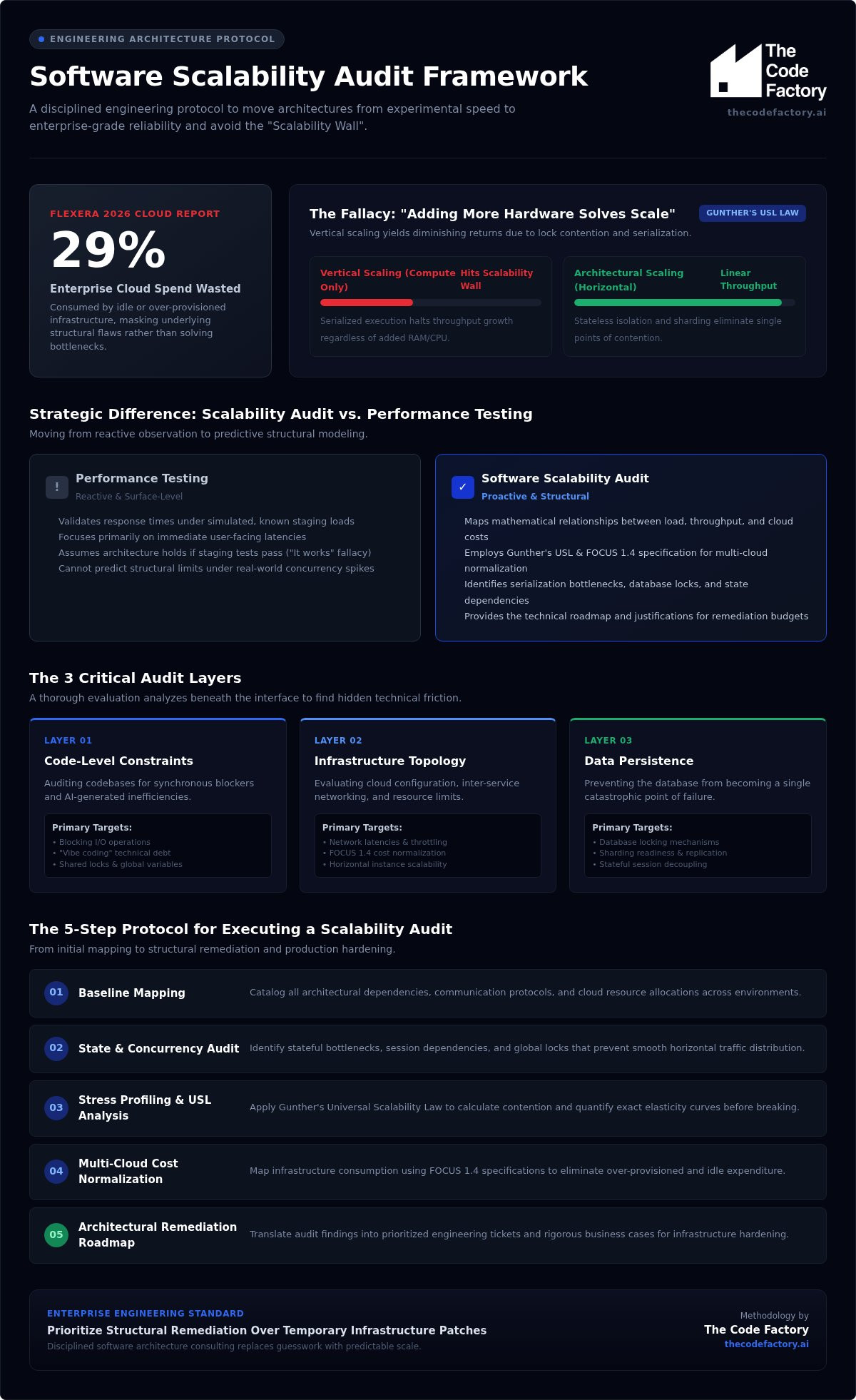
The 5-Step Protocol for Executing a Scalability Audit
Executing a professional software scalability audit requires a transition from intuition-based development to evidence-based engineering. It’s a methodical process that strips away the optimism of the development phase to reveal the hard realities of production. By following a structured protocol, teams can move from experimental speed to a state of enterprise-grade reliability. This ensures that every architectural decision is backed by empirical data rather than hopeful assumptions.
The first phase, Baseline Discovery, involves mapping the current architecture and traffic patterns to identify every service dependency and external API limit. Once the map is clear, we move to Step 2: Stress Profiling. This phase uses synthetic load to find the first point of failure, providing the data needed to separate theoretical capacity from actual runtime limits. It identifies exactly where the system buckles, allowing engineers to focus their remediation efforts on the most critical bottlenecks first.
Executing the Deep Code Review
In Step 3, we perform a granular analysis of the codebase, specifically targeting “Singleton” bottlenecks and unoptimized database queries that act as silent performance killers. We pay close attention to AI generated code vulnerabilities that often introduce inefficient loops or memory leaks into the runtime environment. The ‘Remediation First’ approach dictates that code quality is measured not by its ability to function, but by its capacity to be hardened and refactored without regressing core system performance. This step ensures that the logic itself isn’t the primary constraint on growth.
Validating the Deployment Pipeline
Step 4 focuses on the infrastructure, where we verify that securing CI/CD pipelines doesn’t introduce unnecessary latency during the build or deploy phases. We audit deployment strategies, contrasting Blue/Green and Canary models to ensure zero-downtime scaling is achievable even under heavy load. To maintain long-term stability, we integrate automated scalability checks directly into the build process. This prevents new features from compromising the system’s structural integrity before they ever reach a production environment.
The final stage is Remediation Planning. This involves drafting a technical protocol for hardening the system based on the prioritized findings of the previous four steps. It’s the blueprint for transforming an experimental prototype into a resilient enterprise asset. If your current system is showing signs of strain under load, you should request a production readiness review to begin your audit process today.
From Audit to Remediation: Hardening for Enterprise Production
Hardening a system for enterprise production begins where the diagnostic phase ends. A software scalability audit identifies the fractures, but remediation is the process of reinforcing the foundation. Too many teams attempt to solve performance degradation by simply increasing their cloud spend or adding more RAM. This approach is a temporary bandage that ignores underlying structural rot. Real stability requires architectural intervention. It demands a shift from the experimental speed of “vibe coding” to the disciplined rigor of professional engineering.
Foundational flaws often reside in the logic itself, particularly in modules generated by automated tools. Utilizing code remediation services is essential for stripping away the technical debt that throttles throughput. By refining these modules, you ensure that your software can actually utilize the resources allocated to it. This transition from “identifying problems” to “executing solutions” is what separates a successful scale-up from a system on the verge of collapse.
Strategic Architectural Hardening
Remediation often involves decoupling services to allow for independent scaling. When services are tightly coupled, a surge in one area can paralyze the entire system. We implement “Circuit Breakers” to prevent these cascading failures, ensuring that a single point of failure doesn’t become a total outage. Furthermore, we refine the cloud footprint to balance performance with cost efficiency. With the Flexera 2026 State of the Cloud Report noting that 29% of enterprise cloud spend is wasted, optimizing your infrastructure is as much about the bottom line as it is about uptime.
The Role of External Engineering Partners
Internal teams are often too close to the code to see the bottlenecks objectively. They’ve built workarounds and “temporary” fixes that have become part of the furniture. Leveraging an external partner provides a sober voice of reason. We offer an impartial perspective that prioritizes structural integrity over internal politics or historical preferences. Before engaging any advisory firm, engineering leaders should consult a comprehensive technical architecture consulting buying guide to understand how to evaluate, scope, and select partners who deliver code-level remediation rather than abstract diagrams. This objectivity is vital when you need to justify an architectural remediation budget to stakeholders. To move your system from a fragile prototype to a resilient enterprise asset, you must secure your production future with a professional scalability audit today. It’s the only way to ensure your architecture can withstand the demands of 2026 and beyond.
Securing Your Architectural Foundation for 2026
Scaling a high-concurrency system is a deliberate engineering choice, not an accidental byproduct of rapid feature delivery. We’ve established that a systematic software scalability audit is the only way to uncover the silent bottlenecks hiding within AI-generated modules and complex cloud configurations. You now possess the five-step protocol required to move beyond reactive performance testing toward proactive architectural hardening. This transition is essential for any organization looking to replace the uncertainty of “vibe coding” with the predictability of enterprise-grade production environments.
The Code Factory operates as a global engineering consultancy specialized in enterprise-grade architecture hardening. Our team utilizes an expert AI code remediation protocol to ensure your systems aren’t just functional, but structurally sound. If your current infrastructure is showing signs of strain or unpredictable latency, don’t wait for a total system failure to act. You can Book a Production Readiness Review with The Code Factory to establish a clear remediation roadmap. Hardening your systems today ensures you have the headroom to scale with confidence tomorrow.
Frequently Asked Questions
How often should we perform a software scalability audit?
You should conduct a software scalability audit at least once a year or prior to significant market expansions and product launches. It’s critical to re-evaluate your architecture whenever there’s a major shift in traffic patterns or a transition to new infrastructure providers. Regular audits prevent technical debt from compounding and ensure your system maintains enterprise-grade reliability as the codebase evolves. Waiting for a crash to trigger an audit is a high-risk strategy.
What is the difference between a security audit and a scalability audit?
A security audit focuses on identifying vulnerabilities to prevent unauthorized access and data breaches. In contrast, a scalability audit evaluates a system’s ability to handle increased load by adding resources. While security hardening protects the integrity of your environment, scalability consulting ensures the architecture doesn’t collapse under concurrent user demand. Both are essential for production readiness, but they address different categories of risk: external threats versus internal structural limitations.
Can an audit help reduce our AWS/Azure monthly bill?
Yes, an audit frequently identifies over-provisioned infrastructure and inefficient resource utilization that inflates cloud costs. By analyzing your elasticity curve and identifying serialization bottlenecks, we can refine your cloud infrastructure configuration to balance performance with cost efficiency. Many organizations find that a significant portion of their cloud spend is wasted on idle resources. A professional audit provides the technical justification needed to streamline your environment and reduce unnecessary monthly expenditures.
Does AI-generated code require a different auditing approach?
AI-generated code requires a specialized approach that prioritizes runtime efficiency and structural integrity over mere functional correctness. “Vibe coding” often introduces hidden performance loops and inefficient memory allocation that don’t appear in manual reviews. A software scalability audit includes specific AI code remediation to strip away these silent throughput taxes. We examine how generated modules interact with your core architecture to ensure they don’t become the primary bottleneck as your user base grows.
What are the most common scalability bottlenecks found in audits?
The most frequent bottlenecks include database lock contention, synchronous I/O operations, and improper state management. We often find that “sticky” sessions or local file dependencies prevent effective horizontal scaling. Additionally, unoptimized queries and cache stampede risks frequently throttle throughput during peak demand. Identifying these friction points allows engineering teams to move from reactive firefighting to proactive infrastructure hardening. Most issues require architectural changes rather than simply adding more RAM or CPU resources.
How long does a comprehensive enterprise scalability audit take?
A comprehensive enterprise audit typically spans two to four weeks, depending on the complexity of your service graph and data layer. This timeline allows for thorough baseline discovery, synthetic stress profiling, and a deep code review of critical modules. We move methodically from initial architecture mapping to the delivery of a prioritized remediation roadmap. This structured pace ensures we capture a representative data set of your system’s behavior under various load conditions.
Do we need to stop feature development during the audit process?
You don’t need to halt all feature development, but we recommend a brief code freeze on core architectural components during the stress profiling phase. This ensures that the data we collect accurately reflects the system’s current baseline without interference from flighted changes. Minor UI updates or localized logic changes can usually continue. Our goal is to integrate with your existing CI/CD deployment pipelines to minimize disruption while we identify structural risks.
What documentation do we need to provide for a third-party audit?
To facilitate an efficient audit, you should provide updated architectural diagrams, API documentation, and your current cloud infrastructure configuration. Access to previous load testing results and distributed tracing logs is also highly beneficial. We require a clear map of your service dependencies and data persistence layers to begin the baseline discovery phase. Providing these materials upfront allows our team to function as a specialized fixer and focus immediately on identifying latent performance constraints.
