


Eighty-two percent of cloud security breaches trace directly back to credential failures, according to data from Thales. When rapid shipping outpaces identity governance, permanent access keys and over-scoped policies quietly turn into toxic structural liabilities. Implementing rigorous AWS IAM security best practices isn’t simply an exercise in passing compliance audits; it’s the primary barrier protecting your core infrastructure from lateral movement and privilege escalation.
You already recognize the operational friction here. Enforcing strict least privilege shouldn’t paralyze your engineering velocity, yet untangling stale IAM credentials, unmonitored human access keys, and complex multi-account permissions often threatens to stall deployment pipelines.
This guide delivers a definitive, production-tested roadmap to resolve that compromise. You’ll master actionable strategies to eliminate long-lived credentials, implement automated identity federation, and establish scalable permission boundaries without disrupting delivery. Below is the complete 2026 hardening checklist to audit, remediate, and secure your AWS identity architecture.
Key Takeaways
- Establish an enterprise zero-trust baseline by transitioning all human access from permanent static keys to short-lived sessions through centralized identity federation.
- Apply core AWS IAM security best practices by replacing overly permissive vendor policies with mathematically bounded, customer-managed policies tailored to actual usage.
- Isolate machine workloads and CI/CD deployment pipelines using dynamic IAM role assumption and OpenID Connect to eliminate hardcoded secrets entirely.
- Execute a phased hardening checklist to uncover dormant roles, purge unused permissions, and sever high-risk cross-account trust relationships.
- Preserve engineering velocity without sacrificing governance by deploying automated role-vending workflows governed by strict permissions boundaries.
Eliminating Long-Lived Credentials: The 2026 Identity Baseline
Traditional cloud governance models frequently treated the 90-day rotation of static API keys as an adequate control. In production environments, however, a 90-day rotation schedule simply grants an adversary a three-month operational window. Static IAM access keys remain the single largest attack vector for enterprise cloud credential exposure, continually surfacing in code repositories, build artifacts, and developer workstations. Modern AWS IAM security best practices discard key rotation schedules in favor of absolute credential deprecation. The current enterprise baseline demands zero persistent access keys for human operators, operationalizing the principle of least privilege across the temporal dimension of access itself.
Deprecating IAM Users and Enforcing AWS IAM Identity Center
Managing individual IAM users across a distributed multi-account estate creates blind spots and policy drift. Organizations must deprecate standalone IAM users entirely and consolidate workforce access within AWS IAM Identity Center linked to an authoritative corporate identity provider. This architecture centralizes governance, allowing security teams to enforce consistent authentication standards across the entire organization.
- Enforce phishing-resistant MFA: Require hardware-bound FIDO2 security keys for all console and command-line sessions. Eliminate SMS and virtual authenticator apps for privileged accounts.
- Constrain session lifespans: Configure permission sets with short-lived STS tokens. Limit human console sessions to two hours and privileged operational CLI tasks to one hour.
- Automate offboarding: Terminating an identity in your central identity provider must instantly revoke all active federated AWS sessions without requiring manual account-by-account remediation.
Securing the Root User Account and Emergency Break-Glass Protocols
The root user bypasses all permissions boundaries and resource policies, making it a critical vulnerability if left unguarded. Every account within your AWS Organization must have all active root access keys deleted. Routine administrative tasks should never run under the root principal.
Lock down the root user with dual-custody physical governance. Store hardware MFA tokens and password fragments in separate physical safes requiring two authorized executives to retrieve. Configure Amazon CloudWatch alarms and Amazon EventBridge rules that trigger immediate high-priority alerts to your security operations team whenever a root login event occurs. Root credentials belong strictly in break-glass disaster recovery workflows.
Implementing Context-Aware Least Privilege Access Policies
Least privilege is not a static milestone you reach once and forget; it’s an ongoing, mathematically bounded constraint. Defaulting to AWS managed policies introduces immediate technical debt. These broad policies frequently bundle administrative wildcards (such as iam:* or s3:*) that provide clear pathways for lateral movement. Adhering to core AWS IAM security best practices requires replacing broad managed policies with tightly scoped customer managed policies that incorporate explicit condition keys like aws:PrincipalOrgID, aws:SourceIp, and aws:RequestedRegion.
Developer velocity often clashes with permission limits. To prevent privilege escalation without gating day-to-day deployments, attach IAM permissions boundaries to all human and automation roles. Permissions boundaries set the absolute ceiling of entitlements that a role can delegate, ensuring that even if a developer creates a new role with full administrator access, that role remains bounded by the organization’s maximum allowable perimeter.
Transitioning from RBAC to Attribute-Based Access Control (ABAC)
Role-based access control models collapse under enterprise scale, creating an unmanageable sprawl of single-purpose roles. Transitioning to Attribute-Based Access Control solves this friction by dynamically evaluating principal tags against resource tags during authorization. When teams share compute clusters, condition keys like aws:ResourceTag/Project matched to aws:PrincipalTag/Project automatically restrict access without requiring new policy definitions for every deployment.
Enforcing Multi-Account Guardrails with Service Control Policies (SCPs)
Service Control Policies establish mandatory organizational guardrails that no member account administrator can override. SCPs should systematically deny modifications to critical infrastructure:
- Region gating: Deny API requests targeting unused geographic regions via
aws:RequestedRegionto halt shadow IT in unmonitored zones. - Security defense protection: Deny unauthorized alterations to Amazon GuardDuty, AWS CloudTrail, and security agent configurations.
- Network immutability: Block changes to core transit gateways, route tables, and primary internet egress routes.
Eliminating Policy Over-Permissioning with IAM Access Analyzer
Manual policy auditing cannot keep pace with continuous release cycles. AWS IAM Access Analyzer inspects CloudTrail event histories to reverse-engineer actual usage patterns, transforming months of execution logs into down-scoped, production-ready IAM statements. It also flags public or cross-account access granted to sensitive resources like S3 buckets and KMS keys before attackers exploit them.
For organizations looking to systematically eliminate policy vulnerabilities across complex multi-account environments, partnering with specialized engineering teams for comprehensive security hardening ensures your permission boundaries withstand advanced intrusion techniques.
Machine Identity Security: IAM Roles for Workloads and Pipelines
Machine identities outnumber human users tenfold in modern enterprise cloud architectures. While security programs routinely scrutinize human console logins, background microservices, serverless functions, and CI/CD runners execute the overwhelming majority of production API calls. Storing long-term AWS access keys inside application configurations, Docker containers, or pipeline secret variables creates severe vulnerabilities. Modern AWS IAM security best practices require deprecating static machine secrets in favor of dynamic, role-based credential brokering.
Unmonitored trust architectures also open backdoors. Security teams must continuously audit cross-account IAM trust relationships to prevent unauthorized role chaining, where an attacker leverages an overly permissive workload role in a non-production account to assume high-privilege administrative roles across production boundaries.
Eliminating Pipeline Secrets via OpenID Connect (OIDC) Federation
Hardcoding permanent credentials into pipeline settings turns automation runners into prime targets for lateral compromise. Establishing cryptographic trust between your CI/CD provider and AWS IAM via OpenID Connect allows deployment workflows to exchange transient JSON Web Tokens for short-lived STS credentials.
Trust policies must be strictly bounded. Rather than allowing broad wildcard access to an entire provider domain, write conditions that evaluate the token’s subject claim (sub), locking role assumption to explicit Git repositories, deployment environments, and protected production branches. For end-to-end architectures that protect deployment infrastructure, refer to the technical protocol on securing CI/CD pipelines.
Container and Microservice Identity: IAM Roles for Service Accounts
Granting broad IAM instance profiles to EC2 container worker nodes destroys tenant isolation. If a single microservice suffers a remote code execution vulnerability, the attacker inherits the broad permissions attached to the underlying virtual machine host. Production workloads require process-level identity segmentation:
- Isolate task permissions: Implement IAM Roles for Service Accounts (IRSA) in EKS or IAM roles for ECS tasks, ensuring each microservice retrieves only the exact permissions needed for its operational scope.
- Enforce IMDSv2 globally: Require Instance Metadata Service Version 2 across all EC2 nodes to stop Server-Side Request Forgery (SSRF) exploits from harvesting node-level instance profile credentials.
- Constrain metadata hop limits: Set the
HttpPutResponseHopLimitto 1 on container hosts to block container processes from accessing the host’s metadata endpoint directly.
Enforcing these granular AWS IAM security best practices guarantees that machine credentials remain ephemeral, scoped, and resilient against metadata extraction attacks.
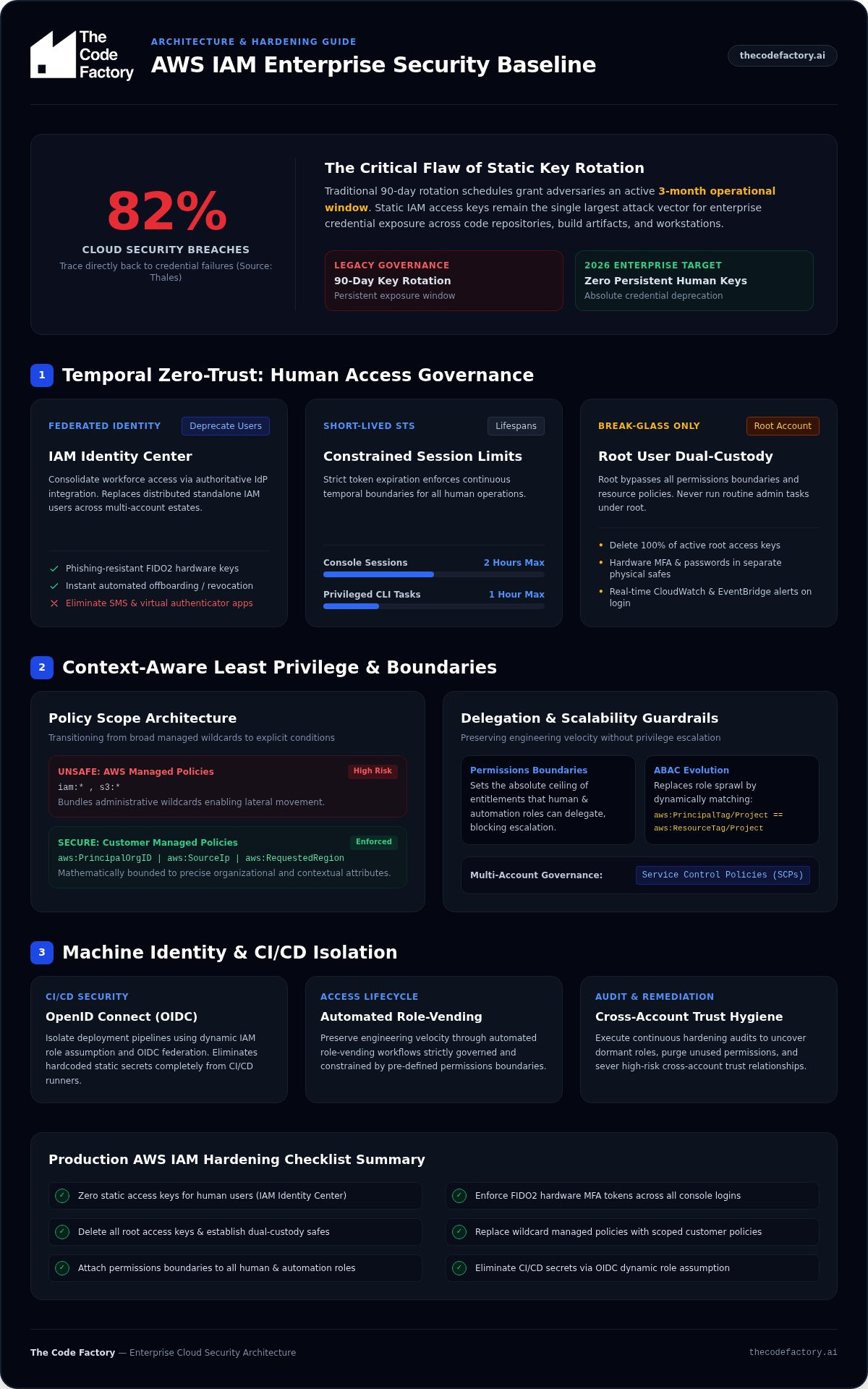
The Production AWS IAM Security Hardening Checklist
Securing cloud identities requires a repeatable, operationalized audit routine rather than sporadic cleanups. Implementing verified AWS IAM security best practices demands systematic, phased inspection gates before any infrastructure configuration touches live environments. Use this four-phase checklist to audit, isolate, and enforce identity governance across your multi-account footprint.
Audit and Elimination: Purging Stale Identities and Over-Privileged Roles
Begin by generating IAM credential reports across every member account in your organization. Identify and deactivate all credentials that have remained dormant for over thirty days. Next, inspect every cross-account trust policy to verify it enforces an sts:ExternalId condition, shielding your infrastructure against confused deputy vulnerabilities. Finally, revoke administrative privileges on legacy test roles that inadvertently persisted into staging and production tiers.
Real-Time Monitoring and Continuous Audit Logging
Hardened policies provide little defense without tamper-proof visibility. Enable multi-region AWS CloudTrail across all accounts, routing immutable logs into a dedicated, isolated log archive account configured with S3 Object Lock. Configure Amazon EventBridge rules and CloudWatch metric filters to trigger instant alerts upon critical IAM modifications, such as unauthorized policy updates or console logins without MFA. Layer this telemetry with Amazon GuardDuty to detect anomalous STS API requests and credential exfiltration attempts as they happen.
Automated Drift Detection and Infrastructure as Code Guardrails
Manual IAM provisioning introduces policy drift that invalidates your security posture over time. Define every role, policy, and boundary deterministically using Infrastructure as Code. Integrate automated linters into CI/CD pull request workflows to reject wildcards and syntax errors before code merges into protected branches.
Adopting mature software architecture consulting patterns ensures your access controls scale predictably as systems grow. If your team requires an independent, rigorous assessment of your multi-account environment, schedule a production readiness review to audit your identity attack surface before your next release.
Operationalizing IAM Security in Enterprise Production Environments
Enterprise IAM governance collapses when security controls become an intolerable bottleneck for engineering. When every minor policy adjustment requires an administrative ticket, developers inevitably find workarounds or petition for blanket administrative privileges to keep release cycles moving. Operationalizing AWS IAM security best practices doesn’t mean slowing release velocity; it means replacing manual ticket queues with automated, mathematically bounded self-service guardrails.
Institutionalizing Self-Service Permissions Boundaries
Engineering teams need the autonomy to create application-specific roles without compromising the organization’s overarching security perimeter. Establishing automated role-vending workflows governed by strict permissions boundaries makes this balance possible:
- Enforce mandatory boundary attachment: Restrict developer roles with an explicit condition requiring any newly created IAM role to include an organization-approved permissions boundary policy.
- Block privilege escalation paths: Explicitly deny rights to edit, delete, or detach the permissions boundary policy itself, preventing principals from lifting their own authorization limits.
- Automate telemetry down-scoping: Ingest observed runtime network and API traffic profiles to automatically replace permissive testing statements with minimal viable permissions before moving workloads into staging tiers.
Validating Cloud Posture with Production Readiness Reviews
Even carefully constructed architectures experience permission creep over time. Microservices expand their scope, legacy trust relationships linger, and third-party integrations accumulate unchecked entitlements across complex account topologies. Systemic stability requires proactive verification before systems handle live production workloads.
Executing a structured production readiness review prior to high-stakes launches ensures that compute tasks operate under bounded roles, network boundaries remain intact, and root protections remain inviolable. Engaging seasoned engineering specialists from The Code Factory delivers the technical rigor necessary to audit cloud infrastructure configurations, remediate dormant attack pathways, and embed resilient AWS IAM security best practices across your enterprise footprint.
Hardening Enterprise Identity Architecture for Production Scale
Securing enterprise cloud infrastructure requires a permanent departure from static credentials and reactive compliance audits. By retiring long-lived access keys, automating short-lived identity federation, and locking down machine workloads with strict permissions boundaries, engineering organizations transform identity from an attack surface into a dependable defensive barrier. Adopting these AWS IAM security best practices ensures that high-velocity feature shipping never undermines your core operational perimeter.
Achieving true policy confidence, however, demands deep architectural discipline. Hidden privilege escalation pathways, stale trust delegations, and gradual configuration drift across distributed environments routinely bypass basic internal assessments. Leverage proven engineering methodologies and expert architectural evaluation to secure your multi-account footprint. Schedule an enterprise production readiness review with The Code Factory to uncover structural IAM vulnerabilities, remediate complex risks, and complete end-to-end security hardening before your next major release.
Frequently Asked Questions
Is it acceptable to use AWS managed policies in enterprise production environments?
No, relying on default AWS managed policies in production environments creates significant security liabilities because they’re notoriously over-scoped. Policies like PowerUserAccess or job-function templates frequently bundle broad wildcards that grant unintended privilege escalation paths. Adhering to AWS IAM security best practices requires replacing managed policies with customer-managed policies restricted strictly to the explicit actions, resources, and condition keys your application actually needs.
How do AWS IAM Identity Center and standard IAM users differ in security posture?
AWS IAM Identity Center centralizes workforce authentication through short-lived STS credentials federated from your corporate identity provider, whereas standard IAM users rely on persistent, account-local credentials. Standalone IAM users create administrative sprawl, unmonitored access keys, and fragmented offboarding workflows. Identity Center eliminates permanent secrets entirely, enforcing consistent session duration limits and phishing-resistant hardware MFA across your entire multi-account organization from a single control plane.
What happens if an EC2 instance metadata service is left configured with IMDSv1?
Leaving IMDSv1 enabled exposes your computing instances to credential exfiltration via Server-Side Request Forgery vulnerabilities. Because IMDSv1 uses simple, unauthenticated HTTP GET requests, an attacker who exploits an application-layer SSRF flaw can directly query the local link-address endpoint to steal temporary instance profile tokens. IMDSv2 neutralizes this attack vector by requiring session-oriented, token-backed PUT requests that external SSRF payloads can’t traverse.
Can OpenID Connect (OIDC) completely eliminate the need for hardcoded CI/CD secrets?
Yes, configuring OpenID Connect federation between AWS IAM and your deployment runner completely removes static credentials from build environments. Rather than storing permanent access keys in GitHub Actions, GitLab, or runner environment variables, the runner exchanges a cryptographically signed token for temporary STS credentials. Trust policies then validate claims like repository, branch, and environment name, ensuring only approved pipelines can assume deployment roles.
How do Service Control Policies (SCPs) differ from standard IAM permissions boundaries?
Service Control Policies establish organization-wide guardrails across accounts or organizational units, while permissions boundaries govern specific IAM principals within an individual account. An SCP sets the absolute maximum permissions ceiling for an entire account and can’t be overridden by local administrators or the root user. A permissions boundary prevents delegated developers from escalating their own privileges when creating new roles within that account.
What are the most dangerous IAM permissions that allow unmonitored privilege escalation?
The most dangerous IAM permissions involve policy creation, versioning, and role attachment without strict condition constraints. Actions such as iam:CreatePolicyVersion, iam:SetDefaultPolicyVersion, iam:AttachUserPolicy, and iam:PassRole allow unprivileged principals to grant themselves administrative control or execute code under privileged service roles. Core AWS IAM security best practices require restricting these calls with mandatory permissions boundaries and multi-party approval guardrails.
How often should an enterprise conduct an AWS IAM permissions audit?
Enterprises should run automated IAM audits continuously and execute formal architectural reviews at least once every quarter. Automated tools like IAM Access Analyzer should scan daily for inactive keys, dormant roles, and public resource policies. Conducting a structured production readiness review prior to major application launches ensures teams catch latent policy drift, unmonitored trust relationships, and overly broad workload roles before code reaches live production environments.
